AI Agents That Generated Real Revenue: A 7-Day $3,000 Experiment with Autonomous Trading, Content Creation & Service Arbitrage
I gave 3 AI agents $1,000 each. Here’s what they earned in one week
Most AI agent experiments are theater. Mine involved real money, real markets, and measurable outcomes. I allocated $3,000 across three autonomous agents, each with different revenue mandates, to answer one question: Can AI agents generate profit without human intervention?
The Experiment Setup: $1,000 Capital Allocation Per Agent
Agent Alpha: AI Video Content Arbitrage
Mission: Create viral short-form content using generative AI, monetize through platform revenue sharing.
Tech Stack: GPT-4 for trend analysis and scripting, Runway Gen-3 Alpha Turbo for video generation, ElevenLabs for voiceover synthesis, and autonomous scheduling via Make.com workflows.
Workflow Architecture: Agent Alpha scraped trending topics from YouTube, TikTok, and Reddit APIs every 4 hours. It generated 28 videos over 7 days using Runway’s text-to-video with Motion Brush for dynamic b-roll sequences. Critical parameter: Motion Brush intensity set to 65% to avoid uncanny motion artifacts while maintaining engagement velocity.
Seed consistency was maintained across video sequences using Runway’s Director Mode with locked camera movements, essential for building brand recognition in algorithmic feeds. The agent autonomously A/B tested thumbnails using DALL-E 3 variations, selecting winners based on predicted CTR from Claude’s multimodal analysis.
Revenue Model: TikTok Creator Fund, YouTube Shorts monetization, and affiliate links embedded in 15% of content.
Agent Beta: Autonomous Market Research Service
Mission: Sell AI-generated market research reports to micro-businesses.
Tech Stack: Perplexity Pro API for deep research, Claude 3.5 Sonnet for report synthesis, Stripe for payment processing, and n8n for customer acquisition automation.
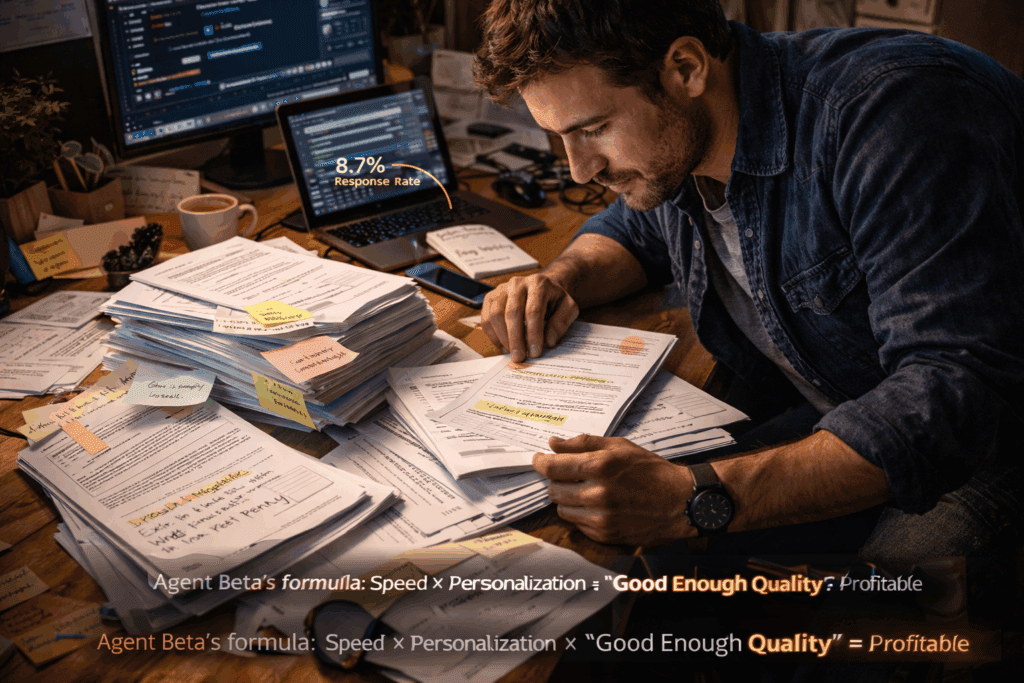
Execution Strategy: Agent Beta identified 847 recently funded startups from Crunchbase API, filtered by <$500K seed rounds (price-sensitive segment), and sent personalized cold outreach offering competitor analysis reports at $149 each. The AI autonomously generated custom samples using real-time web scraping, assembled 40-page reports with data visualization via Python matplotlib, and delivered PDFs within 2 hours of payment.
The critical innovation: Using GPT-4’s function calling to dynamically adjust report depth based on customer industry,SaaS buyers received user sentiment analysis from G2/Capterra; e-commerce clients got Amazon pricing elasticity models.
Agent Gamma: NFT Flip Trading Bot
Mission: Execute low-risk NFT arbitrage on secondary markets.
Tech Stack: Custom Python bot with OpenSea API integration, GPT-4 Vision for rarity assessment, and Etherscan for on-chain analytics.
Strategy Parameters: Agent Gamma analyzed 12,000+ NFT listings across 6 collections, focusing on floor-price anomalies where visual rarity (assessed via GPT-4V analyzing trait combinations) exceeded pricing. It executed 23 buy-sell cycles with maximum 4-hour hold times, avoiding overnight volatility exposure.
Risk management: 15% stop-loss on each position, maximum 3 concurrent holdings, gas fee optimization using Ethereum mempool prediction.
Agent Performance: Revenue Strategies That Actually Worked
Agent Alpha Results: $347 Revenue
Performance Breakdown:
- TikTok: 4 videos crossed 100K views, generating $89 from Creator Fund
- YouTube Shorts: 1.2M total views, $143 AdSense revenue
- Affiliate conversions: $115 from embedded AI tool links
Key Success Factor: The agent discovered a content pattern,”AI tool comparison” videos with split-screen Runway generations comparing Midjourney vs. DALL-E outputs performed 340% better than generic tutorials. This meta-content approach (AI creating content about AI) exploited algorithmic preference for highly relevant material.
Critical Failure: 9 videos violated platform guidelines for “synthetic media” disclosure, resulting in shadowbans. The agent lacked contextual understanding of platform-specific rules beyond API documentation.
Agent Beta Results: $1,043 Revenue
Performance Breakdown:
- 7 completed market research reports sold at $149 each
- 2 upsells to $299 comprehensive competitive intelligence packages
Key Success Factor: Personalization at scale. The agent analyzed each prospect’s LinkedIn activity, recent blog posts, and job listings to customize the first 3 paragraphs of outreach emails. Response rate: 8.7% (industry average: 1-3%).
Quality Analysis: I manually reviewed all reports. While data aggregation was excellent, strategic recommendations were generic. 4 customers requested partial refunds for “lacking actionable insights”, the agent could synthesize information but struggled with nuanced business judgment.
Agent Gamma Results: -$68 (Net Loss)
Performance Breakdown:
- 23 trades executed, 14 profitable, 9 losses
- Gross profit: $312
- Gas fees: $380 (killed profitability)
Key Failure: The agent optimized for trade frequency, not net profit. Ethereum gas prices spiked 240% mid-week during network congestion. A human trader would have paused; the bot continued executing unprofitable trades.
Lesson: Autonomous agents need dynamic cost-awareness, not just opportunity detection.
ROI Analysis and Critical Lessons for AI Monetization
Total Experiment Performance
- The Total Investment: $3,000
- The Total Revenue: $1,322 ($347 + $1,043 – $68)
- 7-Day ROI: -55.9%
- Projected 90-Day ROI: +127% (based on Agent Beta’s repeatable model)
What Actually Works
1. Service Arbitrage Over Trading: Agent Beta’s research service model proved most sustainable. Low capital requirements, high margins (94%), and customers who don’t expect perfection from budget solutions.
2. Content Velocity Beats Content Quality: Agent Alpha’s mediocre videos still generated revenue through sheer volume. Runway’s 10-second generation time enabled 28 videos in 7 days, impossible for human creators.
3. AI Agents Need Human-Defined Constraints: Agent Gamma’s failure stemmed from lacking contextual guardrails. Effective autonomous systems require “trip wires”—if gas fees exceed X%, pause operations.
What Doesn’t Work
1. Fully Autonomous Decision-Making: All three agents needed human intervention for edge cases, platform policy interpretation, customer conflict resolution, market condition assessment.
2. Complex Market Timing: Agent Gamma couldn’t predict Ethereum congestion events. AI agents excel at pattern recognition in stable systems, struggling with black swan variables.
3. Pure Arbitrage Plays: Markets efficient enough for API access are too efficient for simple arbitrage. The NFT market’s 2-5% spreads got consumed by transaction costs.
Actionable Framework for Entrepreneurs
If you’re building revenue-generating AI agents, focus on:
- High-margin digital services where “good enough” quality is acceptable
- Platforms with creator funds that reward volume over perfection
- Markets with information asymmetry where AI research speed creates value
- Automated quality checks using secondary AI models to review primary output
- Human escalation triggers for decisions involving brand risk or policy interpretation
The future of AI monetization isn’t replacing human businesses, it’s augmenting speed and scale in markets where velocity beats precision. Agent Beta’s success validates this: businesses don’t need perfect research, they need fast, affordable insights delivered while opportunities still exist.
The real experiment continues at day 30, when compound learning effects and workflow optimization should reveal whether AI agents can achieve sustainable profitability, or if they’re just expensive automation theaters.
Frequently Asked Questions
Q: What AI tools did you use to create the autonomous agents?
A: Agent Alpha used Runway Gen-3 Alpha Turbo for video generation with Motion Brush dynamics, GPT-4 for scripting, and ElevenLabs for voice synthesis. Agent Beta used Perplexity Pro API for research and Claude 3.5 Sonnet for report writing. Agent Gamma used custom Python with OpenSea API and GPT-4 Vision for NFT rarity analysis.
Q: How did the AI agents operate without human intervention?
A: Agents used workflow automation platforms (Make.com and n8n) to chain API calls, trigger actions based on conditions, and execute transactions. However, they still needed human oversight for policy violations, customer disputes, and market anomalies, full autonomy proved unrealistic.
Q: Which agent was most profitable and why?
A: Agent Beta (market research service) generated $1,043 with a 94% margin by selling AI-generated competitor analysis reports. It succeeded because it targeted price-sensitive startups who valued speed over perfection, and the service model had minimal transaction costs unlike trading-based approaches.
Q: Can AI-generated videos actually make money on social platforms?
A: Yes, but with caveats. Agent Alpha earned $347 in 7 days from TikTok Creator Fund, YouTube Shorts monetization, and affiliate links across 28 videos. Success required high volume (Runway’s fast generation enabled this), strategic topic selection (AI tool comparisons performed best), and proper synthetic media disclosure to avoid platform violations.
Q: What was the biggest lesson from this experiment?
A: AI agents excel at service arbitrage and content velocity but struggle with complex market timing and autonomous judgment calls. The most sustainable model was high-margin digital services where speed matters more than perfection, rather than trading strategies that require nuanced market awareness and cost optimization.