Why 95% of AI Users Don’t Pay: The Hidden AI Economics of AI Subscriptions and Better Monetization Models
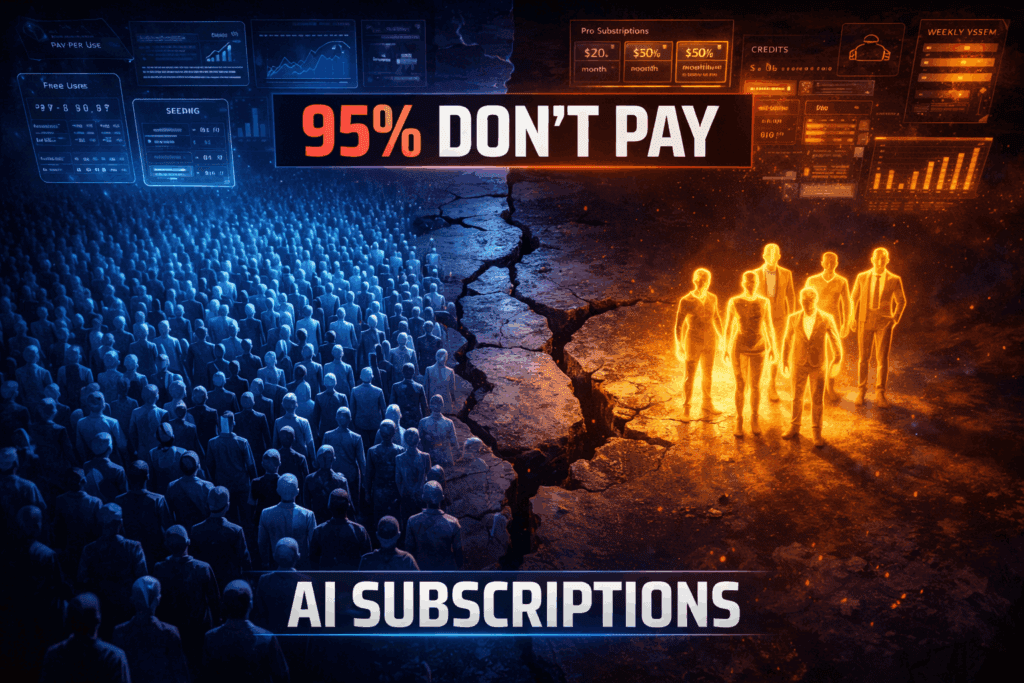
The Subscription Wall: Why Massive AI Adoption Doesn’t Convert to Revenue
Only 5% of ChatGPT users pay. Here’s why your AI subscriptions will fail too.
AI companies love to quote user numbers. Tens of millions of signups. Viral adoption curves. Daily active users exploding after every model release. Yet when you strip away the hype, the monetization layer looks fragile. The core challenge isn’t model quality, it’s human behavior.
Subscription fatigue is real. Consumers are already paying for Netflix, Spotify, Adobe, Notion, Figma, cloud storage, and half a dozen niche SaaS tools they barely remember subscribing to. When an AI tool enters this ecosystem and asks for another $20–$30 per month, it isn’t competing with other AI tools, it’s competing with rent, food, and attention.
From a behavioral standpoint, most AI tools fail the perceived marginal value test. Users ask a simple question: “Is this tool providing consistent, repeatable value that I can’t get elsewhere for free?” In AI video production, this is especially brutal. A creator can generate a cinematic clip in Runway Gen-3, experiment with Kling’s motion fidelity, and prototype scenes in ComfyUI, all without committing to a long-term subscription.
This problem compounds when AI outputs lack deterministic reliability. If your generation pipeline can’t guarantee Seed Parity, meaning the same prompt, seed, and scheduler produce consistent outputs, users perceive randomness as instability. In tools using Euler A schedulers or Latent Consistency Models (LCMs), slight parameter changes can radically alter results. For power users, this is fascinating. For mainstream users, it undermines trust.
Subscriptions rely on predictability. AI systems, by nature, are probabilistic. That mismatch is the first crack in the monetization foundation.
Free Dominance: Behavioral Economics Behind AI Usage Patterns
Free AI tools dominate because they align perfectly with how people explore creativity and problem-solving. Most users aren’t building production pipelines; they’re experimenting. They want novelty, not commitment.
In AI video workflows, free tiers offer just enough to satisfy curiosity:
- Runway’s limited credits allow users to test motion consistency and camera control.
- Sora demos showcase temporal coherence without requiring payment.
- Open-source ComfyUI workflows give unlimited experimentation for users willing to trade time for control.
This creates a psychological ceiling on willingness to pay. Users treat AI like a sandbox*, not a *service. And sandboxes are expected to be free.
Another factor is cross-platform redundancy. If a text-to-video prompt fails in one system, users simply migrate. Prompt engineering knowledge is portable. A cinematic prompt designed for Kling can often be adapted for Runway with minor syntax changes. This portability reduces lock-in, which is fatal for subscription models.
From a cognitive load perspective, AI subscriptions also demand ongoing learning. Understanding CFG scales, sampler selection, latent upscaling, or temporal denoising isn’t trivial. Users subconsciously ask: “Why am I paying to learn how to use this?” When the learning curve outweighs immediate payoff, churn is inevitable.
Even professional creators behave this way. Many studios maintain a stack, not a single vendor. One tool for storyboarding, another for motion, another for compositing. No single AI platform becomes indispensable enough to justify exclusive payment.
This is why freemium dominates. Free tools don’t need to justify themselves. Subscriptions do.
Monetization That Actually Works: Lessons from AI Video Platforms
If subscriptions are structurally misaligned with AI behavior, what works better?
1. Usage-Based Monetization Aligned with Creative Output
Instead of monthly access, successful platforms monetize results. Credits tied to render minutes, resolution, or frame count feel fair because they map directly to creative output. Users accept paying for a 10-second cinematic render at 4K because it mirrors traditional production costs.
Runway’s credit-based system is a step in this direction, but the real opportunity lies in dynamic pricing. Complex workflows using advanced schedulers or multi-pass latent refinement should cost more than quick drafts. This mirrors how GPU time is actually consumed.
2. Workflow Lock-In Through Technical Depth
Creators pay when switching costs are high. This doesn’t mean artificial barriers, it means real productivity gains. If your platform offers:
- Stable Seed Parity across updates
- Versioned models with backward compatibility
- Scene graph memory for multi-shot consistency
…you become infrastructure, not a toy.
ComfyUI has shown how powerful this can be. While free, it creates deep workflow lock-in through node graphs, custom samplers, and latent routing. Paid platforms can learn from this by offering hosted, optimized versions of complex pipelines that save time, not curiosity.
3. B2B Monetization Hidden Behind Consumer Interfaces
The money isn’t in individual creators, it’s in teams. Agencies, studios, and brands care about:
- SLA guarantees
- Render determinism
- Legal clarity on training data and outputs
These users don’t flinch at pricing if risk is reduced. A brand generating AI video ads doesn’t want “creative surprises.” They want repeatable visuals with controlled variance. Latent Consistency Models shine here when exposed properly.
Consumer-facing tools can subsidize free usage while monetizing enterprise features invisibly. This is how many AI video platforms will survive.
4. Outcome-Based Pricing Instead of Access Pricing
Imagine paying not for access, but for performance: engagement-optimized videos, A/B-tested clips, or conversion-ready assets. AI already tracks this data. Monetization tied to outcomes reframes AI as a revenue generator, not an expense.
This is where AI video tools can leap ahead of traditional SaaS. By integrating analytics directly into generation pipelines, platforms can justify pricing based on measurable ROI.
The Hard Truth for AI Founders
If 95% of users don’t pay, it’s not because they’re cheap, it’s because the product doesn’t align with how humans explore, create, and decide. Subscriptions assume routine. AI thrives on experimentation.
The future of AI monetization won’t look like Netflix. It will look like cloud compute, creative tooling, and performance-based infrastructure wrapped in beautiful interfaces.
If you’re building an AI product today, stop asking, “How do I convert free users?” Start asking, “What moment in their workflow becomes too valuable to lose?” That moment, not your model size, is where monetization begins.
Frequently Asked Questions
Q: Why do most AI users avoid subscriptions?
A: Because AI tools are perceived as experimental sandboxes rather than essential services, and users already suffer from subscription fatigue across SaaS products.
Q: Are freemium AI models sustainable long-term?
A: Yes, when paired with B2B, usage-based, or outcome-driven monetization that subsidizes free consumer access.
Q: How do AI video platforms like Runway or ComfyUI influence monetization strategies?
A: They show that creators value workflow depth, flexibility, and output-based pricing more than simple monthly access.
Q: What technical features increase willingness to pay for AI tools?
A: Deterministic outputs, Seed Parity, stable schedulers like Euler A, versioned models, and enterprise-grade reliability.