AI Video Tools Comparison 2026: The Exact AI Software Powering 1M+ View Videos
Introduction: Why AI Video Tools Matter in 2026

AI video creation has reached a tipping point. In 2026, creators are no longer asking whether they should use AI, but which tools actually deliver views, retention, and monetization. The problem is volume. There are dozens of AI video tools, all promising cinematic visuals, realistic voices, and fast production. Most creators feel overwhelmed and end up picking tools that slow them down or produce generic results.
This article reveals the exact AI video tools behind channels consistently reaching 100K to 1M+ views. Instead of theory, this is a practical comparison based on workflows used by high-performing creators.
How This AI Video Comparison Was Made
This ranking focuses on AI tools actively used by successful YouTube and short-form video channels, including insights from creators referenced in videos such as 7jNBIMKh6qQ* and *29sTcay_kX4. The tools were evaluated using four criteria:
- Visual quality and realism
- Speed and ease of use
- Flexibility for different content styles
- Adoption by channels with proven traction (100K+ views)
- The goal is not to crown a single “best” tool, but to show which tools work best at each stage of the AI video creation process.
Step-by-Step AI Video Workflow Used by Top Creators
High-performing AI video creators rarely rely on one tool. Instead, they use a modular workflow:
- Image generation for scenes and characters
- Animation or motion tools to bring images to life
- Voice AI platforms for narration or character dialogue
- Editing and assembly in a standard video editor
This article follows that same structure.
Image Generation Tools Comparison
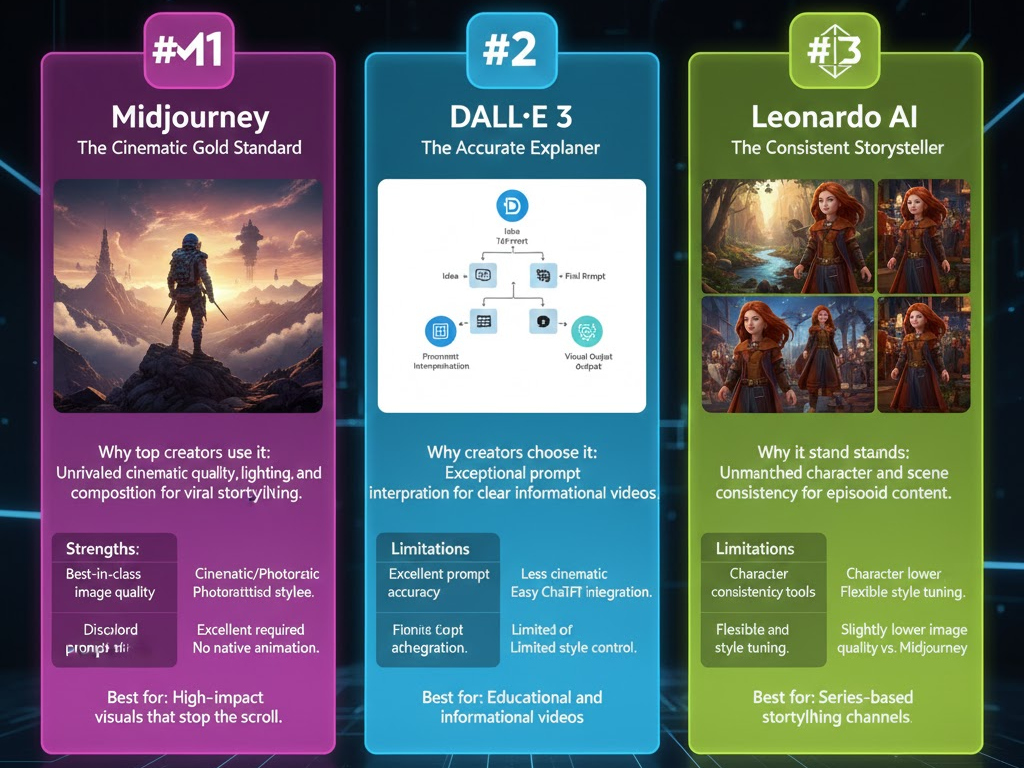
1. Midjourney (Rank #1)
Why top creators use it:
Midjourney remains the gold standard for cinematic AI image generation in 2026. Channels producing viral storytelling, faceless documentaries, and AI-generated shorts consistently rely on Midjourney for its lighting, composition, and artistic depth.
Strengths:
- Best-in-class image quality
- Strong cinematic and photorealistic styles
- Excellent prompt adherence
Limitations:
- Requires Discord
- No native animation
Best for:
Creators who want high-impact visuals that stop the scroll.
2. DALL·E 3 (Rank #2)
Why creators choose it:
DALL·E 3 excels at accurate prompt interpretation. It is often used for explainer-style videos where clarity matters more than cinematic flair.
Strengths:
- Excellent prompt accuracy
- Easy integration with ChatGPT workflows
Limitations:
- Less cinematic than Midjourney
- Limited style control
Best for:
Educational and informational AI videos.
3. Leonardo AI (Rank #3)
Why it stands out:
Leonardo AI is popular with creators who want consistency across characters and scenes. This makes it useful for episodic content.
Strengths:
- Character consistency tools
- Flexible style tuning
Limitations:
- Slightly lower image quality than Midjourney
Best for:
Series-based storytelling channels.
Animation and Motion Tools for Smooth Videos
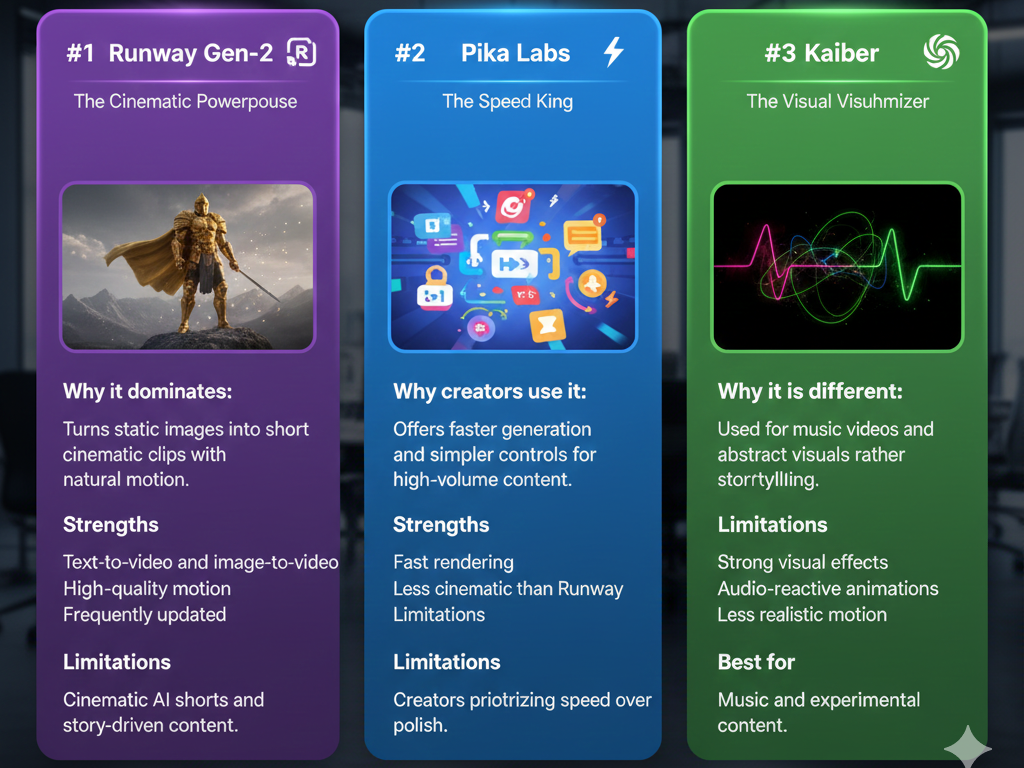
1. Runway Gen-2 (Rank #1)
Why it dominates:
Runway Gen-2 is the most widely used AI video generation tool among viral AI channels. It turns static images into short cinematic clips with natural motion.
Strengths:
- Text-to-video and image-to-video
- High-quality motion
- Frequently updated
Limitations:
- Short clip lengths
- Requires iteration for best results
Best for:
Cinematic AI shorts and story-driven content.
2. Pika Labs (Rank #2)
Why creators use it:
Pika Labs offers faster generation and simpler controls, making it ideal for high-volume content.
Strengths:
- Fast rendering
- Simple interface
Limitations:
- Less cinematic than Runway
Best for:
Creators prioritizing speed over polish.
3. Kaiber (Rank #3)
Why it is different:
Kaiber is often used for music videos and abstract visuals rather than storytelling.
Strengths:
- Strong visual effects
- Audio-reactive animations
Limitations:
- Less realistic motion
Best for:
Music and experimental content.
Voice AI Platforms for Character Dialogue
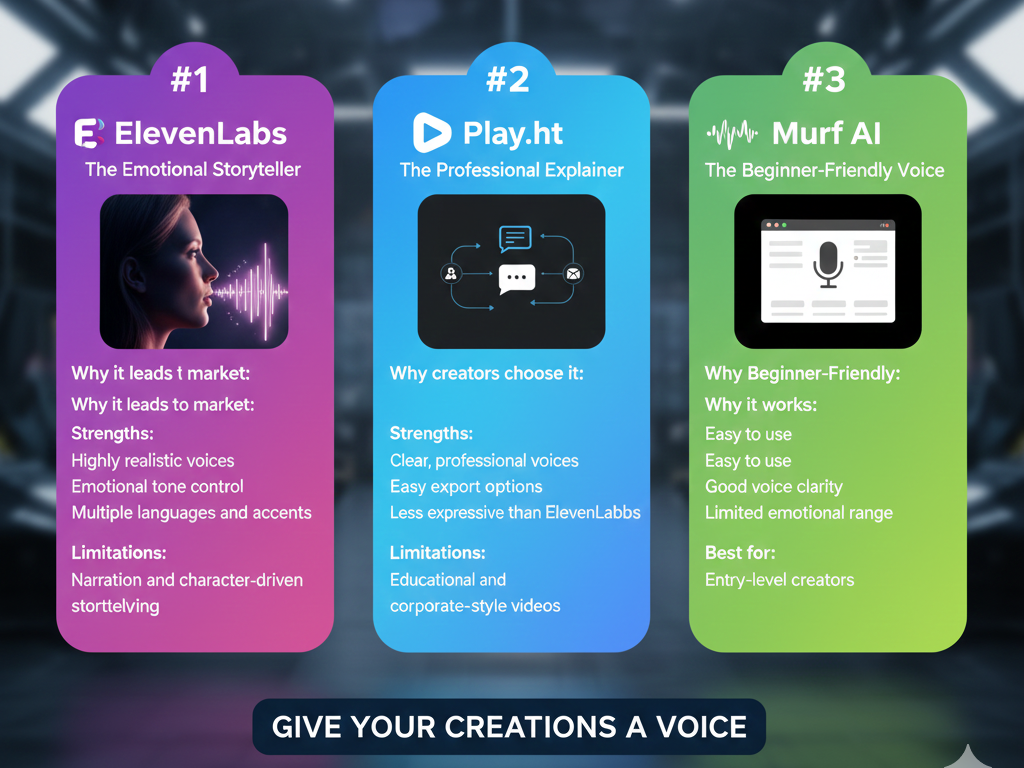
1. ElevenLabs (Rank #1)
Why it leads the market:
ElevenLabs is the most commonly used voice AI platform among viral AI video creators. Its voices sound natural, emotional, and human.
Strengths:
- Highly realistic voices
- Emotional tone control
- Multiple languages and accents
Limitations:
- Premium pricing for heavy usage
Best for:
Narration and character-driven storytelling.
2. Play.ht (Rank #2)
Why creators choose it:
Play.ht is widely used for explainer videos and business content.
Strengths:
- Clear, professional voices
- Easy export options
Limitations:
- Less expressive than ElevenLabs
Best for:
Educational and corporate-style videos.
3. Murf AI (Rank #3)
Why it works:
Murf AI is popular with beginners due to its simplicity.
Strengths:
– Easy to use
– Good voice clarity
Limitations:
– Limited emotional range
Best for:
Entry-level creators.
Practical Example: A 1M+ View AI Video Workflow
A typical viral AI video uses:
- Midjourney for character and scene images
- Runway Gen-2 for motion clips
- ElevenLabs for narration
- CapCut or Premiere Pro for editing
This modular approach allows creators to upgrade individual tools without rebuilding their entire workflow.
Common Mistakes Creators Make
- Relying on one all-in-one tool instead of best-in-class options
- Ignoring voice quality, which hurts retention
- Overusing AI effects, making videos feel artificial
- Choosing tools without testing audience response
Final Checklist: Choosing the Right AI Video Tools
- ✅ Choose one strong image generator
- ✅ Add one motion tool for animation
- ✅ Invest in high-quality voice AI
- ✅ Test outputs before committing
- ✅ Focus on storytelling, not just visuals
Conclusion
In 2026, successful AI video creators do not chase every new tool. They build a focused stack used by proven channels. By combining Midjourney, Runway, and ElevenLabs, many creators are already producing videos with millions of views. The tools matter, but how you combine them matters more.
Use this comparison as a starting point, test aggressively, and refine based on performance.
Frequently Asked Questions
Q: What is the best AI video tool in 2026?
A: There is no single best tool. Most high-performing creators use Midjourney for images, Runway Gen-2 for motion, and ElevenLabs for voice.
Q: Can beginners use these AI video tools?
A: Yes. Tools like Pika Labs and Murf AI are beginner-friendly and require minimal setup.
Q: Do AI video tools guarantee viral videos?
A: No. AI tools improve production speed and quality, but storytelling and audience engagement still determine performance.
Q: Are these tools suitable for YouTube Shorts?
A: Yes. Runway Gen-2 and Pika Labs are widely used for short-form AI content.