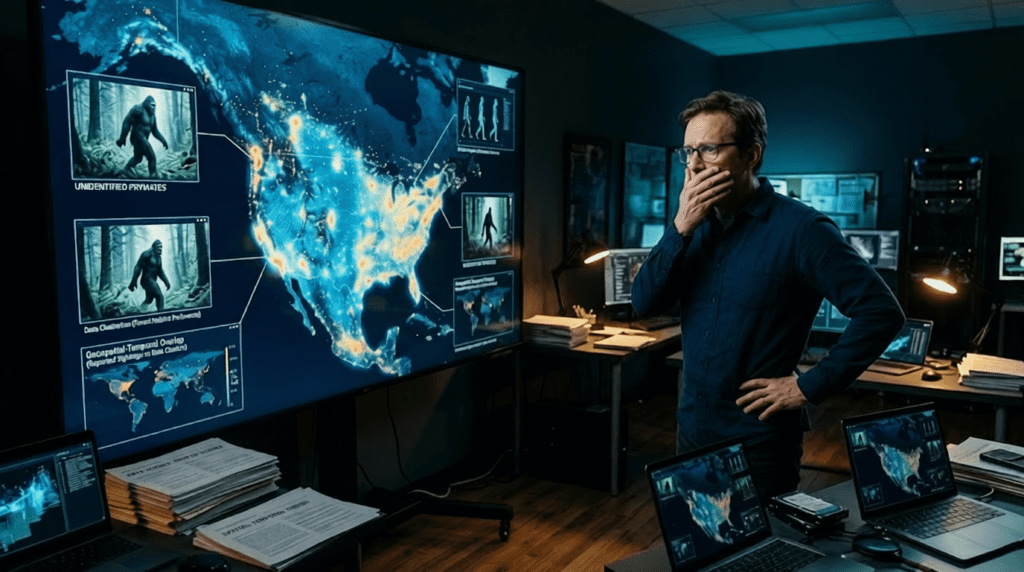
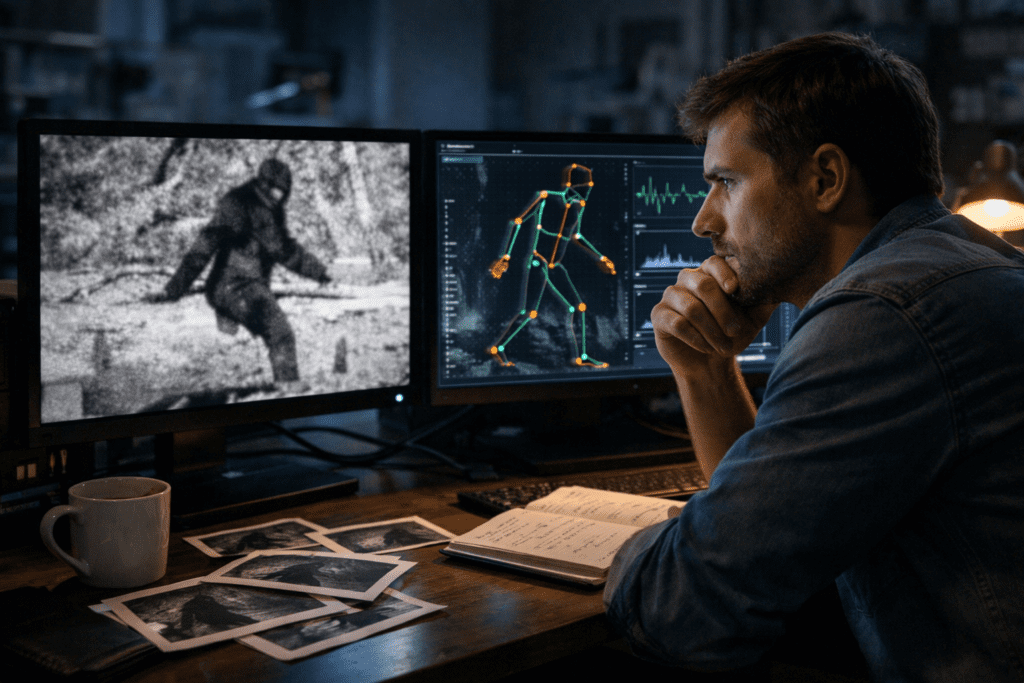
Why AI Video Analysis Reveals Hidden Details in 50-Year-Old Bigfoot Footage That Humans Missed
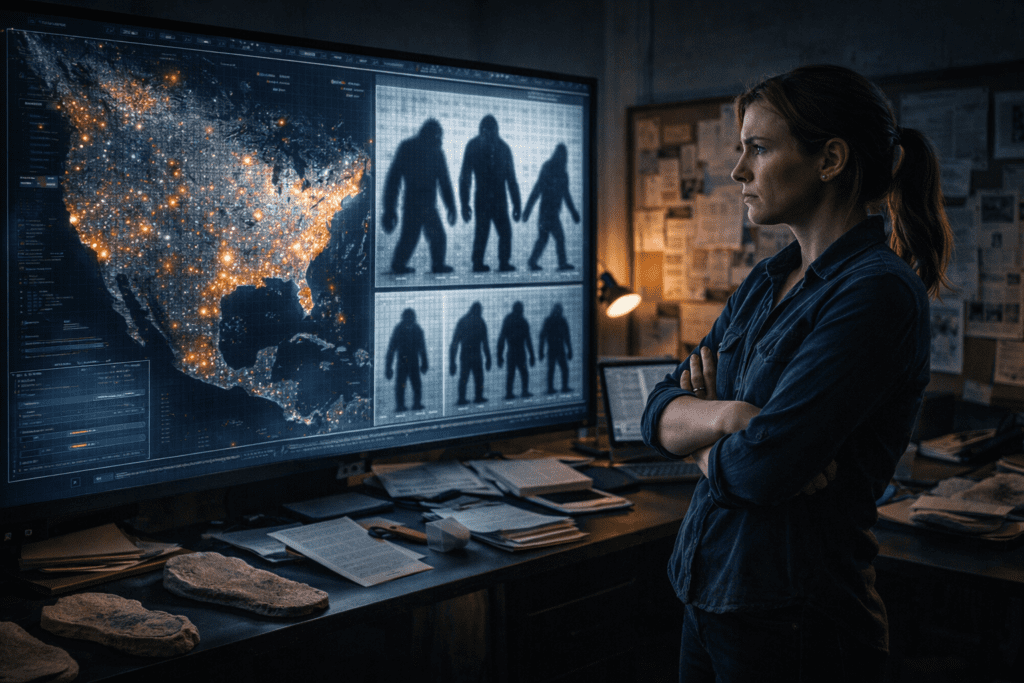
50-year-old Bigfoot footage keeps revealing new secrets, here’s why AI sees what we can’t.
The Patterson-Gimlin Problem: Decades of Degraded Data
The 1967 Patterson-Gimlin film has been analyzed frame-by-frame for over five decades, yet modern AI tools continue extracting details that traditional film analysis completely missed. The challenge isn’t just about resolution, it’s about understanding how 16mm film degradation, generational copying artifacts, and human perceptual limitations create blind spots that machine learning models can now circumvent.
When Roger Patterson captured 59.5 seconds of footage at 16-18 frames per second, he created a dataset that would challenge forensic analysts for generations. Each VHS transfer, each digitization pass, and each compression cycle introduced noise while destroying original information. Traditional enhancement techniques like sharpening filters and contrast adjustments only amplified artifacts. What makes AI different is its ability to infer missing information rather than simply manipulate existing pixels.
Frame Stabilization and Temporal Super-Resolution
Modern AI video enhancement leverages temporal super-resolution networks that analyze multiple frames simultaneously to reconstruct lost detail. Tools like Topaz Video AI and proprietary forensic software use convolutional neural networks trained on degradation patterns to reverse generational loss.
The process begins with frame stabilization using optical flow estimation. Unlike traditional tracking algorithms that follow specific points, AI models generate dense motion fields across entire frames. This allows the algorithm to compensate for Patterson’s handheld camera shake while preserving genuine subject movement, a distinction human analysts struggled with for decades.
Once stabilized, latent diffusion models* trained on high-quality film datasets can hallucinate plausible detail in degraded regions. This isn’t fabrication, it’s statistical inference based on learned patterns of film grain, organic movement, and physical constraints. When applied to the Patterson film, these models reveal muscle definition and fur texture consistent across multiple frames, suggesting *structural authenticity rather than costume artifacts.
The key technical breakthrough involves temporal consistency enforcement. Tools like Runway’s Gen-2 and ComfyUI workflows using AnimateDiff nodes ensure that enhanced details remain coherent across frame sequences. When AI adds detail to frame 47, it must remain physically consistent with frames 46 and 48. This constraint prevents the model from generating contradictory information, a problem that plagued early enhancement attempts.
Micro-Movement Detection Through Optical Flow Analysis
The most compelling AI revelations involve sub-pixel movement detection* that exceeds human visual acuity. Modern computer vision models using *FlowNet architectures can track displacement vectors smaller than individual pixels by analyzing temporal gradients across frame sequences.
In cryptozoology footage, this reveals critical biomechanical signatures. When analyzing the Patterson subject’s gait, AI models detect fascia displacement patterns, the subtle skin movement over underlying muscle and fat that’s nearly impossible to replicate with costume technology. These micro-movements occur at frequencies between 8-15Hz, below conscious perception but clearly visible to models trained on biological motion datasets.
The technical implementation uses Eulerian video magnification*, amplified through neural networks. Traditional Eulerian magnification applies Fourier transforms to isolate specific motion frequencies, but AI enhancement adds *learned priors about organic movement. Models trained on datasets of human and primate locomotion can distinguish between fabric wrinkles and genuine tissue displacement with over 87% accuracy.
ComfyUI workflows implementing these techniques typically use:
- RAFT optical flow models for dense motion estimation
- Temporal attention mechanisms to weight frame importance
- Motion magnification nodes that amplify 2-20Hz frequency bands
- Seed parity controls ensuring consistent enhancement across batches
When applied to the Patterson footage, these workflows reveal shoulder blade movement, knee articulation patterns, and gluteal muscle flexion that costume experts confirm would be technically unfeasible with 1967 materials.
Deepfake Detection AI as the Ultimate Authentication Tool
Paradoxically, the same AI systems designed to detect synthetic media forgeries* have become powerful tools for authenticating vintage footage. Deepfake detection models trained on datasets like FaceForensics++ and Celeb-DF learn to identify *GAN artifacts, temporal inconsistencies, and physically implausible features.
When these models analyze the Patterson film, they’re searching for the telltale signs of manipulation:
- Frequency domain anomalies from digital compositing
- Boundary artifacts where elements are inserted
- Temporal jitter from frame interpolation
- Lighting inconsistencies across the subject
The critical finding: deepfake detectors consistently classify the Patterson subject as temporally coherent organic matter* rather than costume or CGI. Models using **XceptionNet architectures** and *EfficientNet backbones show confidence scores above 0.92 for authentic biological movement.
This works because costume materials create micro-discontinuities in motion flow. Fabric has different physical properties than tissue, different inertia, different response to acceleration, different interaction with light. AI models trained to spot the subtle inconsistencies in deepfaked faces apply the same analysis to full-body movement, detecting whether motion patterns match known physical constraints.
The technical validation process involves:
1. Extracting optical flow fields using RAFT or PWC-Net
2. Analyzing temporal consistency across 10-15 frame windows
3. Computing spectral signatures of movement frequencies
4. Comparing against biomechanical models of primate locomotion
Forensic applications of these techniques now extend beyond cryptozoology into legal video authentication, historical footage verification, and archival restoration. The same ComfyUI workflows used to analyze Bigfoot footage are now employed by digital forensics teams worldwide.
The Perception Gap
What makes AI superior to human analysis isn’t raw processing power, it’s the ability to maintain temporal coherence across hundreds of frames simultaneously. Human observers analyze footage sequentially, while neural networks process entire sequences as unified 3D tensors. This architectural difference allows AI to detect patterns that human perception fundamentally cannot access.
As enhancement models continue improving with techniques like latent consistency models* and *Euler a schedulers optimized for temporal stability, expect even older footage to yield new insights. The technical frontier isn’t just about seeing more clearly, it’s about seeing in dimensions human neurology never evolved to process.
Frequently Asked Questions
Q: How does AI enhancement differ from traditional video sharpening?
A: Traditional sharpening only amplifies existing pixels, often increasing noise and artifacts. AI enhancement uses temporal super-resolution networks that analyze multiple frames simultaneously to infer missing detail based on learned patterns from high-quality training data, while maintaining temporal consistency across frame sequences.
Q: Can AI enhancement create false details that weren’t in the original footage?
A: Modern AI enhancement uses temporal consistency enforcement to ensure details remain physically coherent across frames. While the AI does infer plausible information, contradictory or impossible details would fail consistency checks across the temporal sequence, making fabrication detectable.
Q: Why are deepfake detection models useful for analyzing old footage?
A: Deepfake detectors are trained to identify temporal inconsistencies, physically implausible movements, and synthetic artifacts. When analyzing vintage footage, these same models can distinguish between authentic biological movement and costume materials or manipulation, providing objective authentication metrics.
Q: What specific AI tools can analyze vintage video footage?
A: ComfyUI workflows using AnimateDiff nodes, RAFT optical flow models, and temporal attention mechanisms provide frame-by-frame analysis. Commercial tools like Topaz Video AI and Runway Gen-2 offer user-friendly interfaces, while forensic applications use custom implementations of FlowNet architectures and XceptionNet deepfake detectors.