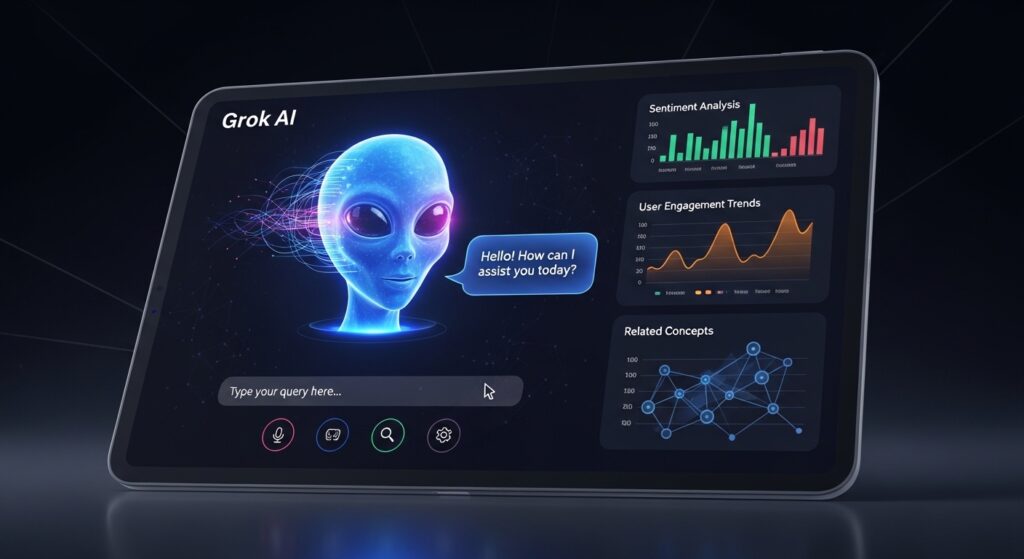
Stress-Testing Grok: A Technical Framework for Evaluating AI Predictions in High-Stakes Decision Environments

I trusted Grok with predictions that actually matter. Not trivia or hypothetical riddles. No use of sandbox simulations.
I put Grok into decision environments where errors have measurable cost: capital allocation scenarios, policy timing predictions, macroeconomic directional forecasts, and operational risk assessments. Then I built a visual audit system around those tests using a generative video pipeline to make the evaluation process inspectable, reproducible, and strategically useful.
This is a technical breakdown of how I stress-tested Grok, what failed, what surprised me, and how to evaluate AI reliability when the stakes are real.
Why “Feels Smart” Isn’t a Valid Metric
For data analysts and strategic planners, the core challenge isn’t whether an AI sounds intelligent. It’s whether it maintains calibration under uncertainty.
Large language models exhibit what I call confidence elasticity—their tone remains assertive even as epistemic reliability drops. That’s dangerous in forecasting.
So instead of asking:
> “Is Grok smart?”
I asked:
1. Does Grok maintain probabilistic calibration under incomplete information?
2. Can it decompose complex systems into causal drivers rather than correlation proxies?
3. Does its reasoning degrade gracefully—or hallucinate confidently—when pushed outside training priors?
To answer that, I designed a repeatable stress-testing framework.
1. Methodology for Testing AI Prediction Accuracy

Building a High-Stakes Prediction Suite
I constructed four prediction categories:
– Macroeconomic directional moves (rate policy timing, inflation persistence)
– Market regime classification (risk-on vs risk-off transitions)
– Operational risk forecasting (supply chain disruption likelihood)
– Strategic decision trees (multi-variable corporate scenario planning)
Each test included:
– Clearly defined time horizons
– Quantifiable outcome metrics
– A requirement for probability assignment (not binary answers)
This forced Grok to move from narrative reasoning into probabilistic forecasting.
Controlling Variables: Prompt Seed Parity
To reduce evaluation noise, I enforced Prompt Seed Parity:
– Identical prompt structures across models
– Same contextual data
– Controlled temperature parameters
– No follow-up clarifications
While LLMs don’t expose diffusion-style seeds like image models, we can approximate seed parity by maintaining consistent prompt scaffolding and sampling temperature.
This ensured that variance reflected reasoning differences—not prompt drift.
Visual Audit System Using ComfyUI
Here’s where the AI video layer becomes critical.
I used ComfyUI to build a generative visualization pipeline that:
– Translated Grok’s probabilistic outputs into animated probability distributions
– Visualized scenario branching as node graphs
– Rendered confidence intervals using latent noise diffusion simulations
Why ComfyUI?
Because it provides node-based control similar to analytical pipelines.
Think of it like this:
– Grok produces reasoning tokens.
– I parse those into structured JSON.
– ComfyUI ingests that JSON.
– A diffusion workflow renders animated uncertainty landscapes.
I used Euler a schedulers for stochastic smoothness in the visual diffusion layers. Euler a’s controlled randomness mirrors uncertainty propagation better than deterministic schedulers.
To ensure visual consistency across prediction updates, I enforced Latent Consistency by locking noise initialization across iterations when the structural reasoning remained unchanged.
This allowed me to detect whether probability shifts were causal—or just narrative rephrasing.
Calibration Testing
Each forecast included a probability score. After outcomes resolved, I calculated:
– Brier Score
– Log Loss
– Calibration curve deviation
I then visualized calibration drift over time using generative heatmaps inside ComfyUI.
If Grok consistently assigned 70% confidence to events that occurred 40% of the time, that miscalibration became immediately visible in the visual layer.
The key insight: narrative quality can mask statistical miscalibration.
2. Where Grok Succeeded—and Where It Failed
Success Case 1: Structural Economic Reasoning
Grok performed strongest in structured macroeconomic analysis.
It demonstrated:
– Clear cause-effect mapping
– Multi-variable reasoning chains
– Identification of second-order impacts
In inflation persistence modeling, it correctly identified labor market stickiness and energy price lag effects as dominant drivers.
Calibration error in this category was relatively low.
Why It Worked
Macroeconomic reasoning aligns well with:
– Public data density
– Established analytical frameworks
– Pattern-rich historical datasets
Grok’s reasoning tokens revealed consistent causal mapping rather than pattern mimicry.
Failure Case 1: Regime Shifts
Where Grok struggled:
Low-frequency, high-volatility regime changes.
Examples:
– Sudden liquidity crises
– Political shocks
– Black swan events
It defaulted to mean-reversion bias.
Visually, this showed up in my ComfyUI uncertainty renderings as narrow diffusion clouds, overconfidence in stable-state continuation.
After shock events, recalibration lagged.
This is classic training prior inertia.
LLMs optimize for likelihood across historical corpora. Rare regime breaks are underrepresented, so probability assignments skew toward continuity.
Failure Case 2: Strategic Game Theory
In multi-agent adversarial scenarios, Grok occasionally assumed rational actors with aligned incentives.
Real-world strategy rarely behaves that cleanly.
In one corporate competition simulation, it:
– Overestimated cooperative outcomes
– Underweighted retaliatory dynamics
When visualized as branching diffusion trees in ComfyUI, the tree density skewed heavily toward cooperative nodes.
The absence of adversarial weighting indicated incomplete strategic modeling.
Unexpected Strength: Structured Decomposition
In complex decision trees, Grok excelled at decomposing problems into modular components.
This made it valuable as a:
– Analytical co-pilot
– Assumption enumerator
– Sensitivity analysis generator
When prompted explicitly to separate:
– Known variables
– Unknown variables
– Controllable inputs
– External shocks
It produced highly structured output that integrated cleanly into my visual pipeline.
The lesson: Grok performs best when guided into system decomposition mode.
3. Reasoning Transparency vs Other Models
One of the biggest differentiators wasn’t accuracy.
It was reasoning visibility.
Transparency Spectrum
Across frontier models, I observed three categories:
1. Opaque summarization (high-level answer, minimal reasoning)
2. Structured explanation (explicit logic chains)
3. Probabilistic self-reflection (uncertainty-aware reasoning)
Grok typically fell into Category 2.
It provides structured explanation but not always deep uncertainty quantification.
Comparing Reasoning Depth
In identical prompts:
– Some models optimized for brevity.
– Some optimized for confident tone.
– Grok leaned toward explanatory expansion.
That’s useful for auditability.
When fed into my ComfyUI visualization layer, Grok outputs required less post-processing to convert into scenario graphs.
However:
It did not consistently expose internal probability weighting logic.
Meaning:
We see the conclusion but not the gradient descent of reasoning.
Hallucination Behavior Under Stress
Under incomplete data, I introduced ambiguity intentionally.
Some models fabricate missing variables.
Grok’s behavior was mixed:
– Often acknowledged uncertainty.
– Occasionally inferred unstated data.
The key signal was tone.
When confidence tone remained high despite missing data, calibration errors increased.
This is why probabilistic forcing (requiring explicit percentage estimates) is non-negotiable in high-stakes testing.
What This Means for Strategic Planners
AI reliability is not binary.
It’s conditional.
Grok is strong when:
– The domain has structured historical precedent
– Causal frameworks are well-defined
– The problem can be decomposed modularly
It weakens when:
– Events are rare and discontinuous
– Adversarial agents behave irrationally
– Data sparsity increases
The solution is not blind trust.
It’s controlled integration.
A Practical Deployment Framework
If you’re a data analyst or strategist, here’s the implementation stack I recommend:
Step 1: Structured Prompt Architecture
– Force probability outputs
– Require assumption lists
– Demand scenario branching
Step 2: Calibration Tracking
– Track Brier scores over time
– Log prediction deltas
– Identify systematic bias patterns
Step 3: Visual Uncertainty Mapping (ComfyUI)
– Convert probabilities into diffusion clouds
– Use Euler a for stochastic uncertainty flow
– Maintain Latent Consistency for version tracking
Step 4: Adversarial Stress Testing
– Introduce conflicting data
– Remove key variables
– Simulate regime shifts
If the model’s confidence does not widen appropriately, you’ve detected overconfidence bias.
The Core Insight
Grok is not an oracle.
But it is a high-speed analytical synthesizer.
When wrapped in:
– Probabilistic enforcement
– Visual uncertainty modeling
– Calibration feedback loops
It becomes strategically useful.
The mistake isn’t trusting AI.
The mistake is trusting AI without instrumentation.
In high-stakes environments, instrumentation is everything.
And once you build the visual audit layer—once you can see uncertainty diffuse, collapse, or spike—you stop evaluating AI by eloquence.
You start evaluating it by reliability under stress.
That’s the only metric that actually matters.
If you’re going to trust Grok with predictions that matter, don’t ask if it’s intelligent.
Ask if it’s calibrated.
And build the system that lets you prove it.
Frequently Asked Questions
Q: How do I measure whether Grok is well-calibrated in forecasting tasks?
A: Use quantitative scoring rules such as Brier Score and Log Loss. Require explicit probability estimates for every prediction, track outcomes over time, and compare predicted confidence against actual event frequency. Visual calibration curves help identify systematic overconfidence or underconfidence.
Q: Why use ComfyUI in a prediction evaluation workflow?
A: ComfyUI enables node-based visual pipelines that can translate structured AI outputs into animated uncertainty maps, diffusion clouds, and scenario trees. This makes abstract probability distributions visually inspectable and supports version-controlled analysis using Latent Consistency and controlled scheduler behavior like Euler a.
Q: Where does Grok perform best in high-stakes scenarios?
A: Grok performs strongest in structured domains with rich historical data and clear causal frameworks, such as macroeconomic analysis and modular decision decomposition. It struggles more with rare regime shifts and adversarial multi-agent strategy scenarios.
Q: What is the biggest mistake when using AI for strategic decisions?
A: The biggest mistake is relying on narrative fluency instead of calibration metrics. High-stakes AI deployment requires probabilistic enforcement, calibration tracking, adversarial stress testing, and visualization of uncertainty not just persuasive explanations.