Prompt-Based Video Animation With Code Tools: Vibe-Coding Custom Animations Using Claude and Remotion
Vibe-code your way to custom animations, no coding skills required.
The promise of AI video generation has always been creative freedom without technical friction. Yet most creators quickly hit a ceiling: template-bound motion, limited control over timing, and outputs that feel visually generic. If you’ve ever wanted precise animation control, custom motion curves, repeatable sequences, dynamic text, or data-driven visuals, without learning After Effects or writing JavaScript from scratch, prompt-based animation with code tools changes the equation entirely.
This deep dive explores how non-coders can use Claude as a visual reasoning engine to generate animation code inside the Remotion framework. Instead of dragging keyframes or relying on black-box diffusion video models, you’re vibe-coding motion logic itself, prompting AI to translate creative intent into deterministic, programmatic animation.
Vibe-Coding Animation: From Natural Language to Motion Design
Traditional AI video tools generate motion through latent diffusion, frame interpolation, and temporal consistency models. While impressive, they abstract away control. You describe a scene, tweak a seed, maybe switch schedulers like Euler a or DPM++, and hope the model’s latent consistency holds across frames.
Programmatic animation flips this paradigm.
Instead of asking a model to hallucinate motion, you define motion mathematically—but with natural language as the interface. Claude becomes the translator between creative intent and executable animation logic.
This approach is particularly powerful for:
– Explainer videos with precise timing
– UI-style animations
– Kinetic typography
– Loopable social content
– Data-reactive visuals
Remotion, a React-based video rendering framework, is the backbone. It renders videos using code, meaning every pixel, frame, and transition is deterministic. There’s no seed drift, no temporal artifacts, and no reliance on latent priors.
For creators coming from AI image or video generation, think of this as replacing probabilistic sampling with absolute control. Instead of worrying about seed parity between shots, you’re defining exact frame-based behavior. Frame 120 is always frame 120.
The “vibe-coding” workflow looks like this:
1. Describe the animation in natural language
2. Prompt Claude to generate Remotion-compatible code
3. Render locally or in the cloud
4. Iterate by refining prompts, not rewriting logic
No IDE expertise required. No animation theory required. Just intent, language, and iteration.
Prompting Claude to Generate Remotion Animation Code
The key to making this workflow accessible to non-coders is prompt architecture. You’re not asking Claude to “write code” in the traditional sense, you’re asking it to encode motion semantics.
Step 1: Translate Visual Intent into Motion Constraints
A weak prompt:
> “Make an animated intro with text.”
A strong prompt:
> “Create a 6-second Remotion animation. White background. The text ‘Prompt-Based Animation’ fades in over 20 frames, scales from 0.9 to 1.0 using an ease-out curve, holds for 60 frames, then slides upward by 120 pixels while opacity fades to zero. 30fps.”
Notice what’s happening:
– Duration is explicit
– Frame rate is explicit
– Motion is described numerically
– Easing is named, not implied
Claude excels at converting this into React + Remotion code using hooks like `useCurrentFrame()` and `interpolate()`.
Step 2: Leverage Deterministic Animation Logic
Unlike diffusion-based video where temporal consistency is probabilistic, Remotion animations are deterministic. This eliminates issues analogous to latent drift or scheduler variance.
Claude will typically generate constructs like:
– Frame-based interpolation
– Spring animations for natural motion
– Conditional rendering by frame ranges
This is where creators coming from tools like Sora or Runway notice a fundamental difference. There’s no need to fight temporal coherence or re-roll generations. Your animation behaves like a physics simulation with exact outcomes.
You can even prompt Claude to mimic diffusion-style easing:
> “Use a spring animation with slight overshoot, similar to a low-step Euler a scheduler feel, fast initial movement with smooth convergence.”
Claude understands the metaphor and maps it to Remotion’s spring parameters.
Step 3: Iteration Through Language, Not Debugging
Non-coders fear code because of syntax errors and debugging. But Claude functions as both generator and debugger.
You can prompt:
> “The text feels too fast. Slow the entrance by 15 frames and reduce the scale overshoot.”
Claude updates the logic accordingly. You’re editing motion behavior, not code structure.
This is the core unlock: iteration speed comparable to AI image prompting, but with cinematic precision.
Why Programmatic Animation Beats Traditional AI Video Tools
AI video models optimize for realism and cinematic coherence, but they struggle with precision. Programmatic animation optimizes for control and repeatability.
1. Absolute Temporal Control
In diffusion video, even with fixed seeds, subtle changes can introduce motion variance. This is a latent consistency problem, each frame is inferred, not declared.
With Remotion:
– Frame 0 is defined
– Frame 180 is defined
– Motion between them is a known function
This is effectively perfect seed parity by design.
2. Modular, Reusable Motion Systems
Once Claude generates an animation component, it can be reused endlessly:
– Swap text
– Change colors
– Adjust timing
– Feed in dynamic data
This is impossible with one-off AI video generations. You’re building a motion system, not a clip.
3. Style Consistency at Scale
AI video tools often struggle with stylistic lock-in across multiple outputs. Programmatic animation guarantees consistency because style is encoded in logic.
Want every title card to animate identically across 50 videos? One component does it.
4. No Render Lottery
Diffusion video rendering can feel like gambling, rerolling until the output matches your mental model. Programmatic animation renders exactly what you describe.
Claude removes the barrier of learning the underlying framework, making Remotion accessible to non-developers.
5. Hybrid Workflows
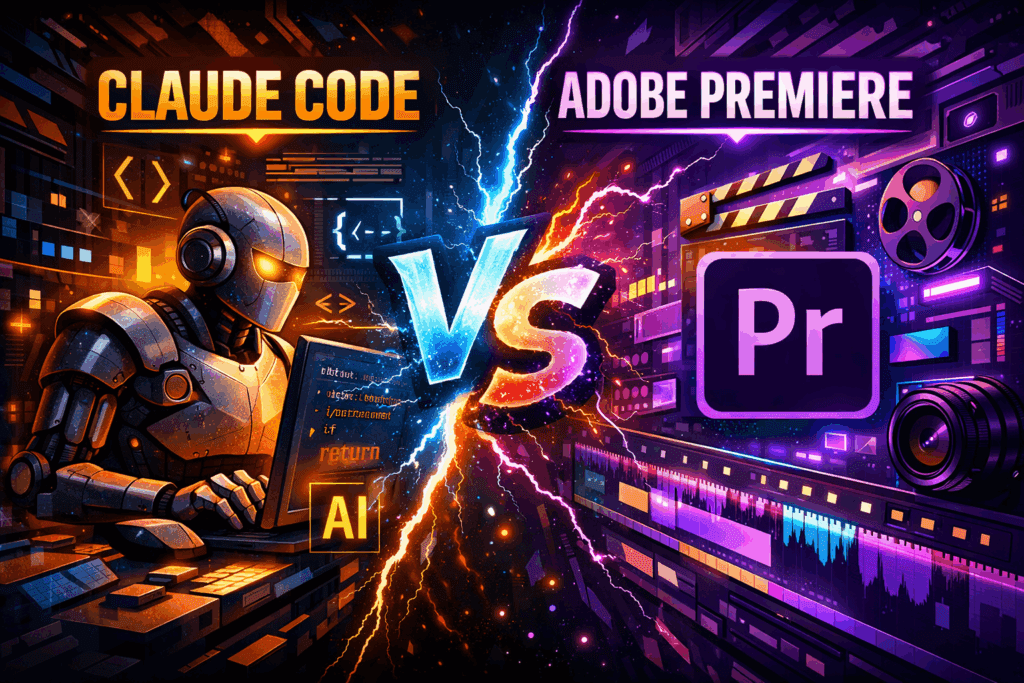
This approach doesn’t replace AI video—it complements it.
Many creators:
– Generate background footage with AI video models
– Overlay programmatic typography and motion graphics using Remotion
– Maintain visual precision on top of generative visuals
Claude becomes the glue layer between generative media and deterministic motion design.
Solving the Core Challenge: Custom Animation Without Traditional Software
The core challenge, creating custom animated videos without traditional animation software, isn’t solved by better UIs. It’s solved by better abstraction.
Claude abstracts code. Remotion abstracts rendering. Language becomes the control surface.
You’re no longer choosing between:
– Learning After Effects
– Accepting generic AI video outputs
You’re designing motion with words and letting AI handle the translation.
This is the future of AI-native video creation: deterministic where it matters, generative where it inspires.
If diffusion models gave us imagination, programmatic animation gives us authorship.
And with Claude as your co-pilot, vibe-coding animation becomes less about syntax and more about vision.
Frequently Asked Questions
Q: Do I need to know JavaScript or React to use Remotion with Claude?
A: No. Claude functions as an abstraction layer, translating natural language animation descriptions into valid Remotion code. You interact through prompts, not syntax.
Q: How is this different from AI video tools like diffusion-based generators?
A: Diffusion video tools generate motion probabilistically, which can cause temporal inconsistency. Programmatic animation with Remotion is deterministic, every frame is explicitly defined.
Q: Can this workflow integrate with AI-generated footage?
A: Yes. Many creators combine AI-generated video backgrounds with programmatic overlays like text, UI elements, and motion graphics rendered through Remotion.
Q: What does ‘vibe-coding’ mean in this context?
A: Vibe-coding refers to designing animation behavior through descriptive language rather than manual coding, allowing AI to handle technical implementation.