Is Seedance 2.0 Worth Waiting For? A Technical Evaluation for AI Video Creators in 2026
Everyone’s hyping Seedance 2.0 but should you actually wait for it?
If you’re a content creator deciding where to invest your time, budget, and workflow development, this isn’t just about hype. It’s about opportunity cost. Every month you delay building with current tools is a month of lost iteration, brand refinement, and monetization.
So let’s break this down technically—no speculation loops, no influencer echo chamber. We’ll evaluate what Seedance 2.0 appears to excel at, where it’s limited, how accessibility factors in, and whether tools like Kling 3, Sora 2, or custom ComfyUI pipelines already cover 90% of real-world production needs.
1. What Seedance 2.0 Promises (And Where It Actually Excels)
Seedance 2.0 is being positioned as a next-generation diffusion-based video model with improved motion coherence, stronger prompt adherence, and higher cinematic realism.
From early demonstrations and technical breakdowns, it appears to focus on three core areas:
1.1 Temporal Consistency and Motion Stability
The standout claim is improved long-range temporal coherence. In practical terms, that means:
– Fewer character morphs between frames
– Reduced identity drift
– More stable camera motion
– Better object persistence across cuts
Under the hood, this likely relies on:
– Enhanced latent consistency mechanisms
– Cross-frame attention anchoring
– Improved keyframe conditioning
– Refined noise scheduling (possibly adaptive Euler a or DPM++ variants tuned for video continuity)
If true, this puts Seedance 2.0 ahead of many first-generation video diffusion systems that struggle with character consistency beyond 4–6 seconds.
But here’s the key question:
How much better is it than Kling 3 or Sora 2 in production scenarios?
Because demo-level coherence and production-level reliability are two very different things.
1.2 Cinematic Realism and Lighting Control
Seedance 2.0 appears to emphasize photoreal lighting response and physically plausible motion. That suggests:
– Stronger latent world modeling
– Better understanding of spatial depth
– More consistent global illumination simulation
This matters for:
– Product ads
– Narrative short films
– High-end brand visuals
But let’s be realistic: Sora 2 already produces highly cinematic footage with complex scene physics. Kling 3 has dramatically improved lighting continuity and camera motion interpolation.
Unless Seedance 2.0 introduces a fundamentally new diffusion-to-video paradigm (e.g., hybrid autoregressive + latent diffusion stacks), we’re likely looking at incremental, not revolutionary, gains.
1.3 Prompt Adherence and Semantic Control
One rumored strength is tighter semantic alignment—better compliance with detailed prompts.
That would imply improvements in:
– Text-video cross-attention weighting
– Token-to-latent mapping precision
– Reduced semantic drift mid-generation
For creators building client-based workflows, this matters a lot. Prompt reproducibility reduces iteration cycles and improves delivery speed.
However, we must compare this to:
– Sora 2’s advanced scene interpretation
– Kling 3’s prompt-weight tuning and negative prompt support
– ComfyUI workflows where you manually control seed parity, scheduler, and conditioning stacks
If you already use structured prompting with scene breakdowns and shot chaining, the marginal improvement may not justify waiting.
2. Accessibility, China-Only Barriers, and the Real Cost of Waiting
Now let’s talk about the elephant in the room.
Seedance 2.0 is currently limited in accessibility, with major concerns around:
– China-only availability
– Region-locked infrastructure
– Limited API access
– No clear timeline for global release
For creators outside that ecosystem, this creates three serious problems.
2.1 No Immediate Workflow Integration
If you can’t access:
– API endpoints
– Batch generation
– Seed control parameters
– Frame export pipelines
You can’t integrate it into:
– Automated content systems
– Client production workflows
– YouTube/TikTok scaling operations
– Multi-shot storytelling pipelines
Waiting for access means delaying workflow mastery.
And mastery is the real advantage not tool novelty.
2.2 Regulatory and Longevity Risk
China-restricted AI tools carry structural uncertainty:
– Geopolitical restrictions
– Platform shutdown risk
– Limited Western API support
– Payment processing barriers
If your business model depends on a tool you may never gain stable access to, that’s not strategic—it’s speculative.
2.3 The Compounding Cost of Inaction
Every month you wait, competitors are:
– Refining Sora 2 shot design
– Building Kling 3 cinematic presets
– Optimizing Euler a vs. DPM++ scheduling in ComfyUI
– Training LoRAs for character consistency
The biggest mistake creators make is assuming the next tool will eliminate the need for skill.
It won’t.
Advanced creators win because they understand:
– Seed reproducibility
– Latent blending techniques
– Multi-pass upscaling
– Frame interpolation refinement
– Shot stitching workflows
No new model replaces production literacy.
3. Are Kling 3, Sora 2, and Current Pipelines Already Enough?
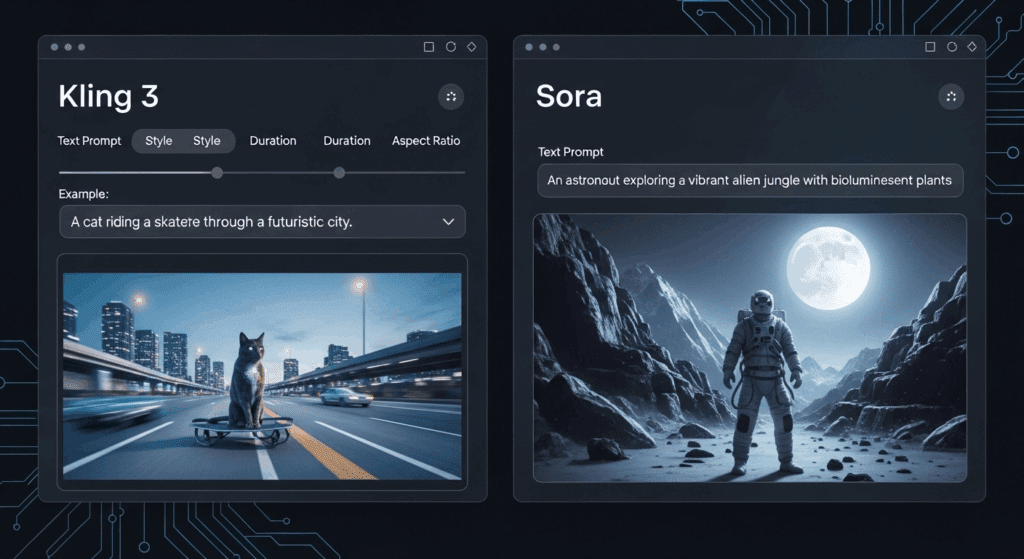
Let’s get practical.
You are likely producing one of these:
– Short-form cinematic social videos
– AI-driven YouTube storytelling
– Product commercials
– Music visuals
– Experimental art films
Do you need Seedance 2.0 to execute these at a high level?
In most cases: no.
3.1 Kling 3: The Current Workhorse
Kling 3 has significantly improved:
– Temporal smoothing
– Camera path control
– Character persistence
– High-resolution exports
It supports structured prompt chaining and offers more predictable generation behavior than earlier models.
For most creators, Kling 3 already delivers:
– 6–10 second coherent shots
– Cinematic lighting
– Stable human faces
– Smooth motion
When combined with post-processing (Topaz, DaVinci, frame interpolation), it becomes production-ready.
3.2 Sora 2: Physics and Scene Intelligence
Sora 2 excels in:
– Complex multi-actor scenes
– Real-world physics simulation
– Environmental interactions
– High semantic prompt understanding
If your work requires:
– Crowd scenes
– Environmental storytelling
– Natural motion dynamics
Sora 2 is already extremely powerful.
Its major constraint isn’t capability—it’s availability and cost.
3.3 ComfyUI Pipelines: Maximum Control
If you prioritize technical control, custom pipelines still offer unmatched flexibility:
– Manual seed parity
– Scheduler experimentation (Euler a, DPM++ 2M, Heun)
– Latent upscaling passes
– ControlNet pose locking
– Multi-stage refinement workflows
Yes, it requires more setup.
But it gives you something closed platforms don’t: deterministic iteration.
That’s essential for:
– Serialized characters
– Brand consistency
– Client revisions
– Scene reshoots
The Real Question: Are You Tool-Driven or Output-Driven?
Waiting for Seedance 2.0 only makes sense if:
1. You cannot achieve required motion fidelity with current tools.
2. Your niche demands extreme temporal coherence beyond 10–15 seconds.
3. You have guaranteed early access.
4. Your competitors are blocked without it.
For most creators, none of these are true.
The limiting factor is rarely the model.
It’s:
– Shot design
– Prompt architecture
– Post-processing
– Story structure
– Editing rhythm
The creators winning right now are stacking tools—not waiting for perfect ones.
They use:
– Kling 3 for base motion
– Sora 2 for complex scenes
– ComfyUI for character locking
– DaVinci for grading
– Topaz for detail refinement
Seedance 2.0 may be impressive.
But unless it delivers a paradigm shift—like real-time controllable scene graphs or persistent world memory across minutes—it’s an optimization, not a revolution.
Final Technical Verdict
From an objective evaluation standpoint:
Seedance 2.0 appears strong in temporal consistency and cinematic realism.
However:
– Accessibility is limited.
– Integration pipelines are unclear.
– Alternatives are already highly capable.
– Opportunity cost of waiting is high.
If you’re making tool investment decisions in 2026, the strategic move is this:
Build mastery with available systems now.
Monitor Seedance 2.0.
Adopt it if and when it becomes accessible and demonstrably superior in measurable benchmarks (long-sequence stability, identity retention, semantic fidelity under complex prompts).
But don’t pause your growth for it.
Because in AI video production, iteration speed beats theoretical capability every time.
Frequently Asked Questions
Q: Is Seedance 2.0 significantly better than Kling 3 for character consistency?
A: Based on available demonstrations, Seedance 2.0 appears to improve long-range temporal coherence. However, Kling 3 combined with structured prompting and post-processing already achieves strong character stability for 6–10 second shots. For most social and commercial use cases, Kling 3 is sufficient.
Q: Should creators outside China wait for global access before committing to other tools?
A: No. Waiting introduces opportunity cost. Without confirmed API access and workflow integration, it’s more strategic to master currently available platforms and adopt Seedance 2.0 later if it becomes globally accessible.
Q: What technical factor matters most when comparing AI video models?
A: Temporal consistency and semantic prompt adherence are the two most critical metrics. However, workflow controllability—such as seed reproducibility, scheduler options, and integration capability—often matters more in real production environments.
Q: Can ComfyUI pipelines compete with closed models like Seedance 2.0?
A: Yes, particularly in terms of control and reproducibility. While closed models may offer stronger out-of-the-box realism, ComfyUI allows deterministic workflows, custom schedulers, ControlNet locking, and multi-stage refinement that are essential for brand or serialized content production.