Why Kling 3.0 Works as a Film System – Not Just Another AI Video Generator
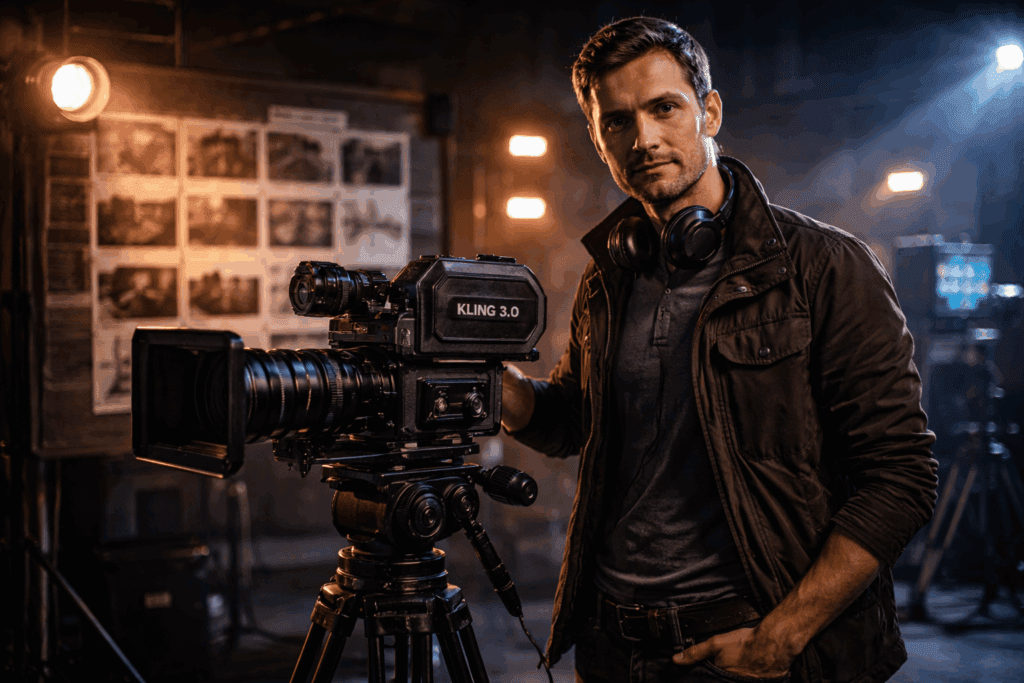
Why AI video feels like a lottery, and how Kling 3.0 fixes it.
If you’ve used most AI video generators long enough, you’ve experienced the pattern: generate five clips, one looks promising, none match each other. Wardrobe changes. Lighting shifts. Camera language resets. Characters subtly mutate. You’re not directing a film, you’re rolling dice inside a diffusion engine.
The core problem isn’t resolution, realism, or motion smoothness. It’s structural continuity.
Most AI video tools are clip generators. Kling 3.0 behaves like a film system.
This article breaks down why that distinction matters, and how Kling 3.0’s shot management and continuity architecture solve the “disconnected clip” problem that limits Runway, early Sora-style workflows, and raw ComfyUI pipelines.
The AI Video Lottery Problem: Why Most Models Fail at Film Continuity
Traditional AI video systems are diffusion-first, structure-second.
They generate each clip as an independent latent event.
Even when you reuse:
- The same prompt
- The same seed
- Same reference image
You’re still re-sampling the latent space per clip.
1. Seed Parity ≠ Narrative Continuity
In text-to-image systems, seed reuse can stabilize composition. In video diffusion, especially with temporal UNet stacks and motion modules, seed parity does not guarantee structural continuity across separate generations.
Why?
Because each clip:
- Re-initializes latent noise
- Re-evaluates attention maps
- Re-balances guidance strength
- Applies scheduler steps independently (Euler a, DPM++, etc.)
The result: semantic similarity, not cinematic continuity.
Characters drift.
Camera height changes.
Lighting temperature shifts.
Motion rhythm resets.
You are not extending a film timeline.
You are generating isolated latent islands.
2. Temporal Coherence Is Local, Not Global
Most AI video tools optimize for intra-clip coherence (smooth motion inside 4–8 seconds).
They do not maintain:
- Persistent scene graphs
- Shot memory states
- Object ID tracking across generations
- Global lighting continuity
Runway and similar systems interpolate motion across frames effectively. But once the clip ends, the state is discarded.
Even advanced Sora-style transformers, while better at physics modeling, still struggle with deterministic cross-shot control because generation remains prompt-conditioned, not timeline-conditioned.
That’s the key difference.
Prompt-conditioned systems regenerate reality.
Timeline-conditioned systems extend it.
Inside Kling 3.0: Shot Management, Latent Consistency, and Structured Sequencing
Kling 3.0 works differently because it treats shots as components inside a unified sequence graph.
Not as independent render jobs.
1. Shot as Structural Unit (Not Render Event)
In Kling 3.0, a “shot” exists within a managed timeline container. That means:
- Character embeddings persist
- Environment descriptors remain bound
- Lighting vectors carry forward
- Camera framing constraints are inherited
Instead of re-randomizing the latent field, Kling constrains the next generation within a bounded latent corridor derived from the previous shot.
This dramatically reduces semantic drift.
You’re not sampling from the entire probability field again.
You’re sampling from a narrowed continuity-aware subset.
2. Latent Consistency Across Shots
Kling 3.0 leverages what can be described as cross-shot latent anchoring.
While most diffusion pipelines treat each clip as a fresh noise-to-signal trajectory, Kling maintains continuity anchors:
- Persistent character tokens
- Scene-level conditioning memory
- Motion trajectory embeddings
- Lighting direction vectors
Think of it as partial latent reuse with constraint reapplication.
Instead of:
Noise → Diffusion → Clip
Noise → Diffusion → Clip
Noise → Diffusion → Clip
You get:
Noise → Diffusion → Shot A
Shot A state → Constrained diffusion → Shot B
Shot B state → Constrained diffusion → Shot C
The difference is profound.
3. Scheduler Stability and Motion Rhythm
Euler a and other schedulers affect motion texture and energy. When you regenerate clips independently, micro-variations in sampling cause noticeable rhythm shifts.
Kling 3.0 mitigates this by stabilizing:
- Guidance scale ranges
- Motion intensity envelopes
- Camera path interpolation curves
So your cuts feel editorially intentional, not algorithmically inconsistent.
4. Camera as Continuity Object
In most AI tools, “camera movement” is a descriptive language.
In Kling 3.0, the camera becomes a parameterized system element.
Instead of repeatedly prompting:
“Slow cinematic push-in”
You can:
- Maintain lens equivalence
- Maintain height and angle class
- Extend motion vector direction
- Chain dolly or crane paths
This prevents the common issue where Shot 2 mysteriously becomes 35mm wide when Shot 1 was effectively an 85mm close-up.
For filmmakers, this is the difference between montage chaos and visual grammar.
5. Object Identity Preservation
Disconnected clip systems often suffer from:
- Costume mutation
- Facial feature drift
- Prop inconsistencies
Kling 3.0 addresses this through stronger identity embedding persistence. Instead of re-describing a character each time, the system maintains a continuity-bound representation.
It behaves more like a tracked asset than a re-generated guess.
That shift alone moves AI video from novelty to production-capable.
Professional Workflow: Building Cohesive Film Sequences with Kling 3.0
For advanced creators, Kling 3.0 is most powerful when used deliberately as a sequencing engine, not a clip generator.
Here’s a professional-grade workflow.
Step 1: Design the Sequence Before Generating
Don’t prompt randomly.
Define:
- Shot list (wide → medium → close)
- Camera progression logic
- Emotional arc per shot
- Lighting continuity rules
Treat Kling like a virtual production stage.
Step 2: Establish the Anchor Shot
Generate Shot A with maximum control:
- Lock character appearance
- Lock wardrobe
- Lock environment tone
- Set lighting direction
- Define camera class
This becomes your continuity anchor.
Avoid regenerating it casually. It’s your latent foundation.
Step 3: Extend, Don’t Recreate
When generating Shot B:
- Maintain character references
- Preserve environment binding
- Adjust only the camera or action
- Keep motion envelope consistent
Do not rewrite the entire scene description.
Modify only what changes.
This prevents the model from interpreting it as a new world.
Step 4: Control Motion Energy Across Cuts
Film sequences feel cohesive when motion energy flows.
If Shot A has slow dolly-in tension, and Shot B is handheld chaos, the jump must be narratively justified.
Kling allows smoother motion transitions because it inherits motion state.
Use that.
Don’t reset energy unless the story demands it.
Step 5: Maintain Lighting Vectors
Lighting inconsistency is the fastest way to expose AI generation.
In Kling:
- Keep directional logic consistent
- Avoid re-describing lighting with new adjectives
- Use relational phrasing (“same lighting as previous shot, slightly tighter contrast”)
This maintains photometric continuity.
Step 6: Export With Editorial Intent
Once your sequence is generated:
- Cut on motion
- Cut on eye-line shifts
- Preserve vector continuity across frames
Kling gives you structurally aligned material.
Editorial decisions complete the illusion of film grammar.
Why This Changes AI Filmmaking
Most AI tools generate moments.
Kling 3.0 generates sequences.
The difference is structural memory.
When shots share:
- Latent anchoring
- Identity persistence
- Camera logic
- Motion envelope stability
You stop fighting the system.
You start directing it.
That’s the leap from AI-assisted visuals to AI-based filmmaking.
The future of generative cinema isn’t about prettier frames.
It’s about systems that understand continuity.
Kling 3.0 is one of the first platforms that behaves less like a diffusion toy and more like a production pipeline.
And for advanced creators, that distinction changes everything.
Because film is not a collection of clips.
It’s a controlled sequence of decisions.
Kling 3.0 finally treats it that way.
Frequently Asked Questions
Q: Why do most AI video generators struggle with continuity across multiple shots?
A: Most AI video systems generate each clip as an independent diffusion process. Even when using the same prompt or seed, the latent space is re-sampled, attention maps are recalculated, and scheduler steps (like Euler a or DPM++) are re-applied independently. This causes character drift, lighting changes, and camera inconsistencies because there is no persistent scene memory or timeline conditioning.
Q: What makes Kling 3.0 different from tools like Runway or standard diffusion pipelines?
A: Kling 3.0 treats shots as structured elements within a managed sequence rather than isolated render events. It maintains cross-shot latent anchoring, character embedding persistence, motion continuity, and camera parameter inheritance. This allows creators to extend scenes instead of regenerating them, dramatically improving film-level cohesion.
Q: How can advanced creators maximize continuity when using Kling 3.0?
A: Start by designing a clear shot list and generating a strong anchor shot with locked character, lighting, and environment conditions. When creating subsequent shots, modify only what changes, such as camera position or action, while preserving scene descriptors. Maintain motion energy and lighting vectors across cuts to ensure cinematic flow.
Q: Does seed reuse guarantee continuity in AI video?
A: No. Seed reuse may stabilize certain compositional elements, but in video diffusion systems it does not ensure cross-clip continuity. Each generation re-enters the diffusion process independently, meaning latent noise trajectories diverge. True continuity requires structural memory and cross-shot constraint systems like those implemented in Kling 3.0.