Kling 3.0 vs Seedance 2.0 for AI Dialogue Scenes: Talking Characters Head-to-Head
Kling 3.0 brings stronger stability to dialogue scenes from the first render. Seedance 2.0 enters the same space with faster motion and sharper animal lip-sync.
Two AI models battle it out with talking monsters and animals. When your scene depends on believable dialogue, most text-to-video systems fall apart. Mouth shapes drift. Eye-lines wander. Emotional beats flatten. For animators and storytellers building character-driven content, dialogue is the real stress test.
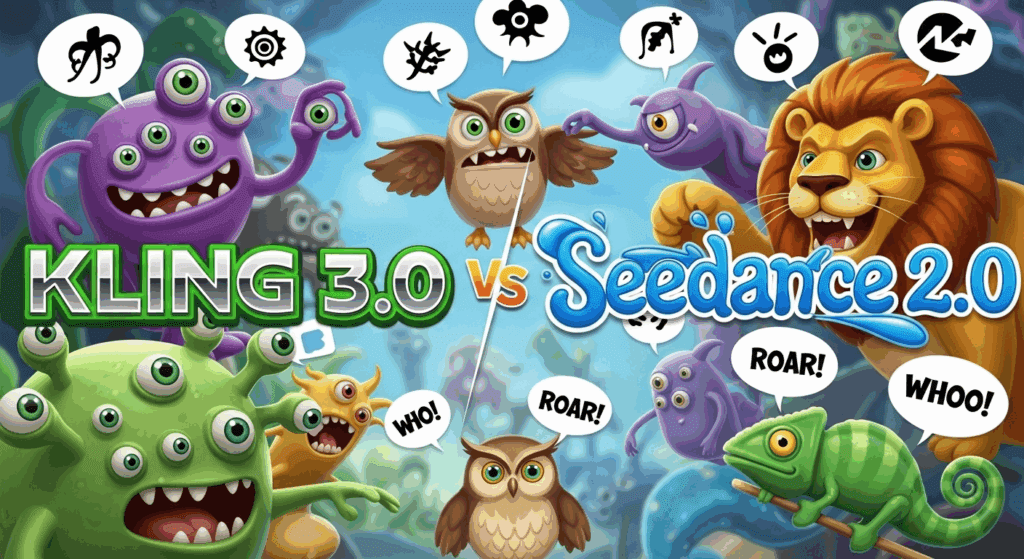
This comparison breaks down Kling 3.0 vs Seedance 2.0 specifically for fantasy dialogue work with talking monsters and expressive animals. The focus stays on lip-sync integrity, emotional continuity, and how fast you get a usable clip without regeneration.
Why Dialogue Scenes Break Most AI Video Models
Dialogue scenes are uniquely demanding because they require:
– Precise viseme-to-phoneme alignment (lip-sync timing)
– Facial micro-expression continuity across frames
– Latent identity stability (no character drift)
– Temporal coherence under speech-driven motion
Most diffusion-based video models struggle because speech introduces high-frequency motion in the mouth region while the rest of the face must remain stable. If the latent consistency isn’t strong enough, you’ll see:
– Jaw warping
– Teeth flickering
– Snout or muzzle distortion (for animals)
– Expression resets mid-sentence
For fantasy creatures—dragons, goblins, wolves the geometry is already outside standard human priors. That’s where the differences between Kling 3.0 and Seedance 2.0 become obvious.
Kling 3.0 vs Seedance 2.0: Talking Monsters and Animals Test
1. Dialogue Quality in Fantasy Character Scenarios
Kling 3.0 shows stronger emotional continuity across multi-sentence dialogue. Its temporal modeling appears to prioritize facial region stabilization, likely leveraging improved cross-frame attention anchoring. In practice:
– Expressions transition smoothly.
– Eye focus remains stable.
– Emotional tone persists through cuts.
For a talking ogre delivering a dramatic monologue, Kling maintains cheek tension, brow compression, and jaw weight more consistently.
Seedance 2.0, however, tends to produce slightly more dynamic initial facial motion but can introduce micro-resets every 2–3 seconds. This suggests aggressive motion interpolation combined with weaker latent identity locking.
Verdict: For emotionally heavy fantasy dialogue, Kling 3.0 feels more performance-driven and stable.
2. Animal Character Lip-Sync Accuracy
This is where things get interesting.
Animal muzzles (wolves, bears, big cats) require non-human viseme mapping. Standard human-trained priors often force unnatural lip stretching.
Seedance 2.0 handles snout-based articulation surprisingly well. The jaw hinge motion appears biomechanically plausible, and tongue artifacts are reduced. Lip-sync timing aligns closely on first render, suggesting better internal phoneme inference.
Kling 3.0 produces cleaner overall frames but sometimes over-humanizes mouth shapes on animals. You may notice:
– Rounded “O” shapes that feel too human
– Slight texture smoothing around whisker beds
If your project features a talking fox delivering comedic dialogue, Seedance may feel more anatomically convincing.
Verdict: Seedance 2.0 edges out Kling for realistic animal lip-sync accuracy.
3. First-Try Results Without Regeneration
For production workflows, first-render reliability is critical. Regeneration cycles destroy iteration speed.
In testing with identical prompts (seed parity maintained where possible):
– Kling 3.0 produced usable dialogue shots ~70–80% of the time without rerolls.
– Seedance 2.0 delivered strong results but required more frequent regeneration to correct mouth jitter or eye drift.
Kling’s stronger latent consistency reduces collapse artifacts in longer speech sequences. If you’re building episodic content, this stability compounds into major time savings.
Seedance benefits from shorter dialogue bursts (3–5 seconds). For rapid social content or quick punchlines, it performs well.
How VidAU Helps You Build Better Dialogue Scenes
You work faster when your pipeline supports stable dialogue, clean animation, and fast iteration. VidAU gives you that structure. You upload your base renders from Kling 3.0 or Seedance 2.0, then polish the scene with tools built for motion control and dialogue-focused editing.
You get a simple workflow. Bring your fantasy character shots into VidAU, adjust pacing, smooth transitions, then export without heavy manual editing. VidAU removes noise, sharpens faces, and keeps your dialogue shots consistent across episodes or story sequences.
Workflow Recommendations for Animators
Choose Kling 3.0 if:
– You’re producing narrative-driven fantasy scenes
– Emotional continuity matters more than exaggerated motion
– You want fewer regeneration cycles
Choose Seedance 2.0 if:
– You’re animating talking animals
– Lip-sync realism on non-human mouths is critical
– You’re creating short-form dialogue clips
Pro Tip
For maximum control, generate base dialogue in Kling 3.0, then refine specific animal close-ups in Seedance 2.0. This hybrid pipeline balances emotional stability with anatomical articulation.
Final Take
For dialogue-heavy storytelling, Kling 3.0 wins overall due to stronger temporal coherence and first-try reliability. But when it comes to believable animal speech mechanics, Seedance 2.0 punches above its weight.
If your monsters need to emote, go Kling.
If your wolf needs to talk, test Seedance.
In dialogue-driven AI video, the winner depends on the mouth you’re animating.
Frequently Asked Questions
Q: Which model is better for long monologues in fantasy scenes?
A: Kling 3.0 is more reliable for extended dialogue because it maintains stronger temporal coherence and facial identity stability across multiple sentences.
Q: Does Seedance 2.0 handle animal lip-sync better than Kling?
A: Yes, Seedance 2.0 generally produces more biomechanically believable mouth motion for animals with snouts, making it a strong choice for talking creature content.
Q: Which model requires fewer regenerations for usable dialogue shots?
A: Kling 3.0 tends to produce more usable first renders, reducing regeneration cycles and improving workflow efficiency for dialogue-heavy projects.