MaxClaw vs OpenClaw: Is This New Alternative Actually Better? (Honest 2026 Comparison)
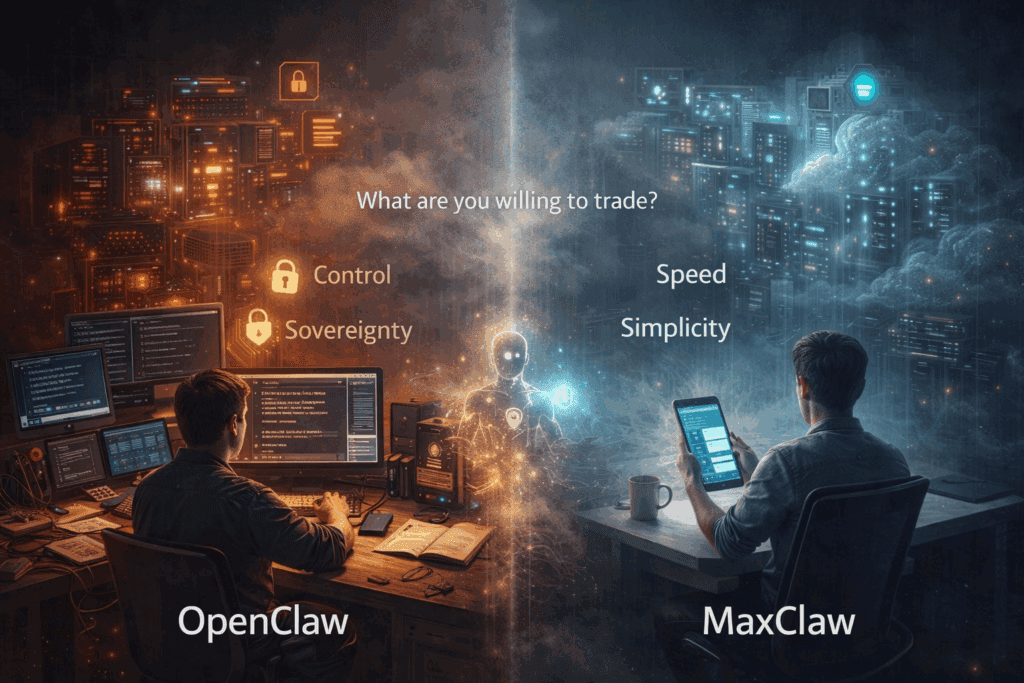
OpenClaw went viral in January 2026. By February, the follow-up questions were everywhere: “Is there a version I don’t have to host myself?” “What if I don’t want to manage Docker?” “Can I get the same capabilities without a weekend of setup?”
MaxClaw, launched by Chinese AI giant MiniMax on February 25, 2026, is the most prominent answer to those questions. It offers OpenClaw’s capabilities as a fully managed cloud service. Zero server setup. One-click deployment. No API key juggling.
But “easier” and “better” are not the same thing. This comparison looks at both platforms honestly, including the trade-offs that most reviews skip.
What Is MaxClaw?
MaxClaw is MiniMax’s official cloud-hosted AI agent. It’s built on the open-source OpenClaw framework, the same architecture, the same fundamental capabilities, but runs entirely on MiniMax’s managed infrastructure rather than your own hardware.
The underlying AI model is MiniMax M2.5: a Mixture-of-Experts architecture with 229 billion total parameters, approximately 10 billion activated per token. MiniMax reports inference costs at 1/7th to 1/20th of comparable models like Claude 3.5 Sonnet, which is the primary reason the managed service can be offered at a competitive price point.
MaxClaw is not a fork of OpenClaw. It’s MiniMax’s deployment of the OpenClaw framework. Same architecture, different execution layer, different default model, different data location.
What Is OpenClaw?
OpenClaw is the original open-source autonomous AI agent, created by Austrian developer Peter Steinberger and launched in November 2025 under the name Clawdbot. After two rebrands driven by trademark pressure from Anthropic, it settled on its current name.
As of March 2026, OpenClaw has 247,000+ GitHub stars and 35,000+ forks, one of the fastest-growing open-source projects in recent history. Its creator joined OpenAI in February 2026 to lead their personal agents division; the project moved to an independent open-source foundation. The MIT licence ensures the community can continue development regardless of any governance changes.
OpenClaw runs on your hardware. You choose the model, control the data, manage the infrastructure. All of it.
MaxClaw vs OpenClaw: Direct Comparison
Setup Time
MaxClaw: Minutes. MiniMax claims 10 seconds via one-click setup at agent.minimax.io. Community testing confirms this is accurate for basic deployment, authenticate, connect messaging channels, agent is running.
OpenClaw: 30–90 minutes for an experienced developer. Longer for first-timers. Requires Node.js setup, Gateway configuration, API key management, and platform pairing.
AI Model
MaxClaw: Locked to MiniMax M2.5. You cannot switch to Claude, GPT, Gemini, or any local model. The model is fixed by the platform.
OpenClaw: Model-agnostic. Claude, GPT, Gemini, DeepSeek, local models via Ollama, swap in one config line. Power users typically run multiple models routed by task complexity.
Data Privacy
MaxClaw: All processing and memory storage on MiniMax’s infrastructure. MiniMax is a Chinese company listed on the Hong Kong Stock Exchange. Your conversation history and agent memory do not stay local.
OpenClaw: All data stored locally on your machine by default. Inference privacy depends on your chosen model: cloud models (Claude, GPT) process content through their APIs; local models via Ollama keep everything on-device.
Ongoing Maintenance
MaxClaw: None. MiniMax handles security patches, dependency updates, model improvements, and infrastructure uptime.
OpenClaw: Ongoing. You manage updates, security patches, dependency compatibility, and server health. The project ships daily updates, staying current is your responsibility.
Cost
MaxClaw: $19/month flat rate. No additional API costs. Suitable for high-volume use where per-token cloud model costs would exceed the subscription.
OpenClaw: Software is free. Costs depend on model choice: cloud APIs charge per token (Claude Sonnet ~$3-15/M tokens); local models cost only electricity (~$1.50/month on a Mac Mini). Hardware investment if you need a dedicated machine.
Messaging Platform Support
MaxClaw: Telegram, Discord, Slack, WhatsApp, Feishu, DingTalk. Six platforms.
OpenClaw: WhatsApp, Telegram, Discord, Slack, Signal, iMessage, and 9+ additional platforms. More than double MaxClaw’s current support.
Skills / Extensions
MaxClaw: 10,000+ pre-configured Expert templates. Extensive out-of-the-box capability without needing to find and install individual skills.
OpenClaw: ClawHub registry with 700+ community skills. More customisable, but requires manual discovery and installation. Quality varies; security vetting is your responsibility.
Security
MaxClaw: MiniMax handles patching. No CVE exposure for users, the RCE vulnerability that OpenClaw users had to patch manually would simply be handled. But you have no visibility into security controls.
OpenClaw: You control the security posture, which is both the advantage and the risk. OpenClaw has had 9+ CVEs; keeping current matters. The security model is transparent because the code is open.
The Broader Claw Ecosystem
MaxClaw isn’t the only OpenClaw derivative. The viral growth of the original project triggered a wave of alternatives, each taking a different bet:
• KimiClaw (Moonshot AI, launched February 15, 2026): Browser-based, no installation. 5,000+ pre-loaded ClawHub skills. 40GB cloud storage for RAG workflows. Powered by Kimi K2.5 (1-trillion-parameter MoE). Best for deep research workflows.
• ZeroClaw (Community, Rust rewrite): 99% lower RAM than the Node.js original. Designed for VPS fleets and edge deployments where memory is constrained.
• PicoClaw: Go-based build optimised for IoT and embedded hardware including Raspberry Pi. Minimal resource footprint.
• NanoClaw: Container-isolated architecture for security. Each agent runs in its own Linux container, limiting blast radius if compromised.
Security: The Honest Conversation Both Sides Skip
OpenClaw’s security record in 2026 has been consequential. CVE-2026-25253 (CVSS 8.8) is a one-click remote code execution chain: visit an attacker-controlled website, and JavaScript can open a WebSocket to your local OpenClaw gateway, brute-force authentication, and gain full machine access. Three CVEs have public exploit code. Over 1,184 malicious ClawHub skills were discovered in a single supply chain attack.
MaxClaw’s managed model eliminates this class of problem. MiniMax patches vulnerabilities without user action. You never face an unpatched RCE because you forgot to run an update.
But MaxClaw introduces a different category of risk: trusting MiniMax with your agent’s memory, your email content, your calendar, and whatever else you connect it to. This isn’t a hypothetical concern — it’s a concrete trade-off that deserves explicit acknowledgment
⚠ Security Note: Users in regulated industries (finance, healthcare, law) should evaluate data sovereignty requirements before choosing MaxClaw. MiniMax’s infrastructure is subject to Chinese law, which includes data access provisions that differ from US and EU frameworks.
Who Should Choose MaxClaw
- You want an agent running this week, not after a weekend of setup
- Infrastructure management is not something you want to think about
- MiniMax M2.5’s capabilities cover your use cases (they’re strong for coding, research, and structured tasks)
- Your data doesn’t have strict jurisdiction or compliance requirements
- You spend time in Telegram, Discord, or Slack and want pre-built agent templates
Who Should Choose OpenClaw
- You need model flexibility, running Claude for reasoning, local GLM for routine tasks, different models for different agents
- Data sovereignty is non-negotiable, sensitive client data, regulated information, or anything you can’t route through a Chinese cloud provider
- You use Signal, iMessage, or platforms MaxClaw doesn’t support
- You want full visibility into the security model via open-source code
- You’re prepared to manage updates and configuration in exchange for complete control
Conclusion
MaxClaw’s value proposition is real: it removes the most significant friction points in OpenClaw, infrastructure management, setup complexity, ongoing maintenance, and delivers a working agent in minutes rather than hours. For non-technical users or anyone who simply doesn’t want to think about servers, it’s a legitimate option that delivers genuine capability.
But the trade-offs are equally real: you’re locked to one AI model, your data lives on someone else’s infrastructure (specifically, a Chinese company’s), and you give up the flexibility that makes OpenClaw powerful for advanced users.
Neither choice is wrong. They serve different users with different priorities. The decision comes down to one question: how much setup complexity are you willing to accept in exchange for data control and model flexibility?
If the answer is “none,” MaxClaw is your tool. If the answer is “some,” OpenClaw self-hosted gives you significantly more in return.
Frequently Asked Questions
Is MaxClaw safe to use?
MaxClaw eliminates the self-hosting security risks of OpenClaw (CVEs, malicious skills, exposed gateways) by handling all infrastructure security at MiniMax’s level. The primary consideration for users is data privacy: your agent’s memory, conversations, and connected account data are processed and stored on MiniMax’s infrastructure, which is subject to Chinese jurisdiction. For personal productivity use, most users will find this acceptable. For business use with sensitive data, evaluate carefully.
Can MaxClaw use Claude or GPT instead of MiniMax M2.5?
No. MaxClaw is locked to MiniMax’s M2.5 model. This is the most significant functional limitation compared to self-hosted OpenClaw, which supports any compatible model including Claude, GPT, Gemini, and local models via Ollama. If model choice matters for your use case, OpenClaw self-hosted is the only option.
How does MaxClaw pricing compare to running OpenClaw with Claude?
MaxClaw is $19/month flat with no additional model costs. OpenClaw with Claude Sonnet for moderate daily use costs approximately $20–50/month in API fees, plus any server or hardware costs. At moderate use levels they’re comparable. At high volume, MaxClaw’s flat rate becomes increasingly cost-effective. Even At low volume with a local model, OpenClaw self-hosted can cost near zero.
What is the Claw ecosystem?
The “Claw ecosystem” is the collective term for OpenClaw and its derivatives: MaxClaw (MiniMax’s managed cloud service), KimiClaw (Moonshot AI’s browser-based version), ZeroClaw (community Rust rewrite for low-resource environments), PicoClaw (Go-based IoT version), and NanoClaw (container-isolated security-focused fork). All share the OpenClaw framework’s fundamental architecture.
Will MaxClaw get better over time?
Almost certainly. MaxClaw launched on February 25, 2026 — less than a month ago at the time of writing. Early users report some bugs with cron job scheduling and occasional inconsistencies in multi-step tasks. MiniMax has significant resources to invest in the product, and the trajectory of improvements from OpenClaw itself (which ships almost daily updates) suggests the managed variant will improve rapidly.
Can I migrate from MaxClaw to self-hosted OpenClaw later?
In principle yes, since both use the OpenClaw framework. In practice, your agent’s memory files, skill configurations, and conversation history live on MiniMax’s infrastructure in MaxClaw — not in a format you can directly export and import into a self-hosted instance. Planning an exit strategy before you accumulate significant agent memory is advisable if you’re considering MaxClaw temporarily.