OpenClaw AI Agent Architecture: A Deep Technical Breakdown of Decision Pipelines, Tool Integration, and Memory Systems
Dissecting the Lobster: How OpenClaw Agents Think, Plan, and Execute
The black box of AI agent architecture remains one of the most misunderstood concepts in production ML systems. OpenClaw ai, an open-source agent framework designed for research transparency, provides an exceptional lens through which to examine these mechanisms.While developers readily grasp supervised learning pipelines or diffusion model inference paths, the internal mechanics of agentic systems, how they reason, select tools, and maintain coherent context across multi-turn interactions often remain opaque.
The Agent Decision-Making Pipeline: From Perception to Action
At its core, OpenClaw implements a recursive reasoning loop that mirrors the ReAct (Reasoning + Acting) paradigm but with critical architectural refinements. The decision pipeline operates in discrete phases:
1. Observation Processing and State Encoding
When an agent receives input whether a user query, environmental signal, or callback from a previous action—OpenClaw first constructs a structured state representation. Unlike chat-based LLM interactions where context is simply concatenated strings, OpenClaw maintains a typed state object containing:
– Task schema: The goal decomposition tree with dependency tracking
– Available tools: A dynamic registry of callable functions with semantic embeddings
– Execution history: A compressed log of previous actions and their outcomes
– Environmental constraints: Token budgets, API rate limits, and cost thresholds
This state object passes through an encoding layer that produces a planning prompt—a carefully structured instruction that primes the language model for systematic reasoning. The prompt architecture here is critical: OpenClaw uses a three-section template that separates system instructions, factual context, and the current decision point. This architectural choice mirrors techniques used in advanced video generation prompting, where ComfyUI workflows separate style directives, content description, and technical parameters to achieve deterministic outputs.
2. The Reasoning Loop: Chain-of-Thought with Verification
OpenClaw’s reasoning mechanism implements a verified chain-of-thought pattern. Rather than executing a single LLM call and acting on the output, the system runs a two-phase verification cycle:
Phase 1: Proposal Generation
The agent generates a candidate action plan, explicitly articulating:
– Which tool to invoke (or whether to respond directly)
– Why this tool is appropriate given the current state
– Expected output format and downstream usage
– Failure modes and fallback strategies
This is structurally similar to how Runway Gen-3’s prompt adherence system works—the model first generates an internal representation of scene composition before committing to temporal consistency constraints across frames.
Phase 2: Plan Validation
A separate validation pass checks the proposal against:
– Executability: Are all referenced tools actually available?
– Coherence: Does this action advance the task graph?
– Safety: Does it respect environmental constraints?
If validation fails, the system enters a backtracking state, resampling with additional constraints. This mirrors the seed parity techniques used in diffusion model generation, where failed samples trigger resampling with modified conditioning.
3. Action Selection and Parameter Binding
Once a plan passes validation, OpenClaw’s parameter binding layer extracts structured arguments from the natural language reasoning trace. This uses a constrained decoding approach—similar to how Kling AI’s motion brush parameters are extracted from natural language descriptions into precise vector fields.
The system employs a function schema registry where each tool defines:
python
{
“name”: “search_database”,
“parameters”: {
“query”: {“type”: “string”, “required”: true},
“filters”: {“type”: “object”, “required”: false},
“limit”: {“type”: “integer”, “default”: 10}
},
“returns”: {“type”: “array”, “items”: “Document”}
}
The binding layer uses a specialized parser that combines regex extraction with LLM-based refinement, achieving >95% accuracy on well-specified schemas comparable to the parameter extraction accuracy in Sora’s camera motion controls.
Tool Use and External API Integration: The Orchestration Layer
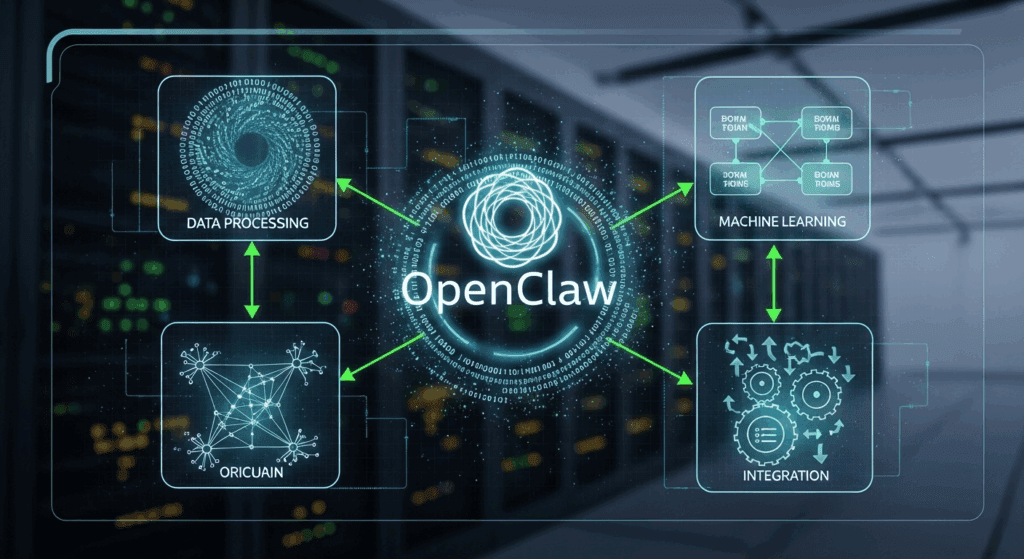
The agent’s ability to interact with external systems is mediated through OpenClaw’s tool orchestration layer, which implements several critical patterns:
Async Execution and Callback Management
Unlike synchronous tool calling in basic agent frameworks, OpenClaw implements a callback-driven execution model. When a tool is invoked:
1. The system registers a continuation in the execution graph
2. The tool executes asynchronously (potentially with retries and exponential backoff)
3. Results are routed through a result validation pipeline before re-entering the reasoning loop
This architecture prevents the reasoning loop from blocking on slow API calls and enables parallel tool execution when the dependency graph permits. The pattern directly parallels how ComfyUI’s workflow executor handles node execution, maintaining a DAG of operations with data flowing through validated edges.
Tool Result Interpretation
Raw API responses rarely map cleanly to agent reasoning contexts. OpenClaw implements a semantic result transformation layer that:
– Filters excessive data: API responses can be megabytes; agents need kilobytes
– Normalizes formats: Converting XML, JSON, CSV, or binary data into consistent schemas
– Extracts relevance: Using embedding similarity to identify which portions of a result actually address the agent’s information need
This is architecturally similar to how video generation systems handle reference images, the raw pixel data undergoes VAE encoding, CLIP embedding extraction, and attention map computation before influencing the generation process.
Error Handling and Graceful Degradation
Production agents must handle tool failures gracefully. OpenClaw’s error taxonomy includes:
– Transient failures: Network timeouts, rate limits (→ retry with backoff)
– Input errors: Invalid parameters, schema mismatches (→ re-plan with corrected inputs)
– Logical failures: Tool succeeded but returned unexpected data (→ invoke alternative tools or escalate)
The system maintains an error budget per reasoning session, similar to how diffusion schedulers (Euler a, DPM++ SDE) maintain step budgets and can trigger early termination if convergence metrics plateau.
Memory Systems and Context Management: Stateful Intelligence at Scale
The most sophisticated aspect of OpenClaw’s architecture is its hierarchical memory system, designed to maintain coherent long-term context while respecting practical token limits.
Three-Tier Memory Architecture
Tier 1: Working Memory (Hot Context)
This is the immediate context window provided to the LLM for each reasoning step. OpenClaw implements a sliding window with semantic anchoring:
– Last N conversation turns (typically 3-5)
– Current task state and active goals
– Recently used tools and their outcomes
– Critical facts marked by the agent as “persistent”
The semantic anchoring mechanism is key: rather than simply truncating old messages, the system uses embedding similarity to retain contextually relevant historical interactions. This mirrors how video generation models use CLIP-guided frame selection to maintain visual coherence across long sequences.
Tier 2: Episodic Memory (Warm Context)
Completed sub-tasks, extended conversations, and historical patterns are compressed into episodic summaries stored in a vector database. Each episode includes:
– Dense embedding (for semantic retrieval)
– Structured metadata (timestamp, involved tools, success/failure)
– Compressed natural language summary
– Graph relationships to related episodes
During reasoning, the system performs contextual memory retrieval: given the current state, it queries the episodic store for relevantly similar past experiences. This is the agent equivalent of ControlNet or T2I-Adapter in diffusion models—injecting relevant structural priors without overwhelming the primary generation process.
Tier 3: Semantic Memory (Cold Context)
Long-term factual knowledge, learned patterns, and skill libraries reside in semantic memory. OpenClaw implements this as:
– Fine-tuned adapters on top of the base LLM (for frequently used domains)
– External knowledge bases with query interfaces
– Cached reasoning patterns (successful tool sequences for common task types)
The system can “promote” frequently accessed episodic memories to semantic memory through a distillation process, similar to how Latent Consistency Models distill multi-step diffusion into few-step inference.
Context Window Management Strategies
As conversations extend beyond base model context limits (8k, 32k, 128k tokens), OpenClaw employs several strategies:
Progressive Summarization: Every N turns, older messages undergo LLM-based compression, reducing 1000 tokens to 100-200 while preserving decision-critical information. The compression model is fine-tuned on agent conversation data to maintain relevant details—analogous to how video codecs preserve perceptually important frequencies.
Hierarchical Attention*: For ultra-long sessions, the system constructs a *two-level attention mechanism: fine-grained attention over working memory, coarse-grained attention over episodic summaries. This mirrors the hierarchical attention patterns in video transformers like Sora, where spatial attention operates at fine resolution while temporal attention operates on compressed frame representations.
Checkpointing and State Serialization: Critical states can be serialized to disk, enabling session resumption and fork-based exploration (“what if I had chosen tool B instead?”). The serialization format preserves the complete reasoning graph, similar to how ComfyUI workflows are saved as JSON DAGs.
Implementation Patterns and Production Considerations
For teams building on OpenClaw or similar architectures, several implementation patterns emerge:
Prompt Engineering as Infrastructure
Treat reasoning prompts as versioned infrastructure code. OpenClaw maintains a prompt registry with:
– A/B testing support for comparing reasoning patterns
– Rollback capabilities when prompt changes degrade performance
– Monitoring for prompt injection attempts
This mirrors how production diffusion systems version their negative prompts, quality tags, and style modifiers.
Observability and Debugging
Agent reasoning is non-deterministic and often opaque. OpenClaw implements:
– Reasoning trace logs: Every LLM call, tool invocation, and decision point captured
– Graph visualization: Rendering the execution DAG with timing and cost annotations
– Counterfactual analysis: “Replay” sessions with different model temperatures or tool availabilities
The debugging experience resembles inspecting latent space activations in diffusion models—you’re examining the system’s internal representations to understand emergent behavior.
Cost and Latency Optimization
Production agents can incur significant API costs. OpenClaw provides:
– Speculative tool execution: For high-confidence decisions, begin tool execution before validation completes
– Caching layers: Identical reasoning contexts return cached responses (with configurable TTLs)
– Model routing: Simple decisions use smaller/faster models; complex reasoning uses frontier models
This is analogous to cascade diffusion models (base → upscaler) or the way some video systems generate low-res previews before committing to expensive full-resolution renders.
Safety and Alignment
Agents that can invoke arbitrary tools require robust safety mechanisms:
– Tool sandboxing: Restricting file system access, network egress, and resource consumption
– Action auditing: Human-in-the-loop approval for high-impact operations
– Bounded exploration: Limiting reasoning depth and tool call chains
These patterns mirror the safety mechanisms in generative media systems—content filters, prompt blocklists, and output validation.
Conclusion: The Agent as Orchestrator
OpenClaw reveals that modern AI agents are less “autonomous reasoners” and more sophisticated orchestrators coordinating LLM reasoning, tool execution, memory retrieval, and safety constraints into coherent task execution. The architecture shares deep structural similarities with video generation pipelines: both manage complex state spaces, coordinate multiple specialized models, handle non-deterministic processes, and must maintain coherence across extended sequences.
For ML engineers building agentic systems, the key insight is that the agent is the infrastructure. Like a video generation pipeline composed of VAEs, transformers, schedulers, and ControlNets, an agent system comprises reasoning loops, tool orchestrators, memory hierarchies, and validation layers. Mastering agent architecture means understanding how these components interact—and where to inject domain-specific optimizations for your use case.
The lobster has been dissected. The mechanisms are visible. Now comes the work of adaptation and optimization for production deployment.
Frequently Asked Questions
Q: How does OpenClaw’s reasoning loop differ from standard ReAct implementations?
A: OpenClaw implements a two-phase verification cycle where proposals are validated before execution, includes structured state objects with dependency tracking, and uses callback-driven async execution rather than synchronous tool calls. This prevents invalid actions and enables parallel tool execution when dependencies permit.
Q: What is semantic anchoring in the context of agent memory systems?
A: Semantic anchoring is a context management technique where instead of truncating old messages chronologically, the system uses embedding similarity to retain contextually relevant historical interactions. This maintains coherence even as conversations exceed token limits, similar to how video models use CLIP-guided frame selection.
Q: How does OpenClaw handle tool failures in production environments?
A: OpenClaw categorizes failures into transient (network timeouts → retry with backoff), input errors (invalid parameters → re-plan with corrections), and logical failures (unexpected results → invoke alternative tools). It maintains an error budget per session and implements graceful degradation strategies rather than catastrophic failures.
Q: What is the three-tier memory architecture and why is it necessary?
A: The three tiers are: (1) Working Memory – immediate context for current reasoning, (2) Episodic Memory – compressed summaries of past interactions in vector stores, and (3) Semantic Memory – long-term factual knowledge and learned patterns. This hierarchy allows agents to maintain long-term coherence while respecting token limits, similar to how humans use different memory systems.
Q: How can prompt engineering be treated as infrastructure code in agent systems?
A: OpenClaw maintains a versioned prompt registry with A/B testing support, rollback capabilities, and injection monitoring. Reasoning prompts are treated as critical infrastructure with the same rigor as database schemas or API contracts, enabling systematic optimization and preventing degradation from uncontrolled prompt changes.