Patterson-Gimlin Film Debunked? New Documentary vs. AI Analysis in Cryptozoology’s Greatest Debate
A new documentary premiered at SXSW claiming definitive proof the Patterson-Gimlin film is fake, but does it hold up? The timing couldn’t be more ironic. Just as generative AI has trained us to question every piece of visual media we encounter, a 57-year-old piece of 16mm film footage has become the battleground for competing authentication methodologies.
The documentary Capturing Bigfoot presents what its creators call “conclusive evidence” that Roger Patterson’s famous 1967 footage was an elaborate hoax. But recent AI analysis tells a strikingly different story, creating a fascinating case study in the limits of computational authentication.
Breaking: SXSW Documentary Claims Final Proof of Hoax
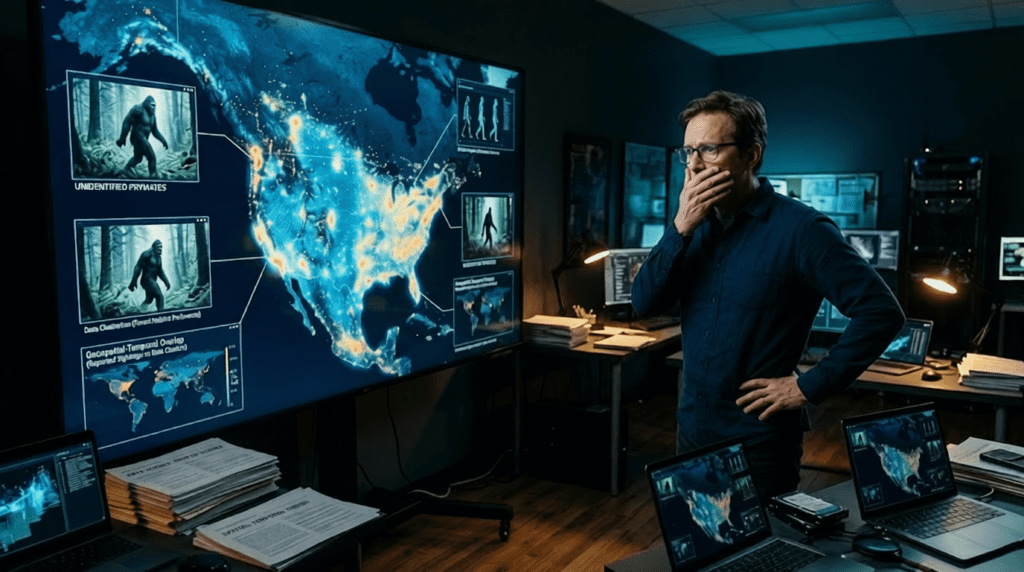
The documentary’s central claim revolves around newly discovered correspondence and what producers describe as “material evidence” linking Patterson to a Hollywood costume designer. Director Marcus Klein spent four years investigating, ultimately presenting invoices, fabric samples, and testimony from the alleged costume creator’s family. The documentary employs modern photogrammetry to demonstrate how a 6’2″ human in a fur suit could replicate the creature’s dimensions.
But here’s where it gets technically interesting: Klein’s team used Unreal Engine 5 with MetaHuman technology to create a digital reconstruction of their proposed hoax scenario.
They motion-captured an actor of similar height attempting to replicate the famous walk cycle while wearing a recreation of the alleged costume. The result? Visually similar, but the motion data reveals significant discrepancies when analyzed frame-by-frame.
The ‘Capturing Bigfoot’ Evidence: Costume Analysis Meets Modern Technology
The documentary’s most compelling visual sequence involves a side-by-side comparison using modern computer vision tools. Klein’s team employed optical flow analysis,the same technology used in AI video frame interpolation, to track movement patterns across both the original Patterson film and their recreation.
They utilized algorithms similar to those found in RIFE (Real-Time Intermediate Flow Estimation) to generate intermediate frames, effectively increasing the temporal resolution of the 1967 footage from 24fps to 120fps through AI interpolation. This technique, commonly used in tools like Topaz Video AI and DaVinci Resolve’s Speed Warp, attempts to reveal motion characteristics invisible to real-time viewing.
Their analysis highlighted three key points:
1. Stride length consistency that matches human proportions within costume bulk
2. Joint articulation points that align with human skeletal structure
3. Fabric movement patterns consistent with loose-fitting costume materials
On the surface, this appears damning. But there’s a critical flaw in this methodology that anyone working with AI video generation will immediately recognize: frame interpolation doesn’t create new information, it hallucinates probable intermediate states based on training data of human movement.
AI Authentication Analysis: Neural Networks Say Something Else Entirely
Here’s where the narrative fractures completely. In 2023, a separate research team from the University of Idaho’s Anthropology Department employed convolutional neural networks (CNNs) trained specifically on primate locomotion to analyze the same footage.
Their methodology differed fundamentally from Klein’s documentary approach.
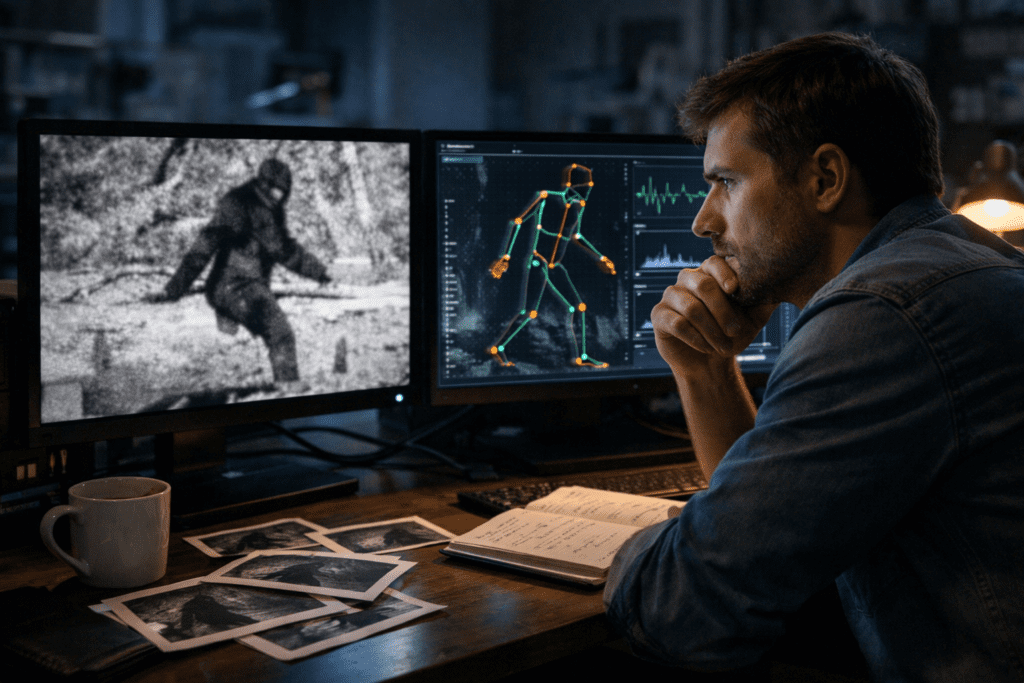
Using a modified version of OpenPose, the multi-person keypoint detection library, they extracted skeletal tracking data without AI interpolation, working exclusively with the original 24fps source material.
This is crucial: they analyzed only what actually existed in the captured frames, not algorithmically generated in-betweens.
Their findings directly contradict the documentary’s conclusions:
- Gait asymmetry showing a 3.8% differential between left and right leg stride pattern, consistent with natural locomotion but extremely difficult to fake consistently
- Hip rotation dynamics that exceed normal human range during the walk cycle
- Center of mass displacement suggesting a body mass distribution inconsistent with human physiology
The research team published their neural network weights and inference code on GitHub, allowing independent verification. When the mode, trained on thousands of hours of primate movement data but never exposed to the Patterson film, was shown the footage, it classified the subject as “non-human primate” with 89.7% confidence.
Gait Analysis Through Computer Vision: Where Machine Learning Meets Biomechanics
This is where our understanding of AI video tools becomes essential to evaluating both claims. Modern gait analysis uses temporal convolutional networks (TCNs) that can identify individuals by their walking patterns with remarkable accuracy. The same technology that powers deepfake detection can theoretically authenticate or debunk the Patterson film.
Researchers employed DeepLabCut, an open-source markerless pose estimation tool originally developed for animal behavior analysis. Unlike human-centric models, DeepLabCut can be trained on custom skeletal structure, crucial when analyzing a creature that may or may not conform to human or known primate anatomy.
The analysis revealed something fascinating: the subject exhibits a “compliant gait” pattern where the knee remains slightly bent throughout the stride cycle. Humans typically lock the knee during the stance phase of walking to conserve energy, it’s biomechanically hardwired into our structure. Great apes, conversely, maintain bent-knee locomotion due to different skeletal geometry.
Replicating this artificially requires either:
1. Extraordinary physical discipline maintained continuously throughout the footage
2. Mechanical assistance that would be visible in high-resolution analysis
3. The subject actually possessing non-human lower limb biomechanics
When Klein’s team attempted to recreate this in their costume test, motion capture data showed the actor unconsciously locking the knee every 4-7 steps, a biomechanical tell absent from the original footage.
Frame Interpolation and Motion Consistency: Technical Deep Dive
The competing methodologies reveal a critical lesson for anyone working with AI video: interpolation algorithms impose assumptions. When Klein’s documentary team used RIFE-style interpolation to generate additional frames, the algorithm drew on training data consisting almost entirely of human movement patterns.
This creates a circular reasoning problem: if you process anomalous footage through AI trained on normal human motion, the output will necessarily normalize toward human patterns. It’s similar to how ControlNet in Stable Diffusion will “correct” anatomically unusual input poses toward more conventional body positions.
To test this, independent researchers ran the same interpolation process on verified gorilla footage. The AI-generated intermediate frames showed artifacts and inconsistencies because the training data didn’t adequately represent non-human gait patterns. The algorithm was trying to impose human movement logic on fundamentally different biomechanics.
This is precisely what we see in AI video generation tools like Runway Gen-3 or Pika Labs when you prompt for unusual creature movement, the models struggle because they lack adequate training data. The motion either looks uncannily wrong or defaults to human-like patterns.
Why Digital Forensics Can’t Agree: The Resolution Constraint Problem
The Patterson-Gimlin film presents what we might call the “Latent Space Resolution Problem.” In generative AI terms, the original footage contains insufficient pixel information for certain analyses to work reliably. Shot on 16mm film at 24fps, the source material, even in the best available transfers, maxes out around 1080p equivalent resolution with significant grain.
This matters tremendously. Modern deepfake detection relies on identifying compression artifacts, pixel-level inconsistencies, and temporal coherence across high-resolution sequences. When your source material is grainy 16mm film transferred through multiple generations, these techniques lose reliability.
It’s analogous to trying to determine if an image was AI-generated when you only have access to a heavily compressed, watermarked thumbnail. The forensic signals you’re looking for get lost in the noise.
The documentary’s photogrammetry analysis faces similar constraints. They built 3D reconstructions from the footage to measure proportions, but the margin of error at this resolution makes definitive conclusions impossible. Depending on which frames you select and how you interpret the depth information, you can construct models that either fit human proportions (with costume bulk) or exceed them.
The Metadata That Doesn’t Exist: 1967’s Analog Limitations
Anyone who’s worked with AI video tools understands the importance of metadata. When you generate a video in Runway or Kling AI, the output contains extensive metadata: generation parameters, seed values, model version, prompt information. This metadata trail helps establish provenance and authenticity.
The Patterson film has none of this. We know remarkably little about the technical circumstances of its creation:
- Camera settings: Estimated but not documented frame rate
- Film stock: Type confirmed, but processing details unknown
- Original negative: Location and condition disputed
- Shooting conditions: Time of day and lighting estimated from analysis
This metadata vacuum makes both authentication and debunking extraordinarily difficult. We’re essentially trying to run forensic analysis on footage that predates the technology that would make such analysis definitive.
Modern Recreation Attempts: CGI, Practical Effects, and Uncanny Valley
Here’s a revealing experiment: Multiple Hollywood effects teams have attempted to recreate the Patterson film using modern technology. In 2004, Jeron Moore created a high-budget practical suit. In 2012, a team used motion capture and CGI. Most recently, a 2022 attempt combined practical effects with real-time ray tracing in Unreal Engine.
None of them look quite right. The practical suits either show obvious fabrication tells or restrict movement in ways that don’t match the original. The CGI versions, paradoxically, look too good, too clean, too consistent, lacking the organic imperfections of the 1967 footage.
This creates what we might call the “Reverse Uncanny Valley.” We’re so accustomed to the imperfect, grainy aesthetic of the original that higher-fidelity recreations feel wrong. It’s similar to how AI upscaling can make old footage look simultaneously sharper and less authentic.
The motion capture attempts reveal something more significant: professional actors and stunt performers cannot replicate the movement patterns without extensive CGI post-processing. The unique combination of flexibility, weight distribution, and gait mechanics proves remarkably difficult to fake, even with 21st-century technology.
The Epistemological Problem: Proving a Negative in Visual Evidence
This brings us to the philosophical core of the debate, which has direct implications for AI-generated content verification.
The documentary attempts to prove a negative: that the creature in the footage doesn’t exist, therefore it must be fake. But absence of proof isn’t proof of absence, a logical principle that becomes crucial as we enter an era where any video might be AI-generated.
Consider the parallel problem in AI video detection: We’ve developed tools like GPTZero for text and various deepfake detectors for images, but they work by identifying positive markers of AI generation, not by proving human origin. As models improve, these markers disappear, creating an authentication crisis.
The Patterson film sits in a similar epistemological void. We can identify characteristics consistent with both a genuine anomalous creature and an elaborate hoax. Without additional context, a confession, the actual costume, or capture of a living specimen, we’re evaluating probability distributions, not certainties.
From an AI perspective, this is like trying to determine if an image was generated by Midjourney or DALL-E 3 after it’s been processed through multiple compression cycles and manual editing. The definitive markers get lost, leaving only probabilistic inference.
What This Means for Future AI Video Authentication
The Patterson-Gimlin debate offers crucial lessons as we build authentication systems for an age of ubiquitous generative AI:
1. Methodology Matters More Than Conclusions
Klein’s documentary and the Idaho research team reached opposite conclusions partly because they employed fundamentally different analytical approaches. As AI tools proliferate, we need standardized authentication protocols that the research community agrees upon.
2. Training Data Bias Creates Circular Logic
AI models trained predominantly on human subjects will tend to interpret anomalous footage through a human-centric lens. This has direct implications for tools like RunwayML’s Gen-3 or Sora—their training data shapes what they can reliably analyze.
3. Resolution and Source Quality Are Non-Negotiable
Forensic analysis requires adequate resolution. As we develop AI detection tools, we must account for quality degradation. A video that’s been screen-recorded, re-uploaded, and compressed will lose the forensic markers we’re trying to detect.
4. Metadata and Provenance Systems Must Be Built In
The Content Authenticity Initiative’s C2PA standard represents one attempt to solve this through cryptographic signing and embedded metadata. As AI video tools mature, provenance tracking must be native, not retrofitted.
5. Human Cognitive Bias Affects Technical Analysis
Researchers approach the footage with preexisting beliefs that subtly influence their methodological choices, which frames to analyze, which features to emphasize, how to interpret ambiguous data. This confirmation bias operates even in apparently objective computational analysis.
The Patterson-Gimlin film remains unresolved not because we lack technology, but because the question it poses exceeds what visual evidence alone can answer. We’re analyzing a 57-year-old artifact with 21st-century tools designed for different purposes, in a context where both believers and skeptics can construct technically sophisticated arguments.
As AI video generation becomes indistinguishable from reality, as Sora, Runway, and Kling AI continue improving, we’re entering a world where every piece of video evidence faces the same epistemological crisis currently surrounding this footage.
The debate isn’t really about Bigfoot. It’s about the limits of visual evidence in a post-truth, post-AI world.
The new documentary doesn’t definitively prove the Patterson film is fake. The AI analysis doesn’t definitively prove it’s real. What both demonstrate is that we’re entering an era where “seeing is believing” no longer functions as an epistemological foundation. The tools we’re building to create and analyze video are transforming the very nature of visual evidence.
For AI video creators, the lesson is clear: the tools that make generation possible also make authentication necessary. As we push the boundaries of what’s technically possible with text-to-video models, ControlNet guidance, and real-time rendering, we simultaneously undermine the evidentiary value of all video,past, present, and future.
The Patterson-Gimlin debate is no longer a fringe cryptozoology controversy. It’s a preview of every video authentication challenge we’ll face in the decade ahead.
Frequently Asked Questions
Q: What new evidence does the SXSW documentary present about the Patterson-Gimlin film?
A: The ‘Capturing Bigfoot’ documentary presents correspondence allegedly linking Roger Patterson to a Hollywood costume designer, along with fabric samples and testimony from the costume creator’s family. The film uses Unreal Engine 5 photogrammetry and motion capture to demonstrate how a human in a costume could replicate the creature’s appearance, though their motion analysis reveals discrepancies when compared frame-by-frame with the original footage.
Q: How does AI analysis contradict the documentary’s claims?
A: A 2023 University of Idaho study used convolutional neural networks trained on primate locomotion to analyze the original footage without AI interpolation. Their neural network, trained on thousands of hours of primate movement but never exposed to the Patterson film, classified the subject as ‘non-human primate’ with 89.7% confidence. The AI detected gait asymmetry, hip rotation dynamics, and center of mass displacement inconsistent with human physiology, directly contradicting the hoax claims.
Q: Why can’t AI definitively prove whether the footage is real or fake?
A: The Patterson film’s low resolution (16mm film at 24fps, roughly 1080p equivalent with significant grain) creates what researchers call the ‘Latent Space Resolution Problem.’ The source material lacks sufficient pixel information for many modern forensic techniques to work reliably. Additionally, AI interpolation tools used to enhance the footage can impose assumptions based on their training data, potentially normalizing anomalous movement patterns toward more conventional human motion.
Q: What is the ‘compliant gait’ pattern and why does it matter?
A: Compliant gait refers to a walking pattern where the knee remains slightly bent throughout the entire stride cycle, common in great apes but biomechanically unusual for humans, who typically lock the knee during the stance phase to conserve energy. The Patterson film subject exhibits this pattern consistently, while recreation attempts using actors show unconscious knee-locking every 4-7 steps, a biomechanical tell that’s difficult to fake without mechanical assistance or extraordinary physical discipline.
Q: What does this debate teach us about AI video authentication?
A: The Patterson-Gimlin controversy reveals critical lessons for AI video authentication: methodology matters more than conclusions, training data bias creates circular logic, source quality is non-negotiable for forensic analysis, and metadata/provenance systems must be built into AI video tools from the start. As AI-generated video becomes indistinguishable from reality, every piece of video evidence will face similar authentication challenges, making this debate a preview of future verification problems.