Pika AI Selves vs Traditional Chatbots: The Technical Difference Tech Teams Need to Understand
Why Pika AI Selves aren’t just another chatbot. If you’re evaluating AI assistant tools for production workflows, that distinction matters more than marketing language suggests.
Most teams compare AI Selves to chatbots the same way beginners compare Sora to Runway: surface-level output similarity, radically different architectural philosophy underneath.
Let’s break down the real difference.
1️⃣ Stateless Chatbots vs Persistent AI Selves
Traditional chatbots operate like single-pass render pipelines.
Think of them as a ComfyUI workflow without saved state:
– Input prompt → Inference → Output
– No evolving context
– No longitudinal memory
Even when “memory” exists, it’s typically session-scoped or retrieval-augmented (RAG-based), not identity-based.
An AI Self, by contrast, functions more like a project file with embedded latent continuity.
If chatbots are single generations with random seed resets, AI Selves operate closer to Seed Parity across sessions:
– Persistent memory architecture
– Stored preference embeddings
– Behavioral fine-tuning over time
– Evolving personality vectors
In video terms:
A chatbot = one-off generation with no latent consistency.
An AI Self = character-level continuity across episodes.
Just like maintaining character coherence in Runway Gen-3 requires latent consistency or reference frames, AI Selves maintain identity coherence across interactions.
That’s not cosmetic. It’s structural.
2️⃣ Programmed Responses vs Autonomous Behavior
Most agents are rule-bound execution layers:
- Condition → Trigger tool
- If prompt type → Call API
- Request → Execute workflow
They behave like Euler a schedulers with fixed stepping logic: deterministic, reactive, parameter-bound.
AI Selves introduce something closer to autonomous planning loops.
Instead of:
> “User asked X → Retrieve Y → Respond Z”
You get:
– Goal modeling
– Context accumulation
– Long-horizon task tracking
– Self-directed follow-ups
In AI video production terms, imagine the difference between:
A. A preset Kling camera move
vs
B. A system that analyzes narrative pacing and dynamically adjusts motion curves.
One executes.
One interprets.
Autonomy means the system isn’t just responding to prompts — it’s evaluating state.
This is similar to the shift from static prompt engineering to multi-node ComfyUI agent workflows that:
– Evaluate intermediate outputs
– Adjust parameters
– Re-invoke models
– Maintain cross-step context
An AI Self isn’t just a tool-calling wrapper around an LLM.
It’s an evolving cognitive loop.
3️⃣ Communication Surface vs Real-World Integration
Chatbots typically live inside:
– A web app
– A Slack bot
– A support widget
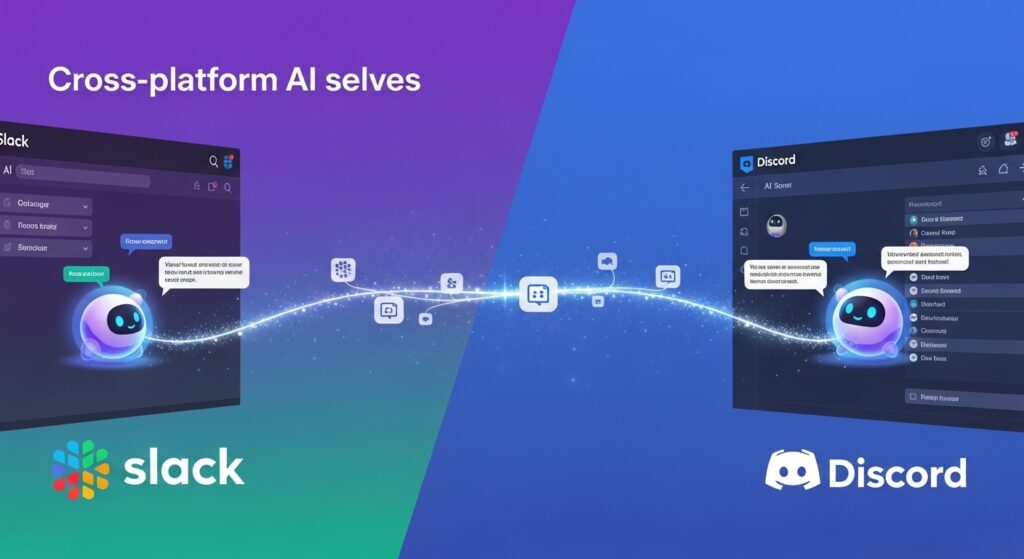
AI Selves extend across communication surfaces.
Think of them as omnichannel render engines rather than single-interface tools.
Real-world integration includes:
– Messaging platforms
– CRM systems
– Task managers
– Knowledge bases
From a systems perspective, this is closer to deploying a model across:
– Runway (editing)
– Sora (long-form generation)
– ComfyUI (custom pipelines)
– API-based automation layers
It’s not just about generating responses.
It’s about operating across environments.
The value proposition shifts from:
> “Better answers”
to:
> “Persistent digital entity operating in your workflow stack”
That’s a category shift.
4️⃣ Why This Matters for Tech Evaluators
If you’re comparing tools for enterprise or production deployment, the key questions aren’t:
– How fluent is it?
– How fast is it?
Instead, ask:
– Does it maintain longitudinal memory integrity?
– Evolve behavioral vectors over time?
– Operate autonomously across platforms?
– Does it maintain identity coherence like latent consistency in generative video?
Chatbots optimize response quality.
AI Selves optimize continuity, autonomy, and integration.
In generative media terms:
Chatbot = prompt-based clip generator.
AI Self = serialized character engine with cross-platform deployment.
Superficially similar.
Architecturally different.
And if you’re building production-grade AI systems, that architectural difference determines scalability, user trust, and long-term value.
AI Selves aren’t a UX upgrade.
They’re a systems upgrade.
Frequently Asked Questions
Q: Are AI Selves just advanced chatbots with better memory?
A: No. While improved memory is part of the architecture, AI Selves incorporate persistent identity modeling, behavioral evolution, and autonomous planning loops. Traditional chatbots are primarily reactive and session-based, even when enhanced with retrieval systems.
Q: How does this relate to AI video production workflows?
A: The distinction mirrors the difference between one-off video generations and maintaining latent consistency across episodes. AI Selves function more like persistent character engines, ensuring continuity and adaptive behavior over time.
Q: What should tech teams evaluate when comparing AI Selves to agents?
A: Evaluate longitudinal memory integrity, autonomy in task execution, cross-platform integration, and identity coherence. These factors determine whether the system behaves as a reactive tool or as a persistent digital entity embedded in your workflow stack.