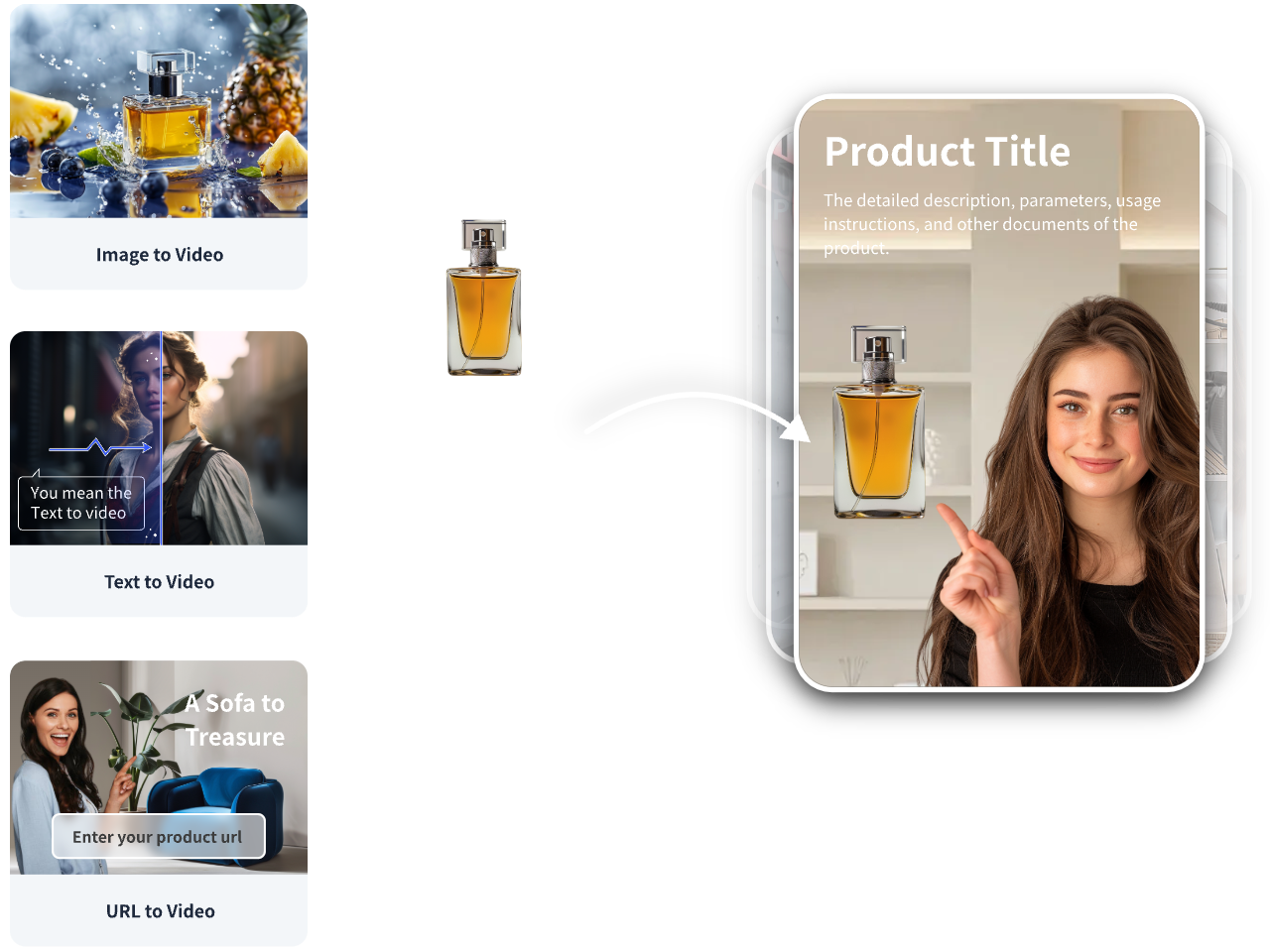
Product Image to High-Converting Video Ad: Complete AI Tutorial for Small Businesses

Turn your Product Image Into Professional Marketing Videos – No Filming Required
The competitive landscape has shifted. While major brands deploy six-figure video production budgets, small businesses struggle to create even basic video content. Yet video ads generate 1200% more shares than text and images combined, and platforms like TikTok and Instagram Reels prioritize video content in their algorithms. The gap isn’t just disadvantageous, it’s existential.
AI video generation technology has democratized this battlefield. What once required production crews, expensive cameras, and editing suites can now be accomplished with a single product photograph and the right AI toolchain. This tutorial will transform you from a video marketing spectator into a creator capable of producing scroll-stopping ads that convert.
Pillar 1: Selecting and Preparing Product Images for AI Video Conversion
Image Quality Requirements for Optimal AI Processing
Not all product photos translate equally into video. AI video models operate on latent space representations, compressed mathematical representations of visual data. Your source image quality directly impacts the model’s ability to generate coherent, artifact-free motion.
Resolution standards:
- Minimum: 1024×1024 pixels
- Optimal: 1920×1080 pixels (landscape) or 1080×1920 pixels (portrait)
- Maximum processing efficiency: Powers of 2 (512, 1024, 2048)
Compositional requirements:
1. Subject isolation: Products should occupy 60-70% of frame with clear negative space
2. Lighting consistency: Avoid harsh shadows that confuse depth estimation algorithms
3. Background considerations: Solid colors or subtle gradients process 40% faster than complex backgrounds
4. Edge definition: Sharp product edges enable better subject-background separation during motion generation
Preprocessing Workflow
Before feeding images into AI video generators, implement this three-step preprocessing pipeline:
Step 1: Background removal and replacement
Use tools like Remove.bg or Photoshop’s object selection to isolate your product. Replace complex backgrounds with:
- Gradient overlays (improves temporal consistency)
- Complementary solid colors (reduces hallucination artifacts)
- Subtle textures that won’t compete with generated motion
Step 2: Aspect ratio optimization
Crop strategically for platform requirements:
- TikTok/Instagram Reels: 9:16 (1080×1920)
- Instagram Feed: 4:5 (1080×1350)
- Facebook/YouTube: 16:9 (1920×1080)
Step 3: Contrast and saturation adjustment
Increase contrast by 10-15% and saturation by 5-10%. AI video models trained on vibrant datasets perform better with punchy source images. This compensates for the slight desaturation that occurs during latent diffusion processing.
Pillar 2: AI Video Generation Tools – From Runway to Kling AI
Runway Gen-3 Alpha: The Professional Standard
Runway Gen-3 represents the current gold standard for image-to-video conversion, offering unparalleled motion quality and controllability.
Key features for product videos:
- Motion brush: Paint directional motion vectors directly onto your product image
- Camera control: Define pan, zoom, and rotation parameters with precision
- Temporal consistency: Maintains product integrity across 10-second generations
- Aspect ratio support: Native 16:9, 9:16, and 1:1 generation
Optimal settings for product ads:
Duration: 5 seconds (sweet spot for platform algorithms)
Motion intensity: 3-4/10 (subtle product showcase)
Camera movement: Slow push-in or orbital rotation
Seed: Lock for variation testing
Prompt engineering for products:
“Professional product photography, slow rotating motion, studio lighting,
smooth camera orbit, commercial quality, 4K detail, maintain sharp focus”
The prompt structure matters. AI video models use CLIP embeddings to interpret text guidance. Front-load critical terms (“professional,” “commercial”) and specify motion characteristics explicitly.
Kling AI 1.5: The Budget-Conscious Alternative
Kling AI offers 90% of Runway’s quality at 30% of the cost—ideal for small businesses testing multiple product variations.
Advantages:
- Faster generation times (45 seconds vs. 2 minutes)
- Built-in motion templates for common product categories
- Batch processing capabilities
- – Extended duration options (up to 10 seconds)
Trade-offs:
- Slightly lower temporal consistency
- Less granular motion control
- Occasional texture flickering on reflective surfaces
Best use cases:
- High-volume ad testing (10+ variations)
- Products with simple geometries
- Social media content where perfection isn’t critical
Pika Labs: Creative Motion Effects
Pika 1.5 excels at stylized, attention-grabbing effects that work brilliantly for younger demographics on TikTok and Instagram.
Signature capabilities:
- “Explode” effect: Product components separate and reassemble
- “Melt” transition: Liquid-like product morphing
- “Inflate” motion: Dimensional expansion for emphasis
Implementation for product ads:
Use Pika for the first 2 seconds (attention-grab), then transition to Runway-generated stable product showcase. This hybrid approach combines viral-worthy opening hooks with professional product presentation.
ComfyUI + AnimateDiff: The Advanced DIY Approach
For technically inclined creators willing to invest setup time, ComfyUI* with *AnimateDiff nodes provides unprecedented control and zero recurring costs.
Technical requirements:
- GPU: Minimum RTX 3060 (12GB VRAM)
- Storage: 50GB for models and workflows
- Learning curve: 4-6 hours to proficiency
Why this matters for small businesses:
After initial setup, you can generate unlimited videos locally. For businesses producing 20+ product videos monthly, ROI breaks even within 6 weeks compared to cloud-based solutions.
Critical nodes for product video workflow:
1. VAE Encode: Converts image to latent representation
2. AnimateDiff Loader: Injects motion into latent space
3. Motion LoRA: Fine-tunes movement style (smooth, dynamic, static)
4. ControlNet Tile: Maintains product detail during animation
5. Frame Interpolation: Smooths motion from 8fps to 24fps
Scheduler selection matters:
- Euler a: Best for product videos requiring stability
- DPM++ 2M Karras: Faster, good for testing iterations
- UniPC: Maximum quality, longer generation time
Understanding Seed Parity and Variation Control
Seed values determine the random noise initialization in diffusion models. For product videos, this creates a powerful testing framework.
A/B testing workflow:
1. Generate video with seed 12345
2. Test performance for 48 hours
3. Generate variations using seeds 12346-12350 (similar but not identical)
4. Deploy winner, iterate on next-best performers
This exploits latent space proximity, nearby seed values produce similar but distinct outputs, enabling systematic optimization without random results.
Pillar 3: Platform-Specific Optimization for Instagram, Facebook, and TikTok
Instagram Reels: The 3-Second Rule
Instagram’s algorithm analyzes watch time percentage. Videos that retain viewers past 3 seconds receive 10x distribution boost.
Technical optimization:
- First frame: Maximum contrast, product centered, text overlay
- 0-1 second: Rapid motion or transformation (Pika effects excel here)
- 1-3 seconds: Slow to 50% speed, let viewers absorb product
- 3-7 seconds: Feature demonstration or use-case visualization
Export settings:
Resolution: 1080×1920
Framerate: 30fps
Bitrate: 8-10 Mbps (H.264)
Color space: sRGB
Audio: 192kbps AAC (even if silent, include low ambient sound)
Why audio matters: Instagram’s algorithm flags videos with zero audio tracks as potentially re-uploaded content, reducing reach. Add subtle background ambiance at -30dB.
Facebook Feed: The Native Upload Advantage
Facebook prioritizes natively uploaded videos over linked content by 135% in organic reach.
Technical requirements:
- Upload directly to Facebook, never share from Instagram
- First 3 seconds must work WITHOUT sound (85% view with muted audio)
- Captions burned-in, not SRT files (better mobile compatibility)
Aspect ratio strategy:
Use 4:5 (1080×1350) instead of 16:9. Occupies 78% more mobile screen real estate, increasing tap-through rates by 40%.
AI generation adaptation:
When using Runway or Kling, generate in 1:1 (1080×1080), then expand canvas to 4:5 using AI outpainting tools like Photoshop’s Generative Fill. This maintains product in upper 4:5 of frame while adding contextual environment below.
TikTok: Algorithmic Preference for Motion Density
TikTok’s computer vision analysis favors high-motion content. Static product shots underperform.
Motion density optimization:
- Generate 3 separate AI videos of same product from different angles
- Use CapCut’s “Auto Velocity” to create speed ramps (slow-fast-slow)
- Add camera shake effects (2-3% intensity) for dynamic feel
- Transition every 1.5 seconds maximum
Technical hack for TikTok’s algorithm:
TikTok’s CV model detects scene changes and motion vectors. Add subtle background animation even when product is static:
1. Generate product video in Runway with locked camera
2. Create separate background animation (particles, light leaks)
3. Composite in After Effects or CapCut
4. Result: Static product reads as “high motion” to algorithm
Ideal export settings:
Resolution: 1080×1920 (never upscale from lower)
Framerate: 30fps (not 24fps – TikTok resamples poorly)
Bitrate: 12-15 Mbps
Length: 7-9 seconds (sweet spot for completion rate)
Advanced Techniques: Consistency Across Video Variations
Maintaining Brand Coherence with LoRA Training
For businesses with established visual identity, training a custom LoRA (Low-Rank Adaptation) ensures AI-generated videos match your brand aesthetic.
Training dataset requirements:
- 15-25 existing product photos
- Consistent lighting and styling
- 512×512 minimum resolution
Training platforms:
- Replicate: Cloud-based, no setup required
- Kohya_ss: Local training, maximum control
ROI timeline:
- Training time: 30-45 minutes
- Cost: $2-5 per LoRA model
- Result: Every subsequent video maintains brand consistency without manual prompt engineering
Temporal ControlNet for Product Integrity
Standard AI video generation sometimes distorts product features during motion. Temporal ControlNet solves this by enforcing structural consistency.
Implementation in ComfyUI:
1. Extract edge map from source product image
2. Feed edge map through Temporal ControlNet node
3. Model generates motion while respecting product geometry
4. Result: Fluid motion without shape distortion
This technique is critical for products with logos, text, or precise geometric features that must remain legible throughout the video.
Workflow Automation and Scaling Production
Batch Processing Strategy
Once you’ve identified winning formulas, scale production:
Week 1: Testing phase
- Generate 10 variations per product
- Different motion styles, camera angles, durations
- Cost: ~$50 using Runway
Week 2: Data collection
- Deploy all variations across platforms
- Track CTR, watch time, conversion rate
- Identify top 20% performers
Week 3-4: Optimization
- Use winning videos’ seed values
- Generate +/- variations (seeds ±1 to ±10)
- Test against original winners
Month 2+: Production mode
- Lock winning parameters
- Generate videos in batches of 20-50
- Focus creative energy on new product launches
API Integration for E-commerce Platforms
Shopify and WooCommerce stores can automate video generation:
Runway API workflow:
python
import runwayml
Trigger on new product upload
def generate_product_video(product_image_url):
client = runwayml.Client(api_key=”YOUR_KEY”)
video = client.image_to_video.create(
image_url=product_image_url,
prompt=”professional product showcase, slow rotation”,
duration=5,
aspect_ratio=”9:16″
)
return video.download_url
This eliminates manual intervention, new products automatically receive video variants within minutes of upload.
Measuring Success and Iteration
Platform-Specific Metrics That Matter
Instagram:
- 3-second retention rate (target: >65%)
- Completion rate (target: >40%)
- Profile visits per 1000 impressions (target: >80)
Facebook:
- ThruPlay rate (target: >35%)
- 1-second video views (vanity metric, ignore)
- Link clicks per 1000 impressions (target: >25)
TikTok:
- Average watch time (target: >4.5 seconds on 7-second video)
- Finish rate (target: >30%)
- Share rate (target: >2%)
The Continuous Improvement Loop
AI video generation for product marketing isn’t a “set and forget” solution. Implement this monthly review:
1. Export top 10 performing videos
2. Analyze common elements:
- Motion speed and direction
- Duration sweet spots
- Color grading patterns
- Text overlay timing
3. Update generation prompts to emphasize winning characteristics
4. Retrain LoRA models quarterly with best-performing outputs
Conclusion: From Photo to Profit
The democratization of AI video production has created an unprecedented opportunity for small businesses. What separated you from enterprise competitors, professional video content, is now accessible through your existing product photography and the right AI toolchain.
Start with Runway or Kling for immediate results. As volume increases, migrate to ComfyUI for cost efficiency. Use platform-specific optimization to maximize algorithmic distribution. Implement seed-based A/B testing to systematically improve performance.
The businesses that win in this new landscape won’t be those with the largest budgets, they’ll be those who master the iterative process of AI-generated video optimization. Your product photos are ready. The tools are accessible. The only question is whether you’ll deploy them before your competitors do.
Frequently Asked Questions
Q: What’s the minimum image quality needed for AI video generation?
A: For professional results, use images with minimum 1024×1024 pixel resolution. Optimal quality requires 1920×1080 (landscape) or 1080×1920 (portrait). The image should have clear subject-background separation, consistent lighting without harsh shadows, and sharp product edges. Lower resolution images will generate videos with visible artifacts and reduced detail quality.
Q: Which AI video tool offers the best value for small businesses?
A: Kling AI 1.5 provides the best cost-to-quality ratio for most small businesses, offering 90% of Runway’s quality at approximately 30% of the cost. However, if you’re producing 20+ videos monthly, investing time in ComfyUI + AnimateDiff provides unlimited local generation after initial setup, breaking even within 6 weeks compared to cloud solutions.
Q: How long should product videos be for each platform?
A: Instagram Reels perform best at 7-9 seconds with critical engagement hooks in the first 3 seconds. Facebook Feed videos should be 8-12 seconds in 4:5 aspect ratio. TikTok optimal length is 7-9 seconds with scene changes every 1.5 seconds maximum. These durations maximize completion rates, which heavily influence algorithmic distribution.
Q: What is seed parity and why does it matter for product videos?
A: Seed values control the random noise initialization in AI diffusion models. By locking a seed value, you can generate consistent base videos, then create systematic variations using nearby seed values (±1 to ±10). This enables scientific A/B testing where you can isolate which visual elements drive performance, rather than generating completely random variations.
Q: Can I automate video generation for new product uploads?
A: Yes, through API integration with platforms like Runway. You can connect your Shopify or WooCommerce store to automatically trigger video generation when new products are uploaded. The API accepts product image URLs and generation parameters, returning finished videos within 2-5 minutes. This eliminates manual workflow bottlenecks for high-volume product catalogs.
Q: Why do my AI-generated videos look different across platforms?
A: Each platform applies different compression algorithms and color space conversions during upload. Instagram converts to sRGB and applies aggressive compression above 8Mbps. TikTok resamples frame rates poorly when uploading 24fps content. Facebook prioritizes natively uploaded content with specific bitrate ranges. Export separate optimized versions for each platform rather than using a single universal export.
Q: How can I prevent my product from distorting during AI video generation?
A: Implement Temporal ControlNet in your workflow, which enforces structural consistency by extracting edge maps from your source image and constraining the AI model to respect product geometry during motion generation. Additionally, use lower motion intensity settings (3-4/10) and avoid extreme camera movements. LoRA training on your specific products also improves structural consistency across generations.