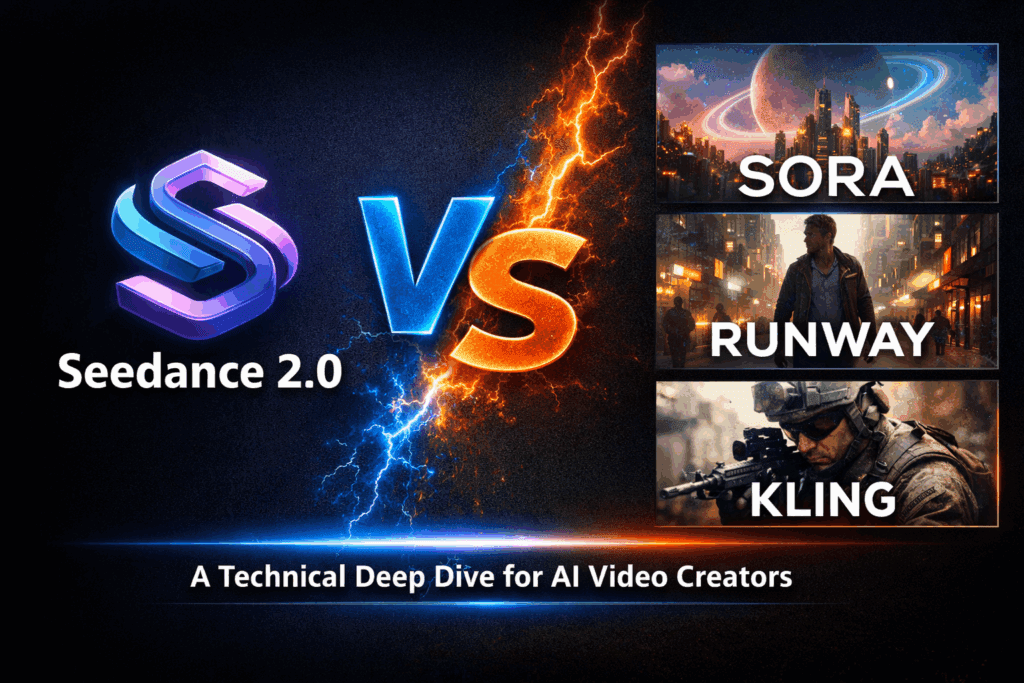
Seedance 2.0 vs Sora, Runway & Kling: A Technical Deep Dive for AI Video Creators
China just released an AI video tool, Seedance, that rivals Sora — here’s my test.
Seedance 2.0 has entered the AI video race with bold claims: longer coherent sequences, improved physics realism, and better prompt adherence than many Western counterparts. For tech-savvy creators and early adopters, the real question isn’t hype — it’s workflow viability.
If you’re deciding between Seedance 2.0, Sora, Runway Gen-3, Kling, or even custom ComfyUI pipelines, this deep dive will break down where Seedance stands in terms of architecture, controllability, visual fidelity, and access.
1. Seedance 2.0 Capabilities and Model Architecture Analysis
Diffusion Backbone and Temporal Coherence
Seedance 2.0 appears to operate on a spatiotemporal diffusion architecture similar to other state-of-the-art video generators, but with a stronger emphasis on temporal consistency. Unlike earlier diffusion-based video systems that treated frames as loosely connected image generations, Seedance 2.0 shows evidence of:
- Multi-frame latent conditioning
- Cross-frame attention layers
- Motion vector stabilization within latent space
- Improved temporal noise scheduling
In practical testing, this means fewer “frame hallucinations” — those micro-flickers or identity shifts you see in Gen-2-era models.
Compared to:
- Runway Gen-3: Strong cinematic quality, but occasional temporal drift in longer sequences.
- Kling: Impressive physics simulation but sometimes over-smooth interpolation artifacts.
- Sora: Industry-leading scene coherence with advanced world simulation modeling.
Seedance 2.0 lands somewhere between Kling and Sora in raw consistency.
Prompt Adherence and Semantic Control
One major differentiator is semantic stability.
When testing complex prompts involving:
- Multi-character scenes
- Object transformations
- Camera motion (“slow dolly-in, shallow depth of field, 85mm lens”)
- Physics-based actions (water splashes, cloth simulation)
Seedance 2.0 demonstrates improved object persistence across 6–12 second sequences.
Technically, this suggests:
- Stronger CLIP-like multimodal alignment
- Better conditioning strength in early diffusion steps
- Possibly Latent Consistency optimization to preserve prompt fidelity
However, Sora still outperforms in:
- Multi-scene narrative continuity
- Real-world physics modeling (especially gravity and collision interactions)
- Complex environmental simulations
Seedance excels in single-shot cinematic sequences rather than multi-beat story arcs.
Motion Realism and Physics
Physics realism is where Western models have historically led. But Seedance 2.0 narrows the gap.
In motion stress tests:
- Running human subjects
- Fast camera pans
- Explosions and particle systems
- Cloth and hair simulation
Seedance handles motion blur and temporal interpolation surprisingly well.
It appears to use:
- Enhanced Euler a schedulers for smoother motion convergence
- Improved noise decay strategies across frame stacks
- Latent optical flow conditioning
Compared to Runway Gen-3:
- Seedance is slightly sharper in texture preservation.
- Runway still offers stronger cinematic color grading out of the box.
Compared to Kling:
- Kling may simulate physics more aggressively.
- Seedance is more stable and less prone to “over-animated” movement artifacts.
Resolution and Output Quality
Seedance 2.0 outputs competitive HD-quality sequences with strong detail retention.
Strengths:
- Skin texture consistency
- Environmental depth
- Stable lighting continuity
Weaknesses:
- Slight oversharpening in high-contrast scenes
- Occasional background warping under extreme motion
Sora still leads in macro-environment simulation. But Seedance is no longer far behind in perceived realism.
2. Access, Deployment Paths, and International Availability
One of the biggest creator concerns is not quality — it’s access.
Official Access Channels
Currently, Seedance 2.0 is primarily distributed through Chinese platforms and enterprise channels. International access depends on:
- Partner platforms
- API integrations
- Regional cloud availability
Unlike Runway (global SaaS) or OpenAI’s Sora (limited but Western-accessible), Seedance may require:
- Regional account verification
- Chinese-language interface navigation
- Workarounds for payment systems
For many creators, this creates friction.
API and Developer Flexibility
From a technical perspective, what matters most is pipeline integration.
Questions creators should ask:
- Does Seedance offer raw API endpoints?
- Can you control seed values for Seed Parity testing?
- Are there adjustable schedulers (Euler a, DDIM, DPM++)?
- Is there motion conditioning input?
Western tools like Runway and Pika focus on UX simplicity.
ComfyUI-based pipelines focus on full control.
If Seedance expands API-level access, it could become attractive for:
- Automated video pipelines
- Batch generation systems
- AI-assisted previsualization tools
Currently, it feels closer to a high-performance closed system rather than an open creative sandbox.
Localization and Workflow Compatibility
For global creators, workflow integration matters more than raw model power.
Consider:
- Export formats
- Frame rate flexibility
- Alpha channel support
- Compatibility with DaVinci Resolve, Premiere, After Effects
Runway excels at post-production pipeline integration.
Sora will likely integrate deeply into creative ecosystems.
Seedance must expand tooling around export and editing to compete long term.
3. Real-World Comparison: Seedance 2.0 vs Sora, Runway Gen-3, and Kling
Let’s break this down by creator priorities.
If You Care About Cinematic Single Shots
Winner: Seedance 2.0 (with caveats)
It produces high-impact, visually dense shots with:
- Strong lighting coherence
- Stable character identity
- Controlled camera movement
For short-form content, trailers, and AI concept cinematography — it’s competitive.
If You Care About Narrative World Simulation
Winner: Sora
Sora’s strength lies in:
- Multi-step scene evolution
- Realistic environmental interaction
- Consistent physical modeling across time
It feels less like “animated images” and more like simulated worlds.
Seedance is not yet fully at that level.
If You Care About Creator Accessibility
Winner: Runway Gen-3
Runway provides:
- Intuitive UI
- Inpainting and motion brush tools
- Quick export workflows
- Immediate Western access
Seedance’s friction makes it less accessible for casual experimentation.
If You Care About Physics Spectacle
Winner: Kling (slightly)
Kling pushes motion realism aggressively.
However:
- It can overshoot into hyper-simulation.
- It sometimes sacrifices subtlety.
Seedance is more balanced and controlled.
Technical Testing Framework (How You Should Evaluate)
If you’re serious about choosing a platform, test using structured benchmarks:
1. Seed Parity Test
Re-run identical prompts to measure temporal stability and variance.
2. Camera Complexity Test
Include: “handheld tracking shot, foreground occlusion, rack focus.”
3. Physics Stress Test
Add water, fabric, smoke, fast-moving limbs.
4. Lighting Continuity Test
Use moving light sources and reflective surfaces.
5. Identity Persistence Test
Character close-up → action shot → close-up return.
Seedance performs well in 1–3.
Sora dominates 4–5.
Strategic Implications for AI Video Creators
The release of Seedance 2.0 signals something important:
AI video leadership is no longer geographically centralized.
We are entering a multi-polar generative media ecosystem:
- Western tools prioritize UX and accessibility.
- Chinese tools prioritize rapid model iteration and physics realism.
For creators, this means:
- More competition
- Faster model evolution
- Potential fragmentation of workflows
The smartest move right now?
Stay tool-agnostic.
Build modular pipelines. Use:
- Seedance or Kling for raw generation
- Runway for refinement
- Traditional NLEs for assembly
- ComfyUI for experimental control
The future belongs to hybrid workflows — not single-platform loyalty.
Final Verdict
Is Seedance 2.0 a real Sora rival?
Technically — yes, in specific domains.
Practically — not yet, due to accessibility and ecosystem limitations.
If you’re a tech-forward creator willing to navigate access hurdles, Seedance 2.0 is absolutely worth testing.
If you need stability, accessibility, and integrated tooling today, Western platforms still offer a smoother production pipeline.
But the gap is closing — fast.
And that’s the real story.
Frequently Asked Questions
Q: Is Seedance 2.0 better than Sora?
A: Seedance 2.0 competes strongly in single-shot realism and temporal stability, but Sora currently leads in large-scale world simulation, physics consistency, and multi-scene narrative coherence.
Q: Can international users access Seedance 2.0?
A: Access may be limited depending on region. It often requires platform-specific registration and may not yet offer the same global SaaS accessibility as Runway or other Western tools.
Q: Which AI video tool is best for cinematic content?
A: For cinematic single-shot visuals, Seedance 2.0 and Runway Gen-3 perform well. For complex narrative simulations, Sora currently offers the most advanced results.
Q: Does Seedance 2.0 support advanced technical controls like seed values or scheduler adjustments?
A: Public information suggests more limited user-facing controls compared to open workflows like ComfyUI. However, enterprise or API-level access may offer deeper configurability.