Character AI Videos: The Viral Formula
Why Character AI Videos Get Millions of Views
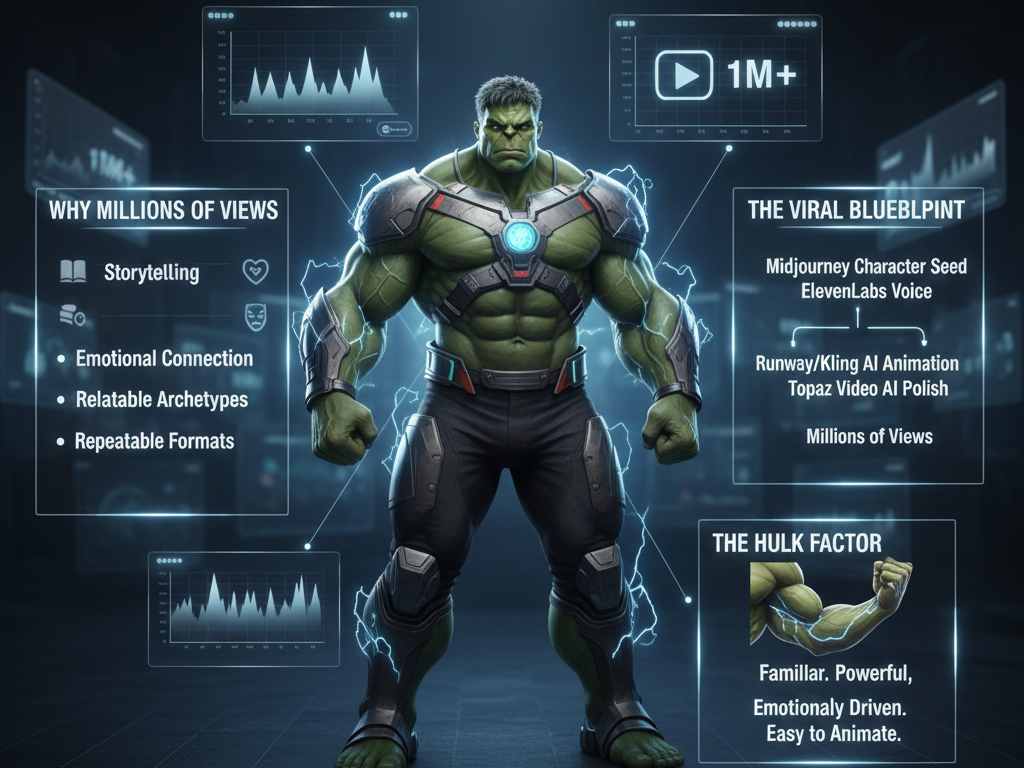
AI video tools are more powerful than ever, yet most AI videos fail to attract views, retention, or engagement. The reason is not the technology. It is the lack of storytelling and emotional connection. Character AI videos solve this problem by combining familiar archetypes, simple narratives, and repeatable formats that audiences instantly understand.
Character-driven AI videos consistently outperform generic AI clips because viewers do not connect with tools or visuals. They connect with characters. When done correctly, a single character-based format can generate millions of views across platforms.
This article explains the proven character AI video formula, why the Hulk-style character format works so well, and how you can replicate this approach to create consistently viral AI videos.
The Core Problem With Most AI Videos
Most AI videos fail for three predictable reasons:
1. No emotional hook: The video looks impressive but gives viewers no reason to care.
2. No narrative tension: The clip lacks conflict, progression, or payoff.
3. No retention strategy: Viewers leave within the first few seconds because nothing pulls them forward.
Creators often focus on visuals, effects, or prompts while ignoring story structure. As a result, the video becomes a technical demo instead of content people want to watch and share.
Why Character-Based Storytelling Works
Character-based storytelling fixes all three problems at once.
A character provides:
- Instant familiarity: Viewers recognize the archetype immediately.
- Emotional grounding: The character gives the audience someone to root for or react to.
- Built-in conflict: Characters naturally face challenges, decisions, or transformations.
In short-form AI video, you do not have time to explain. Characters do the explaining for you.
The Hulk Character Format Explained
The Hulk-style character format is one of the most effective examples of character AI video success. It does not rely on complex plots or dialogue. It uses a simple, repeatable structure that triggers curiosity and retention.
The core elements of the Hulk character format include:
- A powerful but flawed character
- A relatable problem or misunderstanding
- Escalation toward an emotional or visual payoff
- A clear transformation or resolution
The Hulk works because the audience already understands the character’s emotional range: calm to chaos, control to explosion, weakness to power. This emotional arc maps perfectly to short-form video storytelling.
Importantly, the success of this format is not about the Hulk specifically. It is about using a recognizable character archetype with a strong emotional spectrum.
The Viral Story Structure Step by Step
To replicate viral character AI videos, follow this step-by-step structure.
Step 1: The Immediate Hook (First 2–3 Seconds)
Open with the character already in motion or conflict. Do not introduce the character. Assume recognition.
Examples:
- The character reacting to an unexpected situation
- A visual contrast that creates curiosity
- A short line of dialogue or text that signals tension
Your goal is to make the viewer ask, “What happens next?”
Step 2: The Setup (Context Without Explanation)
Provide just enough context to understand the problem. Avoid backstory.
For example:
- The character faces a challenge they should not fail
- Someone underestimates the character
- A simple task turns into a problem
This stage should last only a few seconds.
Step 3: Escalation and Stakes
Increase tension quickly. The situation should clearly get worse or more intense.
In the Hulk-style format, this often means:
- Emotional frustration building
- Visual cues of loss of control
- Reactions from others that heighten conflict
This is where retention is won or lost.
Step 4: The Payoff
Deliver a clear and satisfying payoff.
The payoff can be:
- A transformation
- A reveal of hidden power
- A reversal where the character succeeds
The payoff must feel earned, even in a short video.
Step 5: The Loop or Aftershock
End with a moment that encourages replay or sharing.
Examples:
- A final reaction shot
- A humorous consequence
- An unresolved implication
This step increases watch time and algorithmic performance.
A Replicable Process for Consistent Viral AI Videos
To create consistent results, treat character AI videos as a system, not a one-off experiment.
1. Choose One Character Archetype
Stick to a single archetype per content series. Familiarity increases performance over time.
2. Reuse the Same Story Structure
Change the scenario, not the structure. Audiences reward predictability with retention.
3. Optimize for Speed
Short-form AI video thrives on fast pacing. Cut aggressively. Remove anything that does not move the story forward.
4. Test Variations at Scale
Produce multiple versions with small changes:
- Different hooks
- Slightly different payoffs
- Alternative endings
Data will show you what works.
Practical Examples and Breakdown
A high-performing character AI video often looks simple on the surface but is carefully structured underneath.
Example breakdown:
- Hook: Character reacts angrily to a minor inconvenience
- Setup: The problem escalates unexpectedly
- Escalation: Visual cues show rising tension
- Payoff: The character unleashes full power
- Loop: A humorous or ironic final beat
This format works because it compresses a complete story into seconds while maintaining emotional clarity.
Common Mistakes to Avoid
Even with a strong character format, creators often make avoidable mistakes.
Overcomplicating the Story
Short-form AI video does not reward complexity. Keep the story simple and visual.
Weak Hooks
If the first seconds are passive, the video fails regardless of quality.
Inconsistent Characters
Changing the character’s personality or rules confuses the audience and hurts retention.
Ignoring the Payoff
A strong buildup without a payoff leads to disappointment and drop-offs.
Final Checklist for Viral Character AI Videos
Before publishing, review this checklist:
- Is the hook clear within the first three seconds?
- Is the character instantly recognizable?
- Does the story escalate quickly?
- Is there a clear emotional or visual payoff?
- Does the ending encourage replay or sharing?
If you can answer yes to all five, your video is structurally sound.
Character AI videos succeed because they combine technology with timeless storytelling principles. By using a proven character format, a clear story structure, and a repeatable process, you can move from random experiments to consistent viral performance in AI video content.
Next Steps
Start building your first character-based AI video today by choosing one archetype and applying the viral story structure outlined above. Consistency and structure are the fastest path to AI video growth.
Frequently Asked Questions
Q: Do character AI videos work on all platforms?
A: Yes. Character-based AI videos perform well on platforms that prioritize retention and engagement, including short-form and long-form video platforms.
Q: Do I need to use famous characters for this format?
A: No. The key is the archetype, not fame. Original characters with clear traits can perform just as well.
Q: How long should a character AI video be?
A: The ideal length depends on the platform, but the structure should remain fast-paced with a strong hook and payoff regardless of duration.
Q: Can this formula work for educational AI videos?
A: Yes. Educational content can use characters to personify problems, solutions, or perspectives, increasing retention and understanding.