Fashion Week 2026 Runway Trends: AI-Driven Visual Analysis of Luxury Design, Statement Accessories, and Generative Media Workflows
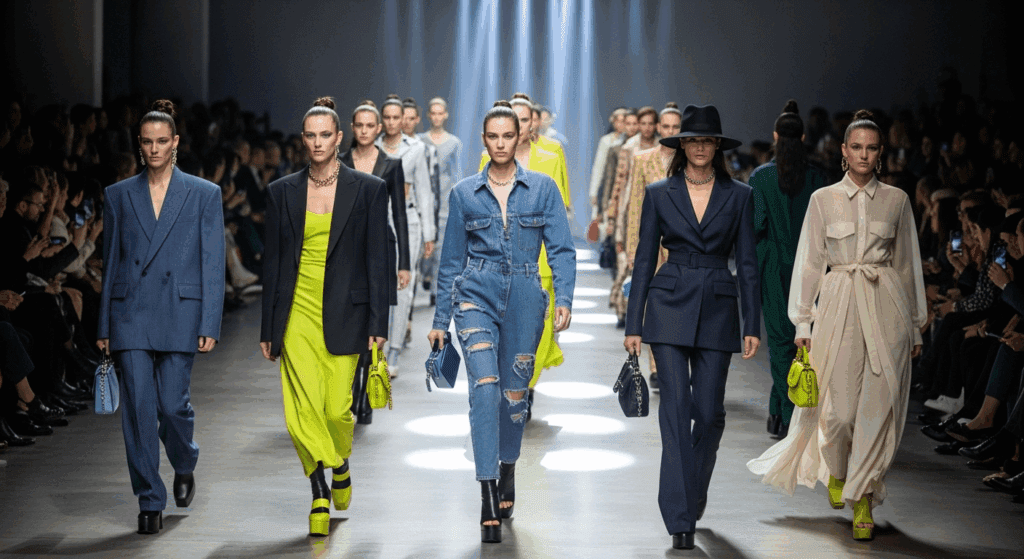
What Fashion Week 2025 reveals about the future of luxury design is not just a shift in silhouette or color palette it’s a structural transformation in how fashion is conceived, visualized, and translated into immersive digital narratives.
For fashion enthusiasts, buyers, and trend forecasters, the challenge is no longer simply spotting trends on the runway. It’s understanding how those trends scale across digital campaigns, AI-generated lookbooks, immersive retail, and video-first storytelling. Using advanced visual engines like Runway, Sora, Kling, and ComfyUI workflows, we can analyze, reconstruct, and forecast the direction of high fashion with technical precision.
This deep dive explores Fashion Week 2025 through three pillars: statement accessories, next-level designer inspiration, and the evolving fusion of elegance and generative creativity.
1. Statement Accessories Defining the 2025 Season
If 2024 flirted with maximalism, 2025 commits to it especially in accessories. Oversized sculptural earrings, architectural handbags, hyper-structured belts, and futuristic eyewear dominated luxury runways from Paris to Milan.
Sculptural Metal and Liquid Chrome Textures
Designers leaned heavily into molten metal finishes and reflective chrome surfaces. In AI video recreation workflows (e.g., ComfyUI with SDXL-based checkpoints), these materials require careful prompt engineering and scheduler control. Using Euler a* or *DPM++ 2M Karras schedulers with higher step counts (30–40 steps) enhances micro-reflection detail in metallic surfaces.
To maintain consistency across multiple shots of the same accessory (e.g., a chrome shoulder piece seen in different lighting environments), Seed Parity becomes essential. Locking seed values ensures the structural geometry remains coherent while allowing lighting prompts to vary.
Example workflow in ComfyUI:
– Base model: SDXL fine-tuned on fashion datasets
– ControlNet: Depth + Lineart for structural consistency
– Scheduler: Euler a
– CFG Scale: 6.5–8 for material fidelity without over-stylization
This allows creators to simulate runway-level lighting realism in digital fashion films.
Oversized Bags as Narrative Anchors
Bags in 2025 are not just accessories, they are central characters. Ultra-large totes, rigid geometric clutches, and asymmetrical forms appeared repeatedly.
When translating these into AI-generated runway sequences using Runway Gen-3 or Sora-style prompt systems, Latent Consistency is critical. If a bag shifts size or structure between frames, the illusion breaks.
Best practice:
– Define the accessory as a persistent object in the prompt hierarchy.
– Use weighted prompt tokens (e.g., “(oversized geometric leather tote:1.3)”) to prioritize its presence.
– Maintain consistent camera movement prompts (“slow dolly-in, 85mm lens, shallow depth of field”) to stabilize visual interpretation.
For trend forecasters, the takeaway is clear: accessories in 2025 are engineered to be visually dominant in short-form video. Designers are thinking in vertical crop ratios (9:16) and social-first composition.
Statement Belts and Waist Architecture
Belts evolved into exoskeleton-like structures—cinched waists framed by metallic frameworks or layered corsetry.
In Kling or Runway motion generation, these complex shapes benefit from pose-guided animation. Using skeletal control or pose reference frames ensures the belt structure moves naturally with the model’s body.
A recommended workflow:
1. Generate a high-detail still in ComfyUI.
2. Export depth and pose maps.
3. Feed into Runway for motion synthesis with low-motion intensity.
4. Adjust motion brush settings to reduce warping near rigid accessories.
This hybrid pipeline ensures fashion accuracy while preserving cinematic motion.
2. Next-Level Fashion Inspiration from Top Designers
Fashion Week 2025 revealed three dominant directional themes: Techno-Romanticism, Neo-Tailoring, and Bio-Luxury Minimalism.
Techno-Romanticism: Softness Meets Structure
Flowing silks were embedded with metallic threading. Sheer fabrics layered over armored bodices. Designers are merging emotional softness with engineered strength.
To recreate this contrast in generative video:
– Use dual-texture prompting (“sheer chiffon overlay, brushed steel corset, diffused rim lighting”).
– Separate texture emphasis through prompt weighting.
– Reduce CFG slightly (5.5–6) to allow organic blending between hard and soft materials.
In Sora-like systems where temporal coherence is model-driven, describing fabric physics explicitly (“fabric moves gently in slow wind, high-frame-rate capture”) improves motion realism.
For buyers and forecasters, this indicates a market pivot: luxury is no longer purely opulent it is emotionally engineered.
Neo-Tailoring and Algorithmic Precision
Structured blazers, exaggerated shoulders, and mathematically precise cuts dominated major houses.
In AI reconstruction, sharp tailoring benefits from:
– High-resolution latent upscaling (1.5–2x latent upscale in ComfyUI).
– Lineart ControlNet to maintain edge precision.
– Lower denoising strength (0.35–0.45) during refinement passes.
Designers appear influenced by digital pattern-making software and parametric design logic. The symmetry and proportion feel algorithmic—almost as if garments were optimized by code.
For AI video creators, this opens a compelling angle: simulate “digital atelier” visuals by combining CAD-style overlays with runway footage using Runway’s compositing tools.
Bio-Luxury Minimalism
Natural dyes, organic silhouettes, and plant-based textures made a strong statement.
However, minimalism in 2025 is hyper-intentional. Clean lines are paired with tactile richness raw silk, matte leather, untreated wool.
In generative workflows, minimalism is harder to render than maximalism. Too little detail leads to flat outputs.
Technical solution:
– Increase texture descriptors (“visible fiber grain, subtle weave detail”).
– Use soft cinematic LUT emulation in post-processing.
– Apply low-noise schedulers to avoid artificial gloss.
The result mirrors runway lighting: soft, museum-like illumination emphasizing craftsmanship.
3. Where Elegance Meets Generative Creativity in Modern Runway Shows
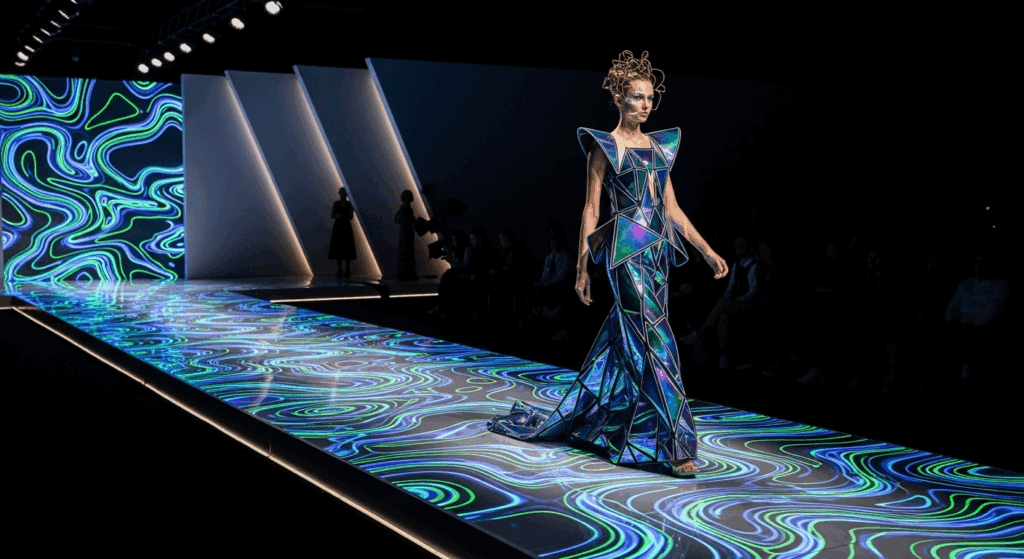
Fashion Week 2025 wasn’t just about clothes—it was about experience design. Runways featured immersive LED walls, AI-generated backdrops, and reactive lighting.
Cinematic Runway as Prompted Environment
Designers increasingly build environments that resemble generative prompts: “futuristic marble cathedral,” “bioluminescent forest,” “chrome desert horizon.”
AI video creators can reverse-engineer these spaces:
– Generate environment plates in ComfyUI.
– Animate subtle environmental motion in Runway.
– Composite model footage with depth-aware masking.
Maintaining Latent Consistency between subject and background is essential. Mismatched lighting temperature or perspective destroys realism.
Pro tip:
– Use shared seed clusters for environment variations.
– Match color grading LUT across shots.
Elegance Through Controlled Motion
Modern runway elegance is defined by restraint. Slow pacing. Intentional turns. Extended pauses.
When generating AI runway sequences:
– Keep motion intensity below 30% in Runway.
– Use “slow cinematic tracking shot” prompts.
– Avoid high-frame interpolation unless necessary.
Elegance in AI video is about temporal discipline. Over-animation equals loss of luxury perception.
The Role of Seed Strategy in Trend Forecasting
For trend forecasters building multiple visual scenarios (e.g., accessory variations, colorway testing), structured seed management becomes a forecasting tool.
By organizing seed libraries:
– Seed Group A: Chrome accessories
– Group B: Organic textures
– Group C: Tailored silhouettes
You can generate controlled aesthetic variations while preserving structural integrity.
This transforms AI from inspiration engine to predictive modeling system.
Translating Runway 2025 into Actionable Creative Strategy
For fashion enthusiasts, buyers, and trend forecasters, the key insights are:
1. Accessories drive visual hierarchy—optimize for close-up storytelling.
2. Structure and softness coexist—embrace contrast in materials.
3. Minimalism requires technical precision in rendering.
4. AI workflows must prioritize latent and seed consistency for brand coherence.
Luxury in 2025 is cinematic, algorithm-aware, and materially expressive. Designers are building collections that anticipate digital reinterpretation. The runway is no longer the final stage—it’s the first dataset.
By integrating tools like ComfyUI for detailed still generation, Runway or Kling for motion synthesis, and disciplined scheduler and seed strategies, creators can not only analyze Fashion Week 2025—they can simulate its future trajectories.
The future of luxury design is not just handcrafted.
It is prompt-crafted, seed-structured, and rendered with intentional elegance.
Frequently Asked Questions
Q: How can AI video tools help trend forecasters analyze Fashion Week 2025 more effectively?
A: AI tools like ComfyUI and Runway allow forecasters to reconstruct runway looks with controlled seeds, schedulers, and prompt weighting. By maintaining latent consistency and testing variations through seed parity, analysts can simulate colorways, accessory scaling, and silhouette adjustments to predict commercial viability.
Q: What is the best scheduler for rendering high-detail luxury materials like chrome and silk?
A: Euler a and DPM++ 2M Karras are strong choices for luxury material rendering. Euler a offers sharp structural clarity for metallic accessories, while DPM++ 2M Karras provides smoother gradation for soft fabrics like silk and chiffon.
Q: How do you maintain consistency across multiple AI-generated runway shots?
A: Use fixed seed values (Seed Parity), consistent camera prompts, shared lighting descriptions, and ControlNet depth or pose references. Keeping denoising strength low during refinement also helps preserve garment structure across scenes.
Q: Why is minimalism harder to generate in AI fashion visuals?
A: Minimalism relies on subtle texture and lighting rather than bold detail. Without precise texture prompts and controlled noise levels, outputs can appear flat. Enhancing micro-texture descriptors and using soft cinematic grading improves realism.