Veo 3.1 vs Wan 2.5: How Google’s Cinematic AI Compares to Alibaba’s Open Video Model
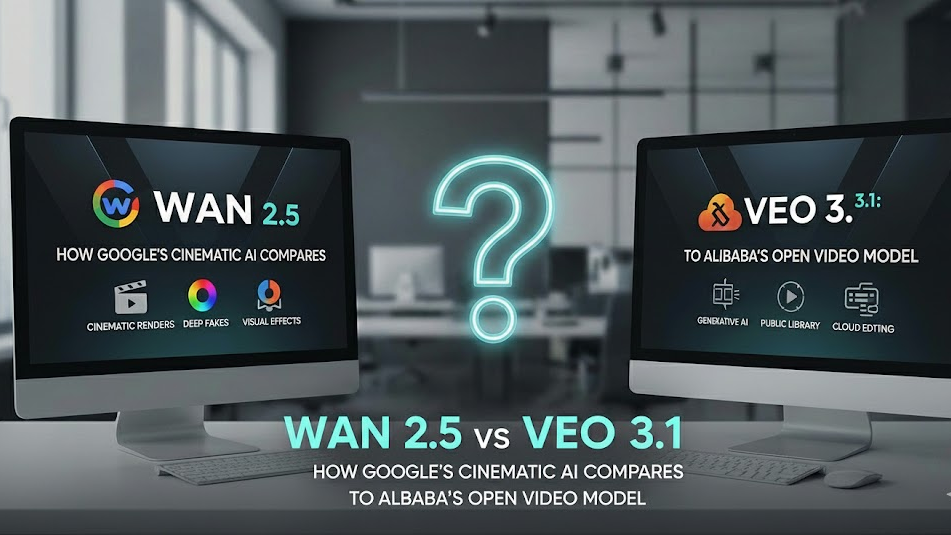
AI video generation is no longer about novelty, it’s about control, realism, and production readiness. Two models often mentioned in the same breath, yet built for very different audiences, are Google Veo 3.1 and Wan 2.5 by Alibaba. While both generate impressive video from text or images, they diverge sharply in philosophy, accessibility, and real-world use cases.
Veo 3.1 and Wan 2.5 are two leading AI video generation models with very different goals. Veo 3.1 prioritizes cinematic realism and long-form scene consistency, while Wan 2.5 focuses on open access, short-form video creation, and fast experimentation for developers and creators.
This article breaks down Veo 3.1 vs Wan 2.5 in practical terms: what each model is designed for, how they perform, and which creators benefit most from each.
What Is Veo 3.1?
Veo 3.1 is Google DeepMind’s most advanced AI video generation model to date. It is positioned as a cinematic, long-form video generator capable of understanding complex prompts involving camera movement, scene continuity, lighting, and narrative structure. Veo is designed to behave more like a virtual film crew than a short-form content tool.
The model emphasizes realism, temporal consistency, and adherence to cinematic language. It excels at producing visually coherent scenes that feel filmed rather than synthesized, making it particularly appealing for filmmakers, studios, and high-end creative experimentation. Access, however, remains limited, with Veo primarily available through select platforms, demos, or research previews rather than broad consumer rollout.
What Is Wan 2.5?
Wan 2.5 is Alibaba’s open-weight AI video model, designed with accessibility, speed, and experimentation in mind. Unlike Veo, Wan 2.5 is widely adopted in the open-source and developer communities, where flexibility and customization matter more than cinematic perfection.
The model focuses on short-form video generation and performs well for stylized motion, concept visuals, animated scenes, and creative prototyping. Wan 2.5 supports text-to-video and image-to-video workflows and is often integrated into third-party tools or custom pipelines. Its open nature makes it attractive to researchers, indie developers, and creators who want control over the model rather than a locked-down interface.
Veo 3.1 vs Wan 2.5: Core Differences
The biggest difference between Veo 3.1 and Wan 2.5 lies in intent. Veo is built to simulate professional cinematography, while Wan is built to democratize AI video creation.
Veo 3.1 prioritizes long-range coherence, realistic motion, and film-style camera behavior. It handles prompts involving shot transitions, scene continuity, and mood with a level of sophistication that rivals early production footage. Wan 2.5, by contrast, is optimized for faster generation and creative freedom, even if that means occasional visual instability or less realistic motion.
In terms of accessibility, Wan 2.5 is far more available. Veo remains gated, making it aspirational for many creators but not yet a daily production tool.
Veo 3.1 vs Wan 2.5: Comparison Table
| Feature | Veo 3.1 | Wan 2.5 |
| Developer | Google DeepMind | Alibaba |
| Model Type | Closed, proprietary | Open / open-weight |
| Primary Focus | Cinematic realism | Accessible AI video creation |
| Video Length | Longer-form scenes | Short-form clips |
| Visual Style | Film-like, realistic | Stylized, creative |
| Motion Quality | High temporal consistency | Fast, expressive motion |
| Camera Control | Advanced cinematic camera logic | Basic to moderate controls |
| Scene Coherence | Strong across shots | Limited on longer scenes |
| Audio Generation | No native audio | No native audio |
| Access | Limited / gated | Widely available |
| Best For | Filmmakers, studios, agencies | Developers, indie creators |
| Ideal Use Cases | Storytelling, previsualization | Prototyping, social clips |
Use-Case Perspective: Which Model Fits Which Creator?
Veo 3.1 is best suited for creators who care deeply about cinematic realism. This includes filmmakers, studios, agencies, and experimental storytellers who want AI to assist with pre-visualization, concept scenes, or even final-quality shots. Veo’s strength lies in scenes that need to feel believable, grounded, and narratively coherent.
Wan 2.5 shines in rapid creation and experimentation. It is well suited for short clips, animated concepts, visual ideas, social content drafts, and developer projects. Because it is open and flexible, it’s often used as a building block rather than a final-output engine.
Video Length, Quality, and Control
Veo 3.1 is designed with longer, more complex scenes in mind, supporting extended clips with consistent characters, environments, and motion logic. Camera instructions such as pans, dolly shots, and depth changes are followed with notable accuracy.
Wan 2.5 typically performs best with shorter clips. While it can generate compelling motion and style, consistency across longer durations is more limited. However, its strength lies in iteration speed and adaptability, especially when paired with custom tooling or fine-tuning.
Audio, Workflow, and Production Readiness
Neither Veo 3.1 nor Wan 2.5 currently positions native audio generation as their core differentiator. Both are primarily visual models, meaning voiceover, sound effects, and music are usually handled in post-production or through separate AI tools.
Where they differ is workflow philosophy. Veo is part of a closed, curated ecosystem focused on quality control and safety. Wan 2.5 fits naturally into modular pipelines where creators mix and match models, editors, and post-processing tools.
Veo 3.1 vs Wan 2.5: Which One Should You Choose?
Choose Veo 3.1 if your priority is cinematic realism, narrative coherence, and film-level visuals, even if access is limited and iteration speed is slower. It represents the high end of AI video generation and signals where studio-grade AI filmmaking is heading.
Choose Wan 2.5 if you value openness, flexibility, and rapid experimentation. It’s a strong choice for developers, indie creators, and teams that want to build custom workflows or iterate quickly on visual ideas.
Conclusion
Veo 3.1 and Wan 2.5 are not direct substitutes, they are answers to different creative problems. Veo is about how close AI can get to cinema. Wan is about how accessible and adaptable AI video can be. As AI video continues to evolve, many creators will likely use both: Wan 2.5 for exploration and iteration, and Veo-class models for high-end visual storytelling.
Wan 2.5 performs best with short video clips. Longer videos typically require stitching multiple clips together using external editing tools.
FAQ
Is Veo 3.1 better than Wan 2.5?
Veo 3.1 is better for cinematic realism, scene coherence, and film-style visuals. Wan 2.5 is better for fast iteration, open workflows, and short-form creative experimentation.
Can Wan 2.5 create long videos?
Wan 2.5 performs best with short video clips. Longer videos typically require stitching multiple clips together using external editing tools.
Does Veo 3.1 generate audio?
No, Veo 3.1 does not generate native audio. Voiceovers, sound effects, and music must be added during post-production.
Is Wan 2.5 open source?
Wan 2.5 is widely available and open-weight, making it popular among developers and creators who want flexibility and custom integrations.
Which AI video model is better for creators?
Creators focused on cinematic storytelling benefit more from Veo 3.1, while creators who value speed, access, and experimentation often prefer Wan 2.5.