VidAU Editorial · AI Search
Agentic AI Coding Tools: Best Workflows, Agents, and Code Review Options — agentic ai coding tools
A practical guide to agentic AI coding tools: wire a labels-to-PR GitHub pipeline, run local agents, and fix code review bottlenecks with CodeRabbit. Includes UiPath context and a neutral comparison framework for OpenHands vs Devin vs Manus.
By the VidAU Editorial Team · Reviewed before publishing
If AI is generating more diffs than you can review, this implementation guide shows how to plug Agentic AI coding tools into a GitHub task-to-PR pipeline and add CodeRabbit as a quality gate. You will get best-practice workflows, agent choices, and review options that keep velocity up and regressions down.
If AI is generating more diffs than you can review, this implementation guide shows how to plug agentic AI coding tools into a GitHub task-to-PR pipeline and add CodeRabbit as a quality gate. You will get best-practice workflows, agent choices, and review options that keep velocity up and regressions down.
Quick Summary
• GitHub labels-to-PR workflow is the fastest way to operationalize agentic AI coding tools with triage, implementation, tests, and Pull Request checks.
• CodeRabbit is the strongest near-term review gate for AI-authored diffs, with Change Stack, Agent Chat, and Autofix shown in late Aug–Sept 2026 demos.
• Required status checks in GitHub keep merges safe: block until tests and CodeRabbit review pass, and scope Autofix to repo rules.
• US engineering teams shipping many small changes benefit most: platform/DevOps, app squads, and managers who need SDLC and DevSecOps control.
What Is Agentic AI Coding Tools?
Agentic AI coding tools are AI agents that plan, execute, and validate software tasks across the SDLC. Instead of one-shot code completion, they triage issues, modify code in isolated workspaces, run tests, open Pull Requests, and respond to review feedback. They fit GitHub-centric workflows, integrate with CI, and rely on human oversight for risky changes or policy enforcement.
The GitHub Task-to-PR Pipeline for agentic ai coding tools

This pipeline turns labeled issues into reviewed PRs with minimal babysitting. It blends agents with your existing SDLC and DevSecOps controls.
Step 1: Labels and triage rules
• Define labels for scope and risk: ready-for-triage, small-change, docs-only, refactor, security-sensitive.
• A triage agent converts issues into an implementation-ready spec: acceptance criteria, touched files, test plan.
• Store specs as issue comments or a spec.md attached to the ticket.
Step 2: Isolated execution (Worktree vs Docker)
• Worktree: fast Git worktree per ticket; ideal for monorepos where local tooling is deterministic.
• Docker: container sandbox for untrusted code, OS-dependent builds, or polyglot stacks.
• Rule of thumb: Worktree for speed in trusted repos; Docker for safety or complex runtime requirements.
Step 3: Implementation with agents
• The implementation agent clones the repo into the isolated environment and follows the spec.
• Preferred models and assistants: Claude Code for reasoning, Codex-style completion for scaffolding, and Copilot for inline IDE help to humans in the loop.
• Keep changes small and atomic; one logical change per PR.
Step 4: Tests and static checks
• Run unit and integration tests locally in the sandbox.
• Enforce linters, formatters, and SAST as preflight steps to reduce noisy PRs.
Step 5: Create the Pull Request
• The agent opens a PR with: summary, linked issue, risk label, change scope list, and test evidence (logs, screenshots, or coverage deltas if available).
• Add GitHub required status checks: CI, security scans, and CodeRabbit review.
Step 6: Review loop and merge
• CodeRabbit posts findings, you request clarifications via Agent Chat, and apply Autofix where appropriate.
• Human reviewers remain required for security-sensitive or data-access changes.
• Merge when all status checks pass.
Key Takeaways
• Labels drive automation; risk labels decide human review depth.
• Worktree favors speed; Docker favors safety and reproducibility.
• Required status checks are the guardrails that make agentic loops shippable.
Suggested Visual: Flow diagram of labels → triage → worktree/Docker → tests → PR → CodeRabbit → merge.
Local Agent Setup: LM Studio, Hugging Face, and Pi Coding Agent
Running local models gives control and privacy while reducing token costs for routine tasks.
1) Model runtime with LM Studio
• Install LM Studio on a build machine or developer workstation.
• Select coding-capable models sourced via Hugging Face; prefer context length sufficient for your repo size and tests.
• Configure memory and GPU settings to match your hardware.
2) Wiring a local agent
• Use Pi Coding Agent or a similar agent harness to connect your model runtime to the repo workspace.
• Expose a local endpoint the agent can call for generate, plan, and tool-use actions.
• Provide tools: shell, git, test runner, linter, formatter; log each tool call for observability.
3) IDE and Copilot coexistence
• Keep Copilot for human-in-the-loop productivity on tricky code.
• Let the agent handle mechanical tasks (boilerplate, small refactors, docs) and kick PRs back for review.
4) Safety configuration
• Limit file write scopes to the targeted worktree or container.
• Cap token budgets per task to prevent runaways; log token usage for cost attribution.
• Require human approval to touch security-sensitive paths.
Suggested Visual: Screenshot mock of LM Studio model selection and a Pi Coding Agent config snippet.
Configure CodeRabbit as Your Review Gate (Aug–Sept 2026 workflows)
As AI output grows, review is the bottleneck. CodeRabbit helps you scale reviews while keeping GitHub as the source of truth.
Core features to enable
• Change Stack: Navigate layered context to see what changed, why, and where; reduces context switching on large PRs.
• Agent Chat: Ask clarifying questions about diffs and prompt follow-up checks; avoids ping-pong in comments.
• Autofix: Apply safe, scoped suggestions that respect repo rules and style guides.
Repository setup checklist
• Enable CodeRabbit on the repo and organization; scope to target branches.
• In PR templates, include: risk label, test plan, and acceptance criteria for better analysis.
• Calibrate sensitivity: prefer high signal-to-noise by tuning rule severity and file globs (e.g., treat docs-only as low risk).
GitHub protection rules
• Mark CodeRabbit as a required status check alongside CI and security scans.
• Block merges until CodeRabbit passes and required reviewers sign off on high-risk labels.
• Allow Autofix commits from a bot user with least-privilege permissions.
Workflow in practice
• Agent opens PR; CodeRabbit annotates with inline comments and a change overview.
• Use Agent Chat to request evidence: run unit tests for a specific module, compare before/after complexity, or surface potential security hotspots.
• Apply Autofix for style, small refactors, and missing null checks; escalate to human review for schema, auth, and cryptography changes.
Limits to acknowledge
• AI-authored diffs can still pass superficial checks; keep human review for critical paths.
• Large binary or generated files can drown signals; exclude them from analysis.
• Token usage for deep analysis should be budgeted per repo to avoid surprises.
Suggested Visual: Annotated PR screenshot showing Change Stack, inline comments, Agent Chat, and an Autofix suggestion.
Choosing agentic ai coding tools: OpenHands vs Devin vs Manus

Use a criteria-based framework that matches your SDLC, security posture, and team skills. Keep the comparison neutral and focus on fit, not hype.
| Openness | Open-source; self-host friendly | Proprietary; vendor-hosted
| Deployment | Local or cloud by choice | Primarily managed platforms
| GitHub PR flow | Common agent pattern support | Common agent pattern support
| Observability | Varies by setup and tooling | Vendor UIs and logs
| Cost governance | You own infra and tokens | Vendor pricing; usage controls
| Safety controls | Depends on harness & policy | Policy features vary by vendor
When to prefer each
• OpenHands: You need self-hosting, custom tools, and tight DevSecOps control.
• Devin/Manus: You want managed onboarding, opinionated workflows, and hosted reliability.
Avoid absolute bets; pilot two options on the same backlog slice and compare throughput, review quality, and rollback rate.
Where UiPath Fits: What Does UiPath Do?
UiPath focuses on agentic automation across business processes, orchestrating people, robots, and AI agents. In developer terms, think RPA plus AI to automate repetitive enterprise workflows. It complements, rather than replaces, agentic coding tools by handling upstream or downstream tasks like provisioning, ticket enrichment, or release approvals in large organizations.
Guardrails, Handoff Criteria, and Operating Limits
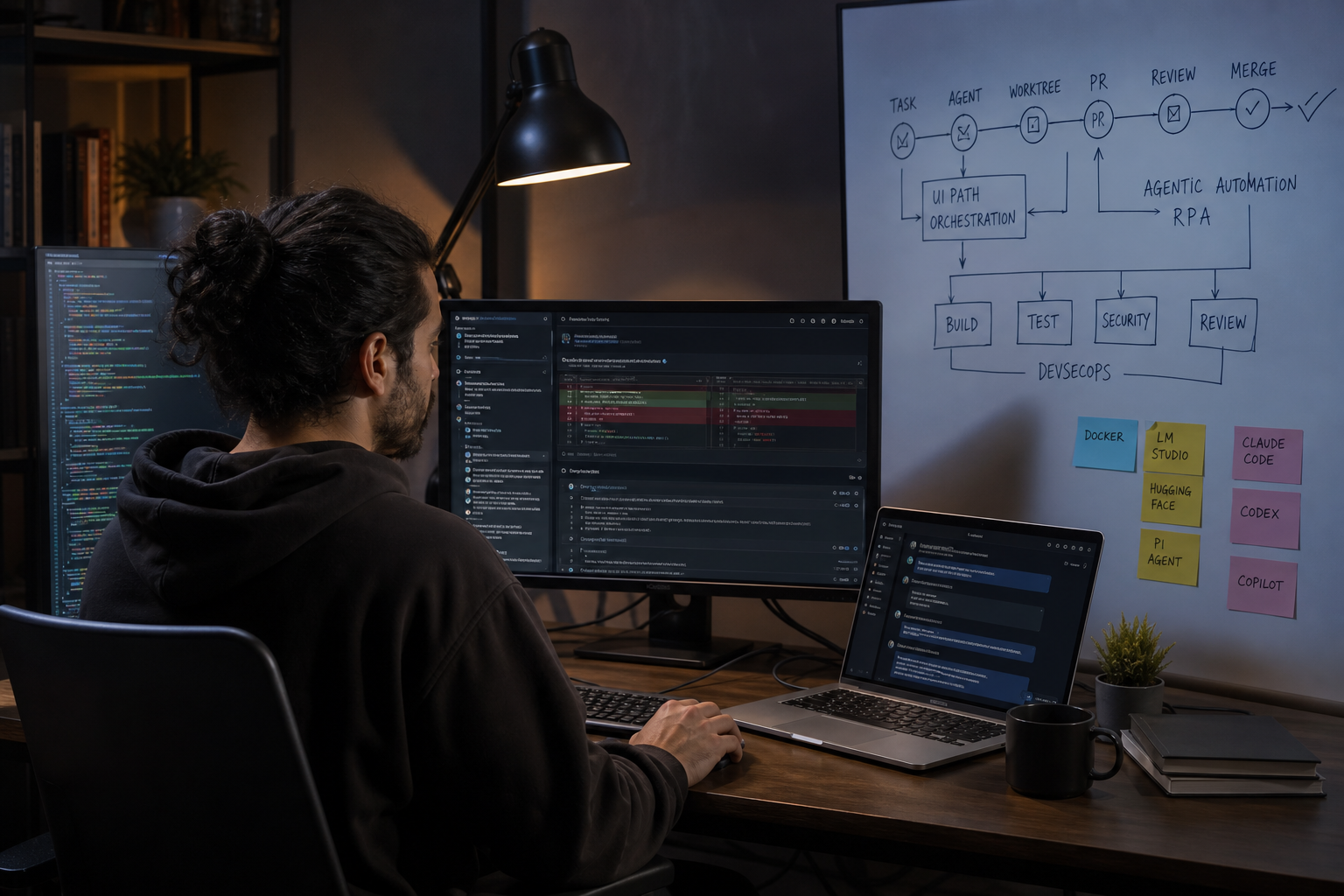
A robust agentic loop needs policy, not just models. Use these practices to keep velocity and quality in balance.
Handoff criteria: which tickets can agents own?
• Good candidates: docs-only, small refactors, generated clients, repetitive config changes, test scaffolding.
• Human-led: security-sensitive code, data-access layers, migrations, auth/session logic, PII handling.
Token and cost management
• Set per-task token caps; fail gracefully with partial output rather than runaway loops.
• Prefer local execution for iterative planning; reserve cloud calls for final reasoning.
• Attribute token spend to issues/labels for cost visibility per team.
DevSecOps alignment
• Enforce pre-commit hooks, SAST, and dependency scans in the sandbox and CI.
• Require PR templates with risk labels and test evidence.
• Use GitHub code owners to auto-request human sign-off on protected paths.
Observability and rollback
• Log all agent tool calls (shell, git, test runner) with timestamps.
• Keep change size small to ease code review and rollback.
• Track defect escape rate and review time as core KPIs; tune policies based on data.
Create With VidAU
Turn scripts, product URLs, and creative ideas into ad-ready video assets with a structured AI workflow.
Key takeaway
Final Thoughts
Agentic AI coding tools work best when they run inside your existing GitHub SDLC: labels drive tasks, isolated worktrees or Docker keep changes safe, and CodeRabbit absorbs the review surge with Change Stack, Agent Chat, and Autofix. Keep risky paths human-reviewed and enforce required status checks.
The best next step is to pilot a labels-to-PR pipeline on low-risk tickets, wire in a local agent with LM Studio, and enable CodeRabbit as a required check. Measure throughput, review time, and rollback rate before expanding scope.
Frequently asked questions
What are agentic AI coding tools in practical terms?
Agentic AI coding tools are AI agents that plan, implement, and validate software changes. They pick up labeled GitHub issues, modify code in isolated worktrees or Docker sandboxes, run tests, and open Pull Requests for review. They integrate with CI, DevSecOps checks, and human reviewers for risky or policy-governed changes.
How do I build a GitHub labels-to-PR workflow with agents?
Define risk labels, add a triage agent to turn issues into specs, use Git worktrees or Docker for isolation, run tests and linters, then open a PR with a clear summary and evidence. Make CI, security scans, and CodeRabbit required status checks to gate merges and keep your SDLC predictable.
How does CodeRabbit help with AI-generated code reviews?
CodeRabbit reduces review bottlenecks using Change Stack for layered context, Agent Chat for clarifications, and Autofix for scoped improvements. Configure it as a required status check so merges are blocked until its review passes. Keep human sign-off for high-risk paths like security, data access, and migrations.
What does UiPath do, and how is it different from coding agents?
UiPath specializes in agentic automation for business processes, combining RPA with AI agents to orchestrate work between systems and people. Coding agents focus on software changes within repos. In enterprises, UiPath may automate upstream tasks like ticket enrichment or approvals that complement developer-focused agent workflows.
When should I use Git worktrees vs Docker for agent execution?
Use Git worktrees for speed in trusted repos with deterministic builds. Choose Docker when you need isolation for untrusted code, OS-specific dependencies, or complex polyglot stacks. Many teams use both: worktrees for safe refactors and docs, Docker for integration-heavy or security-sensitive changes.
How do I control token costs for agentic workflows?
Set per-task token caps, log usage per issue or label, and run local models via LM Studio for iterative planning. Reserve cloud reasoning for final passes. Keep PRs small to minimize context windows, and fail fast on runaway loops with clear error reporting to the issue thread.
Which tickets are good candidates for autonomous agents?
Docs-only updates, small refactors, generated SDKs, config changes, and test scaffolding are solid starts. Avoid handing off security-sensitive code, data-access layers, auth/session logic, and major schema migrations. Use labels to enforce these policies and require human reviewers on protected paths.
How do OpenHands, Devin, and Manus compare for agentic coding?
Use a criteria framework: openness and self-hosting needs, deployment model, GitHub PR flow support, observability, cost governance, and safety controls. OpenHands suits self-hosted customization; Devin and Manus offer managed, workflow-centric experiences. Pilot on the same backlog slice and compare results before standardizing.
Can Copilot coexist with agentic AI coding tools?
Yes. Keep Copilot for human developers in the IDE while agents handle mechanical tasks and open PRs. Copilot accelerates in-context edits and exploration; agents automate repetitive changes. Together, they raise throughput without skipping required reviews, tests, and security checks.
What model and tooling stack should I start with?
Start local with LM Studio and a coding-capable model from Hugging Face, wrap it with Pi Coding Agent or a similar harness, and integrate GitHub PR automation. Add CI, SAST, and CodeRabbit as required checks. Iterate on labels, risk policies, and token budgets as you expand ticket coverage.