Agentic AI vs AI Agents · Workflows, Autonomy, Guardrails & Coding
Agentic AI vs AI Agents: Key Differences, Workflows, and When to Use Each
Learn agentic AI vs AI agents with practical examples, autonomous AI workflows, coding assistants, and tips for choosing the right AI solution.
By the VidAU Editorial Team · Agentic AI vs AI agents guide · orchestrated workflows, standalone agents, autonomous agentic AI, planner–executor, tool calling, memory/state, LangGraph-style orchestration, Gemini, Gemma, coding evaluation, human-in-the-loop, and VidAU creative pipelines
Still unclear on Agentic AI vs AI Agents? This comparison distills the autonomy spectrum, shows where human-in-the-loop fits, and gives you a practical checklist to avoid overusing autonomous agentic AI.
Confusion between agentic AI and AI agents leads teams to overbuild autonomy when a workflow would be safer and faster. In 2026, the shift is toward orchestrated agentic workflows with human-in-the-loop, not standalone agents set loose without gates.
I reviewed and analysed recent practitioner guidance, including Google Cloud Tech content on agentic workflows with Gemini and Gemma. The most consistent takeaway: start with explicit workflows, add autonomy in measured steps, and keep evaluation and guardrails front and center.
Quick Summary
- Agentic workflows are the 2026 baseline: use an orchestrator, explicit steps, tool use, and human-in-the-loop for higher control.
- Standalone AI agents fit low-risk, well-scoped tasks; escalate to multi-agent systems only when gains outweigh coordination cost.
- A planner–executor pattern, tool calling, memory/state, and LangGraph-style orchestration are the practical core.
- Developers and TPMs building production apps benefit most, especially for coding, data, or marketing pipelines under compliance.
In This Guide
- What agentic AI is and how it works
- What AI agents are and why they differ
- How agentic AI vs AI agents differ across the autonomy spectrum
- When to choose each: a practical decision checklist
- Architecture patterns that work in 2026
- Best practices for coding tasks and how to vet courses
- Evaluation metrics, guardrails, and human-in-the-loop
- Common mistakes and what to do instead
- Final Thoughts
- FAQ
What Is Agentic AI?
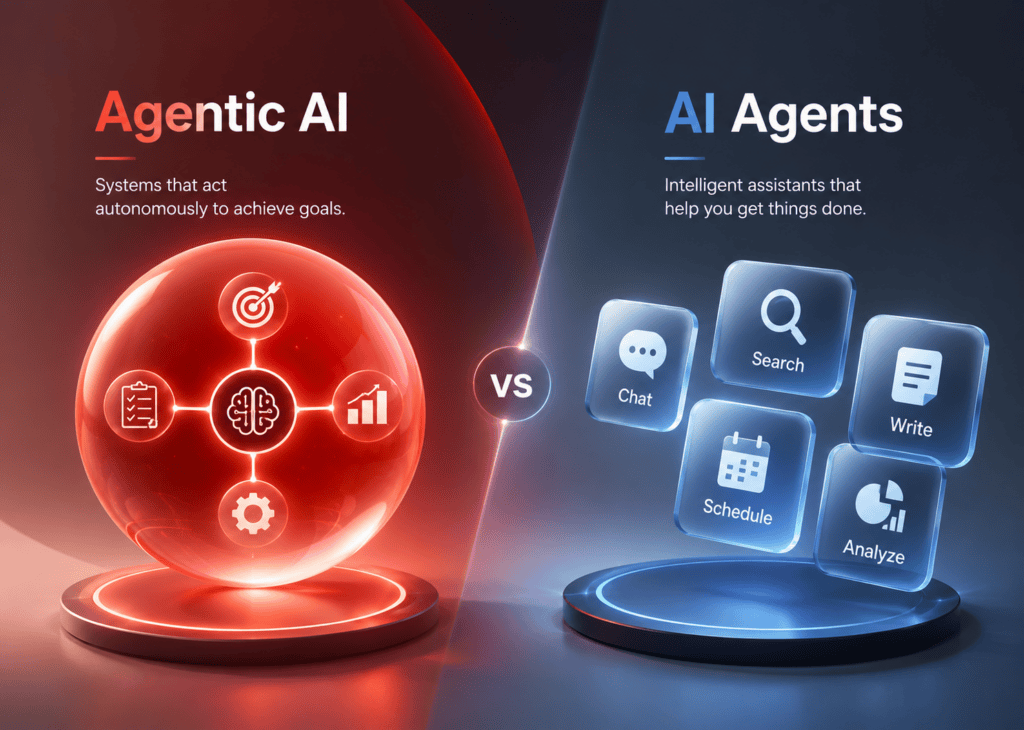
Agentic AI is a design approach where AI systems plan, call tools, and adapt across steps inside an orchestrated workflow governed by policies, state, and human-in-the-loop gates. In practice, teams build agentic workflows that combine a planner–executor pattern, tool use, memory/state, and an orchestrator that can pause for review, retry, or escalate.
Definition
Agentic AI is a design approach where AI systems plan, call tools, and adapt across steps inside an orchestrated workflow governed by policies, state, and human-in-the-loop gates.
Key Takeaways
- Treat agentic AI as workflows, not free-roaming autonomy.
- Make steps explicit, observable, and recoverable.
- Insert human gates where risk or ambiguity spikes.
What Are AI Agents?
AI agents are instantiated programs that attempt to achieve goals autonomously within an environment by planning, acting, and observing results until termination. A single agent can be useful for narrow, well-scoped tasks; multi-agent systems coordinate several agents with roles, negotiation, or shared memory.
Definition
AI agents are instantiated programs that attempt to achieve goals autonomously within an environment by planning, acting, and observing results until termination.
Key Takeaways
- Single agents shine on bounded, low-risk tasks.
- Multi-agent systems add coordination overhead; only add when necessary.
- Most production teams still wrap agents inside explicit workflows.
How Do Agentic AI vs AI Agents Differ Across the Autonomy Spectrum?
The difference is control and composability: agentic workflows prioritize explicit orchestration and human-in-the-loop, while AI agents prioritize autonomy within constraints. Think of a spectrum from scripts, to workflows, to autonomous agentic AI, to multi-agent systems.
| Dimension | Agentic workflows | Standalone AI agents |
|---|---|---|
| Control | Orchestrator and policies | Internal loop per agent |
| Human-in-the-loop | First-class gates | Optional or afterthought |
| Tool use | Orchestrated tool calling | Tool calling inside agent |
| Memory/state | Shared, queryable state | Agent-internal memory |
| Evaluation | Step-level metrics | Episode-level metrics |
| Best fit | Regulated, high-stakes flows | Low-risk, bounded tasks |
Key difference
Agentic workflows prioritize explicit orchestration, shared state, step-level evaluation, and human-in-the-loop. Standalone AI agents prioritize autonomous loops within constraints.
When Should You Choose Agentic AI vs AI Agents?
Choose agentic workflows by default when correctness, compliance, traceability, or cross-system coordination matter. Choose a single AI agent when tasks are low-risk, clearly bounded, and benefit from quick autonomous loops without orchestration overhead.
Use this decision checklist:
- Task ambiguity: High ambiguity favors an orchestrated planner–executor with human review; low ambiguity can fit a single agent.
- Risk and blast radius: Regulated or user-visible changes require gates; autonomous agentic AI is inappropriate without escalation paths.
- Tool surface area: Many tools or APIs favor workflows with explicit tool contracts and retries.
- Evaluation needs: If you must measure stepwise success, cost, and latency, prefer workflows.
- Team operations: If non-ML stakeholders need insight or approvals, human-in-the-loop is mandatory.
- Scale and iteration: If you expect rapid policy or prompt updates, workflows make changes safer to ship.
Decision tip
- Start with a workflow baseline; add autonomy where it demonstrably helps.
- Use autonomy as a dial: more for prototyping and bounded tasks, less for production-critical steps.
- Document gates, guardrails, and rollback before enabling self-directed loops.
What Architecture Patterns Work Best in 2026?
The most effective production setups center on planner–executor, reliable tool use, explicit memory/state, and an orchestrator such as LangGraph.
- Planner–executor pattern: A planner drafts a plan from the goal and context; executors run atomic steps; the orchestrator supervises retries and escalation.
- Tool use: Encode tools with strict input/output schemas and idempotency where possible; log every call for audits.
- Memory/state: Use short-term scratchpads for step context and long-term stores for artifacts, facts, and verdicts; keep state queryable.
- Orchestrator: Use a graph-based orchestrator to model branches, parallelization, and human review nodes.
- Models: Use Gemini or Gemma variants appropriate to task complexity and latency; bind them via tool-calling interfaces.
Example baseline (pseudo-workflow):
1) Ingest goal and constraints
Ingest goal and constraints; populate state.
2) Planner proposes steps and tools
Planner proposes steps and required tools.
3) Policy check
Policy check; if high-risk, require approval.
4) Executor calls tools
Executor calls tools; write outputs to state.
5) Evaluate step
Evaluate step; retry or escalate on failure.
6) Summarize and hand off
Summarize and hand off to next system or human.
Mid-article CTA for marketing builders: If you are orchestrating a content or ad-creative pipeline, agentic workflows can supervise AI generation, review, and localization steps. VidAU is an AI video ad platform that generates video ads from product URLs, images, or scripts in 49 languages. See tool endpoints your workflow might call: VidAU AI Video, Text to Video , URL to Video, UGC Avatars, Video Enhance, and Text to Speech.
Build Safer Creative Pipelines With Agentic Workflows
Use orchestrated workflows to call VidAU AI Video, Text to Video, URL to Video, UGC Avatars, Video Enhance, and Text to Speech as controlled steps in your content or ad-creative pipeline.
VidAU workflow
Where VidAU Fits In Agentic AI Workflows
- Use the orchestrator for control: Let the workflow define steps, state, retries, approvals, and policy gates before creative output is generated.
- Use specialized VidAU endpoints for generation: Call VidAU AI Video, Text to Video, URL to Video, UGC Avatars, Video Enhance, and Text to Speech as explicit workflow tools.
- Write outputs to shared state: Store generated videos, scripts, voiceovers, and review notes as artifacts that later steps can inspect.
- Add human approval before publishing: Require brand or compliance review before publishing ad-ready video outputs.
- Avoid free-roaming creative agents: A workflow that calls specialized endpoints is often simpler and safer than a standalone agent making unbounded publishing decisions.
What Is the Best Agentic AI for Coding Tasks?
There is no single best agentic AI for coding; instead, choose based on tool-calling reliability, repo-scale context, latency-cost tradeoffs, and your evaluation harness. Start with a workflow baseline and add a single coding agent only where autonomy beats stepwise control.
Criteria to prioritize:
- Tool-calling reliability: Structured calls for search, run, test, and diff; strict schema enforcement.
- Repo-scale context: Ability to ground decisions in docs, code index, and issue history.
- Evaluation harness: Golden tasks, mutation tests, and coverage checks for regressions.
- Guardrails: Permissions for write operations, protected branches, and human code review.
- Telemetry: Step success rate, flaky tool calls, hallucination events, and rollback counts.
If you still want a single agent baseline, limit scope to local refactors, test generation, or log triage, with a policy that escalates pull requests for human review.
How to vet the best AI agent course
If you are comparing the best ai agent course options, favor curricula that cover agentic workflows, evaluation metrics, guardrails, planner-executor, LangGraph-style orchestration, and human-in-the-loop patterns. Courses that only show autonomous loops without policies, tests, or rollback are incomplete for production use.
Coding workflow tip
Start with a workflow baseline for coding. Add a single coding agent only where autonomy beats stepwise control, and require human review for pull requests.
How Should You Evaluate and Guardrail Your System?
Treat evaluation and guardrails as first-class citizens from day one. Define metrics at both step and episode levels, and build automatic stop conditions.
Recommended evaluation metrics:
- Step success rate and episode completion rate
- Tool-call accuracy and schema-violation rate
- Cost and latency per step and per episode
- Hallucination or unsafe output rate
- Human escalation frequency and resolution time
Guardrail practices:
- Input and output validation with strict schemas
- Policy checks before write or external actions
- Least-privilege credentials for tools and repos
- Red-teaming critical flows and logging every action
- Human-in-the-loop approvals for high-risk steps
Guardrail tip
Define metrics at both step and episode levels, then enforce automatic stop conditions with schemas, policy checks, least-privilege credentials, red teaming, logging, and human approvals.
Common Mistakes and What To Do Instead
- Conflating workflows with agents: Build an orchestrated flow first; add agents inside it, not the other way around.
- Overusing autonomous agentic AI: Add autonomy only where gains are proven and rollback is safe.
- Missing state management: Centralize memory and artifacts; avoid burying state inside an agent.
- Tool sprawl: Define a small, reliable tool set with schemas and retries; prune aggressively.
- No eval harness: Ship with golden tasks and regression tests; expand coverage as the system evolves.
- Ignoring human-in-the-loop: Insert approvals at risk inflection points; remove only after stable evidence.
Mistake to avoid
Do not overuse autonomous agentic AI. Build an orchestrated flow first, centralize state, keep tools small and reliable, ship with an evaluation harness, and add autonomy only where gains are proven and rollback is safe.
Key takeaway
Final Thoughts
In 2026, production teams default to agentic workflows with clear policies, state, and human-in-the-loop. Use standalone AI agents for bounded, low-risk loops, and promote autonomy gradually as evaluation evidence accumulates.
If you are building a creative or marketing pipeline, an orchestrated flow that calls specialized endpoints is often simpler and safer than a free-roaming agent. For ad-ready video generation components, explore VidAU AI Video, URL to Video, Text to Video, UGC Avatars, VidAU Vid Remix, and Product Sample to Video.
FAQ
Here are answers to common questions about agentic AI vs AI agents, autonomous agentic AI, agentic workflows, standalone agents, planner–executor architecture, LangGraph-style orchestration, human-in-the-loop, best agentic AI for coding, best AI agent course options, evaluation metrics, multi-agent systems, and creative workflow applications.
What is the core difference between agentic AI and AI agents?
Agentic AI refers to orchestrated workflows that coordinate planning, tool use, state, and human review. AI agents are autonomous programs that pursue goals via plan–act–observe loops. In practice, teams use agentic workflows for control and traceability, and agents for bounded tasks where autonomy yields speed.
When should I prefer an agentic workflow over a standalone agent?
Prefer workflows when correctness, compliance, cross-tool coordination, or explainability matter. Workflows support human-in-the-loop gates, retries, and stepwise evaluation. Use a standalone agent only for low-risk, well-scoped tasks where the overhead of orchestration does not pay off.
What is autonomous agentic AI and when is it inappropriate?
Autonomous agentic AI describes systems that can plan and execute across steps with minimal human intervention. It is inappropriate for high-risk operations, irreversible writes, regulated actions, or ambiguous goals without clear rollback and escalation paths. Add autonomy only after guardrails and evaluation are in place.
Which architecture patterns are most reliable today?
A planner–executor pattern with strict tool schemas, shared memory/state, and a graph orchestrator such as LangGraph is the pragmatic core. Bind capable models like Gemini or Gemma through tool-calling interfaces, track metrics per step, and include human approval nodes for risk inflection points.
What is the best agentic AI for coding work?
There is no universal best. Evaluate by tool-calling reliability for run and test actions, repo-scale context grounding, cost–latency tradeoffs, and your evaluation harness. Start with a workflow baseline and restrict autonomous agents to bounded tasks like refactors or test generation with mandated code review.
How do I choose the best AI agent course?
Select a course that covers agentic workflows, planner–executor, tool use with schemas, shared state, evaluation metrics, guardrails, and human-in-the-loop. Hands-on projects using orchestrators like LangGraph and model families such as Gemini or Gemma are preferable to slideware or open-loop demos.
How do I implement human-in-the-loop without slowing everything down?
Gate only the risky steps, not every action. Use policy checks to auto-approve low-risk cases and route edge cases to reviewers. Provide reviewers with state, diffs, and recommended actions so approvals are fast. Measure escalation rates and continuously tune thresholds.
What evaluation metrics should I track from day one?
Track step success rate, tool-call accuracy, schema violations, latency and cost per step, hallucination or unsafe output rates, and human escalation frequency. These metrics reveal flaky tools, poor prompts, and unsafe autonomy early, before failures reach users or production systems.
Do multi-agent systems outperform single agents?
Sometimes, but only when coordination overhead is justified by specialization gains. Multi-agent systems make sense for decomposable tasks with clear role boundaries and shared state. Start simple with one agent inside a workflow; add agents when evidence shows bottlenecks a specialist can solve.
How can marketing or creative teams apply these patterns?
Wrap generation tools inside an orchestrated flow with policy checks and review. For example, call video generation, enhancement, and voiceover tools as steps, log outputs to state, and require brand or compliance approval before publishing. This approach balances speed with control.