AI Agent Marketplace · Evaluation, Pilots, Guardrails & Launch Workflows
AI Agent Marketplace: How to Evaluate, Choose, and Launch Your First Agents
Evaluate, choose, and launch your first agents with clear pilots, guardrails, KPIs, internal workflows, and marketplace review gates.
By the VidAU Editorial Team · AI agent marketplace guide · MuleRun demo-informed examples, human-in-the-loop controls, audit logs, orchestration, helpdesk compatibility, payment-processing guardrails, e-commerce visuals, BI reporting, and VidAU creative workflows
An AI agent marketplace promises plug-and-play AI workers, but the real wins come when you evaluate them like hires and pilot with clear review gates. In this guide, I share a practical rubric and launch plan shaped by hands-on marketplace demos, including MuleRun as a demo-informed example, so you can pick, test, and scale agents with confidence.
AI agent marketplace buyers want outcomes, not demos. The fastest path is to evaluate agents like hires, validate one or two real workflows, and scale what proves repeatable. I reviewed and analysed recent marketplace demos, including MuleRun as a demo-informed example, and the strongest pattern was simple: the system around the agents is where the value shows up.
If your pilot touches ad creatives or product visuals, VidAU is an AI video ad platform that generates video ads from product URLs, images, or scripts in 49 languages. Use it to supply high-quality visuals that your agents can pull into campaigns.
Quick Summary
- An AI agent marketplace is best evaluated with a hiring-style rubric covering data privacy, human-in-the-loop, audit logs, orchestration, and pricing transparency.
- MuleRun stands out in demos as a marketplace pattern to study, but your choice should hinge on verified workflows, not brand-led feature lists.
- Production pilots need clear inputs, outputs, review gates, and KPIs; do not assume ai agents for customer service compatible with any helpdesk without integration proofs.
- US-based entrepreneurs and small teams benefit most when they start with e-commerce visuals, content automation, or BI reporting where outputs are easy to check.
What Is an AI Agent Marketplace?
AI Agents, Clearly Explained
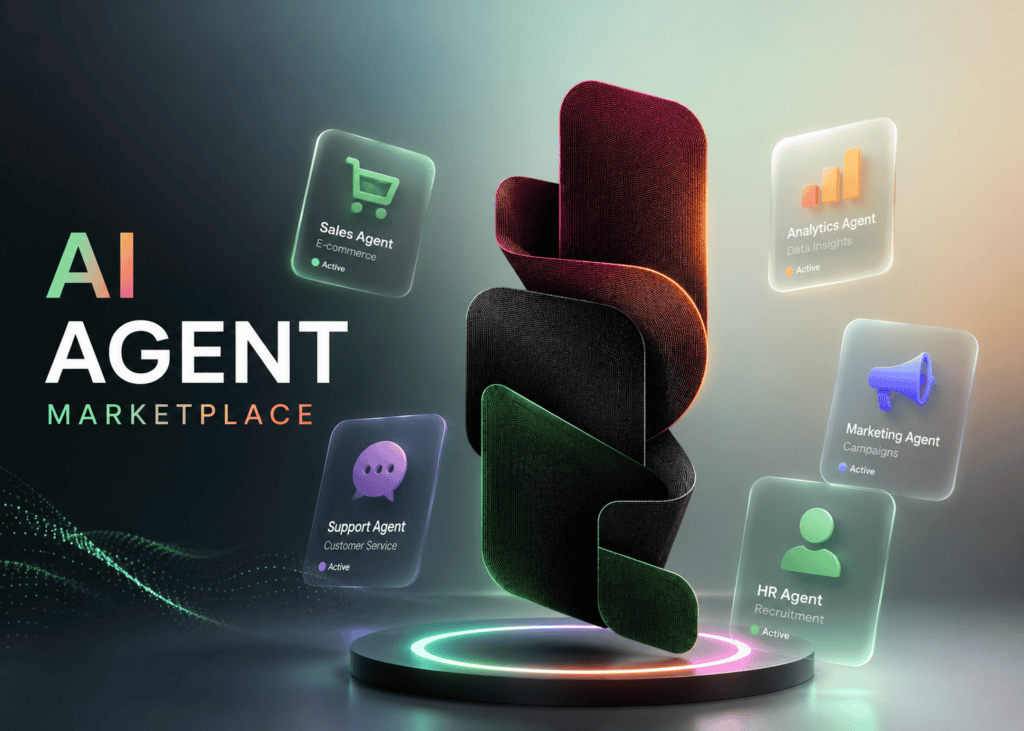
An AI agent marketplace is a store for AI workers you can hire for specific business tasks, from creative production and content operations to support and reporting. Instead of prompting a chatbot, you select prebuilt agents, connect your tools, define inputs and outputs, and run workflows with audit trails and optional human review.
Definition
An AI agent marketplace is a store for AI workers you can hire for specific business tasks, from creative production and content operations to support and reporting.
How should you evaluate an AI agent marketplace?
You should evaluate an AI agent marketplace like you would a contractor: verify safety, control, repeatability, and cost before scale. In our team’s review of marketplace demos, the winning factor was not a single feature but predictable workflows with clear review gates and logs.
| Criterion | Why it matters | How to verify |
|---|---|---|
| Data privacy | Protects PII and business data | Ask for data flow diagrams |
| Human-in-the-loop | Prevents bad outputs in prod | Check approval and rollback |
| Audit logs | Enables compliance and RCA | Confirm immutable event logs |
| Orchestration | Handles multi-step tasks | Inspect task graphs and retries |
| Integrations | Reduces glue work | See native apps and API limits |
| Pricing clarity | Avoids surprise bills | Separate agent fees vs tokens |
Rubric checklist
- Data privacy and residency: where data is stored, how long, and encryption at rest and in transit.
- Human-in-the-loop controls: staged approvals, safe defaults, and emergency stop.
- Audit logs: timestamped actions, prompts, outputs, and tool calls retained for investigation.
- Workflow orchestration: retries, timeouts, idempotency, and error routing.
- Helpdesk, CRM, and storage integrations: confirm scopes, rate limits, and permission boundaries.
- Pricing transparency: per-agent or per-seat fees vs token pass-through, and caps.
I reviewed marketplace examples where teams rushed to pick a single best agent; the more reliable wins came from a stack mindset: one agent for sourcing, one for transformation, one for QA. The system around them is where the value shows up.
Key Takeaways
- Treat agent selection like hiring: privacy, control, and logs first.
- Ask for a live demo of orchestration, approvals, and rollback.
- Separate platform fees from model token costs before you pilot.
How do you run a pilot for an e-commerce visual pipeline?

Start with a narrow, measurable workflow: product visual refresh for a small SKU set. Use agents for sourcing inputs, transforming assets, and QA, and keep a human approval step before publish.
- Inputs: product URLs, images, and target channels.
- Outputs: hero images, short product videos, and alt text.
- Review gates: brand compliance, spec checks, and variant coverage.
- KPIs: time-to-first-draft, approval rate, and CTR change after swap.
Practical steps
1) Define inputs and spec
Define inputs and spec: 1080×1350 images, 9:16 vertical videos, brand-safe copy.
2) Connect sources
Connect sources: store assets in a workspace folder the marketplace agent can read.
3) Generate visuals
Generate visuals: for video assets, create drafts with VidAU AI Video, Text to Video, or convert a product URL via URL to Video to give agents consistent source clips.
4) Transform and variant
Transform and variant: agents adapt aspect ratios and cutdowns; enhance quality with Video Enhancer if needed.
5) QA gate
QA gate: a separate QA agent checks specs and brand terms; human approves.
6) Publish and measure
Publish and measure: swap creatives on one channel, track CTR and ROAS deltas.
Mid-article CTA: If a creative bottleneck blocks your pilot, feed your agents with fast, on-brand visuals from VidAU AI Image and VidAU AI Video. Teams use these assets inside agent workflows to speed reviews.
Feed Your Agent Marketplace Pilot With On-Brand Visuals
Use VidAU AI Image, VidAU AI Video, Text to Video, URL to Video, Product Sample to Video, UGC Avatars, Vid Remix, Object Remover, Video Enhancer, and Text to Speech to supply high-quality creative inputs that agents can review, transform, and publish.
VidAU workflow
Where VidAU Fits In An AI Agent Marketplace Pilot
- Use the marketplace for agent selection and orchestration: Choose agents for sourcing, transformation, QA, BI reporting, support triage, or content automation based on verified workflows.
- Use VidAU AI Image and VidAU AI Video for creative inputs: Supply marketplace agents with consistent, on-brand visual assets that make QA easier.
- Use Text to Video, URL to Video, and Product Sample to Video for e-commerce pilots: Turn product URLs, product samples, and scripts into draft assets agents can adapt across channels.
- Use UGC Avatars, Vid Remix, Object Remover, and Video Enhancer for production polish: Create spokesperson pieces, repurpose longer clips, remove distracting objects, and improve quality before approval.
- Use Text to Speech for voice and accessibility: Add voiceovers to product, content, or support explainers before routing finished assets into marketplace workflows.
How do you deploy content automation agents with QA gates?
Content agents work best when the inputs are structured and the outputs are templated for channels.
- Inputs: a source article or product page.
- Outputs: social posts, thumbnails, short clips, and captions.
- Review gates: topical accuracy, claims policy, and brand voice.
- KPIs: time-to-publish, edit count per post, and engagement lift.
Steps to run
- Source and plan: a research agent extracts key points and approved links.
- Draft generation: a writing agent creates post variants; a separate agent drafts scripts.
- Creative production: turn scripts into shorts with Text to Video, or create spokesperson pieces with UGC Avatars and voiceovers via Text to Speech.
- Thumbnails and cuts: remix longer clips with Vid Remix; clean up frames with Object Remover if needed.
- QA and approvals: a fact-checking agent flags risks; human signs off.
- Schedule and measure: standardize UTM tags; compare engagement to baseline.
From our internal analysis of creator workflows, repeatability and render predictability beat a single best tool hunt. Assign agents to distinct jobs and bake QA into the pipeline.
Content workflow tip
Assign agents to distinct jobs: one for source extraction, one for drafting, one for creative production, one for QA, and one for scheduling. Repeatability and render predictability beat a single best tool hunt.
How do BI reporting agents get set up, measured, and reviewed?
BI agents shine when they read from stable sources, follow a fixed reporting cadence, and are confined to read-only scopes.
- Inputs: read-only connections to analytics, CRM, and finance exports.
- Outputs: daily or weekly summary reports, anomalies, and slides.
- Review gates: data freshness, source scopes, and anomaly thresholds.
- KPIs: on-time delivery rate, error rate, and analyst review time saved.
Steps to run
- Connect data: provision least-privilege API keys and restrict to read-only.
- Define report specs: metrics, date windows, and visualization rules.
- Schedule jobs: orchestrate runs with retries and timeout policies.
- QA agent: cross-check totals against a reference query or CSV.
- Delivery: send reports to Slack or email; maintain an audit log for every run.
I reviewed and analysed marketplace demos where teams tried dynamic, prompt-heavy BI; the more reliable approach used rigid templates with a small set of well-defined metrics and strict QA.
BI reliability note
Keep BI agents read-only, template-driven, and tied to strict QA. Rigid templates with a small set of well-defined metrics are more reliable than dynamic, prompt-heavy reporting.
What should you verify before assuming ai agents for customer service compatible with any helpdesk?
Do not assume ai agents for customer service compatible with any helpdesk. Treat compatibility as a hypothesis to prove with a live integration check and a staged rollout.
Verification checklist
- Supported helpdesk: confirm named integrations, required scopes, and SSO.
- Data scopes: restrict access to specific inboxes and redacted fields.
- Handoffs: ensure smooth escalate-to-human paths and SLAs.
- Guardrails: pre-approved macros, knowledge bases, and policy enforcement.
- Metrics: first response time, resolution accuracy, and deflection rate.
- Safety: PII handling, redaction, and transcript retention policies.
Start in a single queue with human shadowing and promote autonomy only after accuracy clears your threshold in audit logs.
Compatibility warning
Do not assume “compatible with any helpdesk.” Prove named integrations, scopes, SSO, handoffs, SLAs, guardrails, PII handling, and transcript retention in a live integration check before expansion.
What guardrails are essential for ai agents for payment processing chatbots?
Use minimal-trust design principles for ai agents for payment processing chatbots. Keep agents away from raw card data and route all payments through PCI DSS compliant processors.
Risk controls to implement
- Never collect or store full card data in chat; use hosted checkout links.
- Tokenize customer identity; scope API keys tightly and rotate often.
- Add mandatory human approvals for refunds, chargebacks, or credits.
- Log every tool call and response with immutable timestamps.
- Rate-limit financial actions; alert humans on anomalies.
- Fail safe: if a payment step misfires, the agent stops and escalates.
Agents can triage, collect intent, and hand off to secure payment flows; they should not handle sensitive payment instruments directly.
Payment guardrail
Agents can triage and collect intent, but they should not handle sensitive payment instruments directly. Route payments through PCI DSS compliant processors and fail safe on any payment misfire.
What does it cost and how do you measure ROI?
Expect two cost lines: marketplace platform fees and model token usage. Some marketplaces charge per agent or per seat, plus pass through token costs; others bundle. Demand explicit caps and alerts.
ROI calculator
- Baseline: current time per task x hourly rate x volume.
- Pilot: time-to-first-draft, approval rate, and rework hours.
- Net: baseline minus pilot time, plus platform and token costs.
For entrepreneurs and small teams, the fastest path to payback is a narrow workflow with measurable outputs and a weekly review, not a big-bang replacement of multiple roles.
Who should use an AI agent marketplace, and who should wait?
- Strong fit: ai agents for entrepreneurs who juggle e-commerce creatives, content pipelines, or weekly BI, and need reliable throughput with human approvals.
- Conditional fit: support teams exploring partial automation in specific queues, after verifying helpdesk scopes and safety.
- Wait or limit scope: highly regulated processes, sensitive finance flows, or ambiguous creative tasks without clear specs.
Where VidAU fits: if your pilot depends on product visuals or short ads, pair your marketplace with VidAU AI Video, Product Sample to Video, or URL to Video for consistent assets. Honest limitation: VidAU is not a helpdesk or payment platform, so use it for creative inputs, not customer support or transactions.
Best fit
AI agent marketplaces fit entrepreneurs and small teams best when workflows are narrow, repeatable, reviewable, and supported by human approvals. Use VidAU for creative inputs, not customer support or transactions.
Costs, KPIs, and your rollout checklist
KPIs to track weekly
- Throughput: tasks completed per week per agent.
- Quality: approval rate on first pass; edit count per output.
- Speed: time-to-first-draft and time-to-approval.
- Safety: incidents per 100 tasks; escalation rate.
- Cost: dollars per approved output, including tokens.
Rollout checklist
- Define one workflow, one channel, and one success metric.
- Provision least-privilege keys; enable audit logs and approvals.
- Run a shadow week: agents produce drafts; humans do the work.
- Flip to assisted mode: agents act, humans approve.
- Review KPIs; expand to a second queue or SKU set only after two steady weeks.
Key takeaway
Final Thoughts
Choosing an AI agent marketplace is less about a feature matrix and more about a pilot you can measure. Start narrow, insist on privacy, logs, and approvals, and scale only what proves repeatable.
If your pilot depends on e-commerce visuals or short ads, supply agents with consistent, on-brand assets from VidAU AI Video and VidAU AI Image so your QA gate passes faster.
CTA: Launch Agents
FAQ
Here are answers to common questions about an AI agent marketplace, fast evaluation, ai agents for customer service compatible with any helpdesk, first workflows, creative workflows, payment processing chatbot guardrails, costs, MuleRun, human-in-the-loop controls, and ai agents for entrepreneurs.
What is an AI agent marketplace?
An AI agent marketplace is a store for prebuilt AI workers you can hire for specific tasks. You connect your tools, define inputs and outputs, and run workflows with audit logs and optional human approvals. It moves beyond chat to production tasks like creatives, content, support triage, and reporting.
How do I evaluate an AI agent marketplace quickly?
Use a hiring-style rubric: confirm data privacy posture, human-in-the-loop controls, audit logs, workflow orchestration, integrations, and pricing transparency. Ask for a live demo showing approvals, rollback, and error handling. Separate platform fees from token costs and require caps before piloting.
Are ai agents for customer service compatible with any helpdesk?
Do not assume ai agents for customer service compatible with any helpdesk. Verify named integrations, scopes, rate limits, and SSO. Test in a single queue with staged human approvals, ensure smooth escalate-to-human paths, and track accuracy and deflection rates with audit logs before expanding.
What are good first workflows to pilot?
Pick narrow, reviewable tasks: e-commerce visual refreshes for a few SKUs, content repurposing to three channels, or a weekly BI report. Define inputs, outputs, approval gates, and KPIs like time-to-first-draft, approval rate, and error rate. Expand only after two steady weeks of metrics.
How should I handle creatives inside agent workflows?
Provide consistent, on-brand assets up front. Generate product clips via tools like VidAU’s Text to Video (https://www.vidau.ai/text-to-video/) or URL to Video (https://www.vidau.ai/url-2-video/), clean footage with the Video Enhancer (https://www.vidau.ai/vidau-video-enhancer/), and use a QA agent to check specs and brand terms before publish.
What guardrails do payment processing chatbots need?
Keep agents away from raw card data. Use hosted checkout links, strict API scopes, immutable logs, rate limits, and human approvals for refunds or credits. Tokenize identities and rotate keys. Fail safe: if a step misfires, the agent stops and escalates to a human immediately.
How much do marketplaces cost?
Expect platform fees plus model token usage. Some charge per agent or seat with separate token pass-through; others bundle. Demand usage alerts, monthly caps, and clear overage rules. Calculate ROI as baseline labor time minus pilot time, plus platform and token costs.
What is MuleRun in this context?
MuleRun is a demo-informed example of an AI agent marketplace model highlighted in public videos. Treat it like any option: verify privacy, approvals, logs, orchestration, integrations, and pricing. Choose based on proven workflows, not just features or marketing claims.
What is human-in-the-loop and why does it matter?
Human-in-the-loop means a person must approve certain agent actions before they affect customers or data. It reduces risk, raises output quality, and creates a clear training path as agents learn your rules. Require staged approvals during pilots and keep them for high-impact actions.
Which teams benefit most from ai agents for entrepreneurs?
Solo founders and small US teams running e-commerce, content, or BI get quick wins. The work is repeatable, outputs are reviewable, and KPIs are straightforward. Start with a narrow pilot, then scale to adjacent workflows once throughput and approval rates stabilize.