Agentic AI Frameworks · LangChain, LangFlow, LlamaIndex, Ollama & Hugging Face
Best Agentic AI Frameworks in 2026: LangChain, LangFlow, LlamaIndex, Ollama, Hugging Face
A practical comparison showing when to pick LangChain, LangFlow, LlamaIndex, Ollama, or Hugging Face for AI agents, tool use, RAG, local inference, and rapid demos.
By the VidAU Editorial Team · Agentic AI frameworks guide · LangChain, LangFlow, LlamaIndex, Ollama, Hugging Face Transformers, RAG, MCP, local models, visual prototyping, tool orchestration, and VidAU creative workflows
Evaluating agentic AI frameworks in 2026? This practical comparison shows exactly when to pick LangChain, LangFlow, LlamaIndex, Ollama, or Hugging Face for AI agents, tool use, and Retrieval-Augmented Generation and how they fit together without rework.
The Best Agentic AI frameworks in 2026 for real builds are LangChain, LangFlow, LlamaIndex, Ollama, and Hugging Face Transformers. Together, they cover orchestration and tools, visual prototyping, Retrieval-Augmented Generation, local inference, and model breadth. If you need AI agent frameworks that ship, pick a stack that combines these strengths rather than betting on one library.
In under 60 minutes, you can validate a working agent by pairing Ollama for local models, LlamaIndex for RAG, and LangChain or LangFlow for tools and orchestration. This guide is for US-based engineers, data scientists, and product builders choosing the best AI agent frameworks 2026 for shipping agents that use tools and your data.
CTA:Try VidAU AI Agent Out Now
Quick Summary
- LangChain plus LlamaIndex and Ollama (or Hugging Face) is the fastest 2026 stack for agent tool use and RAG.
- LangFlow is the strongest alternate when teams want drag-and-drop prototyping and quick demos before coding.
- RAG via LlamaIndex and a vector store plus LangChain Agents for tool calls is the standard pattern for productionizing agents.
- Teams building privacy-sensitive, local-first agents or rapid POCs benefit most from Ollama-powered stacks.
What Are Agentic AI Frameworks?
Agentic AI frameworks are developer libraries and tools that help you build AI agents capable of reasoning, using tools and APIs, and grounding outputs on your data via Retrieval-Augmented Generation. They provide orchestration primitives, tool abstractions, memory or state patterns, and connectors that reduce boilerplate and speed up iteration.
Definition
Agentic AI frameworks are developer libraries and tools that help build agents capable of reasoning, using tools and APIs, and grounding outputs on data through Retrieval-Augmented Generation.
Why do these five frameworks dominate in 2026?
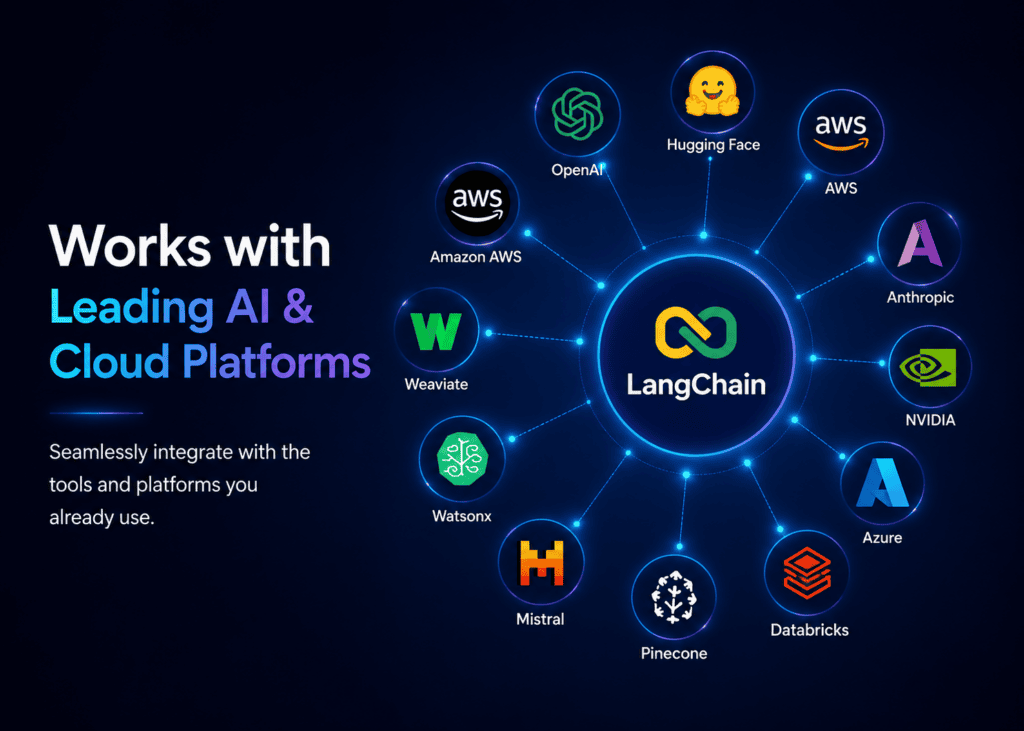
They collectively solve the core build problems: orchestration and tools (LangChain), visual prototyping (LangFlow), RAG and data graphs (LlamaIndex), local runtime (Ollama), and model breadth via Transformers APIs (Hugging Face). Each plays a distinct role, and they stack well.
Our team reviewed Runway’s May 2026 MCP push that exposes generation features to assistants like Claude and ChatGPT. The takeaway for developers: agent tooling is moving into assistant call-chains, so frameworks with clean tool abstractions and runtime flexibility win. I also reviewed Tech With Tim’s frameworks overview; the five here mirror what practitioners actually use for build-ready agents, not just research demos.
Key Takeaways
- The winning stacks combine orchestration, RAG, and flexible runtime.
- Assistant ecosystems (e.g., MCP) reward clean tool wrappers.
- Visual prototyping accelerates iteration, then code hardens it.
How should you choose among Agentic AI Frameworks?
Start from decision criteria aligned to 2026 builds:
- Orchestration and tools: Choose LangChain when you need structured tool use, Agents, and chains in code.
- Visual prototyping: Choose LangFlow to drag-and-drop graphs, debug flows, and share demos.
- RAG and data graphs: Choose LlamaIndex for connectors, indexing, query pipelines, and graph-based retrieval.
- Local runtime: Choose Ollama to run models on developer machines or private servers.
- Model breadth and standard APIs: Choose Hugging Face Transformers when you need custom models or portable inference patterns.
Selection tip
Do not bet on one library. Choose by layer: LangChain or LangFlow for orchestration, LlamaIndex for RAG, and Ollama or Hugging Face for runtime and model access.
What is the fastest quick start to a working agent?
This 6-step flow gets a minimal agent working with your data and tools:
1) Environment
Create a fresh Python environment. Install LangChain, LlamaIndex, and your chosen model runtime (Ollama or Transformers).
2) Base model
Start with a small local model via Ollama or a readily available Transformers model. Keep context modest while prototyping.
3) Data ingestion (RAG)
Use LlamaIndex to index a small doc set. Build a simple query pipeline that returns top-k chunks.
4) Tools
Add one or two high-signal tools in LangChain: a search function over your index and a safe calculator or retrieval tool.
5) Orchestrate
Wrap the model plus tools in a LangChain Agent or a LangFlow graph. Route user prompts to either RAG retrieval or tool calls.
6) Test
Run a short script or LangFlow session to validate: the agent answers using retrieved context and only calls whitelisted tools.
How do LangChain and LangFlow differ for Agentic AI Frameworks?
LangChain is a code-first orchestration library focused on chains, tools, and agents; LangFlow is a visual builder for constructing and debugging similar flows with a drag-and-drop UI.
| Framework | Best for | Why |
|---|---|---|
| LangChain | Code orchestration | Strong tools and agents |
| LangFlow | Visual prototyping | Drag-and-drop, quick demos |
| LlamaIndex | RAG over data | Connectors and query graphs |
| Ollama | Local runtime | Fast local model serving |
| Hugging Face | Model breadth | Transformers APIs and models |
Key Takeaways
- Use LangChain to ship code; use LangFlow to iterate fast.
- Keep visual graphs for demos and debugging even after coding.
- Both interoperate well with LlamaIndex RAG and Ollama/HF runtimes.
When should you pick LlamaIndex, Ollama, or Hugging Face?
Pick LlamaIndex when you need deep RAG, complex retrieval pipelines, and connectors. Pick Ollama when privacy, offline development, or local-first POCs are priorities. Pick Hugging Face Transformers when you need custom model selection, portability, or unified APIs across many models.
Choose-this-when map
- Local-first POCs or privacy: Ollama
- Deep RAG over your data: LlamaIndex
- Multi-tool agent control: LangChain
- Drag-and-drop demos and iteration: LangFlow
- Custom model selection and portability: Hugging Face
Choose-this-when tip
Pick Ollama for local-first POCs, LlamaIndex for deep RAG, LangChain for multi-tool control, LangFlow for drag-and-drop iteration, and Hugging Face for custom model selection and portability.
What stack recipes work best for agents, tool use, and RAG?
Use these proven recipes to avoid rework:
Minimal Local Agent (fast POC)
- Ollama for local model runtime
- LlamaIndex to index a small doc set
- LangChain Agent with retrieval and one safe tool
RAG-First Production Candidate
- LlamaIndex query pipeline with reranking
- LangChain for tool orchestration and guardrails
- Transformers or Ollama for inference, depending on infra
Visual Demo to Code Handoff
- Build and debug in LangFlow
- Replicate flow in LangChain code
- Swap models via Ollama or Transformers without changing the graph logic
Mid-article CTA: If your agents need to output ad-ready creatives, VidAU can help. VidAU is an AI video ad platform that generates video ads from product URLs, images, or scripts in 49 languages. Explore Text to Video , URL to Video VidAU AI Video UGC Avatars Video Enhancer , and Text to Speech
Turn Agent Outputs Into Ad-Ready Creatives With VidAU
If your agents need to output ad-ready creatives, use VidAU AI Video, Text to Video, URL to Video, UGC Avatars, Video Enhancer, and Text to Speech to turn product URLs, images, or scripts into video ads in 49 languages.
VidAU workflow
Where VidAU Fits In Agentic AI Framework Workflows
- Use LangChain or LangFlow for orchestration: Route the agent through tools, retrieval, and runtime choices with either code-first or visual flows.
- Use LlamaIndex for RAG: Ground responses on your data with indexing, query pipelines, connectors, and reranking.
- Use Ollama or Hugging Face for model runtime: Run local-first models, private-server inference, or custom Transformers-based models depending on infrastructure needs.
- Use VidAU AI Video, Text to Video, and URL to Video for creative output: When the agent produces scripts, product pages, or ad briefs, turn those outputs into videos.
- Use UGC Avatars, Video Enhancer, and Text to Speech for polish and localization: Create spokesperson-style clips, improve output quality, and add voiceovers for campaigns generated from agent workflows.
What common mistakes should builders avoid?
The most common mistakes are over-engineering early and skipping retrieval quality. Start with one agent plus two tools, not multi-agent sprawl. Index a few clean, high-signal documents first; verify the agent cites retrieved context. Avoid mixing too many models or embeddings until the core loop is stable.
Other pitfalls to watch:
- Tool bloat without strict whitelists and timeouts
- Loose RAG chunking that returns irrelevant text
- No offline test prompts or eval set for regression checks
- Assuming a single framework will solve every layer of the stack
Mistake to avoid
Do not start with multi-agent sprawl. Start with one agent, two tools, clean high-signal documents, strict whitelists, timeouts, and a small offline eval set.
What advanced strategies matter in 2026?
Two areas stand out: assistant ecosystems and retrieval quality. From our internal analysis of public announcements like Runway’s MCP push to assistants, we expect more tools to be invoked from agent call-chains. Prioritize frameworks that make tool registration, safety, and routing explicit.
For retrieval, favor query pipelines and reranking in LlamaIndex rather than raw vector search. Keep orchestration in LangChain or LangFlow, and use Ollama or Transformers for flexible runtimes. Add lightweight evaluation harnesses so changes to prompts, chunking, or tools are measured before shipping.
Advanced strategy
Prioritize explicit tool registration, safety, routing, query pipelines, reranking, and lightweight evaluation harnesses so changes to prompts, chunking, or tools are measured before shipping.
Who is each framework best for?
- LangChain: Teams needing precise tool orchestration, guards, and code-first control.
- LangFlow: PMs and engineers prototyping flows visually and sharing quick demos.
- LlamaIndex: Data teams building reliable RAG pipelines and connectors.
- Ollama: Privacy-first orgs and local POCs that must run without external calls.
- Hugging Face Transformers: Builders who need custom models and portable APIs.
Key takeaway
Final Thoughts
If you want agents that actually ship, don’t pick a single library; pick a stack. In 2026, the pragmatic default is LangChain or LangFlow for orchestration, LlamaIndex for RAG, and Ollama or Hugging Face for models.
If your agents need to produce marketing-ready videos or assets, explore VidAU’s creation tools like Text to Video and URL to Video to automate outputs alongside your agent workflows.
FAQ
Here are answers to common questions about agentic AI frameworks, the best agentic AI framework in 2026, LangChain, LangFlow, LlamaIndex, Ollama, Hugging Face Transformers, RAG, native vector search, local agents, hosted APIs, multi-agent systems, production evaluation, MCP, and rapid demo stacks.
What are agentic AI frameworks?
Agentic AI frameworks are developer tools that help build AI agents capable of reasoning, using tools and APIs, and grounding responses on your data. They provide orchestration, tool abstractions, memory or state patterns, and RAG connectors so you can assemble agents faster and with less boilerplate.
Which is the best agentic AI framework in 2026?
No single library covers every need. A practical 2026 stack is LangChain or LangFlow for orchestration, LlamaIndex for RAG, and Ollama or Hugging Face Transformers for models. This combination delivers tool use, retrieval over your data, and flexible runtime without locking into one layer.
How do LangChain and LangFlow differ?
LangChain is code-first and ideal for agents, tools, and precise orchestration in production code. LangFlow is a visual builder that speeds up demos, debugging, and stakeholder reviews. Many teams prototype in LangFlow and then translate the final graph to LangChain code when hardening.
Can I run agents locally with Ollama?
Yes, Ollama is well-suited for local-first development and privacy-sensitive environments. Use it to run models on developer machines or private servers, then connect orchestration via LangChain or LangFlow and retrieval via LlamaIndex to keep data on your infrastructure during POCs.
When should I use LlamaIndex versus native vector search?
Use LlamaIndex when you want connectors, indexing, and query pipelines that go beyond raw vector similarity. It helps with chunking, metadata, reranking, and graph-style retrieval. If you already have a reliable vector database flow, LlamaIndex can still orchestrate higher-quality queries on top.
Should I choose Hugging Face Transformers or hosted APIs?
Choose Hugging Face Transformers when you need custom model selection, fine control over inference, or portability across environments. Hosted APIs are fine for speed and simplicity, but Transformers give standardized local interfaces and broader model access when infra control matters.
Do I need multi-agent systems to get value?
Not initially. Most teams get further faster with a well-scoped single agent using a few high-signal tools and solid RAG. Add multi-agent patterns only after you have measurable wins and a lightweight eval harness to prove each additional agent improves outcomes.
How do I evaluate an agent before production?
Create a small, repeatable eval set of prompts and expected behaviors. Measure groundedness with RAG on/off, track tool call success rates, and verify latency is acceptable for your use case. Run the suite whenever you change models, prompts, chunking, or tools to avoid regressions.
Are assistant ecosystems like MCP relevant to framework choice?
Yes. Public moves toward assistant-callable tools suggest frameworks with clean tool registration, strict whitelists, and timeouts will age better. Prioritize LangChain or LangFlow for explicit tool orchestration and plan to expose critical capabilities as stable, testable tools the agent can call.
What is the best AI agent framework stack for rapid demos in 2026?
For rapid demos, use LangFlow to design the flow, LlamaIndex for quick RAG over a small document set, and Ollama for a local model. This combination minimizes setup friction while keeping a clear path to transition the visual graph into LangChain code later.