VidAU Editorial · AI Search
Best AI Models 2026: GPT-5.2 vs Gemini 3 vs Claude vs Grok — Which Should You Use?
Choosing the best AI model in 2026? See how GPT-5.2, Gemini 3/Pro, Claude, and Grok compare for coding, multimodal (image/video), real-time use, hallucinations, and value—plus clear picks by task.
By the VidAU Editorial Team · Reviewed before publishing
Looking for the best AI models 2026 choice for your actual workload? Instead of endless demos, use task-based picks: coding and agents, multimodal image/video, real-time knowledge work, safety/reasoning, and budget/API. This best ai models 2026 gpt-5 claude gemini comparison gives you clear winners by job-to-be-done.
If you are trying to pick the best ai models 2026 for real work, stop testing everything and match the model to the task. Below, we name winners for coding/agents, multimodal image/video, real-time work, safety/reasoning, and budget/API—with concrete workflows to get started today.
Quick Summary
• Coding and agents: GPT-5.2 is the default pick in 2026 for robust tool use, repo-scale refactors, and ecosystem depth.
• Multimodal: Gemini 3 Pro is the strongest alternate for image understanding, sketch-to-code, and 2026 multimodal pipelines.
• Platform constraints: Real-time web tasks require browsing/tool use enabled (e.g., Grok 4.1), while careful drafting benefits from safety-focused models like Claude.
• Best fit: Developers, creators, teams, and students who choose by job-to-be-done see faster results and fewer hallucinations.
What Is an AI Model in 2026?
An AI model in 2026 is a large language model (LLM) or multimodal AI system that processes text, code, and often images, audio, or video to generate answers, content, or actions. Leading models—GPT-5.2, Google Gemini 3/Pro, Claude, and Grok—vary in reasoning style, tool use, real-time capabilities, and ecosystem depth, so the best choice depends on your task.
The Best AI Models 2026: Winners by Job-to-be-done
Use this quick matrix to choose the right model without weeks of ad-hoc testing.
• Stage: Coding & agents
Recommended Tools: GPT-5.2
Why: Strong tool use and ecosystem depth
• Stage: Multimodal (image/video)
Recommended Tools: Gemini 3 Pro
Why: Multimodal powerhouse; sketch-to-code
• Stage: Real-time/web tasks
Recommended Tools: Grok 4.1
Why: Fast retrieval and live context
• Stage: Safety/reasoning
Recommended Tools: Claude
Why: Careful reasoning; lower-risk drafts
• Stage: Budget/API automation
Recommended Tools: GPT-5 family
Why: Mature APIs; broad integrations
• Stage: General assistant
Recommended Tools: Any of the four
Why: Pick by your primary task
Suggested Visual: A one-page decision flowchart that routes tasks to each model.
Why task-based picks beat one-size-fits-all
• Models make different trade-offs: speed vs depth, creativity vs caution, real-time vs offline reasoning.
• Your workload matters: repo refactoring is not the same as live market monitoring.
• Consistency wins: one model may be best for daily coding, while another handles your weekly policy-safe report.
GPT-5.2: The Ecosystem-first Coding and Agents Pick – Best AI Models 2026
Best for
• Refactoring large repos with tool use
• Multi-step coding tasks, test generation, and CI assistance
• Agentic workflows across planning, code edits, and verification
Strengths
• Ecosystem depth: mature APIs, broad library support, and stable dev tooling.
• Agent readiness: handles multi-tool chains, from retrieval to code execution.
• Coding reliability: tends to follow spec-driven prompts and structured test scaffolds.
Watch-outs
• Requires clear guardrails for external actions; always review diffs and test results.
• Hallucinations drop with good specs and verification, but never skip reviews.
Example workflow: repo refactor with tool use
• Input: Monorepo + refactor brief + quality gates (lint, tests).
• Model capability: Plan-by-file changes, generate patches, run tests, summarize failures, iterate.
• Output: PR with rationale, changelog, and test artifacts for human review.
Key Takeaways
• Treat GPT-5.2 as your default for coding and agent workflows.
• Combine strong prompts with explicit success criteria and automated checks.
• Keep a human-in-the-loop for merges and production deployment.
Suggested Visual: A swimlane diagram of an agent calling retrieval, code-edit, and test tools.
Gemini 3 / Gemini 3 Pro: the Best Multimodal AI 2026 for Image and Sketch-to-code
Best for
• Interpreting screenshots, mockups, charts, or whiteboard photos
• Sketch-to-UI code and multimodal research assistance
• Image reasoning alongside text and code
Strengths
• Multimodal powerhouse: natural with images plus text-based reasoning.
• Front-end workflows: turn sketches or Figma exports into structured UI code.
• Document vision: reads tables, charts, and diagrams with useful structure.
Watch-outs
• Video generation remains a fast-moving space; pair with dedicated video models when needed.
• For complex coding beyond UI, pair with robust test specs or a coding-focused model.
Example workflow: turn a whiteboard sketch into UI code
• Input: Photo of a whiteboard wireframe + component library rules.
• Model capability: Identify layout, map to design system, emit React/Vue components.
• Output: Clean starter UI with TODOs for state management and accessibility.
Brief note on video: creators increasingly test Hailuo, Wan, Kling 3.0, Seedance 1.5 Pro, Seedance 2.5, and Veo 3.1 alongside Gemini 3 for end-to-end image/video pipelines. Treat these as complementary options to cover complex motion, lip-sync, or style needs.
Where VidAU AI fits
• If the deliverable is ad-ready short-form video, feed a product URL, product images, or a script into VidAU AI to draft shoppable creative for TikTok, Meta, or YouTube. Then refine with your brand voice and run creative tests.
Grok 4.1: the Real-time, Web-first Operator – Best AI Models 2026
Best for
• Live market digests, trending topics, and news-aware drafts
• Rapid source scanning with concise summaries
• Lightweight research that benefits from up-to-date context
Strengths
• Real-time orientation: quick at pulling in current signals and providing context.
• Terse, practical summaries that point you to relevant sources.
• Handy for social monitoring, headline briefs, and operational alerts.
Watch-outs
• For deep reasoning or long-form policy writing, move to a safety-focused model.
• Validate sources and quotes; use citation checks for important outputs.
Example workflow: live market digest with sources
• Input: Tickers, sectors, and watchlist topics.
• Model capability: Scan recent coverage, cluster signals, draft a 5-minute brief.
• Output: Bullet digest with source attributions and suggested follow-ups.
Claude: Careful Reasoning and Lower-risk Drafting – Best AI Models 2026
Best for
• Policy-safe executive summaries and research memos
• Careful reasoning with lower hallucination risk
• Sensitive communications, guidelines, and compliance-adjacent writing
Strengths
• Safety-first posture: pushes for clarity, caveats, and source framing.
• Structured reasoning: helpful when you want transparent chains of thought in outlines.
• Strong at turning messy notes into coherent, conservative drafts.
Watch-outs
• For highly creative or speculative tasks, outputs can be more restrained.
• For heavy coding or agent chains, you may prefer a model tuned for tool use.
Example workflow: policy-safe executive summaries with citations
• Input: PDFs, briefs, and data excerpts.
• Model capability: Extract key points, cross-check claims, flag risks/policy issues.
• Output: Executive memo with citations, assumptions, and open questions.
Multimodal Video in 2026: What Creators Actually Test – Best AI Models 2026
If your workflow spans images and video, you will likely mix models. Beyond Gemini 3 for multimodal reasoning, creators test Hailuo, Wan, Kling 3.0, Seedance 1.5 Pro, Seedance 2.5, and Veo 3.1 for motion quality, character consistency, and style control. There is no definitive ranking—try a small storyboard across two or three and compare by storyboard fidelity, motion smoothness, and editability.
How to Choose the Best AI Models 2026 for Your Stack
Use this evaluation checklist instead of vague side-by-sides:
• Define the job: coding/agents, multimodal image/video, real-time tasks, or safety-first drafting.
• Specify constraints: latency targets, citation requirements, compliance posture, and review steps.
• Tool access: confirm browsing, code execution, file size limits, and image/video handling.
• Verification: plan tests, linters, type checks, and citation audits before rollout.
• Data boundaries: decide what can leave your environment and what must stay local.
• Human-in-the-loop: mandate sign-off for merges, publishing, or ad spend.
Key Takeaways
• Pick one primary model per job-to-be-done; avoid constant context switching.
• Document your prompts, input formats, and success criteria.
• Start with a 1–2 week pilot, measure quality and effort saved, then scale.
Task-to-Model Playbook (with example prompts) Best AI Models 2026
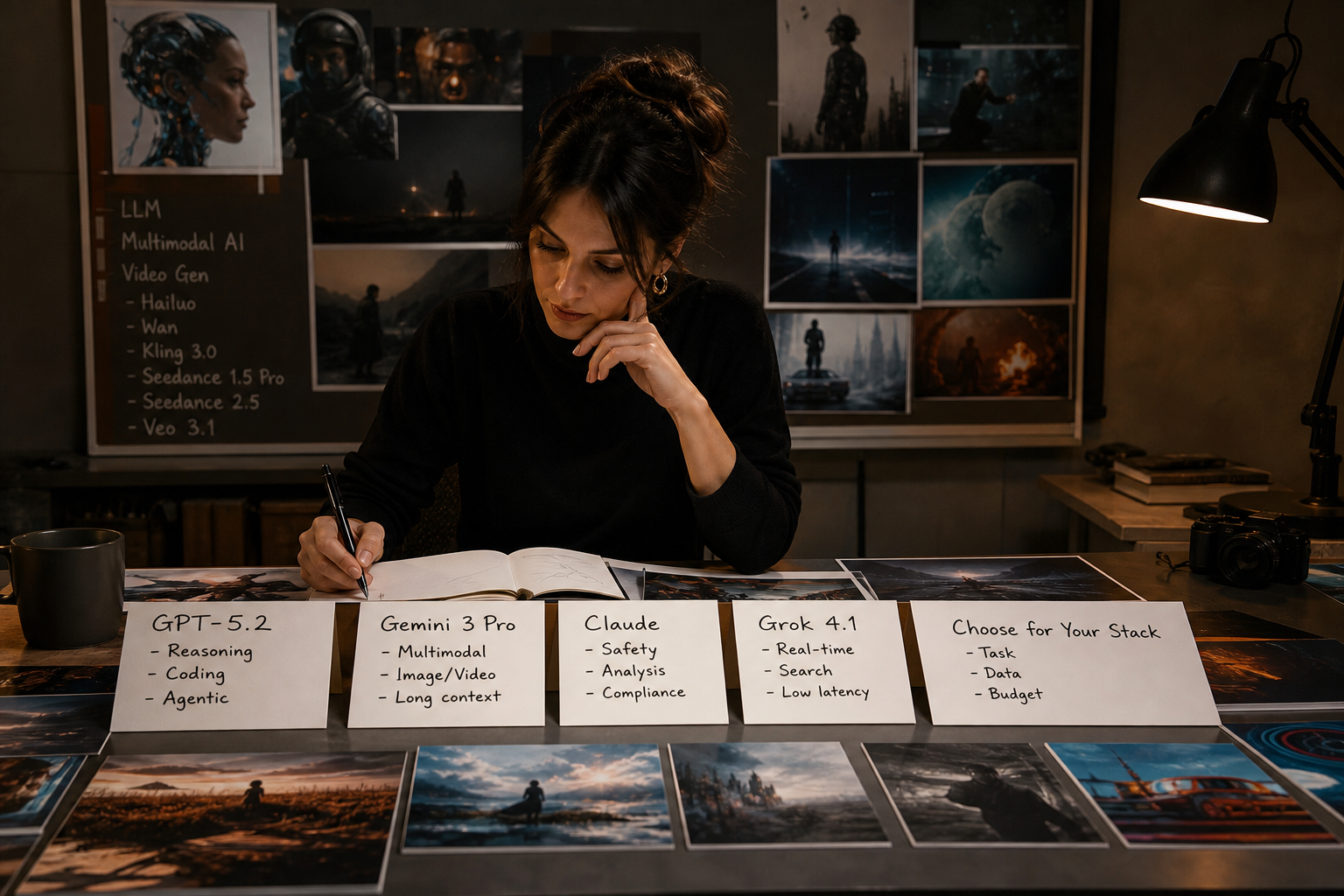
• Coding & agents → GPT-5.2
• Prompt idea: Audit this monorepo, propose a refactor plan, generate patches per package, run tests, and summarize failures with fixes.
• Multimodal (image/UI) → Gemini 3 Pro
• Prompt idea: Convert this whiteboard photo into responsive components using our design tokens; list assumptions and accessibility notes.
• Real-time briefs → Grok 4.1
• Prompt idea: Compile a 5-minute sector update from the last 24 hours; cite sources and flag contradictions.
• Safety/reasoning → Claude
• Prompt idea: Draft a policy-safe executive summary from these PDFs; list claims with citations, risks, and items needing legal review.
Create With VidAU
Turn scripts, product URLs, and creative ideas into ad-ready video assets with a structured AI workflow.
Key takeaway
Final Thoughts
There is no single winner for the best ai models 2026—it depends on the job. Use GPT-5.2 for coding and agents, Gemini 3 Pro for multimodal image/UI work, Grok 4.1 for real-time tasks, and Claude for careful reasoning and lower-risk drafts. Start with a small, well-scoped pilot for each task and track quality and effort saved.
If your output is ad-ready short video, pair your chosen model with VidAU AI to turn a product URL, product images, or a script into testable shoppable creative—then iterate based on performance.
Frequently asked questions
What is the best ai model 2026 for coding and agents?
GPT-5.2 is a strong default for coding and agentic workflows thanks to ecosystem depth, reliable tool use, and mature APIs. Use it for repo refactors, test generation, and CI assistance, but keep human review for merges and production deployments. Clear specs and automated checks reduce hallucinations and errors.
Which is the best multimodal ai 2026, and is Gemini 3 Pro worth it?
For multimodal image understanding and sketch-to-code, Gemini 3 Pro is often the best pick in 2026. It handles screenshots, charts, and whiteboard photos naturally. For deeper video needs, pair it with specialized video models while keeping Gemini for image reasoning and UI code generation.
GPT-5.2 vs Gemini 3 vs Claude vs Grok 4.1: which hallucinates the least?
Hallucinations depend on task and prompts. Claude tends to draft more cautiously and is preferred for lower-risk summaries. GPT-5.2 does well when specs and tests are explicit. Grok is useful for real-time briefs but requires source validation. Gemini 3 excels at image reasoning but still benefits from citation checks.
Which AI model is best for real-time or web-informed tasks in 2026?
Grok 4.1 is a solid choice for real-time tasks, live trend scans, and quick market digests. It is oriented toward current context and concise summaries. For high-stakes outputs, validate sources and consider handing long-form or policy-sensitive writing to Claude for careful reasoning and framing.
What is the best ai model 2026 for students or policy-safe writing?
Claude works well for students, researchers, and teams that need careful, lower-risk drafts. It structures arguments clearly, flags uncertainties, and encourages citations. For data-heavy appendices or code snippets, combine Claude’s summaries with a secondary model tuned for computation or verification.
Is there a single best ai model 2026 for everything?
No. Recent comparisons show winners by task: GPT-5.2 for coding/agents, Gemini 3 Pro for multimodal image/UI work, Grok 4.1 for real-time briefs, and Claude for safety/reasoning. Map tasks to models, run small pilots, and measure output quality and iteration time before standardizing your stack.
How should I choose an API for automation and value in 2026?
Start with your workload: throughput needs, latency targets, and verification steps. The GPT-5 family offers broad integrations for automation. If real-time context matters, include Grok in tests. For compliance-friendly drafting, test Claude. Compare by stability, tool access, and monitoring/observability rather than headline claims.
Which models should creators use for video or image workflows?
Use Gemini 3 for image reasoning and UI scaffolding. For video, creators commonly test Hailuo, Wan, Kling 3.0, Seedance 1.5 Pro, Seedance 2.5, and Veo 3.1 to balance motion quality, consistency, and style. There is no fixed winner—prototype the same storyboard across two or three models and compare.
Do I need agents or tool use enabled for coding tasks?
Yes. For repo-scale work, enable retrieval, code editing, and test execution tools. GPT-5.2 handles multi-tool chains well, but results hinge on strong specs, lint/test gates, and human review. Keep the model’s permissions scoped, require diffs, and log each tool call for auditability.
What prompts work best for task-based model selection?
Write prompts that mirror your deliverable and constraints: success criteria, input/output formats, length, citations, and review steps. For coding, specify tests and acceptance criteria. For multimodal, describe layout rules and design tokens. For real-time briefs, set time windows and citation requirements.