Meta Ads Automation · Claude Code + VidAU
How to Create an Advertisement That Works: A Complete Guide to Automating Meta Ads with Claude Code
Automate your entire Meta Ads workflow in under 60 seconds by connecting creative production, campaign deployment, performance analysis, and human-approved scaling logic.
By the Taiwo Oluwole · Date not specified · Estimated 15 min read
Automate your entire Meta Ads workflow in under 60 seconds.
That line sounds like hype until you understand what the stack looks like.
Most media buyers do not lose because they lack ideas. They lose because profitable campaigns demand constant checking, budget edits, creative swaps, naming control, tracking QA, audience refreshes, and fast scaling decisions. Miss a few hours and your winning ad set slips out of the window. Leave a weak ad live too long and CPA rises. Push the budget too hard and the learning phase resets. Keep doing this by hand and burnout follows.
This is where automation changes the game.
Meta’s Marketing API exists to let advertisers automate campaign setup, management, and reporting at scale. Anthropic’s Claude Code is built to work inside codebases, edit files, run commands, and interact with tools you connect to it. VidAU AI sits on the creative side, turning product URLs, images, text, and video inputs into ready-to-publish ad creatives, including video ads and UGC-style assets. Put these together and you move from manual execution to a system that generates creatives, launches campaigns, reads performance data, and makes scaling suggestions with far less human friction.
This article shows you how to create an advertisement inside a modern performance workflow, not as a one-off design task, but as an automated revenue system. You will see how creating an advertisement changes once AI handles production, analysis, and deployment. You will also see where human judgment still matters, because no serious media buyer should hand over full spend control without clear rules.
Quick summary
- Automated advertisement making becomes a loop: generate, launch, measure, score, scale, and refresh.
- VidAU AI handles creative production, Claude Code handles orchestration and decision logic, and Meta’s Marketing API handles publishing and reporting.
- Winning automation depends on hard rules for creative signals, ad set performance, account economics, budget edits, and creative fatigue.
- Human judgment still matters for offer strategy, brand risk review, landing page diagnosis, market context, and scaling direction.
Contents
- Why Manual Meta Buying Breaks At Scale
- The Foundation Of A Winning Automated Meta Ad System
- Creating Sales Images And Auto-Publishing To Meta, Tiktok, And Google Ads
- AI-Driven Campaign Analysis And Scaling Decisions
- Setup Tutorial For 100% Automated Ad Creation And Deployment
- Dedicated Answers To The Exact Questions
- Advanced Strategic Notes For Serious Media Buyers
- Where Human Judgment Still Wins
- Conclusion
- FAQ
Why Manual Meta Buying Breaks At Scale
If you manage Meta ads long enough, you hit the same pattern.
You launch three to five concepts. One starts pulling strong CTR, solid thumb-stop, cheap CPC, and an early ROAS lift. Another gets spend but no purchases. One ad set needs a budget increase. One needs to die. A fresh angle is overdue because creative fatigue is already showing up in falling hold rates, lower outbound CTR, and rising CPA. By the time you finish one account, another account needs work.
Meta’s ad system rewards speed, signal quality, and structured iteration. Its APIs expose campaigns, ad sets, ads, insights, budgets, audiences, and Advantage+ campaign setup, which means repetitive execution work does not need to stay manual. The trap is that many advertisers still treat media buying as spreadsheet labor instead of system design.
A better model looks like this:
The New Operating Model
Layer 1, Creative Engine
VidAU AI generates image and video assets from product pages, text prompts, images, or source videos. This is where your short advertisement video pipeline lives. VidAU positions itself around ready-to-publish AI video ads, UGC-style videos, avatars, and URL-to-video workflows. That matters because creative testing volume is the oxygen of paid social.
Layer 2, Deployment Engine
The Meta Marketing API handles campaign creation, ad set creation, ad publishing, insight pulls, and updates. This is your execution rail.
Layer 3, Decision Engine
Claude Code becomes the operator across your local repo, scripts, cron jobs, API connectors, and rule files. Anthropic describes Claude Code as an agentic coding tool that works in your terminal, IDE, and connected tools. In practice, that makes it a strong orchestration layer for campaign automation.
With this setup, advertisement making stops being a one-time creative act. It becomes a loop.
- Generate.
- Launch.
- Measure.
- Score.
- Scale.
- Refresh.
The Foundation Of A Winning Automated Meta Ad System
Before you automate anything, define what success means. Most failed automations do not fail at code. They fail at logic.
You need a rules framework.
Core idea
Most failed automations do not fail at code. They fail at logic.
Your Core Performance Thresholds
Start with hard thresholds for each funnel stage:
Creative-Level Signals
- Hook rate
- Hold rate
- Thumb-stop rate
- CTR
- CPC
- Outbound CTR
Ad Set-Level Signals
- CPA
- ROAS
- Cost per add to cart
- Cost per initiate checkout
- Purchase conversion rate
- Frequency
Account-Level Signals
- Spend pacing
- Marginal ROAS
- Blended CAC
- Creative fatigue rate
- Budget concentration risk
Claude Code should not “guess” what good looks like. You define a rules file such as:
- Kill ads with spend above 1.5x target CPA and zero purchases
- Cut ad sets with low CTR and weak landing page view rate
- Raise budget 15 percent on ad sets with stable ROAS over target for 3 reporting windows
- Duplicate winning ad sets into broader lookalikes when frequency rises
- Trigger fresh creative generation when CTR drops 20 percent from baseline
This matters because Meta’s automation is strong, but your business economics still need guardrails.
Creating Sales Images And Auto-Publishing To Meta, Tiktok, And Google Ads
This is where most advertisers waste time.
- They brief a designer
- Wait for variants.
- Resize assets.
Write copy.
Export versions.
Upload manually.
Repeat next week.
That process breaks once you need 20, 50, or 100 creative variations per month.
VidAU AI fits here as the creative engine feeding paid acquisition. Its positioning centers on turning text, images, videos, URLs, or samples into ready-to-publish video ads. It also promotes AI UGC-style workflows, avatars, and URL-to-video production. For a performance marketer, this solves one of the hardest problems in paid social, creative fatigue.
Why VidAU AI Matters To Media Buyers
A strong media buying system does not need one ad. It needs a creative matrix.
You want variations across:
- Hooks
- Offer framing
- Pain point angle
- Testimonial angle
- Demo angle
- Before and after angle
- Founder angle
- UGC angle
- Promo angle
- Seasonal angle
VidAU AI helps you build these faster by turning source material into multiple creative outputs. Its public pages highlight AI video ads, UGC ad flows, avatars, voices, and URL-based ad generation. That makes it useful for brands that need repeatable creative production tied to paid campaigns.
A Practical Asset Workflow
Step 1, Define Creative Inputs
Feed the system:
- Product URL
- Product title
- Offer
- Price
- Main pain point
- Desired audience
- Desired platform
- CTA
- Brand voice
- Aspect ratio needs
Step 2, Generate Creative Packs In VidAU AI
Build:
- 3 static sales images
- 5 UGC ad videos
- 2 product demo edits
- 2 voiceover explainer cuts
- 3 hook-first short advertisement video versions
Each version should test a different mechanism, not a surface-level visual change.
Practical tip
Each version should test a different mechanism, not a surface-level visual change.
Step 3, Export Structured Metadata
Every asset needs machine-readable fields:
- creative_id
- concept_name
- angle
- hook
- format
- duration
- platform_fit
- primary_CTA
- target_audience
This lets Claude Code map each asset to campaign templates.
Step 4, Auto-Publish
Once the pack passes brand QA, your deployment scripts publish creatives into Meta first, then adapt variants for TikTok and Google Ads. Meta’s Marketing API supports programmatic ad setup. The same architecture works cross-channel when your connectors are in place.
Why The Short Advertisement Video Matters
A short advertisement video is not “nice to have” in paid social. It is often the fastest way to test hooks at scale.
A good one does four things fast:
- Stops scroll
- Frames the problem
- Shows proof or outcome
- Pushes one clear action
In automated workflows, short-form creatives win because they are cheap to produce, easy to version, and easy to test in high volume. VidAU AI fits this model because its product messaging centers on high-converting AI video ads and quick ad generation from simple inputs.
Example Creative Matrix For A Skincare Brand
Suppose you sell an acne serum.
Your automated system could generate:
- UGC “I tried this for 7 days” angle
- Founder “why we built this” angle
- Problem-solution “breakouts before date night” angle
- Social proof “customers kept asking” angle
- Demo “texture and absorption” angle
- Offer-led “buy 2 get 1” angle
Each version becomes a separate creative object with its own labels. Claude Code can push these into naming conventions like:
- SKIN_UKC_UCG_HOOK7D_V1
- SKIN_US_DEMO_TEXTURE_V2
- SKIN_BROAD_OFFER_B2G1_V1
That sounds technical because it is. Good advertisement making at scale requires operations discipline.
AI-Driven Campaign Analysis And Scaling Decisions
Most ad accounts do not need more dashboards. They need better decisions.
Meta’s Insights API exposes performance reporting data. Claude can use tools and structured function calls when connected by your application. Claude Code, working inside your environment, is well suited to read data files, inspect scripts, update configs, and run logic around scaling rules.
What Claude Code Should Analyze
Your analysis layer should inspect:
Spend And Efficiency
- Spend
- CPA
- CPC
- CPM
- ROAS
Conversion Quality
- Add to cart
- Initiate checkout
- Purchase value
- Purchase count
- Purchase conversion rate
Creative Health
- CTR trend
- Frequency
- Video retention trend
- Fatigue flags
- Winner decay
Scaling Readiness
- Stable conversion volume
- Time since last edit
- Spend capacity
- Audience saturation risk
Sample Rule Logic
Kill Rule
Pause an ad set when:
- Spend > target CPA x 2
- Purchases = 0
- CTR below floor
- Landing page view rate weak
Budget Raise Rule
Increase budget 10 to 20 percent when:
- ROAS above goal for 3 consecutive windows
- At least 3 to 5 purchases recorded
- Frequency still healthy
- No major CTR decline
Creative Refresh Rule
Trigger a VidAU AI request when:
- Frequency rises
- CTR drops 20 percent from launch baseline
- CPA rises 25 percent over trailing average
Horizontal Scaling Rule
Clone winning ad sets into:
- New broad audiences
- Lookalike audiences
- Geography split tests
- New placements
- New creatives with same offer
Meta’s infrastructure supports working with campaign objects, audiences, insights, and Advantage+ configurations. Your automation layer sits on top of those primitives.
Why AI Analysis Helps
A human media buyer gets tired.
A rules engine does not.
That does not mean AI replaces the buyer. It removes delay.
For example:
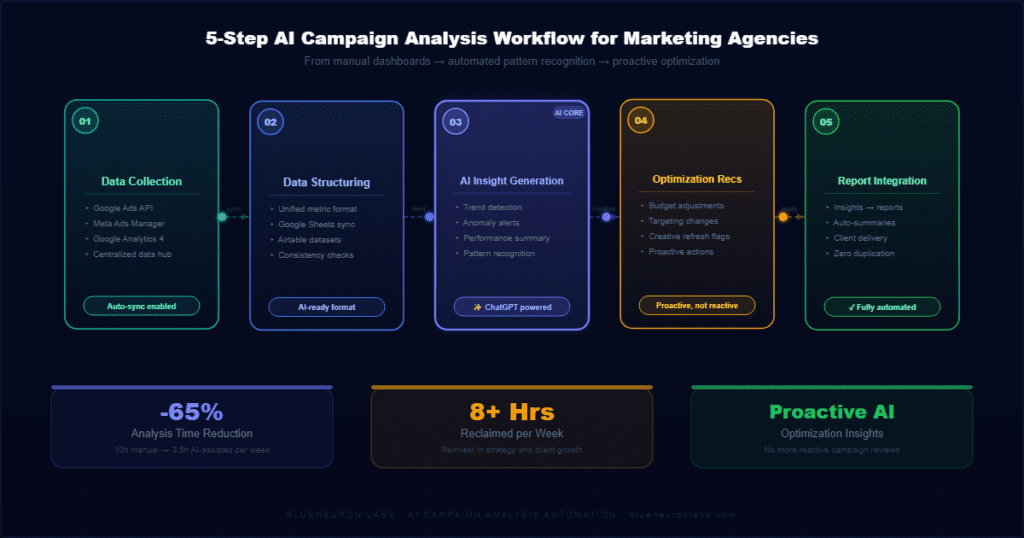
- At 8:00 AM, the script pulls yesterday’s data.
- Claude Code reads the CSV or API response.
- It scores campaigns against rule thresholds.
- It writes a proposed actions file.
- Approved actions update budgets or pause ad sets.
- VidAU AI receives fresh creative briefs for weak concepts.
Now your team spends time on strategy, offer testing, and landing page improvement, not endless ad manager clicking.
Setup Tutorial For 100% Automated Ad Creation And Deployment
This section gives you the conceptual setup.
Do not read “100% automated” as “zero human control.” The best setup is fully automated in execution and tightly controlled in approvals.
Watch out
Do not read “100% automated” as “zero human control.” The best setup is fully automated in execution and tightly controlled in approvals.
System Architecture
Component 1, Creative Source
VidAU AI generates assets from:
- Product pages
- Text prompts
- Images
- Videos
- UGC scripts
Component 2, Orchestration Layer
Claude Code operates within your repo and tools. Anthropic’s docs describe it as able to read code, edit files, run commands, and integrate with your tool stack.
Component 3, Ad Platform Connector
Meta Marketing API handles:
- Campaign creation
- Ad set creation
- Ad creation
- Insights pulls
- Updates to budgets and status fields
Component 4, Data Layer
Store:
- Pixel or event summaries
- Cost data
- Naming taxonomies
- Performance snapshots
- Creative metadata
- Approval state
Component 5, Trigger Layer
Use:
- Cron jobs
- Webhooks
- Queue workers
- CI runs
- Manual approval gates
Step-By-Step Setup
Step 1, Create Your Campaign Schema
Build JSON templates for:
- Objective
- Campaign budget mode, CBO or ABO
- Geography
- Placement strategy
- Audience logic
- Optimization event
- Attribution settings
- Naming convention
Example objects should include:
- TOF prospecting
- MOF retargeting
- BOF conversion push
- Creative testing sandbox
Step 2, Standardize Your Creative Brief Format
Every request to VidAU AI should use a repeatable schema:
- product_name
- landing_page_url
- audience_avatar
- pain_point
- promise
- objection
- offer
- CTA
- aspect_ratio
- platform
- duration
- concept_type
This turns creating an advertisement into a data problem. That is what makes scale possible.
Step 3, Generate Assets In VidAU AI
Request:
- Static sales images
- UGC video variants
- Demo videos
- Founder ads
- Voiceover cuts
Use VidAU AI as the creative engine. Its official positioning around AI video ads, UGC content, and URL-driven ad generation makes it a strong fit for this stage.
Step 4, Build The Meta Publishing Script
Your script should:
- Create or locate campaign
- Create ad set with targeting
- Upload creative
- Create ad
- Apply UTM parameters
- Log response IDs
- Save mapping to database
Step 5, Build The Analysis Script
On schedule:
- Pull insights
- Compare against targets
- Mark winners, losers, stable assets
- Generate recommendation file
- Send alerts to Slack or email
Step 6, Build The Action Script
Based on approved logic:
- Pause losing ad sets
- Raise winning budgets
- Duplicate winners into new audiences
- Trigger VidAU AI refresh for fatigued ads
Step 7, Add Approval Controls
Do not let the system edit spend freely without limits.
Set:
- max daily budget edit
- max pause volume
- manual approval for large increases
- whitelist for protected campaigns
Step 8, Build Audit Trails
Every automation should log:
- before state
- after state
- reason
- timestamp
- script version
- operator source
This protects you when results swing.
Dedicated Answers To The Exact Questions
How Can I Create My Own Advertisement
You create your own advertisement by starting with one audience, one problem, one promise, and one action. In a modern setup, begin with a product page or offer brief, turn it into multiple creative concepts in VidAU AI, export structured assets, then deploy them through Meta using a campaign template. Your best ad is rarely the prettiest one. It is the one with a strong hook, clear message, believable proof, and one direct CTA. If you want scale, structure your ad creation as a repeatable system, not a one-time design task.
How To Create The Best Advertisement
The best advertisement is built from testing, not opinion. Start with a sharp audience insight. Match one pain point to one promise. Lead with a hook in the first seconds. Show proof fast. Remove extra claims. Make the CTA simple. Then test multiple angles, such as UGC, demo, problem-solution, testimonial, and offer-led versions. Use automated analysis to keep winners live and replace weak creatives fast. The best ad is the ad that sustains efficient CPA and ROAS under spend, not the ad your team likes most.
How Do We Create An Advertisement
We create an advertisement by moving through five stages:
- Research the audience and buying trigger
- Write the offer and hook
- Produce creative assets, including image and video
- Launch through a structured campaign setup
- Measure results and iterate
In an automated Meta workflow, VidAU AI handles creative production, Claude Code handles orchestration and decision logic, and the Meta Marketing API handles publishing and reporting. That is the cleanest model for teams that want speed with control.
Advanced Strategic Notes For Serious Media Buyers
CBO Versus ABO In Automated Systems
Use ABO when:
- You want isolated testing
- You need even spend across concepts
- You are validating new offers
Use CBO when:
- You already have signal
- You want budget concentration on stronger ad sets
- You trust the account structure
Automation works in both models. The difference is where your control sits. In ABO, you scale at ad set level more often. In CBO, you manage portfolio behavior.
Horizontal Scaling Versus Vertical Scaling
Vertical scaling means budget increases on proven units.
Horizontal scaling means expanding:
- audiences
- countries
- placements
- angles
- creatives
- account structures
A mature Claude-driven system should do both, with stricter rules for vertical moves because aggressive budget jumps often destabilize performance.
Lookalike Audiences And Broad
Use lookalikes once you have good seed quality.
Use broad when your creative and event signal are strong.
Test both. Do not assume one wins forever.
Learning Phase Discipline
Even with automation, do not churn settings every hour. Good systems respect time windows, conversion volume, and edit frequency. Your rules should protect the account from constant reset behavior.
Where Human Judgment Still Wins
You still need humans for:
- Offer strategy
- Positioning shifts
- Landing page diagnosis
- Brand risk review
- Market context
- Scaling judgment during volatility
Claude Code should be your operator.
VidAU AI should be your creative factory.
Meta should be your delivery engine.
You remain the strategist.
That is the right split.
Create Video Ads With VidAU
Use VidAU AI as the creative engine for image and video assets, then connect your campaign workflow to structured publishing, reporting, and refresh logic.
VidAU workflow fit
How VidAU fits into the automated advertisement system
1. Generate creative assets
VidAU AI generates image and video assets from product pages, text prompts, images, or source videos, including ready-to-publish AI video ads, UGC-style videos, avatars, and URL-to-video workflows.
2. Export structured metadata
Every asset needs machine-readable fields such as creative_id, concept_name, angle, hook, format, duration, platform_fit, primary_CTA, and target_audience so Claude Code can map each asset to campaign templates.
3. Publish through campaign templates
Once the pack passes brand QA, deployment scripts publish creatives into Meta first, then adapt variants for TikTok and Google Ads when the connectors and asset specs are mapped correctly.
4. Refresh creative when signals weaken
Trigger fresh creative generation when frequency rises, CTR drops 20 percent from launch baseline, CPA rises 25 percent over trailing average, or creative fatigue appears in performance data.
Key takeaway
Conclusion
If you want to learn how to create an advertisement that works in 2026, you need to stop treating ads as isolated files. You need to build a machine.
Use VidAU AI to generate creative volume. Use Claude Code to orchestrate rules, analysis, and actions. Use the Meta Marketing API to launch and manage campaigns. Then use human judgment to steer the system.
That is how to create an advertisement at scale. That is how to create the best advertisement through testing. That is how do we create an advertisement in a serious performance team. That is also how to make your own advertisement and create your own advertisement without getting buried in manual work.
The advertiser who wins is not the one who clicks faster in Ads Manager. The advertiser who wins builds the better operating system.
FAQ
Here are concise answers drawn from the article’s core workflow, rules, and automation guidance.
What is the main benefit of automating Meta ads with Claude Code?
The main benefit is speed with consistency. Claude Code works well as an orchestration layer because it can interact with your codebase, files, commands, and connected tools, which helps you automate launch, reporting, and decision workflows.
Does Meta support programmatic ad creation and management?
Yes. Meta’s Marketing API is built for automated advertising management, including campaign setup, updates, and reporting.
What role does VidAU AI play in this workflow?
VidAU AI acts as the creative engine. Its public product pages focus on AI video ads, UGC-style content, avatars, and URL-to-video generation, which fits paid social creative production well.
Why is creative fatigue such a big problem in Meta ads?
Because even strong ads decay over time as frequency rises and audience response drops. That often shows up in falling CTR, weaker conversion efficiency, and higher CPA. Automated creative refresh helps reduce that drag.
Should I automate budget changes fully?
Only within limits. Use guardrails, caps, and approval logic. Full freedom without thresholds creates avoidable risk.
Is this workflow only for big ad accounts?
No. Smaller accounts benefit too, especially if the team lacks time. Even a simple system that automates reports and creative refresh saves work.
What is better for automation, CBO or ABO?
Both work. ABO gives more test control. CBO gives more portfolio-level optimization. Pick based on your stage and volume.
Can this workflow support TikTok and Google Ads too?
Yes. The same creative and orchestration model extends well to other paid channels, as long as your connectors and asset specs are mapped correctly.
What is the best use of a short advertisement video?
Use it for rapid hook testing, offer testing, retargeting refreshes, and native-feed creative. Short videos are fast to produce, fast to test, and easy to version.
How often should automated analysis run?
Daily is a strong default. Higher-spend accounts may run multiple review windows per day, with tighter controls on action frequency.
Can Claude Code directly buy ads by itself?
Not on its own. You connect it to your scripts, APIs, and tools. Anthropic’s docs describe Claude Code as an agentic coding tool and tool-integrated environment, not a standalone ad platform.
What is the biggest mistake in advertisement making automation?
Automating action before defining good rules. Bad logic at scale creates expensive mistakes at scale.
How many creatives should I test at once?
Enough to compare real angles, not tiny edits. For many accounts, 3 to 5 distinct concepts per batch is a solid start, with multiple variants inside each concept.
Does AI replace the media buyer?
No. AI removes execution drag. The media buyer still owns offer quality, strategy, interpretation, and account direction.