About the Kling 3.0 Model — Kling 3 vs Veo 3.1 vs Sora 2: Who Wins?
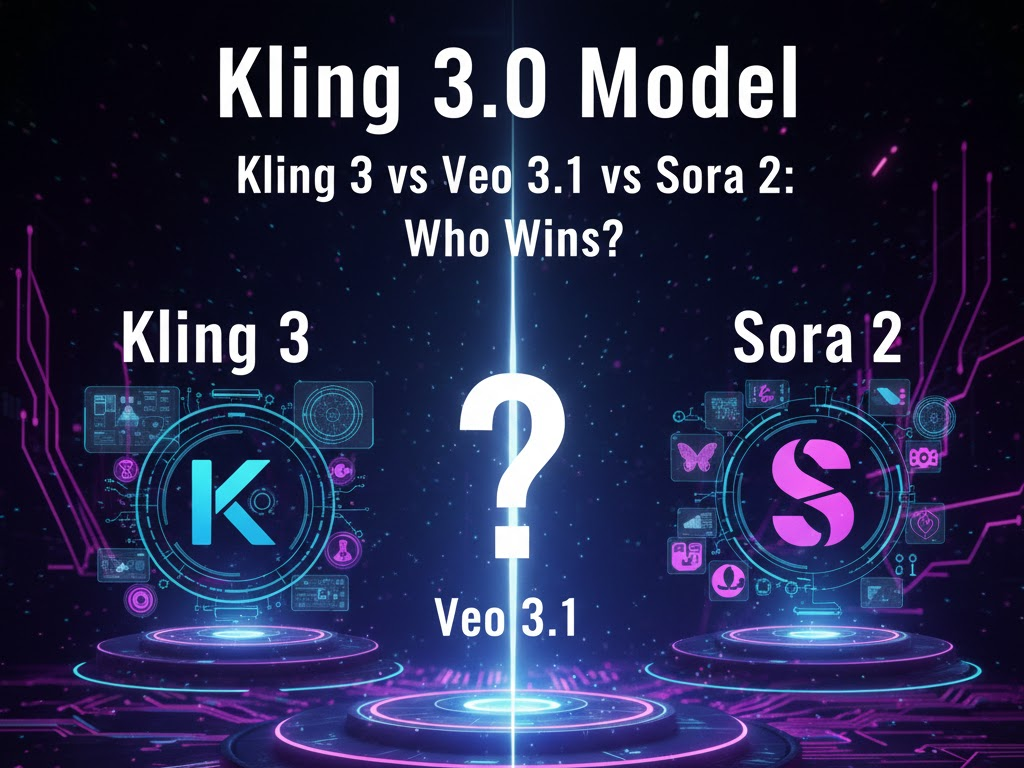
The AI video generation landscape is rapidly evolving, and the newest models, Kling 3.0, Veo 3.1, and Sora 2, are turning heads for different reasons. Each promises high-quality motion visuals, but their strengths and ideal use cases differ significantly.
This deep dive compares the three major modern AI video models, breaks down what they do best (and worst), and helps creators choose the right tool for their projects.
Why Kling 3.0 Matters in 2026
Kling 3.0 isn’t just another generator — it represents a shift toward motion-aware video creation with temporal coherence in mind. Early AI video tools often struggled to maintain consistent character motion, coherent environment continuity, or predictable pacing across frames.
Kling 3.0 tackles these by:
- Prioritizing frame-to-frame motion logic
- Preserving object and character stability
- Treating scenes as sequences, not disconnected clips
For creators focused on narrative animation, ambient loops, or continuous motion visuals, Kling 3.0 is now a favorite in early adopters’ workflows.
The Contenders: Kling 3.0 vs Veo 3.1 vs Sora 2
Below is an honest, hands-on comparison of the three leading models.
1. Kling 3.0 — Best for Motion Continuity
Strengths
- Strong temporal consistency
- Smooth motion between scenes
- Works well with looping and background action
- Ideal for projects with characters, vehicles, or flowing elements
Weaknesses
- May produce less detailed close-up faces than static image models
- Less end-to-end cinematic polish compared to Veo 3.1
Best For
Narrative animations, scenic loops, long-form ambient content, continuity-focused videos
Kling 3.0 shines where motion matters more than still image aesthetics. Its design emphasizes visual logic across time, making every frame part of a coherent sequence.
2. Veo 3.1 — Best for Cinematic and Narrative Video
Strengths
- High cinematic quality
- Excellent camera direction understanding
- Smooth shot transitions and lighting continuity
- Strong for storytelling and multi-shot sequences
Weaknesses
- Longer generation times
- Requires more detailed prompting in complex scenes
Best For
Short films, promo videos, storytelling with narrative continuity
Veo 3.1 is designed to behave like a director — it understands camera moves, lighting logic, and scene composition. When your goal is movie-like quality, Veo 3.1 is often the top choice.
3. Sora 2 — Best for Quick Motion and Playful Clips
Strengths
- Fast generation
- Decent motion interpretation
- Great for short narrative or comedic clips
- User-friendly for rapid iteration
Weaknesses
- Less cinematic than Veo 3.1
- Temporal continuity weaker than Kling 3.0
Best For
Short animations, character-driven micro-stories, playful clips for social
Sora 2 does not aim for cinematic polish, but it gets moving visuals out fast. For social media clips or quick storytelling bursts, it’s a strong contender.
Head-to-Head Comparison
| Feature | Kling 3.0 | Veo 3.1 | Sora 2 |
| Motion Continuity | ⭐⭐⭐⭐ | ⭐⭐⭐ | ⭐⭐ |
| Cinematic Quality | ⭐⭐⭐ | ⭐⭐⭐⭐ | ⭐⭐ |
| Speed of Generation | ⭐⭐ | ⭐⭐ | ⭐⭐⭐⭐ |
| User-friendly Prompting | ⭐⭐⭐ | ⭐⭐⭐ | ⭐⭐⭐⭐ |
| Best For Narrative Films | ⭐⭐⭐ | ⭐⭐⭐⭐ | ⭐⭐ |
| Best for Ambient/Loops | ⭐⭐⭐⭐ | ⭐⭐⭐ | ⭐⭐ |
| Best for Quick Social Clips | ⭐⭐ | ⭐⭐⭐ | ⭐⭐⭐⭐ |
Practical Usage Scenarios
Scenario 1 — Ambient Loop Video
If you want sprawling visuals — flowing clouds, moving landscapes, or ambient sci-fi worlds, Kling 3.0 generally keeps motion coherent across long frames.
Winner: Kling 3.0
Scenario 2 — Short Promotional Clip
For ads, intros, or promo reels where every frame needs polish, controlled lighting, and camera movement, Veo 3.1 tends to deliver more refined visuals.
Winner: Veo 3.1
Scenario 3 — Quick Character Animation
When you want a short character clip with motion and expression but minimal setup, Sora 2 creates usable outputs rapidly.
Winner: Sora 2
Workflow Tips — Get the Most Out of Each Model
For Kling 3.0
- Lock seed usage per shot to maintain character consistency
- Use latent buffering to reduce drift
- Employ camera path scripts to guide motion rather than ad-hoc wording
For Veo 3.1
- Provide explicit camera language (e.g., “slow dolly in, soft rim lighting”)
- Break scenes into beats (intro → action → reaction)
- Keep lighting rules consistent across shots in a project
For Sora 2
- Use simple scene descriptions and let the model focus on motion
- Prioritize pacing over detail in prompts
- Rapidly iterate prompts to find fun variations
Bottom Line — Who Wins?
There is no single winner. Instead, pick based on what you need:
- Need seamless motion and continuity?
➡️ Kling 3.0 - Need cinematic storytelling and shot polish?
➡️ Veo 3.1 - Need quick, animated clips for social?
➡️ Sora 2
Smart creators often use them together: Kling 3.0 for motion base, Veo 3.1 for main narrative, and Sora 2 for snackable social content.
Conclusion
Kling 3.0, Veo 3.1, and Sora 2 all represent remarkable advances in AI video generation in 2026, but they serve slightly different creator workflows:
- Kling 3.0 → Motion and consistency engine
- Veo 3.1 → Cinematic, narrative generator
- Sora 2 → Fast, expressive motion clips
Understanding these differences helps you choose the right tool, or combine them intelligently, to produce content that feels professional and polished without massive manual effort.
Frequently Asked Questions
Q: What is Kling 3.0 best used for
A: Kling 3.0 works best for videos where motion continuity matters. It handles flowing movement, looping scenes, and long ambient visuals better than most models.
Q: Is Kling 3.0 better than Veo 3.1
A: Kling 3.0 is better for smooth motion and temporal consistency. Veo 3.1 is better for cinematic storytelling, camera control, and polished narrative scenes.
Q: What makes Veo 3.1 different from other AI video models
A: Veo 3.1 focuses on film-style output. It understands camera movement, lighting logic, and scene transitions, making it strong for short films and brand videos.
Q: Is Sora 2 still relevant compared to Kling 3.0 and Veo 3.1
A: Yes. Sora 2 remains useful for fast generation and short character-driven clips. It trades cinematic depth for speed and ease of iteration.
Q: Which AI video model is best for YouTube Shorts and Reels
A: Sora 2 works best for fast social clips. Kling 3.0 is good for looping visuals. Veo 3.1 fits higher-effort short films or promo content.
Q: Which model handles long videos better
A: Kling 3.0 performs better for long or continuous motion scenes. Veo 3.1 handles multi-shot narratives well but takes more setup time.
Q: Do these models replace video editing software
A: No. They generate video clips. Most creators still use editing tools for sequencing, sound, captions, and final export.
Q: Can creators use more than one model in a workflow
A: Yes. Many creators combine them. Kling 3.0 for motion base, Veo 3.1 for main scenes, and Sora 2 for quick social content.
Q: Which model is easiest for beginners
A: Sora 2 is the easiest to start with. Veo 3.1 and Kling 3.0 require more structured prompting and planning.
Q: Which AI video model is best overall
A: There is no single best model. The best choice depends on whether you prioritize motion continuity, cinematic quality, or speed.