AI Coding Agents · AutoGPT, BabyAGI & Autonomous LLM Loops
Popular AI Coding Agents: AutoGPT, BabyAGI, and How Autonomous LLM Agents Work
Learn how AutoGPT and BabyAGI plan, prioritize, execute, reflect, and use memory, plus how to build an autonomous AI marketing agent with GPT models or OpenAI Agent Builder.
By the VidAU Editorial Team · Autonomous LLM agent guide · AutoGPT, BabyAGI, planner–executor loops, task queues, vector memory, OpenAI GPT models, OpenAI Agent Builder, and VidAU creative handoffs
Evaluating popular AI coding agents and autonomous systems like AutoGPT and BabyAGI? This comparison shows exactly how they plan, iterate, and use memory so you can pick the right fit. I reviewed and analysed the most-referenced examples and recent explainer content to map how planner–executor loops, task queues, and memory stores actually run.
If you need a practical path, you will also get a short build plan for an autonomous AI marketing agent and a quick start using OpenAI GPT models or the open ai agent builder. This guide is for developers, PMs, and tech-savvy marketers.
Evaluating popular AI coding agents and autonomous systems like AutoGPT and BabyAGI? This comparison shows exactly how they plan, iterate, and use memory so you can pick the right fit. I reviewed and analysed well-known examples and recent how-to videos to trace the planner–executor loop, task queues, and memory patterns.
If you want something you can build, you will find a compact plan for an autonomous AI marketing agent plus a quick-start using OpenAI GPT models or the open ai agent builder. This is for developers, PMs, and technical marketers.
Quick Summary
- AutoGPT and BabyAGI use a planner → task queue → executor → reflection loop with Large Language Models (LLMs) like OpenAI GPT models to pursue goals.
- BabyAGI emphasizes task prioritization and tight loops; AutoGPT leans into broad goal decomposition and tool use for open-ended work.
- Successful autonomy needs explicit scopes, memory (short-term + vector store), tool timeouts, and human checkpoints to prevent runaway loops.
- Teams running research, backlog grooming, or marketing ops benefit, while compliance-heavy flows may prefer constrained, supervised agents.

What Are Popular AI Coding Agents?
Popular AI coding agents are autonomous LLM-driven programs that can plan, prioritize, and execute multi-step tasks with minimal supervision. They typically combine a planner (LLM), a task queue, an executor with tools or APIs, and memory that persists context across iterations. AutoGPT and BabyAGI are two widely referenced implementations of this autonomy pattern.
I reviewed and analysed the available examples highlighted in recent explainer content, and the common thread is simple: LLM reasoning plus an external loop that manages tasks, tools, and memory.
Definition
Popular AI coding agents are autonomous LLM-driven systems that combine a planner, task queue, executor, reflection loop, and memory to complete multi-step tasks with limited supervision.
How Do AutoGPT and BabyAGI Work Internally?
They both run an LLM-centered loop that plans tasks, executes actions with tools, and reflects to re-plan until a goal or stop condition is met.
Typical components and flow:
- Planner (LLM): Interprets a high-level goal and proposes next tasks.
- Task queue: Stores, prioritizes, and pops tasks for execution.
- Executor: Calls tools/APIs (search, code run, scraping, file I/O) per task.
- Reflection: Summarizes results, updates memory, and adjusts the plan.
- Memory: Short-term context window plus a long-term vector store for facts.
- Stop condition: Budget, step limit, confidence threshold, or human approval.
| Aspect | AutoGPT | BabyAGI |
|---|---|---|
| Planning style | Broad goal decomposition | Tighter task prioritization |
| Task queue | Dynamic, can expand rapidly | Compact, reprioritized each loop |
| Memory model | LLM context + vector store | LLM context + vector store |
| Loop focus | Exploration and tool use | Progress via prioritized next task |
| Best for | Open-ended research, prototyping | Structured backlogs, focused sprints |
| Oversight | Benefits from checkpoints | Easier to supervise in short runs |
Our team reviewed community patterns and found the biggest day-one choice is appetite for exploration versus need for predictable, short cycles; that’s the core split between AutoGPT-style and BabyAGI-style loops.
Key comparison
Choose AutoGPT-style loops when exploration and broad decomposition matter. Choose BabyAGI-style loops when predictable prioritization, shorter cycles, and easier supervision matter more.
Which Popular AI Coding Agents Fit Which Tasks?
Choose AutoGPT-like or BabyAGI-like loops based on task structure, oversight needs, and failure tolerance.
- Open-ended research and ideation: Favor AutoGPT’s broader decomposition; it explores alternatives and tools well.
- Structured backlogs and checklists: Favor BabyAGI’s prioritized queue; it advances step-by-step with less drift.
- Compliance-heavy or high-risk flows: Use constrained loops with human-in-the-loop approvals regardless of style.
- Time or budget constrained: Prefer shorter BabyAGI-like loops and stricter stop conditions.
From my review, teams often start with a BabyAGI-style kernel to get a feel for costs and failure modes, then selectively open exploration where value justifies it.
Selection tip
Start with a shorter, BabyAGI-style loop when you need predictable costs and clearer oversight. Add AutoGPT-style exploration only where broader tool use and research depth justify the risk.
How Do Planner–Executor Loops, Memory, and Task Queues Improve Reliability?
Reliability improves when the loop, memory, and queue are explicit, bounded, and observable.
- Clear goal and spec: Provide role, constraints, success criteria, and non-goals directly to the planner.
- Dual memory: Use the LLM context for short-term steps and a vector database for durable facts and drafts.
- Tool contracts: Define input/output schemas, timeouts, and error handling; retry with backoff.
- Reflection discipline: Summarize outcomes, log decisions, and prune memory to avoid context drift.
- Stop conditions: Enforce token, step, and spend caps; require human approvals at key gates.
- Telemetry: Log each task, prompt, tool call, and cost for reproducibility and audits.
Key Takeaways
- Most failures come from vague goals, missing stop conditions, and unbounded memory.
- Reliability grows when you make queues, memory, and tools explicit and supervised.
- Shorter loops surface issues early and reduce cascading hallucinations.
How Can I Build a Simple Autonomous AI Marketing Agent?
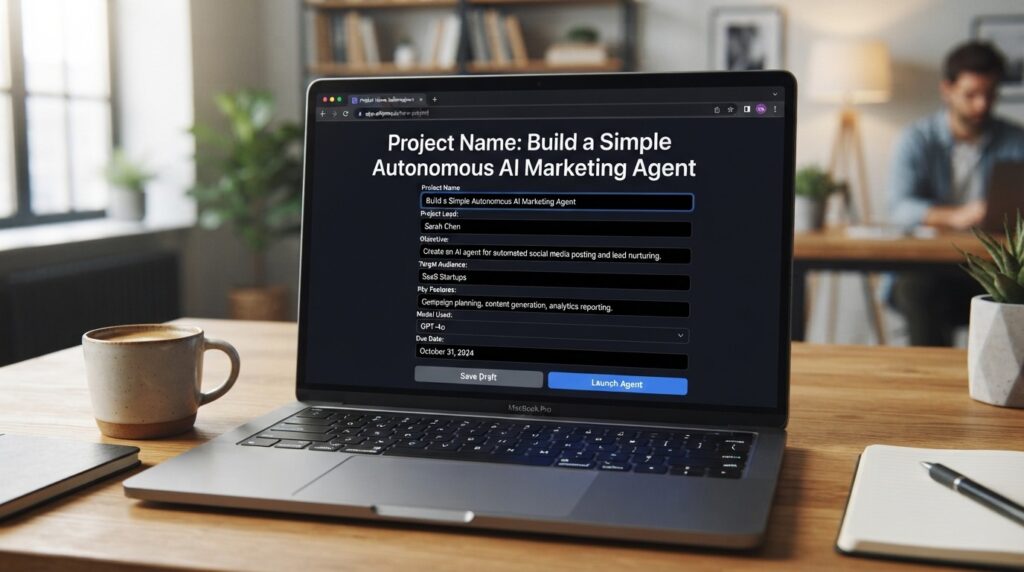
Start with a minimal planner–executor loop and add tools only when a task requires them. This section intentionally covers a building autonomous ai marketing agent technical stack.
Reference stack:
- LLM core: OpenAI GPT models (choose a model sized for cost vs quality).
- Task manager: Priority queue with step and budget caps.
- Memory: Vector database for briefs, brand rules, and research notes.
- Tools: Web search/scrape, spreadsheet updates, calendar, CRM or CMS writes.
- Output generators: Video/image tools for creative deliverables.
- Oversight: Human approvals before publishing or spend commits.
Minimal loop (pseudocode):
- while goal not met and within caps:
- plan next task with LLM using memory + last result
- execute task via tool, collect result/errors
- reflect: summarize, store to vector DB, adjust priority queue
- check stop conditions or request human approval
Where creative assets are required, route drafts to fit-for-purpose generators:
- For ad videos: feed scripts, URLs, or product shots into VidAU AI Video, Text to Video, or URL to Video.
- For UGC-style spokesperson clips or voiceovers: use UGC Avatars and Text to Speech.
- For repurposing or enhancing assets: consider VidAU Vid Remix and Video Enhancer.
- For product-centered workflows: try Product Sample to Video.
Mid-article CTA: If your agent outputs ad creatives, pairing its planning loop with VidAU’s generators can turn copy, URLs, or product images into ready-to-test video variations without leaving your pipeline.
Note: VidAU is a video ad platform, not an agent framework; keep the autonomy loop in your codebase and call VidAU tools as external steps.
Turn Agent Plans Into Ready-to-Test Ad Videos
Keep your autonomy loop in your codebase, then call VidAU AI Video, Text to Video, URL to Video, UGC Avatars, Text to Speech, VidAU Vid Remix, Video Enhancer, and Product Sample to Video as external creation steps for marketing assets.
VidAU workflow
Where VidAU Fits in an Autonomous AI Marketing Agent Stack
- Use the autonomous loop for planning and control: Keep the planner, task queue, executor, memory, reflection, telemetry, budget caps, and human approvals in your own stack.
- Use VidAU AI Video for ad video outputs: Feed approved scripts, creative directions, URLs, or product shots into VidAU when the agent needs ready-to-test ad videos.
- Use Text to Video and URL to Video for faster production: Convert agent-generated copy, campaign URLs, or product pages into video variations without leaving the pipeline.
- Use UGC Avatars and Text to Speech for spokesperson and voiceover assets: Add UGC-style clips or narration when the marketing task calls for human-style delivery.
- Use VidAU Vid Remix, Video Enhancer, and Product Sample to Video for repurposing and polish: Recut winning formats, improve quality, and generate product-centered assets while keeping publishing and spend behind approvals.
Can I Start Faster With OpenAI Agent Builder and GPT Models?
Yes, you can prototype with OpenAI GPT models and organize workflows in OpenAI Agent Builder when a UI-defined toolset and guardrails help more than a from-scratch codebase.
When to use open ai agent builder:
- You have a few clearly defined tools and want a hosted configuration UI.
- You need quick experiments with role instructions, tool schemas, and routing.
- You want non-engineers to adjust prompts, capabilities, or instructions.
When to code your own loop:
- You require custom schedulers, complex queues, or specialized memory.
- You need strict on-prem data paths, custom observability, or budget accounting.
- You plan to orchestrate multiple agents with hierarchical routing.
From my comparison work, many teams start with a builder for fast iteration, then codify the stable loop and monitoring in their stack.
| Option | Use When | Why |
|---|---|---|
| OpenAI Agent Builder | You need quick experiments, clear tools, role instructions, routing, and non-engineer configurability | Hosted configuration UI speeds prototyping |
| Custom loop | You need custom schedulers, complex queues, specialized memory, strict data paths, observability, or budget accounting | Code-level control supports production-grade autonomy |
| Hybrid path | You want to validate fast, then codify stable patterns later | Builder-first learning can reduce wasted engineering |
Build path tip
Use a builder for fast iteration when the toolset is simple. Code your own loop when queue design, memory, data paths, observability, or cost accounting becomes part of the product.
What Mistakes Do Teams Make With Autonomous LLM Agents?
Common pitfalls concentrate around goals, memory, and budgets.
- Vague goals and roles: Leads to scope creep and tool thrashing.
- No step caps or approvals: Causes runaway loops and surprise costs.
- Missing memory pruning: Accumulates noise; drifts from the brief.
- Tool ambiguity: Unvalidated outputs and flaky timeouts break chains.
- No evaluation harness: Hard to compare prompts, models, and stop rules.
- Excessive autonomy early: Start supervised; add freedom as reliability grows.
Mistake to avoid
Do not launch autonomous loops without clear goals, step caps, approvals, memory pruning, tool contracts, and evaluation harnesses. Unbounded autonomy compounds small errors into expensive failures.
What Advanced Strategies Help Scale Agents Safely?
Use structure, supervision, and evaluation to expand scope without sacrificing control.
- Hierarchical agents: A planner routes tasks to focused executors.
- Human-in-the-loop: Approve goal changes, external posts, or spends.
- Sandboxing: Isolate code-execution tools; rate-limit risky calls.
- Objective functions: Score outputs against specs; auto-stop on low confidence.
- Prompt and tool versioning: Reproducibility for audits and rollback.
- Caching and retrieval: Reduce tokens with smart context packing and vector recall.
CTA: Create UGC Videos
Scaling pattern
Scale from a supervised single agent to hierarchical routing only after the base loop is stable. Add sandboxes, objective functions, versioning, caching, retrieval, and human checkpoints before expanding autonomy.
Key takeaway
Final Thoughts
AutoGPT and BabyAGI differ mainly in how they plan and prioritize work, but both follow the same autonomy backbone: planner, task queue, executor, reflection, and memory. Start with the simplest supervised loop that solves a real task, then open autonomy where it pays off.
If you are building a marketing agent that needs ad-ready outputs, connect your loop to VidAU’s creation tools like VidAU AI Video, Text to Video, URL to Video, UGC Avatars, and Text to Speech. Keep in mind: VidAU accelerates asset generation, while your agent logic stays in your own stack.
FAQ
Here are answers to common questions about popular ai coding agents and autonomous systems like autogpt babyagi, AutoGPT versus BabyAGI, memory setup, preventing runaway loops, OpenAI Agent Builder, planner–executor–reflection loops, marketing content and ads, starting stacks, and improving agent reliability over time.
What are popular ai coding agents and autonomous systems like autogpt babyagi?
They are LLM-driven programs that plan, queue, and execute tasks toward a goal with limited supervision. AutoGPT leans into broad goal decomposition and tool use, while BabyAGI emphasizes a prioritized task list and short loops. Both rely on memory and reflection to iterate until stop conditions are met.
How does AutoGPT differ from BabyAGI in practice?
AutoGPT pursues open-ended goals by decomposing them into many sub-tasks and exploring tools widely. BabyAGI keeps a compact task list, reprioritizes each loop, and advances in smaller, more predictable steps. Choose AutoGPT for exploration, and BabyAGI-style loops for structured backlogs and tighter oversight.
What memory setup should an autonomous agent use?
Use a dual approach: the LLM context window for immediate step reasoning and a vector database for long-term facts, drafts, and decisions. Prune or summarize aggressively, log each step, and design reflection prompts that add only durable insights to the vector store to prevent drift.
How do I prevent runaway loops and high costs?
Define clear stop conditions: maximum steps, token budgets, and timeouts per tool call. Add human-in-the-loop approvals for risky actions, external posts, or spending. Log prompts, tool results, and costs, then evaluate runs against objective criteria so you can halt or adjust earlier in the loop.
When should I use OpenAI Agent Builder versus coding my own loop?
Use OpenAI Agent Builder for quick prototypes, clear tool definitions, and non-engineer configurability. Code your own loop when you need custom schedulers, specialized memory, strict data paths, or multi-agent orchestration. Many teams start with a builder, then migrate stable patterns into code.
What tasks fit these agents best?
They shine at research synthesis, backlog grooming, content drafting, and process automation that tolerates iteration. For compliance-heavy or safety-critical work, run constrained, supervised loops with strong guardrails, approvals, and auditing. Keep risky code execution or external posting behind gates and quotas.
How do planner–executor–reflection loops actually run step by step?
The planner proposes the next task based on the goal and memory, the executor calls tools or APIs to act, and reflection summarizes results, updates memory, and adjusts priorities. The loop repeats until a stop condition is reached, a human approves completion, or the budget cap triggers.
Can I use these agents for marketing content and ads?
Yes, many teams wire an agent to research briefs, produce scripts, and hand off to creative generators. For video outputs, you can connect to asset tools such as VidAU AI Video (https://www.vidau.ai/vidau-ai-video/), Text to Video (https://www.vidau.ai/text-to-video/), or URL to Video (https://www.vidau.ai/url-2-video/) while keeping approvals before publishing.
What is a simple starting stack for a marketing agent?
Start with OpenAI GPT models, a small priority queue, a vector store of brand rules and research, and a few tools like web search, spreadsheets, and CMS writes. Add creative generators only when needed and enforce step caps, tool timeouts, and human approvals to maintain control.
How do I evaluate and improve agent reliability over time?
Create an evaluation harness: seed goals, expected outcomes, and failure flags. Track success rates, steps taken, tokens spent, and user interventions. Iterate prompts, tool schemas, and memory policies. Add hierarchical routing or human checkpoints only after the base loop is demonstrably stable.