
AI Video Ad Generator · Paid Ad Creative Workflow
Best AI Video Ad Generators That Actually Convert in 2026
Discover the best AI video ad generator tools for Meta, TikTok, and YouTube ads with AI scripts, UGC videos, platform-ready formats, and faster testing workflows.
By the VidAU Editorial Team · Updated 2026 · 15 min read
Most of the AI video Ad generator look impressive in demos but fall apart when you try to run paid ads with them. The problem isn’t the video quality. It’s that most tools aren’t built with advertising workflows in mind.
Most AI video tools look impressive in demos but fall apart when you try to run paid ads with them. The problem isn’t video quality. It’s that most tools aren’t designed with advertising workflows in mind. There’s a real difference between generating cinematic clips and producing video ads built to stop the scroll and drive clicks.
The best ai video ad generator for your campaigns isn’t necessarily the one with the most realistic visuals. It’s the one that helps you build ad-specific structure, test multiple creative variations, and ship content that fits Meta, TikTok, and YouTube requirements without heavy post-production.
This guide cuts through the noise. You’ll learn which tools are actually optimized for paid advertising, what separates ad-focused platforms from general video generators, and how to pick the right one for your campaigns in 2026.
Quick Summary
- Most AI video generators are built for creative content, not paid advertising workflows.
- The best ai video ad generator options in 2026 combine ad scripting, scene structure, and platform-specific formatting.
- Tools like Creatify are purpose-built for ads, while CapCut, HeyGen, and InVideo AI serve different parts of the workflow.
- Creative testing velocity — generating multiple ad variations quickly — is the metric that matters most for performance marketers.
What Is an AI Video Ad Generator?
An ai video ad generator is a software tool that uses artificial intelligence to produce video advertisements — combining scripts, visuals, voiceovers, captions, and calls to action into a finished ad format. Unlike general AI video generators, ad-focused tools are built around advertising logic: hooks, offer clarity, pacing, and platform specs.
The key distinction is intent. General AI video tools like Google Veo 3 or Kling AI are designed to generate high-quality video clips from prompts. They’re impressive for creative production. But they don’t automatically structure content for a 15-second TikTok ad or help you generate five hook variations for split testing.
Key definition
An AI video ad generator is different from a general AI video generator because it is built around ad anatomy: hooks, offer clarity, pacing, platform specs, captions, calls to action, and creative variation testing.
Why the AI Video Ad Generator Distinction Matters
Paid media teams face a specific problem: creative fatigue. Ads stop performing after a few weeks, and the only cure is fresh creative. That means you need volume — multiple variations of each concept — not just one polished video.
This is where the ad-versus-content gap becomes real. A general AI video tool might produce stunning footage, but it won’t help you write an ai ad copy generator-style hook, add a CTA overlay, format for 9:16, or produce ten variations from a single product brief. Ad-specific tools are designed around that workflow.
Marketers running campaigns on Meta Ads, TikTok Ads, and YouTube Ads need tools that understand ad anatomy: the first three seconds, the benefit statement, the social proof element, and the closing CTA. Most general video generators skip all of that.
Key Takeaways
- Ad-focused tools prioritize structure and testing, not just visual quality.
- Creative testing velocity matters more than single-video perfection.
- Platform specs (aspect ratio, length, caption style) should be built into the tool.
Evaluating an AI Video Ad Maker: What to Look For
Before comparing tools, establish what actually matters for advertising. Use these criteria:
| Criterion | Why It Matters for Ads |
|---|---|
| Ad script and hook generation | Saves time on copy; drives click-through |
| Creative variation output | Enables split testing across audiences |
| Platform format support | Ensures compliance with Meta, TikTok, YouTube specs |
| Voiceover and caption control | Critical for sound-off viewing environments |
| UGC-style or avatar options | Performs well in native ad formats |
| Speed of production | Supports high-volume creative workflows |
Any ai video ad maker worth using in 2026 should satisfy at least four of these six criteria.
Tip
Do not evaluate an AI video ad maker only by demo quality. For paid media, the real test is whether the tool helps you produce structured, platform-ready variations quickly.
Tool-by-Tool Breakdown for 2026
Creatify
Creatify is the clearest example of a tool built specifically for video advertising. It focuses on ad structure, script generation, creative variation, and testing workflows. You can generate multiple ad variations from a product URL, select different hooks, swap avatars, and export platform-ready formats. For teams running paid campaigns and needing to scale creative output, this is the most purpose-aligned option currently available.
It’s not a general video generator. It’s an advertising production tool. That distinction matters a lot when you’re evaluating for conversion workflows.
InVideo AI
InVideo AI sits closer to the ad workflow than most general tools. You can generate videos from scripts or prompts, add voiceovers, and customize scenes. It’s solid for social media video content and short-form ads, especially for small business owners who need affordable, fast production. The output is template-driven, which helps with consistency but can feel formulaic at scale.
For teams that also need text to video (https://www.vidau.ai/text-to-video/) capabilities alongside ad creation, InVideo AI is a reasonable starting point.
HeyGen
HeyGen is built around AI avatars and spokesperson-style videos. It’s highly effective for explainer-style ads, product demos, and talking-head formats. If your ad strategy relies on UGC-style content or presenter-led creatives, HeyGen delivers quality output with strong multilingual support.
It doesn’t handle raw ad scripting or hook variation natively, so you’ll need a separate ai ad copy generator step in your workflow. Pair it with a script tool and it becomes genuinely useful for certain ad formats.
For similar spokesperson or avatar-driven content, UGC Avatars (https://www.vidau.ai/ugc-avatars/) from VidAU AI offer a comparable workflow for brands that want to create avatar-based ad creatives at scale.
CapCut
CapCut has expanded into AI video creation, and its AI Video Maker is capable and free for most users. It works well for TikTok-native content, short-form social media video, and quick edits. The platform is designed for content creators first, advertisers second.
The main limitation for paid media teams is that CapCut doesn’t generate ad-specific structure automatically. You’re working from templates and manual edits. It’s useful for creative experimentation and rapid content production, but it’s not a substitute for a dedicated ai video ad maker in a performance marketing workflow.
Google Veo 3 and Kling AI
Both tools are world-class at generating realistic video footage from text prompts. Google Veo 3 in particular produces impressive cinematic output with audio. Kling AI handles motion and physics well.
But neither tool is designed for advertising. They generate clips, not ads. You won’t get hook structures, CTA overlays, or variation testing. They’re best used as raw asset generators — feeding footage into an ad editing workflow rather than producing finished ads directly.
For teams wanting to enhance existing video assets (https://www.vidau.ai/vidau-video-enhancer/) or remix footage (https://www.vidau.ai/vid-remix/) before using them in ad campaigns, these tools can feed into a broader production pipeline.
Meta AI
Meta’s own AI tools are increasingly integrated into Meta Ads Manager. Features like Advantage+ Creative and AI-generated ad variations are useful for teams already running campaigns inside Meta’s ecosystem. The AI can generate image variations, text overlays, and basic video edits.
The limitation is that you’re locked into Meta’s platform. It won’t help you produce assets for TikTok Ads or YouTube Ads, and the creative control is limited compared to dedicated tools.
VidAU AI
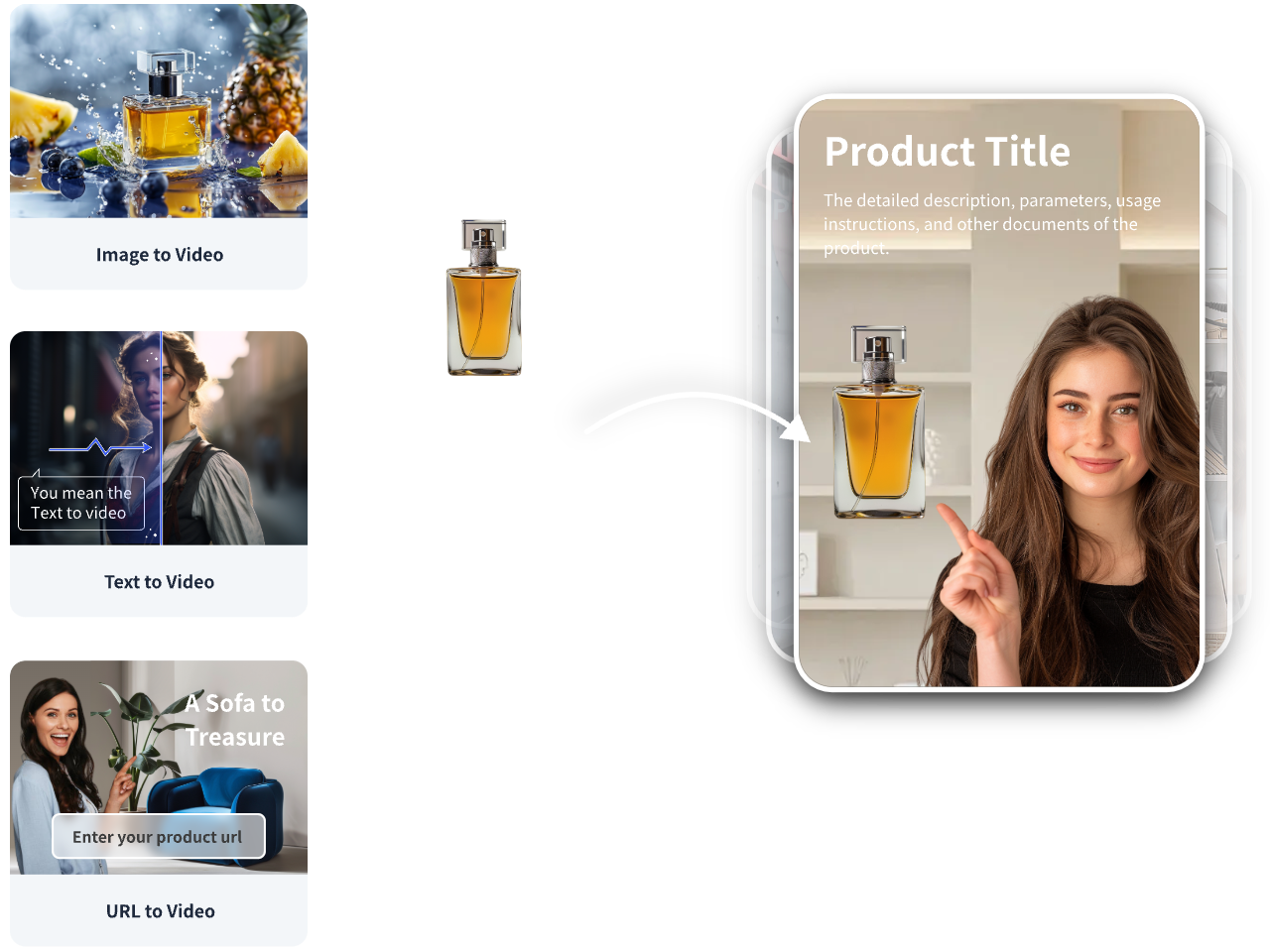
VidAU AI covers several parts of the ad production workflow. The URL to Video (https://www.vidau.ai/url-2-video/) feature turns a product page into a video ad automatically. Product Sample to Video (https://www.vidau.ai/product-sample-to-video/) converts product images into video creatives. The Text to Video (https://www.vidau.ai/text-to-video/) tool handles script-to-video production, and UGC Avatars (https://www.vidau.ai/ugc-avatars/) support native-style ad formats.
For eCommerce brands and performance marketers who need product-focused video ads across multiple platforms, VidAU AI’s toolset covers a meaningful portion of the ad creation workflow without requiring heavy editing skills.
Create With VidAU
Use VidAU AI to turn product URLs, product samples, scripts, AI avatars, and text prompts into product-focused video ads for Meta, TikTok, YouTube, and performance marketing campaigns.
VidAU workflow
From product brief to platform-ready ad creative
- Start with your ad input: Use a product URL, product sample, script, prompt, or product image as the foundation for the creative.
- Generate the first ad draft: Use URL to Video, Product Sample to Video, or Text to Video to create a structured first version quickly.
- Add native ad formats: Use UGC Avatars when the campaign needs presenter-led or spokesperson-style ad creative.
- Improve the production layer: Use video enhancement, remixing, captions, voiceover, and editing to make the output ready for paid platforms.
- Scale creative testing: Create multiple hooks, CTAs, aspect ratios, and product angles so you can test faster without rebuilding every ad from scratch.
Platform-Specific Optimization for the Best AI Video Ad Generator Results
Meta Ads
Meta rewards native-looking content. UGC-style ads, talking-head formats, and videos that don’t look like polished commercials consistently outperform high-production content in feed placements. Tools like HeyGen and Creatify are well-suited here. Export at 9:16 for Stories and Reels, 1:1 for feed.
For viral advertising videos on Meta, the first three seconds carry disproportionate weight. Use an ai video ad maker that lets you test multiple hook variations without rebuilding the entire ad.
TikTok Ads
TikTok’s algorithm favors content that feels organic. Fast-paced editing, on-screen text, trending audio cues, and authentic presenter energy work better than branded ad aesthetics. CapCut is natively designed for TikTok and integrates directly. Creatify also supports TikTok-format outputs.
Keep ads between 9 and 15 seconds for most placements. Use captions — most TikTok users watch without sound.
YouTube Ads
YouTube pre-roll and in-feed ads tolerate longer formats. The first five seconds must earn the skip. Structure matters: hook, problem acknowledgment, solution, proof, CTA. Tools that generate full-length scripts with clear scene structure — like Creatify or InVideo AI — are better suited here than clip generators.
For longer explainer-style YouTube ads, Text to Speech (https://www.vidau.ai/vidau-text-to-speech/) tools can add professional voiceover without hiring a voice actor.
| Platform | Recommended approach |
|---|---|
| Meta Ads | Use native-looking UGC-style ads, talking-head formats, 9:16 for Stories and Reels, 1:1 for feed, and multiple hook variations. |
| TikTok Ads | Use organic-feeling content, fast-paced editing, on-screen text, trending audio cues, captions, and 9 to 15 second ads for most placements. |
| YouTube Ads | Use a clear structure: hook, problem acknowledgment, solution, proof, CTA. Longer explainer formats can work when the first five seconds earn the skip. |
Tip
Platform fit matters as much as video quality. A visually impressive clip that ignores Meta, TikTok, or YouTube ad behavior will still underperform.
Common Mistakes When Using an AI Video Ad Generator
Using a general video tool and expecting ad results. Kling AI and Google Veo 3 are powerful. They’re not ad tools. Feeding a prompt and expecting a high-converting TikTok ad is a workflow mismatch.
Skipping the hook. The first three seconds of any ad determine whether it runs or dies. Many AI video tools don’t surface hook optimization prominently. Make sure you’re testing multiple opening lines.
Ignoring aspect ratio and caption requirements. An ad that’s cropped wrong or missing captions will underperform regardless of how good the content is. Always export to platform specs.
Producing one ad and calling it a test. Creative testing requires volume. If you’re only making one version of each ad, you’re not testing — you’re guessing. The entire advantage of an ai video ad maker is the ability to generate variations quickly.
Over-relying on AI for the offer. AI can generate the video, but it can’t identify your strongest offer or audience insight. That still requires human judgment.
Watch out
The most common mistake is treating an AI video generator like an AI video ad generator. Ad performance depends on hooks, offer clarity, captions, aspect ratio, CTA structure, and testing volume.
Advanced Strategies for Creative Testing Velocity
The best-performing paid media teams in 2026 treat creative like a testing pipeline, not a production project. Here’s how to build that with AI tools.
Start with hooks. Generate three to five different opening lines for the same ad concept. Use Creatify or a standalone ai ad copy generator to produce hook variants. Test them as separate ads before committing to full production.
Modular production. Build ads in components — hook, middle, CTA — so you can swap individual sections without rebuilding the whole ad. This is where tools with scene-level control become valuable.
Batch production. Use URL-to-video or product-sample-to-video workflows to generate ad drafts in bulk. Tools like VidAU AI’s product-to-video feature (https://www.vidau.ai/product-sample-to-video/) are designed for this kind of batch creative output.
Audit and iterate. Check which hooks, formats, and CTAs are generating the best cost-per-click and conversion rates. Feed that data back into your next round of AI generation. The tools improve faster when you give them informed direction.
Tip
Treat AI ad production as a testing pipeline. Generate hooks, build modular sections, batch drafts, audit performance, and feed the results into the next creative round.
FAQ
Here are answers to common questions about AI video ad generator tools, AI video ad maker workflows, AI ad copy generator steps, viral advertising videos, Creatify, CapCut, HeyGen, InVideo AI, Meta Ads, TikTok Ads, YouTube Ads, and VidAU AI video ad production.
What is the best ai video ad generator in 2026?
Creatify is currently the most purpose-built option for conversion-focused ad workflows, with strong support for variation testing and platform formatting.
Can I use general AI video tools like Veo 3 for paid ads?
Yes, but they generate clips rather than structured ads — you’ll need additional editing and scripting steps to make them campaign-ready.
What makes an ai video ad maker different from a general video generator?
Ad-specific tools include script generation, hook variation, CTA overlays, platform formatting, and creative testing features that general tools omit.
Which AI video ad generator works best for TikTok Ads?
CapCut and Creatify both support TikTok-native formats, with CapCut being particularly well-integrated into TikTok’s creative ecosystem.
How does an ai ad copy generator fit into a video ad workflow?
It handles the scripting and hook-writing stage before video production, ensuring your messaging is strong before you commit to visual creation.
Can AI tools help produce viral advertising videos?
AI tools can help you produce high volumes of test creatives quickly, which increases your chances of finding content that resonates — but virality still depends on the strength of your offer and audience targeting.
Key takeaway
Final Thoughts
The gap between AI tools built for ads and AI tools built for general video content is real and growing. In 2026, the most effective paid media teams aren’t just using the most visually impressive AI video generator — they’re using tools that understand ad structure, support creative testing, and output platform-ready formats without extra work.
If you’re running campaigns on Meta, TikTok, or YouTube and need to increase creative output without ballooning your production budget, start with tools that are designed specifically for advertising. Creatify leads that category. VidAU AI covers product-focused ad creation, URL-to-video workflows, and avatar-based content. Use general generators like Veo 3 or Kling AI as asset sources, not finished ad producers.
Pick the right tool for the right job, build a testing workflow, and treat every campaign launch as the start of an iteration cycle — not the end of a production process.


