VidAU Editorial · AI Search
UGC Marketing Playbook: A Performance-Based System for Viral Short-Form Growth
Build a metric-first UGC marketing engine with performance-based creator payouts, new-account warm-ups, hook-to-demo formats, and retention benchmarks. A practical playbook for TikTok, Instagram Reels, and YouTube Shorts.
By the VidAU Editorial Team · Reviewed before publishing
Stop guessing which creators or videos will move the needle. This UGC marketing playbook shows how to use base + tiered CPM deals, launch on brand-new accounts with a 3‑day warm‑up, and iterate hook‑to‑demo videos until 3‑second retention and 75% watch rate are green on TikTok, Instagram Reels, and YouTube Shorts.
Build a metric-first engine for short-form growth, not a one-off campaign. This playbook gives you the creator roster setup, payout structure, 3-day warm-up, hook-to-demo templates, and weekly iteration loop that predictably improves watch rates and revenue.
Quick Summary
• A performance-based UGC marketing system using base + tiered CPM payouts is the most reliable way to align creators with 2026 distribution goals across TikTok, Instagram Reels, and YouTube Shorts.
• A founder-led testing workflow on brand-new accounts with a 3-day warm-up is the strongest alternative to flat-fee influencer deals on stale profiles.
• A hook-to-demo format targeting 3-second retention and a 75% watch rate is the key platform rule that predicts virality and downstream conversions.
• US growth leads, app founders, and DTC marketers benefit most when they keep 20–60 consistent creators and iterate weekly via a tight feedback loop.
What Is UGC Marketing?
UGC marketing is a growth system that sources short-form videos from creators and real users, then iterates formats based on early watch metrics. Instead of relying on big one-off influencers, teams scale daily hook-to-demo posts across TikTok, Instagram Reels, and YouTube Shorts while optimizing for 3-second retention, hook rate, and 75% watch rate.
The UGC Marketing Mindset: Performance First

If you cannot measure it, you cannot scale it. In recent playbooks, the teams shipping millions of monthly views avoid vanity metrics and run their programs like a media lab: small creator rosters, rigorous benchmarks, and a weekly test-and-learn cadence.
Core principles:
• Incentive alignment over flat fees (base + tiered CPM payouts)
• New accounts to remove stale signals and audience mismatch
• 3-day algorithm warm-up to prime distribution
• Hook-to-demo creative that earns retention fast
• A/B testing and a weekly feedback loop to clone winners
Build a Lean, Reliable Creator Roster (20–60)
Aim for consistency over headcount. A roster of 20–60 UGC creators is easier to brief, measure, and coach than a chaotic list of hundreds.
How to source creators
• Start with creator marketplace postings and inbound outreach from prior brand mentions.
• Prioritize reliable micro creators (not just follower count) who demonstrate clear on-camera presence and consistent retention.
• Request 3 unedited sample clips to assess audio, lighting, and energy.
Selection criteria (practical, not absolute)
• Past videos with strong 3-second retention and solid hook rate.
• Comfort producing native, lo-fi content quickly.
• Niche alignment with your product’s use case (apps, beauty, fitness, tools, etc.).
Creator brief essentials (template)
• Product: 1-sentence value prop plus 3 proof points.
• Hook angles: 5 first lines to try.
• Shot list: 5–7 native frames (selfie, screen demo, overlay, reaction, testimonial).
• Do/Don’t: Claims to avoid; compliance notes; feature accuracy.
• CTA: What viewers should do next; handle and hashtags.
• FTC disclosure: #ad or equivalent platform-approved language.
Structure Payouts That Reward Performance (Base + Tiered CPM)
Flat fees can misalign incentives when discovery is algorithmic. A base + tiered CPM model encourages creators to iterate toward watch-rate goals.
Example structure from recent playbooks (adjust to your economics)
• Base: $10–$30 per post to cover time and reduce friction.
• Bonus: $1–$2 CPM on verified views, with tiers (e.g., $1 CPM for 50k–250k, $1.50 CPM for 250k–1M, $2 CPM beyond 1M).
• Trailing views: Pay for incremental views for up to 90 days to reward content that keeps compounding.
Tracking and fairness
• Define the view definition per platform upfront (e.g., 3-second views vs. autoplay impressions).
• Use a shared dashboard or weekly report to reconcile views and payouts.
• Cap daily or monthly exposure if you need budget predictability.
When to consider whitelisting
• After an organic winner emerges, request creator whitelisting to repost through their handle or run paid amplification. Keep disclosures and permissions documented.
Set Up the 3-Day Warm-Up on Brand-New Accounts
New accounts can outpace stale ones when the content is aligned and consistent. The goal is to prime the algorithm with tight topic signals and strong early retention.
Day-by-day warm-up
• Day 1: Post 3–5 short videos on a single subtopic; aim for fast hooks and clear demos.
• Day 2: Post 3–5 more with new hooks; reply to top comments with short replies or micro-demos.
• Day 3: Repeat volume; test 1–2 variant CTAs and slightly different first frames.
Best practices
• Keep visuals native: selfie shots, screen recordings, close-ups.
• Avoid heavy edits; prioritize clarity over polish.
• Hold audio consistency: clean mic and clear speech cadence.
• Maintain topic focus; don’t mix unrelated niches during warm-up.
Benchmarks to watch
• 3-second retention trending up day over day.
• Hook rate improving as you refine first lines and first frames.
• Approaching 75% watch rate on 10–20% of posts as a green-light signal.
Design the Hook-to-Demo Content OS
Think in frameworks, not scripts. The hook-to-demo format wins because it earns attention quickly, then proves value fast.
Hook-to-demo template
1) Hook (0–2s): A sharp, curiosity or payoff-led first line plus a clear first frame.
2) Problem snapshot (2–5s): Name the pain or goal in the viewer’s words.
3) Demo (5–20s): Show, don’t tell—screen walkthrough, before/after, or applied use.
4) Proof or social cue (optional): Comment overlay, micro-testimonial, or time-lapse.
5) CTA (last 2–3s): Clear next action (install, try, buy, comment).
Creative guardrails
• First frame matters: motion, human face, or a striking on-screen outcome.
• Captions/subtitles: Improve comprehension and silent autoplay performance.
• On-screen text: Keep to 6–10 words per beat; front-load keywords.
• Audio: Keep it simple; loudness normalized; avoid copyrighted tracks.
Target metrics (practical examples, not absolutes)
• Hook rate: >35% viewers stay after first 2 seconds.
• 3-second retention: Trending up with each iteration in a week.
• 75% watch rate: A key green light for broader distribution.
Mini A/B testing plan
• Test 3 hooks against one constant demo each day.
• Replace only the first line and first frame; hold length, CTA, and pacing steady.
• Promote winners into new variants: same hook, faster demo; or same demo, bolder hook.
Where video automation helps
• If you need quick variants from a product page or image set, use VidAU AI to turn a product URL, images, or a short script into editable UGC-style drafts. Input: your URL or product shots. Output: multiple hook-to-demo cuts sized for TikTok, Instagram Reels, and YouTube Shorts. Fit: ideal for seeding 10–20 concept tests before handing the best angles to creators to remake natively.
Daily Cadence and Scale Without Burnout – UGC Marketing

Posting rhythm
• Warm-up: 3–5 posts/day for 3 days.
• Weeks 2–3: 2–4 posts/day per account.
• Weeks 4+: Maintain 1–3/day on proven accounts; add new accounts as you spin up more creators.
Asset management
• Keep a shared asset library: hooks, b-roll, overlays, comment screenshots, and music cues cleared for use.
• File naming: hookID_demoID_creatorID_date for easy retrieval.
Collaboration rhythm
• Daily: Quick metric checks; green-light successful hooks for clones.
• Weekly: 45-minute sync to retire underperforming angles and promote top creators.
The Metric Stack: What Predicts Virality (and Sales)
Track early signals that correlate with distribution. Do not wait for late-lagging conversions to guide creative.
Leading indicators
• Hook rate: % who stay after the first 2 seconds.
• 3-second retention: Improves with better first frames and line density.
• 75% watch rate: Predictive of distribution for many niches.
Bridge metrics
• Comment saves and shares: Signals that content is useful or novel.
• Profile taps: Indicator your framing resonated.
Lagging metrics
• Click-through to site/app; add to cart; installs; revenue. Use these to validate, not to pick daily hooks.
Key Takeaways
• Optimize hooks and first frames to lift 3-second retention.
• Promote creatives that approach a 75% watch rate.
• Use lagging metrics to confirm winners, not to choose daily tests.
Week-by-Week Rollout Plan – UGC Marketing
Week 0: Set the foundation
• Define your one-line value prop and 3 proof points.
• Draft creator brief and compliance notes (FTC disclosure, music rights, claims).
• Shortlist 25–60 creators; lock 10 for your first two weeks.
• Set payout rules (base + tiered CPM) and trailing views window (e.g., 90 days).
Week 1: Warm-up and initial tests
• Launch 2 brand-new accounts per product line.
• Run the 3-day warm-up with 3–5 posts/day.
• A/B test 6–9 hooks using a single clean demo.
• Daily: retire bottom 25% hooks, clone top 25%.
Week 2: Expand and refine
• Add 2–3 new hooks; speed up or simplify demos.
• Promote 1–2 creators whose content nears 75% watch rate.
• Start a simple payout dashboard and daily reconciliation routine.
Week 3: Clone winners and add creators
• Turn top hooks into 5–10 variants with new first frames.
• Onboard 10–15 additional creators; keep total under 60.
• Consider whitelisting standout posts after legal/compliance review.
Week 4–5: Systematize
• Freeze 3 losing angles; double down on 2 winning frameworks.
• Standardize captions, overlays, and CTA language.
• Begin cross-posting to Instagram Reels and YouTube Shorts with platform-native tweaks.
Ongoing: Optimize and scale
• Run a weekly feedback loop for fast learnings.
• Introduce new accounts only when creators are fully briefed and metrics are steady.
Compliance, Brand Safety, and Creator Trust – UGC Marketing
FTC disclosure
• Require on-screen disclosure (#ad or platform-approved variant) when compensation or value exchange exists.
• Keep a screenshot archive for each post.
Claims and accuracy
• Avoid unverified performance claims.
• Approve all scripts or bullet-point claims in the creator brief.
Rights and whitelisting
• Clarify usage rights (organic reposting, paid amplification, whitelisting) and duration.
• Record consent and platform handles used for amplification.
Payment transparency
• Share how views are counted, when trailing views lock, and payment cadence.
• Provide dispute resolution steps and a point of contact.
A Simple Workflow Map (One-Page View)
• Stage: Ideation
Recommended Tools: Platform analytics, comments
Why: Surface real user language
• Stage: Scripting
Recommended Tools: Internal brief, checklists
Why: Keep claims and CTA tight
• Stage: Video creation
Recommended Tools: VidAU AI Video, native camera
Why: Fast variants; native feel
• Stage: Posting
Recommended Tools: Platform scheduler/manual
Why: Preserve timing control
• Stage: Measurement
Recommended Tools: Platform analytics, spreadsheet
Why: Track hook and watch rates
• Stage: Feedback
Recommended Tools: Weekly sync doc
Why: Clone winners; retire losers
The Weekly Feedback Loop That Compounds Results – UGC Marketing
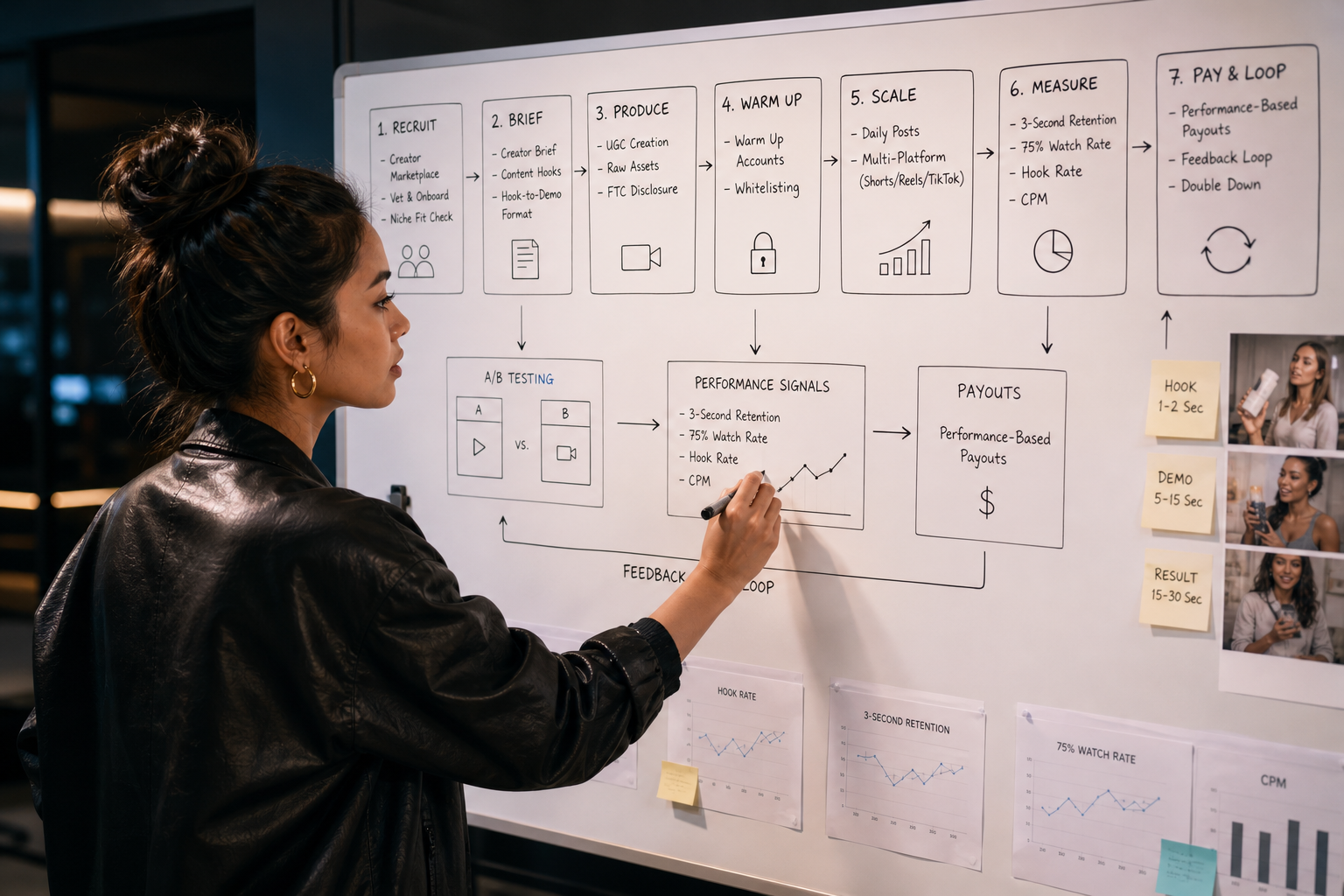
Run a 45-minute, metric-first meeting with creators and internal leads.
Agenda (template)
• Top 5 performers: Hook, first frame, duration, 3s retention, 75% watch rate.
• Bottom 5: What failed? Hook density, weak first frame, unclear demo?
• Clone list: Which hooks get 3 new variants this week?
• Retire list: Which frameworks pause for now?
• Compliance check: FTC, claims, rights.
Decisions
• Promote 1–2 creators to higher volume.
• Trial 1 new subtopic or framing per week.
• Lock this week’s A/B tests by end of meeting.
Create With VidAU
Turn scripts, product URLs, and creative ideas into ad-ready video assets with a structured AI workflow.
Key takeaway
Final Thoughts
A durable UGC marketing engine is built on aligned incentives, fresh accounts, disciplined warm-ups, and relentless hook-to-demo iteration. Keep the roster small and consistent, reward performance with transparent CPM tiers and trailing views, and let early watch metrics guide daily creative decisions.
If you need fast, testable variants to seed your pipeline, use VidAU AI to turn a product URL, images, or a script into multiple short, UGC-style drafts, then hand the best angles to your creators to remake natively. The next step: run your 3-day warm-up and start A/B testing hooks against a single clean demo this week.
Frequently asked questions
What is ugc marketing in short-form video?
UGC marketing uses creators and real users to produce native, short-form videos for TikTok, Instagram Reels, and YouTube Shorts. Teams prioritize hooks, demos, and early watch metrics like 3-second retention and 75% watch rate. Rather than flat-fee influencers, programs scale daily posts with performance-based payouts and a weekly feedback loop.
How many UGC creators should I work with at once?
A practical range from recent playbooks is 20–60 consistent creators. This size enables clear briefs, faster iteration, and meaningful statistical readouts. Fewer than 20 risks single-point failure; more than 60 often adds management overhead that slows testing, compliance reviews, and feedback loops.
How do performance-based payouts work for UGC?
Many teams combine a small base ($10–$30 per post) with tiered CPM bonuses ($1–$2 per thousand verified views). The model aligns incentives around watch metrics and distribution. Clearly define view counting, include trailing view payments for up to 90 days, and reconcile via a shared weekly report.
Why launch on brand-new accounts instead of existing ones?
New accounts help avoid stale audience signals and allow tighter topic focus during the 3-day warm-up. Posting 3–5 focused videos daily for three days trains the algorithm on your niche. The goal is rising 3-second retention and approaches to a 75% watch rate before scaling volume.
What is a hook-to-demo format and why does it work?
Hook-to-demo opens with a sharp first line and frame to win attention, then quickly proves value with an on-screen walkthrough, before/after, or applied use. It works because short-form distribution rewards early retention. Aim for strong hook rate, improving 3-second retention, and a 75% watch rate target.
Which metrics predict virality most reliably?
Leading indicators include hook rate (stay after 2 seconds), 3-second retention, and watch rate to 75%. These signals often precede large view spikes. Bridge metrics like saves and shares add confidence. Lagging metrics like installs or revenue validate winners but should not determine daily creative picks.
How often should I post during the warm-up and beyond?
During the 3-day warm-up, post 3–5 times daily per new account on tightly related subtopics. In weeks two to three, hold 2–4 daily. Later, sustain 1–3 daily on proven accounts while spinning up new ones. Keep quality high and iterate hooks aggressively rather than chasing volume for its own sake.
When should I whitelist or amplify a post?
Consider whitelisting after an organic winner emerges with strong watch metrics and comments. Ensure FTC disclosure, clear rights, and creator consent. Keep the original creator handle visible when possible, and maintain brand safety with pre-approved messaging and accurate product claims.
How do I keep creators engaged long term?
Be transparent on payouts and view counting, pay for trailing views, share weekly learnings, and promote creators whose posts trend toward 75% watch rate. Provide crisp briefs, fast feedback, and asset libraries. Recognize top performers publicly and expand their scope as outcomes improve.
Can AI tools help with ugc marketing?
AI can accelerate ideation and pre-visualization. For example, use VidAU AI to transform a product URL, images, or draft script into multiple short, UGC-style cuts sized for TikTok, Instagram Reels, and YouTube Shorts. This speeds early hook testing before creators remake the strongest angles natively.