
2026 AI Video Trends: Data-Driven Strategies, Tools, and Formats That Are Actually Going Viral
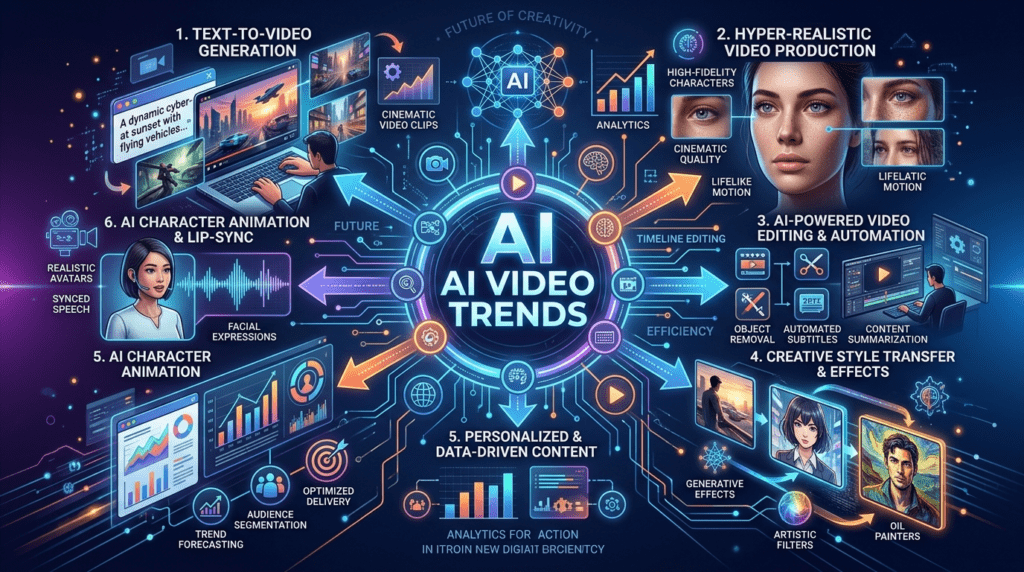
These AI video trends styles are dominating 2026 – are you using them?
The AI video landscape is evolving at a pace that makes last year’s viral formats look primitive. What worked in early 2025 hyper-real spectacle clips, surreal morph transitions, abstract diffusion art has been replaced by more structured, character-driven, retention-optimized formats.
If you’re a content strategist, AI creator, or trend-focused YouTuber, the real challenge isn’t access to tools. It’s understanding what patterns are statistically dominating and how to reproduce them systematically using the right pipelines.
This is a data-driven breakdown of what’s actually going viral in 2026 and how to architect your workflow around it.
Top AI Video Trends in 2026
AI video trends in 2026 are moving faster than most creators expected. Short-form content still dominates, but the format, editing style, and viewer behavior have changed. Audiences now expect cleaner visuals, faster storytelling, realistic AI avatars, and content that feels native to TikTok, YouTube Shorts, Instagram Reels, and Pinterest.
Brands and creators who follow these AI video trends are getting more reach, stronger watch time, and lower production costs.
AI UGC Videos Continue to Dominate
User-generated style content remains one of the biggest AI video trends in 2026. Viewers respond better to videos that feel personal and casual instead of polished studio ads.
Creators now use AI avatars, voice cloning, and talking photos to produce:
- Product reviews
- Story-based ads
- Skincare demos
- TikTok shop videos
- Testimonial content
This shift helps brands create more content without hiring multiple creators for every campaign.
Faceless AI Channels Keep Growing
Faceless content now drives millions of views across YouTube Shorts and TikTok. Many creators rely on AI-generated visuals, stock footage, subtitles, and automated voiceovers to publish daily videos at scale.
Popular faceless formats include:
- AI storytelling
- Reddit reaction videos
- Motivation clips
- Finance explainers
- AI history channels
- Anime recap videos
Creators focus on speed and consistency instead of expensive production.
Cinematic AI Ads Are Replacing Traditional Shoots
AI-generated commercials now look close to studio-level productions. Brands use cinematic prompts, motion effects, product close-ups, and realistic lighting to create premium ads in minutes.
One major AI video trend in 2026 is first-frame consistency. Brands want the same product, same character, and same visual style across multiple campaigns.
Tools inside VidAU AI help marketers create consistent video ads without full production teams.
Vertical Video Editing Is Becoming Standard
Most AI video trends now focus on vertical-first content. Creators optimize videos for mobile viewing before desktop viewing.
Common vertical editing styles include:
- Fast zoom cuts
- Subtitle-heavy storytelling
- Split-screen hooks
- Motion captions
- Product transitions
- Loop endings
This style keeps retention high on TikTok and Reels.
AI Animation Content Is Exploding
AI animation now performs strongly across YouTube and TikTok. Many viral pages use animated AI characters for comedy, storytelling, and reaction content.
Popular AI animation formats include:
- Cartoon skits
- AI meme videos
- Anime-style storytelling
- AI pets and creatures
- Fantasy character edits
These videos attract strong engagement because they feel different from traditional creator content.
Hyper-Localized AI Content Is Rising
Creators now generate videos tailored to specific countries, cities, and audiences. AI voice translation and subtitle generation make localization faster.
Brands create one campaign and convert it into:
- English versions
- Spanish versions
- French versions
- Nigerian Pidgin versions
- Arabic versions
This trend increases global reach without rebuilding videos from scratch.
AI Search Optimization for Video Is Becoming Important
Search-driven video creation is now part of modern AI video trends. Creators optimize captions, subtitles, spoken keywords, and thumbnails for TikTok SEO and YouTube discovery.
Strong AI videos now combine:
- Search intent
- Trend-based hooks
- Retention editing
- AI visuals
- Fast storytelling
Creators who understand both SEO and AI video production are growing faster than creators who depend only on trends.
The Tools Powering AI Video Trends in 2026
The tools haven’t just improved, they’ve redefined workflow architecture.
Sora: Narrative Control and World Cohesion
Sora dominates for:
- Multi-scene continuity
- Real-world physics consistency
- Cinematic framing
Its advantage lies in temporal understanding. Instead of stitching frames, it models motion across time. That reduces the need for heavy post-processing.
Best use cases:
- Episodic storytelling
- Dialogue-driven AI narratives
- Character arcs with location changes
Limitation: Iteration speed is slower than lightweight diffusion workflows.
Kling: High-Fidelity Motion Realism
Kling excels in:
- Cinematic camera movement
- Realistic human motion
- Natural environmental physics
Creators use Kling when realism is essential—especially for:
- Documentary simulations
- AI recreations of historical events
- Emotional close-ups
Its motion consistency makes it ideal for narrative bursts in the 35–55 sec range.
Runway: Rapid Trend Prototyping
Runway remains the fastest environment for:
- Concept testing
- Style iteration
- Short-form experimentation
Trend-focused YouTubers use Runway to validate:
- Hook strength
- Visual aesthetic
- Thumbnail frames
Once validated, they upscale production in Sora or Kling.
Think of Runway as the A/B testing lab.
ComfyUI: The Power User’s Viral Engine
While consumer tools dominate headlines, ComfyUI is the backend weapon of serious creators.
In 2026, advanced workflows include:
- Custom node graphs for seed locking
- IPAdapter for character preservation
- ControlNet depth + pose stacking
- Euler a vs DPM++ scheduler testing for texture fidelity
- Batch rendering for episodic consistency
Creators building recurring characters often:
- Train LoRAs on character identity
- Lock base embeddings
- Use fixed seed groups for scene families
- Apply minimal denoise strength between shots
This creates what audiences perceive as “the same person,” even across radically different environments.
That perception builds brand equity.
The Future of AI Video Trends
The future of AI video trends points toward faster content creation, stronger realism, and full automation across the video workflow. Creators no longer rely only on editing skills. AI now handles scripting, visuals, voiceovers, subtitles, translations, and scene generation within minutes.
Short-form content will keep leading platform growth, especially on TikTok, YouTube, and Instagram. At the same time, audiences are becoming harder to impress. Generic AI videos already face lower engagement. Creators who combine storytelling, trend timing, and realistic visuals will stay ahead.
Several changes are shaping the future of AI video trends:
- AI avatars will become more human-like
- Lip sync accuracy will improve
- AI-generated scenes will look more cinematic
- Multi-language content will grow faster
- Personalized video ads will increase conversions
- Real-time AI editing will reduce production time
Brands are also shifting budgets from traditional production toward scalable AI video systems. Instead of filming one ad campaign, companies now generate dozens of video variations for different audiences, products, and platforms.
Another major shift involves interactive AI videos. Viewers are starting to expect clickable products, dynamic storytelling, and personalized viewing experiences inside short-form videos.
Conclusion
AI video trends in 2026 are no longer based on random viral moments. The creators winning today follow repeatable systems built around retention, storytelling, speed, and platform behavior. Short-form videos, AI avatars, cinematic ads, faceless channels, and localized content now shape how audiences consume media online.
The biggest shift involves consistency. Viral creators no longer depend on one successful post. They build repeatable workflows using tools like Sora, Kling, Runway, ComfyUI, and VidAU AI to publish content faster across TikTok, YouTube Shorts, Instagram Reels, and Pinterest.
Creators who understand audience retention, AI-assisted editing, and search-focused content production will continue growing faster than creators relying only on visual effects or random trends.
The next stage of AI video trends will focus on:
- Better realism
- Faster production
- Personalized video experiences
- Multi-language content
- Interactive storytelling
- Scalable AI workflows
AI video creation is becoming less about expensive equipment and more about how efficiently you turn ideas into content people watch until the end.
Frequently Asked Questions
Q: Are pure AI spectacle videos completely dead in 2026?
A: No, but they no longer sustain long-term growth. Spectacle works best as a hook or narrative amplifier. Channels relying solely on abstract diffusion visuals without recurring characters or story arcs see lower retention and weaker subscriber conversion.
Q: What are AI video trends in 2026?
A: AI video trends in 2026 focus on short-form storytelling, AI avatars, cinematic product ads, faceless channels, realistic animations, and localized content built for TikTok, YouTube Shorts, Instagram Reels, and Pinterest.
Q: What is the most optimal video length for AI-generated content right now?
A: The 35–55 second range currently performs best for short-form platforms because it allows for a structured emotional arc while maintaining high completion rates. For long-form YouTube, 2–4 minutes with strong narrative cohesion and motion stability is outperforming longer experimental formats.
Q: How do I maintain character consistency across AI-generated scenes?
A: Use seed locking, IPAdapter or reference-based conditioning, consistent VAE selection, and low denoise strength for scene transitions. In advanced workflows like ComfyUI, combining LoRA-trained character models with fixed seed groups significantly improves cross-scene identity retention.
Q: Which AI video tool should trend-focused creators prioritize?
A: Use Runway for rapid testing and iteration, Kling for realistic motion and cinematic quality, Sora for narrative continuity and multi-scene storytelling, and ComfyUI for advanced character control and scalable production workflows.
Q: Is AI animation content growing on YouTube and TikTok?
A: Yes. AI animation continues gaining traction because animated characters, meme edits, fantasy scenes, and cartoon storytelling attract strong engagement and replay value.
Q: How long should AI-generated videos be?
A: Most viral short-form AI videos perform best between 35 and 55 seconds. This range keeps audience retention high while giving enough time for storytelling and product promotion.
Q: What makes AI UGC videos perform well?
A: AI UGC videos feel natural and relatable. Viewers respond better to casual storytelling, realistic reactions, and creator-style product demonstrations than polished commercial ads.
Q: What is the best AI video format for engagement?
A: Story-driven short-form videos currently perform best. Videos with strong hooks, subtitles, emotional pacing, and fast editing usually achieve stronger watch time and completion rates.
Q: Are faceless AI channels still growing?
A: Yes. Faceless AI channels continue growing across finance, motivation, storytelling, anime recap, and educational niches because creators publish consistently without appearing on camera.
Q: How does SEO affect AI video performance?
A: Search optimization now plays a major role in video discovery. Captions, spoken keywords, subtitles, titles, and thumbnails help videos rank better on TikTok and YouTube search.
Q: What is the future of AI video trends?
A: The future of AI video trends will focus on real-time editing, interactive videos, advanced realism, multilingual campaigns, and scalable video generation systems built for daily publishing.


