AI Animation · Beginner Guide
10 Most Satisfying AI Animations Trending Now: The Ultimate Animation for Beginners Guide
Understand why satisfying AI animations feel magnetic, what patterns make them shareable, and how beginners can start creating better motion clips with stronger taste.
By the VidAU Editorial Team · Updated 2026 · 11 min read
These AI animations are oddly satisfying and you can’t look away. For anyone exploring animation for beginners, that reaction is the real starting point: before tools, before prompts, before style, there is the simple question of why some motion clips feel magnetic while others are instantly forgettable.
This article is built for animation enthusiasts, casual viewers, and AI Video Ads Enthusiasts who want to understand what makes satisfying AI animation content work, where to find more of it, and how to begin creating it with better taste.
Quick summary
- Satisfying AI animations work because of visual clarity, rhythmic motion, and fast payoff. They do not just move. They resolve tension.
- The most common patterns include clear transformation, loop-friendly motion, controlled contrast, readable composition, and textural payoff.
- Beginners should start with short-form transformation or loop-based animation because it is easier to judge, finish, improve, and share.
- VidAU AI can help package satisfying animation ideas into viral videos, sharper social media content, short-form UGC content, and visually striking video ads.
What you’ll get from this article
- The visual patterns that make AI animations feel satisfying and shareable
- A simple explanation of why certain motion sequences hold attention
- A beginner-friendly way to decide what type of animation to start with
- A practical guide to finding better creators, channels, and content formats
Why satisfying AI animations are trending in the first place
The core problem is not that there is too little AI animation online. It is that there is too much of it, and most of it blurs together. Viewers can find endless clips, but discovering what actually makes AI animations visually satisfying and worth sharing takes more than scrolling.
The most memorable pieces usually combine three things at once: visual clarity, rhythmic motion, and a payoff that arrives quickly. That is why short AI loops, transformation clips, texture reveals, and clean cinematic transitions often outperform longer, less focused animations. They do not just move. They resolve tension.
Why this matters
The strongest satisfying AI animations do not rely on complexity alone. They combine visual clarity, rhythmic motion, and a payoff that arrives quickly enough for short-form viewing.
Common patterns in satisfying AI animation content
If you study enough clips, a few patterns show up again and again.
Clear transformation
One object becomes another. A rough environment turns glossy. A sketch evolves into a finished world. Transformation works because the viewer can instantly understand the before and after. The satisfaction comes from watching the bridge between them.
Loop-friendly motion
Some of the best AI animations feel complete, then restart so smoothly that the beginning and end almost disappear. This creates a repeat-watch effect. The viewer is not just watching motion. They are watching a cycle that feels finished every time.
Controlled contrast
Satisfying clips often rely on strong contrast: dark to light, empty to full, stillness to movement, chaos to order. When contrast is too weak, the animation feels vague. When contrast is clean, the clip feels intentional.
Readable composition
Even fast AI motion works better when the frame is easy to read. Clean focal points, obvious subject placement, and simple movement paths matter. This is one reason cinematic AI animation feels stronger than random visual noise. It gives the eye somewhere to go.
Textural payoff
A lot of shareable AI animation is less about story and more about sensory payoff. Melting metal, liquid glass, smoke trails, morphing fabrics, glowing particles, and hyper-clean lighting all create that oddly satisfying effect because they reward the viewer frame by frame.
For people searching how to animate for beginners, which ai animation tool is best for beginner, animation tools for beginners, and animation apps for beginners, this matters because tool choice is only half the story. Taste begins with pattern recognition.
Transformation and loops
Clear before-and-after motion and smooth repeatable cycles create the satisfaction viewers want to replay.
Contrast and composition
Clean contrast, strong focal points, obvious subject placement, and simple movement paths help the eye know where to go.
Texture and sensory payoff
Melting metal, liquid glass, smoke trails, morphing fabrics, glowing particles, and hyper-clean lighting reward viewers frame by frame.
Why your brain locks in on certain AI animations
The psychology behind satisfying AI animation is simple even when the visuals look advanced.
First, the brain likes prediction with a twist. When you can guess the motion path but still feel surprised by the result, attention stays high. Second, the brain likes closure. A clip that resolves neatly feels more rewarding than one that drifts. Third, the brain loves rhythm. Repeated pulses, waves, expansions, and symmetry create visual comfort.
That is why satisfying AI animation often feels closer to design choreography than pure spectacle. The clip is not powerful because it is busy. It is powerful because it is controlled.
This logic also reflects principles long emphasized in animation training, film editing, and visual communication programs such as those associated with CalArts. Readability, timing, and payoff still matter, even when AI speeds up production.
A beginner-friendly way to start without getting overwhelmed
The mistake many newcomers make is chasing the most cinematic result first. A better approach is to start with the kind of satisfaction you already enjoy watching.
A simple starter checklist
Choose your first animation direction based on these questions:
- Do you enjoy loops more than stories?
- Do you prefer object transformations or character motion?
- Are you drawn to texture and lighting, or to humor and surprise?
- Do you want short social clips or longer cinematic pieces?
Which animation is best for beginners
The best animation for beginners is usually short-form transformation or loop-based animation. It is easier to judge, easier to finish, and easier to improve because the result is compact. You can focus on motion clarity, transitions, and pacing without needing a full narrative system.
Character-heavy animation can be exciting, but it asks for more control over consistency, timing, and expression. For most beginners, simple visual transformation content creates faster learning.
What does a beginner animator need
A beginner animator needs four essentials:
- A clear visual taste reference
- One simple animation format to practice repeatedly
- A workflow that keeps the clip short and finishable
- A feedback habit based on replay value, not just visual detail
Beginners do not need to master everything at once. They need to learn what makes a clip readable, repeatable, and emotionally clean.
How to start animation as a beginner
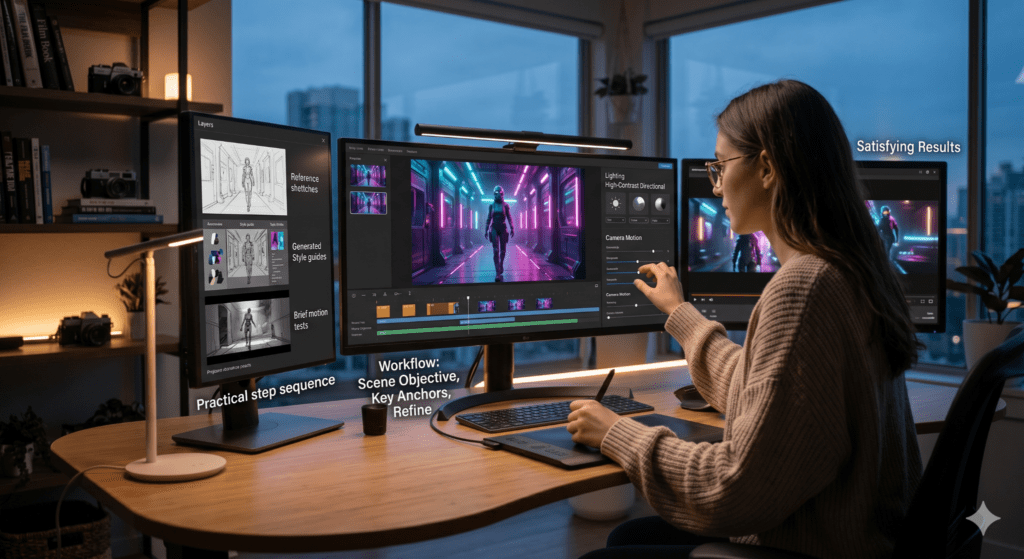
Start by collecting five to ten satisfying AI animations you genuinely want to rewatch. Study what repeats across them: angle, lighting, motion speed, transition type, and ending. Then make one short piece built around a single effect, not a full universe.
A practical sequence looks like this:
1
Pick one format
Pick one format: loop, transformation, or reveal.
2
Limit the idea
Limit the clip to one central visual idea.
3
Prioritize clean visuals
Prioritize clean lighting and strong composition.
4
Check replay value
Test whether the clip still works on a second and third replay.
5
Adjust pacing first
Adjust pacing before adding more complexity.
That process is better for animation for beginners than trying to imitate a whole cinematic trailer on day one.
Animate with One Prompt Now
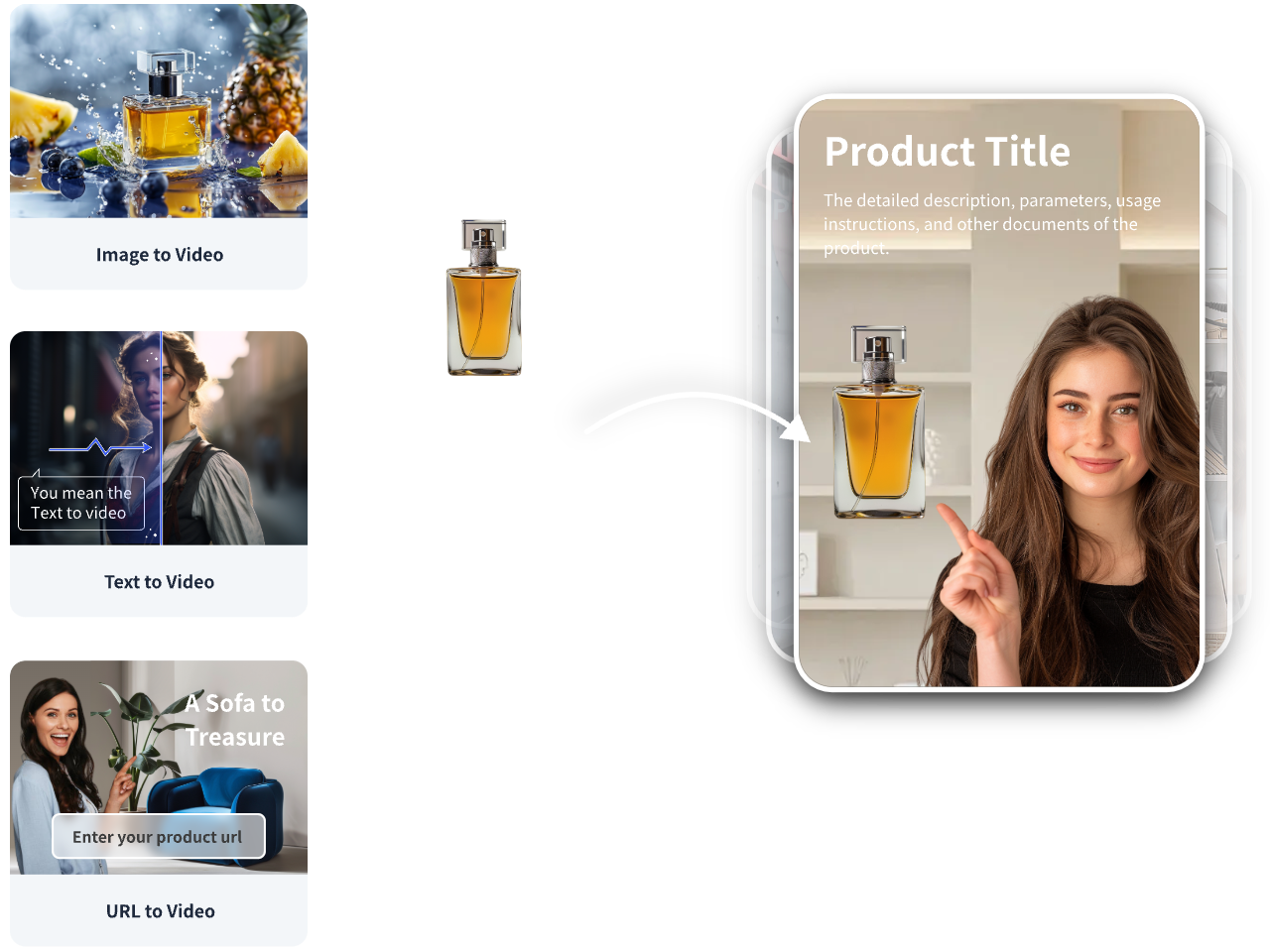
Turn one clear animation idea into social-ready videos, promotional clips, UGC-style content, and visually striking campaign assets with VidAU AI.
Where to find the best satisfying AI animation content
The best sources are usually platforms where short repeat-viewing behavior is rewarded. Social video feeds, creator reels, visual art pages, and niche AI art communities tend to surface the most satisfying clips because viewers respond quickly to pacing, transformation, and replay value.
When evaluating channels, look for creators who do at least one of these well:
- Consistent visual theme
- Strong first second
- Clear transformation payoff
- Distinct lighting or texture signature
- Clips that work without explanation
This is also where VidAU AI fits naturally. If you are curating or creating satisfying AI animation content, VidAU AI can help package it into viral videos, sharper social media content, short-form UGC content, and even visually striking video ads. That matters because many satisfying animations are not just watched for art appreciation. They are also repurposed into shareable campaign assets, product moments, and audience hooks.
For an enthusiast or collector, that means you can study what performs culturally. For a beginner creator, it means your animation experiments can live beyond a portfolio folder.
Tip
When evaluating AI animation channels, look for clips with a strong first second, clear transformation payoff, distinct lighting or texture signature, and enough clarity to work without explanation.
What can go wrong when chasing satisfying AI animations
There are a few common failure modes.
The first is visual overload. Too many effects reduce satisfaction because the eye loses the focal point. The second is weak ending logic. If the clip does not resolve, it rarely feels satisfying no matter how polished it looks. The third is fake cinematic style without structure. Dramatic lighting alone cannot save unclear motion.
Another issue is platform mismatch. A beautiful clip may underperform if it is too slow for short-form social viewing or too repetitive for a longer edit. Brief safety note: if you use AI animation for public sharing, stay mindful of copyright, likeness, and platform rules, especially when remixing recognizable people or branded visuals.
Watch out
Visual overload, weak ending logic, fake cinematic style without structure, and platform mismatch can make even polished AI animation feel less satisfying.
Common mistakes beginners make
Beginners often assume “more detail” means “more satisfying.” Usually, the opposite is true. Satisfaction comes from clarity.
Other frequent mistakes include:
- Starting with long scenes instead of short loops
- Copying surface style without understanding pacing
- Ignoring composition because the AI output looks impressive
- Choosing tools first instead of choosing animation behavior first
A smarter beginner mindset is to judge a clip by replay value, not just by how advanced it looks on first watch.
Assumptions and limitations
- This guide focuses on visually satisfying AI animation, not full traditional animation training
- Assumes the reader cares about shareability as well as artistic appeal
- Prioritizes short-form discovery and beginner learning over deep production pipelines
- It does not rank specific tools because the better starting point is content behavior and not brand chasing
Create Your Animation
Use VidAU AI to package satisfying animation ideas into viral videos, sharper social media content, short-form UGC content, and visually striking video ads.
VidAU workflow
From satisfying animation idea to social-ready content
- Choose the satisfying pattern: Start with a loop, transformation, reveal, texture payoff, or clean cinematic transition.
- Keep the clip focused: Limit the animation to one central visual idea with readable composition and clear pacing.
- Package with VidAU AI: Turn the visual idea into viral videos, sharper social media content, short-form UGC content, or visually striking video ads.
- Review for replay value: Check whether the payoff is clear in the first few seconds and whether the clip feels worth watching again.
Key takeaway
Conclusion
The most satisfying AI animations trending now succeed because they make motion feel inevitable, clean, and rewarding. For people exploring animation for beginners, that is the real lesson: learn to recognize transformation, rhythm, contrast, and payoff before worrying about complexity.
Once you understand why a clip is satisfying, you are no longer just scrolling. You are studying. And once you start studying, you are already closer to making work people will want to watch twice.
FAQs
Here are answers to common questions about satisfying AI animations, animation for beginners, short-form loops, shareability, and how VidAU AI can support social-ready animation content.
What makes an AI animation feel satisfying?
Usually a clear transformation, smooth motion, readable composition, and a strong ending or loop.
Are satisfying AI animations always cinematic?
No. Some work because they are simple, minimal, and rhythmically clean rather than dramatic.
Is animation for beginners better with short clips?
Yes. Short clips are easier to finish, compare, improve, and share.
Should beginners start with character animation?
Usually not. Transformation clips and loop-based visuals are easier starting points.
Why do loop animations perform so well?
Because they create replay value and make the viewer stay with the motion longer.
Do I need expensive tools to begin?
Not necessarily. Beginners benefit more from a focused format and consistent practice than from a large tool stack.
How do I know if an animation is shareable?
Ask whether the payoff is clear in the first few seconds and whether the clip feels worth replaying.
What type of AI animation works best for casual viewers?
Short, visually obvious transformations and texture-rich motion usually connect fastest.
What do AI art collectors often notice first?
Distinct style, clean visual identity, and whether the animation feels memorable beyond novelty.
Can satisfying AI animation be used for marketing?
Yes, especially when adapted into short social assets, video ads, UGC content, and viral videos.
How can VidAU AI support this kind of content?
VidAU AI can help turn visually satisfying animation ideas into social-ready edits, promotional clips, and campaign-friendly formats.
What is the fastest way to improve as a beginner?
Study repeated patterns in clips you already love, then make one short piece around one strong visual idea.