VidAU Editorial · AI Search
Agentic AI Models: Definition, Architecture, and How to Build Real‑World Agents
Learn what agentic AI models are, how the perceive‑think‑act loop works, and how to build real‑world agents using LangChain, LangGraph, LlamaIndex, CrewAI, RAG, memory, and guardrails.
By the VidAU Editorial Team · Reviewed before publishing

If you’re asking what is an agentic ai, this guide gives a precise definition, a crisp model‑vs‑agent distinction, and the core perceive→reason→act→observe loop. Then we build a minimal agentic AI model using a 2026 stack: LangGraph orchestration, LangChain/Langflow for rapid prototyping, and LlamaIndex for Agentic RAG no fluff, just a working baseline.
Quick Summary
• Agentic AI models are LLM-powered systems that perceive→reason→act→observe to achieve goals autonomously, not just chat.
• LangGraph is the top 2026 orchestration choice; CrewAI handles multi‑agent collaboration, with LlamaIndex or LangChain for Agentic RAG.
• Use a scoped tool stack, vector DB (Pinecone, Weaviate, Qdrant, or Chroma), MCP/A2A for interop, and Langfuse for telemetry.
• Engineering and product teams building email processing, content creation, or sales outreach agents benefit most from this blueprint.
What Is an Agentic AI Model?
An agentic AI model is an LLM‑driven system that plans and executes multi‑step tasks via a perceive→reason→act→observe loop. Unlike a plain chatbot, it selects tools, queries knowledge (RAG), updates memory, and adapts based on observations. If you wondered what is an agentic ai, think goal‑seeking software, not just a responder.
Agentic AI Models vs Base Models: The Difference
• Model: predicts tokens. It “thinks” but does not act.
• Agentic AI model: thinks and acts. It decomposes goals, calls tools/APIs, retrieves context, and inspects outcomes to decide next steps.
Key implication: reliability depends on orchestration, tools, memory, and guardrails not the model alone.
Agentic AI Models Architecture: The Perceive→Reason→Act→Observe Loop
• Perceive: accept inputs (user query, email, image) and fetch context (RAG).
• Reason: apply patterns like ReAct or Chain‑of‑Thought to plan next steps.
• Act: call tools (search, DB, email via SendGrid), or delegate to sub‑agents.
• Observe: parse tool results, update memory, and decide whether to continue.
Add layers around the loop:
• Memory: working (scratchpad), episodic (task history), semantic (vector DB).
• Policies/guardrails: allow/deny lists, rate limits, HITL checkpoints.
• Telemetry: traces, costs, tool call logs with Langfuse.
Suggested Visual: A loop diagram showing perceive→reason→act→observe with memory, RAG, guardrails, and telemetry around it.
Agentic Design Patterns: ReAct, CoT, Plan‑and‑Execute, Reflexion, Tree of Thoughts
• ReAct: interleave reasoning and tool use. Great default for tool‑calling reliability.
• Chain‑of‑Thought: encourages stepwise reasoning; pair with tools for complex tasks.
• Plan‑and‑Execute: create a plan, then run steps; lower latency variance but can be brittle if the plan is wrong.
• Reflexion: self‑critique after attempts; improves quality with extra tokens and time.
• Tree of Thoughts: branch/explore options, then select; highest quality, highest cost.
Trade‑offs
• Reliability vs latency vs cost: Reflexion and ToT help accuracy but raise latency and spend. ReAct balances speed and correctness for many production tasks.
Key Takeaways
• Start with ReAct; add Reflexion only when quality gaps persist.
• Prefer Plan‑and‑Execute for predictable workflows with limited branching.
• Use ToT sparingly for high‑stakes decisions.
Memory and Agentic RAG: LlamaIndex, LangChain, and Vector Databases

Agentic RAG augments each loop with fresh, task‑specific context. Use LlamaIndex or LangChain for indexing, retrievers, and tool adapters. Maintain:
• Working memory: the scratchpad for the current loop.
• Episodic memory: prior attempts and outcomes.
• Semantic memory: long‑term knowledge via embeddings in a vector DB.
Vector DB options (choose one for your scale/ops needs):
• Option: Pinecone
Recommended Tools: Vector DB
Why: Managed, high scale, low ops burden
• Option: Weaviate
Recommended Tools: Vector DB
Why: Hybrid search, modular, flexible hosting
• Option: Qdrant
Recommended Tools: Vector DB
Why: Fast, open‑source, good filtering
• Option: Chroma
Recommended Tools: Vector DB
Why: Simple local dev/startup use
Suggested Visual: Architecture sketch showing LlamaIndex/LangChain with retriever, vector DB, and agent loop.
Interoperability, Multi‑Agent, and Vision Agents
• Multi‑agent collaboration: CrewAI orchestrates specialist agents (researcher, planner, executor) for complex tasks; smolagents offers lightweight code and tool‑calling agents.
• Interop: Model Context Protocol (MCP) exposes standardized tools; Agent2Agent (A2A) enables cross‑agent communication.
• Vision agents: pair a vision‑capable model with ReAct for tasks like reading invoices or inspecting screenshots before acting.
When to use:
• CrewAI when roles and handoffs are clear.
• MCP/A2A when connecting diverse tools, models, or vendors.
• Vision agents when input includes images or documents with layout.
Quickstart: Build a Minimal Agent with LangGraph, LlamaIndex, and LangChain/Langflow
Goal: An email triage agent that summarizes a message, retrieves policy context, drafts a reply, and optionally sends via SendGrid with logs in Langfuse.
1) Define tools (scoped)
• retrieve_context(query): LlamaIndex retriever restricted to your KB.
• send_email(to, subject, body): SendGrid tool with allow‑list on recipients.
• log_event(meta): telemetry hook to Langfuse.
2) Graph the loop with LangGraph
• Nodes: perceive, plan, act_tool, observe, decide_done.
• Edges: perceive→plan→act_tool→observe→(plan or done).
• Add a timeout and max_turns to prevent runaway loops.
3) Reasoning pattern (ReAct)
• Prompt: system role defines goal, safety rules, and available tools.
• Scratchpad: capture thought→action→observation in working memory.
4) Agentic RAG with LlamaIndex
• Index HR/policy docs; use a top‑k retriever.
• Before drafting, call retrieve_context to ground the reply.
5) Guardrails and HITL
• Allow/deny: restrict send_email to internal domains.
• HITL checkpoint: require human approve flag before final send.
• Input sanitization: strip URLs or attachments from untrusted sources.
6) Telemetry and evals
• Langfuse: record traces, token use, tool calls, latencies.
• Evals: task success rate (approved sends), tool‑call accuracy (right tool, right args), latency per loop, and cost per task.
7) Prototype visually with Langflow
• Mirror the LangGraph nodes, attach tools, and tweak prompts and retrievers interactively.
Pseudocode outline
• perceive: extract email fields, summarize intent
• plan: choose next action (retrieve or draft)
• act_tool: run retrieve_context or draft+send_email
• observe: parse tool output; update working/episodic memory
• decide_done: if reply drafted and approved, finish; else loop
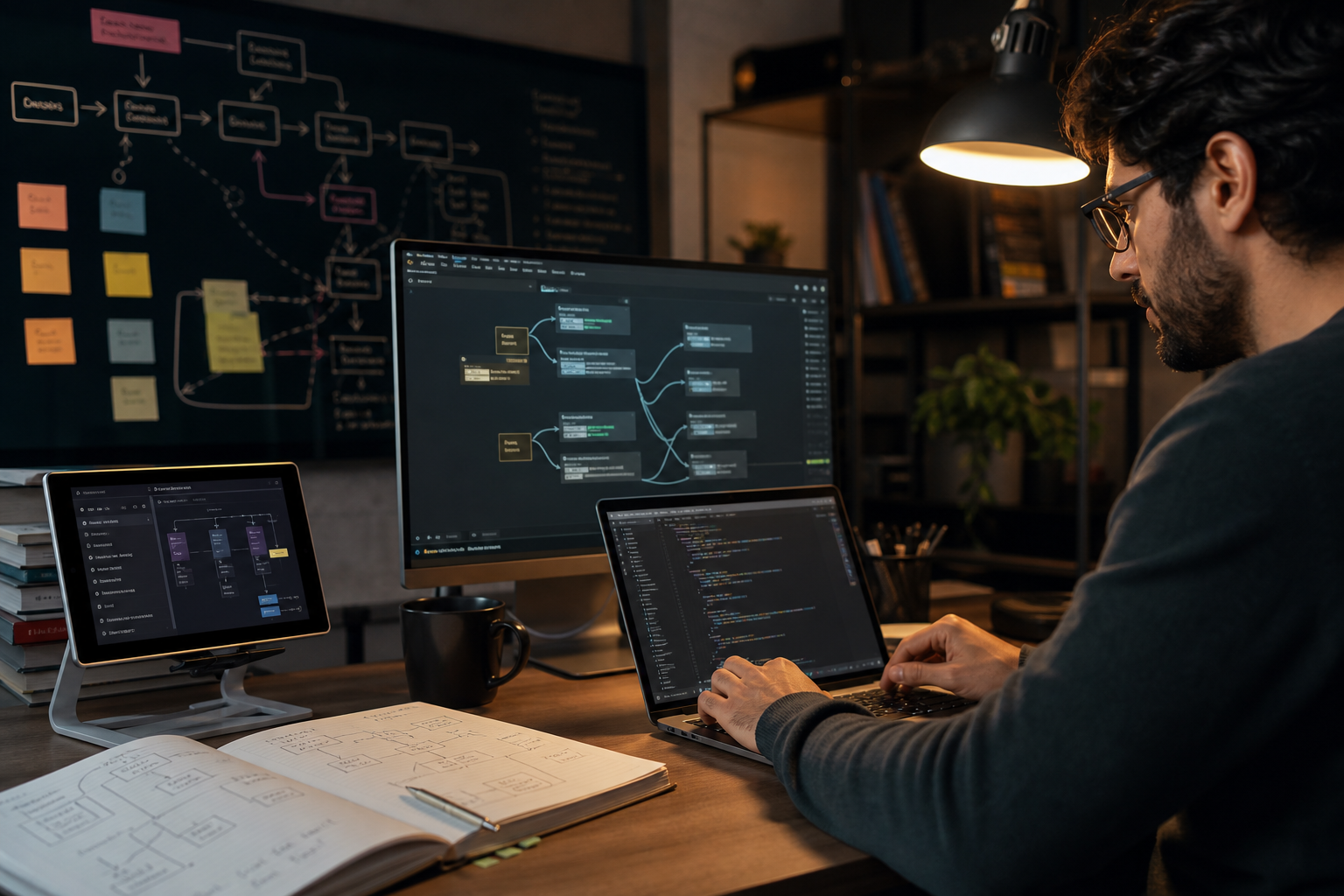
Suggested Visual: Node‑edge diagram of the LangGraph workflow with guards and telemetry.
Finalizing Your Stack Choices (2026 Checklist)
• Orchestration: LangGraph for the control loop.
• Reasoning: ReAct default; enable Reflexion if quality gaps persist.
• RAG: LlamaIndex or LangChain; pick a vector DB fitting your ops.
• Interop: MCP for tools; A2A for cross‑agent messaging when needed.
• Multi‑agent: CrewAI for role‑based workflows; smolagents for lightweight cases.
• Guardrails: scoped tools, allow/deny lists, HITL checkpoints, max_turns.
• Observability: Langfuse traces, token/cost/latency dashboards.
Create With VidAU
Turn scripts, product URLs, and creative ideas into ad-ready video assets with a structured AI workflow.
Key takeaway
Final Thoughts
Agentic AI models shift you from chat to goal‑seeking systems. Start small: one loop, one retriever, one write‑action tool, and measured guardrails. Add Reflexion or multi‑agent patterns only when your evals demand it.
The best next step: implement the LangGraph quickstart above, wire a single SendGrid action, ground with Agentic RAG, and track outcomes in Langfuse. Expand tool scope only after you hit reliability targets on a narrow task.
Frequently asked questions
What is an agentic AI model in simple terms?
An agentic AI model is an LLM‑driven system that plans and executes steps toward a goal. It follows a perceive→reason→act→observe loop, uses tools and RAG for context, updates memory, and adapts based on results. It differs from a chatbot because it can decide actions and verify outcomes.
How is an agentic AI model different from a regular LLM?
A regular LLM generates text given a prompt; it does not act. An agentic AI model orchestrates the LLM with tools, memory, and policies so it can plan, call APIs, retrieve knowledge, evaluate results, and iterate. Think model equals thinker; agent equals thinker plus doer.
Which frameworks should I use to build agentic AI models in 2026?
Use LangGraph for orchestration, LlamaIndex or LangChain for Agentic RAG and tooling, and CrewAI for multi‑agent collaboration. Langflow helps rapid prototyping, smolagents offers lightweight agents, and Langfuse provides telemetry. Pick one vector DB (Pinecone, Weaviate, Qdrant, or Chroma) for semantic memory.
When should I use ReAct vs Plan‑and‑Execute or Reflexion?
Start with ReAct because it blends reasoning and tool calls with good speed. Choose Plan‑and‑Execute for predictable, linear workflows. Add Reflexion when quality needs improvement through self‑critique, accepting more latency and cost. Reserve Tree of Thoughts for high‑stakes, complex decisions.
What is Agentic RAG and why does it matter?
Agentic RAG injects relevant, up‑to‑date context into each loop step. Rather than a single retrieval at the start, the agent retrieves when needed, grounding plans and actions. It improves factuality, reduces hallucinations, and lets you scale knowledge independently of the base model.
How do I add memory to an agentic AI model?
Use a layered approach: working memory as a scratchpad in prompts, episodic memory for past attempts and feedback, and semantic memory stored in a vector DB. Retrieve and update memories per loop, and prune or compress to control token use, latency, and cost.
How do MCP and A2A help with interoperability?
Model Context Protocol standardizes how agents access tools and services, making integrations consistent and safer. Agent2Agent defines how agents communicate across systems. Together they let different agents and vendors collaborate without bespoke glue code for every connection.
What guardrails do production agents need?
Apply tool scoping and allow/deny lists, set max turns and timeouts, sanitize inputs, and enforce human‑in‑the‑loop approvals for risky actions like sending emails or triggering payments. Monitor with Langfuse and run evaluations on task success, tool‑call accuracy, latency, and cost.
Which vector database should I choose for an agentic AI model?
For managed scale, Pinecone is a common pick; Weaviate offers hybrid search flexibility; Qdrant is fast and open‑source with strong filtering; Chroma suits local dev and small deployments. Choose based on ops maturity, budget, and latency/throughput requirements.
Can I build vision‑capable agentic AI models?
Yes. Pair a vision‑capable model with ReAct and restrict tools to safe actions. Use vision to parse invoices, screenshots, or product images, then ground decisions via Agentic RAG before acting. Apply HITL approvals for irreversible steps and log everything in Langfuse.