Agentic AI · Payments & Billing Stack
Agentic AI Companies: The Emerging Stack for Autonomous Agents, Payments, and Billing
Explore agentic AI companies and the payments/billing stack behind autonomous agents. Learn how SaaS teams can adopt agents, shift to per-query pricing, and stay compliant.
By the VidAU Editorial Team · Updated 2026 · 10 min read
If you are evaluating agentic AI companies, the real blocker is not the model. It is payments and billing. This guide maps the emerging stack. If you are also looking at coding workflows for autonomous agents, see our guide on agentic AI coding assistants.
VidAU is an AI video ad platform that generates video ads from product URLs, images, or scripts in 49 languages. When your agentic rollout needs fast customer-facing explainers, VidAU produces them in minutes.
Quick summary
- ATXP by Circuit and Chisel brings agent-native payments described as HTTP for agentic payments, with stablecoin rails and 402-style metering.
- Alternate stacks combine agent runtime, custom metering, and multi-chain stablecoin support across Base, Solana, Polygon, and World Chain.
- Per-query pricing requires precise usage events, 402-style payment challenges, and KYA policy gates before autonomous spending.
- SaaS teams with 24/7 agent workloads, microtransactions, or variable-intensity tasks benefit most from stablecoin-native payment rails.
In this guide
- What agentic AI companies are and how they work
- Why payments and billing block production
- Where agentic AI companies fit in the stack
- Step-by-step workflow for per-query pricing
- How SaaS companies use AI agents in production
- KYA compliance and policy gating for agents
- Common mistakes to avoid with agent payments
- Metrics and rollout checklist for your pilot

What Is an Agentic AI Company?
AI Agents, Clearly Explained
An agentic AI company builds autonomous AI agents that use large language models plus tools to perceive goals, plan steps, call APIs, and pay for services. The defining difference from a general AI vendor is production-grade payments: agents need to spend money autonomously, settle instantly, and stay within policy limits at all times.
Why are payments and billing the real blocker?
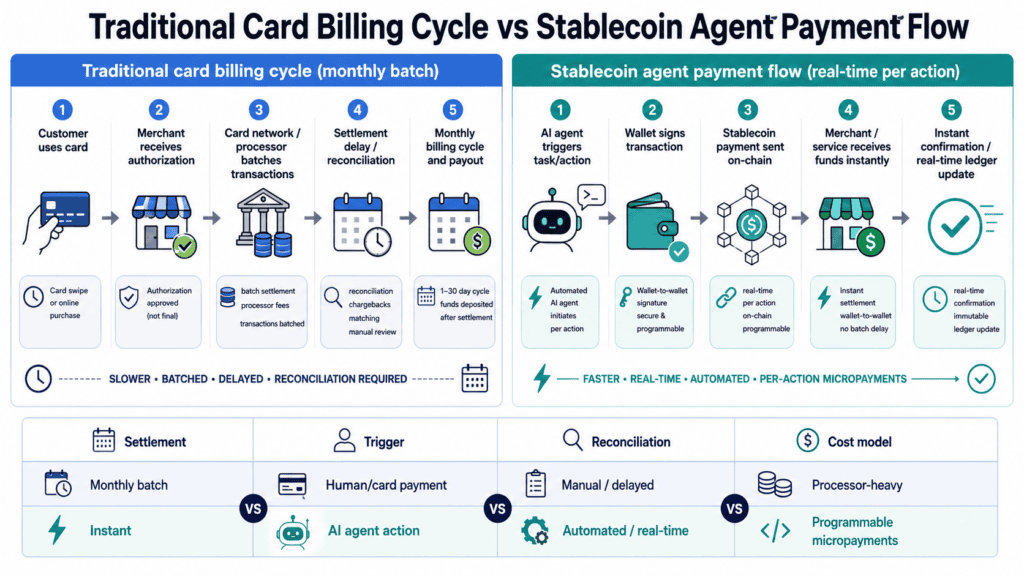
Agents act continuously. Traditional card rails and monthly invoices do not match the flow of micro, always-on decisions. Stablecoin settlement on Base, Solana, Polygon, or World Chain matches the agent tempo: near-real-time, programmable, and auditable.
Why this matters
The operational edge is not only in the agent runtime. It is in whether the agent can trigger payments, settle them quickly, meter usage precisely, and stay inside policy controls while acting continuously.
Where do agentic AI companies fit in the stack?
Agentic AI companies provide runtimes and rails. The operational edge comes from the payments layer.
- Agent reasoning: LLMs and agent runtime. Plan, call tools, decide.
- Data and actions: APIs and webhooks. Read and write business systems.
- Payments protocol: Circuit and Chisel ATXP. HTTP-402-style agent payments.
- Settlement rails: Stablecoins on Base, Solana, Polygon, World Chain. Always-on, low-latency.
- Billing and pricing: Per-query meter and invoice. Align cost with usage.
- Orchestration: For open-source agent automation workflows, see the OpenClaw vs Google Antigravity comparison to find the right orchestration layer for your stack.
- Compliance: KYA and policy engine. Identity, limits, audit.
Key takeaways
- Stablecoin rails match agent tempo; batch cards do not.
- HTTP-402-like prompts make payment native to the request.
- KYA ensures only approved agents can spend within policy.
How do you implement per-query pricing with autonomous AI agents?
Here is a concise implementation playbook after reviewing public examples and patterns referenced by agentic AI companies in 2026.
1
Define Billable Units
Choose per-query, per-action, or per-token units tied to value. Map each agent tool to a SKU and price.
2
Instrument Metering
Emit a usage event for every agent action: timestamp, agent ID, SKU, quantity, cost basis, request hash. Store in an append-only ledger for audit.
3
Add 402-Style Payment Challenges
When balance is insufficient, return a payment-required response with the exact amount and accepted chains or tokens. Resume the workflow automatically once settled.
4
Wire Stablecoin Settlement
Support stablecoins on Base, Solana, Polygon, or World Chain per your risk policy. Listen for confirmations via webhooks and post a credit to the customer ledger on finality.
5
Apply KYA and Policy Gates
Register agent identity, owner, scopes, and spend limits. Block high-risk SKUs or routes unless pre-approved.
6
Convert Usage to Invoices
Aggregate ledger entries per account into bill runs. Generate human-readable invoices plus machine-parsable receipts for audits.
7
Expose Controls in Product
Show real-time balance, usage graphs, and per-agent limits. Support auto-reload thresholds and capped daily spend.
8
Test Failure Paths
Simulate chain delays, partial fills, and policy denials. Prove idempotency on retries and double-spend protection before GA.
Explain Your Rollout With VidAU
When your agentic rollout needs fast customer-facing explainers, VidAU helps turn product URLs, images, or scripts into video ads in minutes.
How SaaS companies use AI agents in production
Effective early patterns from SaaS teams using agentic AI in 2026:
- Tier-1 support triage: Agents resolve common tickets and raise complex cases, priced per interaction with spend caps.
- Procurement bots: Agents source quotes and submit small purchases within policy, settled via stablecoins. For teams needing ad creative alongside procurement workflows, see how Claude Code pairs with ad automation.
- Analytics copilots: Agents run scoped data pulls and summaries, billed per query with KYA on dataset access.
What does KYA compliance require for agentic AI companies?
KYA (Know Your Agent) extends identity and policy to autonomous systems. At minimum, keep:
- Agent identity and owner linkage: who controls it and why it exists.
- Capability scopes: allowed tools, spend ceilings, and blocklists.
- Policy evaluation: preflight checks before payment or API calls.
- Audit trail: immutable logs of intents, approvals, payments, and outcomes.
Watch out
Skipping KYA creates unbounded risk because autonomous systems can act continuously. Set identity, ownership, scopes, and spend limits before launch.
Common mistakes to avoid with agent payments and billing
- Treating agents like seats: Seat licenses misalign with bursty agent usage. Switch to per-query pricing.
- Delaying settlement: Card batches break autonomy. Adopt stablecoins for near-real-time settlement.
- Skipping KYA: Unscoped agents create unbounded risk. Set limits before launch.
- Weak metering: Missing or mutable events kill audits. Use append-only ledgers.
- One-chain lock-in: Customers prefer choice. Support Base, Solana, Polygon, or World Chain per policy.
Metrics and rollout checklist for your pilot
Track: authorization success rate, settlement latency, cost-to-serve per query, net dollar retention on per-query plans, and failed-payment recovery rate.
Pilot checklist
- Billable SKUs defined and priced.
- End-to-end meter to ledger to invoice path confirmed working.
- 402-style responses and resume tested.
- Stablecoin rails confirmed on at least one chain.
- KYA registry, scopes, and audit logs live.
- Product UI for balances, limits, and receipts ready.
Key takeaway
Final Thoughts
Agentic AI companies succeed when payments are native to the agent loop. Stablecoin settlement, 402-style metering, per-query pricing, and KYA gates are the four production requirements that most teams underestimate at the start.
Create Product Explainers With VidAU
Use VidAU to produce fast, customer-facing explainers from product URLs, images, or scripts in 49 languages.
FAQ
Here are concise answers to the most common questions about agentic AI companies, stablecoin payments, HTTP 402, KYA, and per-query pricing.
What makes agentic AI companies different from general AI vendors?
Agentic AI companies focus on autonomous AI agents that plan and act using LLMs plus tools, including payments. They emphasize continuous operation, per-query metering, stablecoin-native settlement, and KYA policy controls rather than one-off predictions or monthly seat licenses.
Why are stablecoins preferred for agent payments?
Stablecoins settle at machine speed with predictable value, enabling 24/7 autonomous transactions. This matches agent workloads better than batch card processing. They also enable microtransactions and low-latency confirmations across chains such as Base, Solana, Polygon, or World Chain, when allowed by your risk policy.
What is HTTP 402 and how does it relate to agents?
HTTP 402 is the ‘Payment Required’ status envisioned to make payments native to web requests. For agents, a 402-style challenge can pause an action, request payment details or a top-up, and then resume automatically once settlement is confirmed. It’s a clean fit for per-query pricing.
What is Know Your Agent (KYA) in this context?
KYA records agent identity, ownership, scopes, and spend limits, then enforces policy before sensitive actions or payments. It provides an auditable trail of intents, approvals, transactions, and outcomes, enabling safer autonomous purchases and compliance alignment across teams.
How do I start shifting from seat licenses to per-query pricing?
Define billable units tied to value, instrument metering for each agent action, and convert usage events into invoices. Add 402-style payment challenges, expose balances and limits in your product, and adopt stablecoin settlement. Pilot on one high-signal workflow before wider rollout.
Where does ATXP fit in the agent stack?
ATXP by Circuit & Chisel is described publicly as ‘HTTP for agentic payments,’ enabling agent-native payments on stablecoin rails. It fits between your agent runtime and billing, handling payment challenges, settlement across supported chains, and KYA-aligned policy enforcement.
How do SaaS companies use AI agents safely in production?
Successful teams scope agents tightly—support triage, procurement within limits, or analytics queries—then meter every action, enforce KYA, and settle via stablecoins. They publish clear balances, per-agent limits, and receipts, and test failure paths for partial payments, delays, and retries before scaling.