AI Agents for Marketing · Problem-First, HITL & Enterprise Guardrails
AI Agents for Marketing: A Problem-First, Human-in-the-Loop Playbook
Design, build, and deploy dependable marketing agents with right-sized autonomy, curated context, human-in-the-loop approvals, observability, and ROI-focused rollout controls.
By the VidAU Editorial Team · AI agents for marketing guide · Problem-first agent design, context management, autonomy levels, HITL approvals, enterprise tool criteria, and VidAU creative workflows
Tired of demos that wow but agents that wobble in production? This implementation guide shows how to ship ai agents for marketing with right-sized autonomy, tight context management, and meaningful human-in-the-loop gates so you can move fast without breaking brand, budget, or trust.
Most teams do not fail at models; they fail at engineering autonomy, context, and controls. This guide lays out a problem-first blueprint to deploy ai agents for marketing that are dependable, on-brand, and measured against ROI.
From our review of recent agentic engineering talks and adoption stories, the teams that win right-size autonomy, invest in context management, and keep humans meaningfully in the loop from day one—not bolted on later.
Quick Summary
- A single-job agent with explicit inputs, outputs, guardrails, KPIs, and HITL gates is the fastest path to a reliable ai agents for marketing deployment.
- The strongest alternative is a multi-agent workflow with orchestration and shared memory when one agent cannot safely cover data retrieval, reasoning, and action.
- A practical spec uses autonomy levels 0–3, immutable brand guidelines, retrieval-augmented context, approval workflow, and observable logs for evaluation and monitoring.
- Marketing ops, demand gen, and RevOps teams with clear campaign data and CRM integration benefit most, especially for paid media optimization and lead management.
In This Guide
- What ai agents for marketing are and how they work
- Who should deploy ai agents for marketing and when
- Step-by-step: building agentic ai applications with a problem-first approach
- How to build ai agents from scratch with HITL and observability
- Human-in-the-loop approval workflow and guardrails that actually stick
- Enterprise rubric: top 5 tools for building ai agents for enterprise
- Common mistakes and how to avoid them in production rollouts
- Final Thoughts
- FAQ

What Is AI Agents for Marketing?
AI agents for marketing are autonomous or semi-autonomous systems that use campaign data, brand guidelines, and tools to plan or perform tasks such as content drafting, paid media optimization, and lead management under human-in-the-loop controls.
Definition
AI agents for marketing use campaign data, brand guidelines, and connected tools to draft content, suggest optimizations, enrich leads, or manage marketing workflows while humans approve risky or irreversible actions.
Who should deploy ai agents for marketing and when?
AI Agents for Marketing are Actually HERE – Full Build of Your First One
You should deploy ai agents for marketing when a repeatable job has clear inputs, measurable outputs, and well-defined risk boundaries. Ideal first candidates include ad creative drafts, budget pacing suggestions, audience expansions, and CRM enrichment flows with reversible actions.
Key Takeaways
- Start where mistakes are low-cost and reversible.
- Require observable logs before any write or spend action.
- Tie the agent to specific KPIs and ROI assumptions.
Step-by-step: building agentic ai applications with a problem-first approach
Step 1: Define one job-to-be-done
- Example: Draft three UGC-style product ad variants for Meta, each mapped to a funnel stage.
- Inputs: campaign data, product feed, brand guidelines, past winners.
- Outputs: scripts, captions, aspect ratios, and a rationale trace.
- Guardrails: claim checks, brand voice constraints, compliance do-nots.
- KPIs and ROI: approved creative rate, time saved per concept, lift in CTR.
Step 2: Choose autonomy level (0–3)
- 0: Suggest only; no actions.
- 1: Create drafts; human approves.
- 2: Auto-iterate drafts; human approves final.
- 3: Limited auto-activation under spend caps and HITL spot checks.
Step 3: Engineer context management
- Retrieval from approved knowledge: brand guidelines, campaign briefs, offer calendars.
- Structured memory: per-campaign and per-account facts.
- Freshness rules: decay stale data; pin immutable rules.
Step 4: Design human-in-the-loop (HITL) approval workflow
- Gates: content quality, brand compliance, legal risk, channel fit.
- Approval surfaces: web UI, Slack/Teams threads, or ticketing.
- Evidence: force the agent to show sources and rationale.
Step 5: Add evaluation and monitoring with observability
- Preflight evals: brand-voice score, claim linting, PII detectors.
- Run-time: tool-call success rate, latency, failure reasons.
- Postflight: CTR/CPA deltas, approval rate, rollback count.
Step 6: Pilot rollout and risk and governance
- Pilot scope: one channel, one product line, four weeks.
- Controls: read-only for week 1, level-1 autonomy weeks 2–3, level-2 in week 4.
- Governance: change logs, audit trails, spend caps, and incident owners.
Mid-article CTA: To speed the content pipeline, you can pair agents with ad-ready video creation using VidAU AI Video, Text to Video, and URL to Video for consistent inputs your HITL reviewers can approve quickly.
Problem-first tip
Start with one job, one channel, one product line, one approval path, and one ROI assumption. Expand only after quality, approval rate, and downstream performance prove the workflow is stable.
How do you build ai agents for marketing from scratch?
This section covers building ai agents from scratch while keeping autonomy, context, and HITL front and center.
- Tools and actions: define the smallest toolset first—draft script, fetch performance stats, propose audiences, create tasks; postpone ad activation until the pilot proves safe.
- Retrieval for context management: restrict retrieval to curated docs; include brand guidelines and campaign data with version stamps.
- Reasoning patterns: chain-of-thought hidden, structured rationales logged; enforce schema for inputs/outputs.
- Approval workflow: one-click promote to production only from the HITL UI; no side channels.
- Observability: centralized logs of prompts, tool calls, outputs, and reviewer decisions; create dashboards for approval latency and error clusters.
- Hard stops: disallow spend, CRM writes, or publish without explicit approval workflow at autonomy levels 0–2.
For video-focused content pipelines, feed approved scripts to UGC Avatars, then refine visuals with VidAU Vid Remix or upscale with Video Enhancer. For multilingual rollouts, add narration via Text to Speech and variant assets from Product Sample to Video.
Our team has seen teams chase a hidden setting when the real fix is upstream data quality and guardrails. Treat brand guidelines, approved offers, and past winners as decisive inputs not optional hints.
Hard stop
Disallow spend, CRM writes, publishing, or ad activation without explicit approval workflow at autonomy levels 0–2. Prove the pilot before expanding the toolset or permissions.
Generate Ad-Ready Video Outputs With VidAU
Pair marketing agents with VidAU AI Video, Text to Video, URL to Video, UGC Avatars, VidAU Vid Remix, Video Enhancer, Text to Speech, and Product Sample to Video so HITL reviewers can approve consistent creative inputs faster.
VidAU workflow
Where VidAU Fits in AI Agents for Marketing
- Use the agent to define the creative job: Feed campaign data, product feed, brand guidelines, past winners, and funnel-stage goals into a single-job marketing agent.
- Use HITL to approve scripts and rationale: Review scripts, captions, aspect ratios, source evidence, brand checks, and claim constraints before production.
- Use VidAU AI Video, Text to Video, and URL to Video for ad outputs: Turn approved scripts, product URLs, and campaign briefs into video assets for review.
- Use UGC Avatars, Text to Speech, and Product Sample to Video for variants: Add avatar-led creatives, voiceovers, multilingual narration, and product-based variants.
- Use VidAU Vid Remix and Video Enhancer for iteration and polish: Repurpose winning assets, refine quality, and keep the final creative pipeline measurable against approval rate, time saved, CTR, and CPA.
How should a HITL approval workflow and guardrails work?
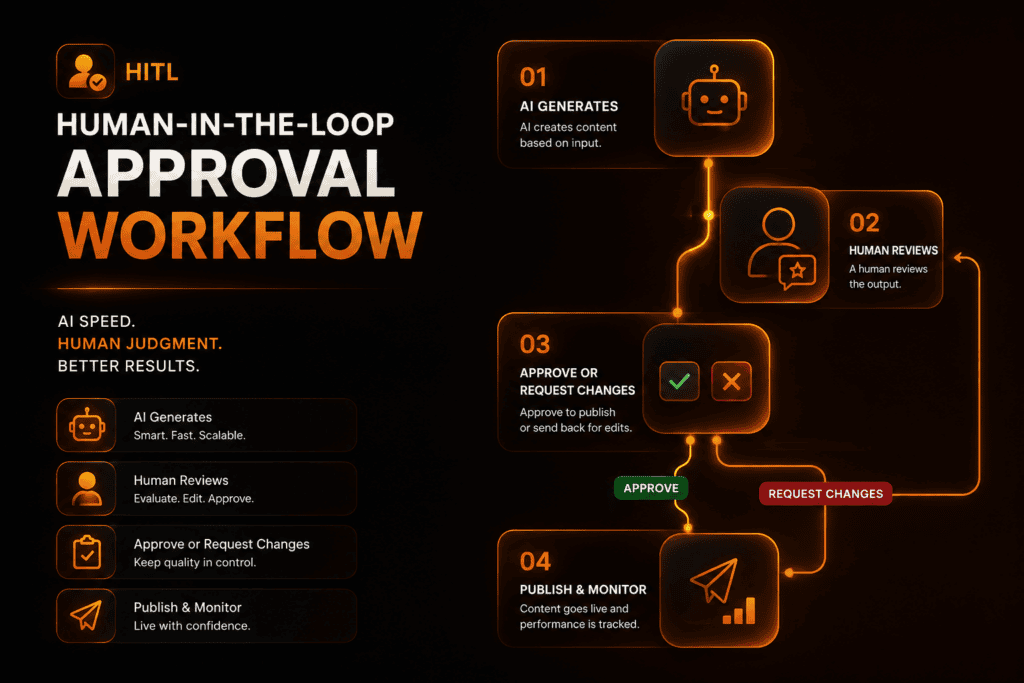
An effective HITL system gives reviewers clear evidence, fast diffing, and rollback. Define gates by risk: brand and legal first, then channel fit, then performance potential.
- Inputs required: rationale trace, cited sources, and change summary.
- Approvals: single owner per gate; no multi-owner ambiguity.
- Rollback: one-click revert to last approved artifact or budget state.
- Audit: immutable logs for risk and governance reviews.
Approval workflow tip
Give each approval gate a single owner, require rationale and cited sources, support fast diffing, and make rollback available from the same review surface.
Enterprise rubric: top 5 tools for building ai agents for enterprise
Use this neutral rubric to shortlist platforms; score each 1–5. Avoid vendor lock-in until pilots prove ROI.
| Capability | What to look for | Why it matters |
|---|---|---|
| Orchestration | Multi-agent flows, retries | Complex jobs need resilience |
| HITL UI | Evidence, diffing, rollback | Safe approvals and control |
| Connectors | CRM integration, paid media | End-to-end activation |
| Security & governance | SSO, RBAC, audit trails | Enterprise risk posture |
| Observability | Traces, metrics, eval hooks | Debug and improve fast |
| Cost control | Token caps, caching | Predictable unit economics |
If your workflow centers on creative generation, ensure smooth handoffs into production tools like VidAU AI Video and rapid localization via Text to Speech.
Enterprise selection note
Shortlist platforms by orchestration, HITL UI, connectors, security and governance, observability, and cost control. Avoid deep platform commitment until the pilot proves measurable ROI.
Common mistakes and how to avoid them
- Over-autonomy too early: skip level-3 until level-1 approvals are reliably green.
- Fuzzy brand rules: convert guidelines into checklists and machine-readable constraints.
- Uncurated context: retrieval against messy knowledge bases produces off-brand drafts.
- No observability: without traces and evals, you cannot improve or defend decisions.
- KPI theater: track approval rate, time saved, and CTR/CPA movement—not just output counts.
Mistake to avoid
Do not scale based on output counts alone. Track approval rate, time saved, CTR/CPA movement, tool-call success, error clusters, rollback frequency, and reviewer decisions so the system improves under production pressure.
Key takeaway
Final Thoughts
Production-grade ai agents for marketing start with one clear job, right-sized autonomy, curated context, and a real HITL approval workflow. Prove safety and ROI in a tight pilot before you scale.
If creative velocity is your bottleneck, pair your agent with ad-ready generation from VidAU AI Video plus fast variant creation via URL to Video and Text to Video, then expand with UGC Avatars.
FAQ
Here are answers to common questions about ai agents for marketing, problem-first agent design, autonomy levels, context management, HITL approval workflows, ROI KPIs, CRM integration, paid media channels, legal and brand guardrails, cost control, and enterprise pilot rollout.
What problems are best suited to ai agents for marketing first?
Start with reversible, bounded tasks like ad draft generation, audience suggestions, budget pacing alerts, and CRM enrichment proposals. These jobs have clear inputs, measurable outputs, and natural HITL gates. Proving safety and value here creates a blueprint for higher-autonomy use cases later.
How do I choose the right autonomy level for a marketing agent?
Use a staged approach: level-0 suggestions only, level-1 draft creation with approval, level-2 auto-iteration with final approval, and level-3 limited activation under caps. Advance levels only after evaluation and monitoring data shows consistent quality and safe behavior.
What should go into my agent’s context management layer?
Include immutable brand guidelines, current campaign data, offer calendars, product facts, and past winners. Apply retrieval over curated sources, add freshness windows, and version everything. Good context management prevents off-brand output and reduces review time during HITL approvals.
How do I design a human-in-the-loop approval workflow that scales?
Define risk-based gates, assign a single owner per gate, and require rationale traces with cited sources. Provide Approve, Request changes, and Rollback actions, plus audit logs. Measure approval latency, change rates, and post-approval performance to refine the workflow.
What KPIs prove ROI for marketing agents?
Track approval rate, time saved per deliverable, cycle time from brief to approved asset, and downstream metrics like CTR, CPA, or qualified lead rate. Add reliability measures such as tool-call success rate, error clusters, and rollback frequency to balance speed with quality.
How do agents connect to CRM integration and paid media channels safely?
Use read-only data access during early pilots, then graduated write permissions with caps and explicit approvals. Log all reads/writes, enforce role-based access control, and keep a rollback plan for audiences, budgets, or CRM fields to maintain governance.
What guardrails reduce brand and legal risk in content outputs?
Codify brand voice, banned claims, disclosure rules, and compliance do-nots into machine-checkable lists. Add automated linting for claims, disclaimers, and PII detection before HITL review. Require rationale traces that show sources for any factual statement.
How do I keep costs from spiraling as I scale agents?
Adopt caching for repeated prompts, constrain tool calls, cap tokens per task, and monitor cost-per-approved-output. Consolidate evaluation and monitoring dashboards to spot regressions early, and prioritize fixes that reduce retries and human rework.
What is the best way to pilot rollout an enterprise marketing agent?
Pick one product line and one channel, run a four-week pilot with level-0 to level-2 autonomy progression, and maintain strict observability. Conduct weekly reviews on quality, latency, and ROI, then decide to expand scope, refine guardrails, or pause based on data.