
Genvideos · Open Source AI Video Generators
GenVideos: Best Open Source AI Video Generators with Local Installation
Explore LTX 2.3, JoyAI-Echo, Wan2GP, local GPU workflows, hardware requirements, and when a hosted VidAU workflow is faster than running genvideos locally.
By the Sarah Iruoje · Open source AI video guide · Local installation workflow
If you want to run genvideos on your own hardware instead of paying for cloud credits, open source AI video generators now make that realistic. Recent releases like LTX 2.3 and JoyAI-Echo bring sound generation, character consistency, and multi-shot video to local machines.
If you want to run genvideos on your own hardware instead of burning cloud credits, open source AI video generators now make that realistic. Two recent releases lead the field: LTX 2.3, which added local sound generation in March 2026, and JoyAI-Echo, a multi-shot framework from JD.com released in June 2026. Both run on a local GPU and avoid subscription credit limits.
This guide is for AI enthusiasts, content creators, and developers who prefer local setups over web tools. I reviewed and analysed the available LTX 2.3 install walkthrough and the JoyAI-Echo benchmark notes, then mapped out the steps, hardware reality, and trade-offs so you can pick the right tool for your machine.
Featured image placeholder for genvideos, open source AI video generators, LTX 2.3, JoyAI-Echo, Wan2GP, Git, Conda, Hugging Face model weights, local GPU setup, VRAM requirements, sound generation, multi-shot video, and VidAU AI Video workflows.
Quick Summary
- LTX 2.3 is the best starting genvideos pick for local installation because it generates video with synced sound and installs through Wan2GP using Git and Conda.
- JoyAI-Echo is the strongest alternative for long multi-shot video, generating up to five-minute clips with consistent character appearance and voice.
- Local genvideos work needs a capable GPU; the JoyAI-Echo pipeline is roughly a 70GB model, and tutorials reference cards like the Nvidia RTX 5000 Ada.
- Developers and creators who want repeatable output without per-clip credit fees benefit most from running these models locally.
In This Guide
- What genvideos and open source AI video generators are
- Why local installation matters for creators and developers
- Step-by-step LTX 2.3 install and usage workflow
- How to use JoyAI-Echo for multi-shot genvideos
- Best open source AI video tools compared by use case
- Hardware and VRAM requirements for local genvideos
- Common mistakes when running genvideos locally
- When a hosted tool beats a local setup
- Final Thoughts
- FAQ
What Are Genvideos and Open Source AI Video Generators?
Genvideos refers to AI-generated videos created from text or image prompts, and open source AI video generators are models you can download, install, and run on your own machine. Unlike cloud tools, these expose model weights through GitHub and Hugging Face, so you control the hardware and avoid credit-metered output.
The two current standouts are LTX 2.3 and JoyAI-Echo. LTX 2.3 handles text-to-video and image-to-video generation with sound. JoyAI-Echo focuses on long, multi-shot scenes with stable identity and voice across cuts.
Definition
Genvideos are AI-generated videos created from text or image prompts. Open source AI video generators let you run those models on your own machine instead of relying on cloud credits.
Why Local Installation Matters for Genvideos
Local installation matters because free cloud generators rarely stay free. In community threads I reviewed, users repeatedly note that long-form AI video tools eventually move to credit systems because GPU costs are high. One reply summed it up plainly: most of these tools burn through massive GPU power, so they all switch to credits.
Running genvideos locally flips that math. You pay once for hardware, then generate without per-clip fees. The trade-off is setup complexity and a real learning curve.
Key Takeaways
- Free cloud genvideos usually act as trial surfaces, not production tools.
- Local open source models remove credit limits but add install effort.
- LTX 2.3 and JoyAI-Echo are the most capable recent open source options.
How Do You Install and Use LTX 2.3 Locally?
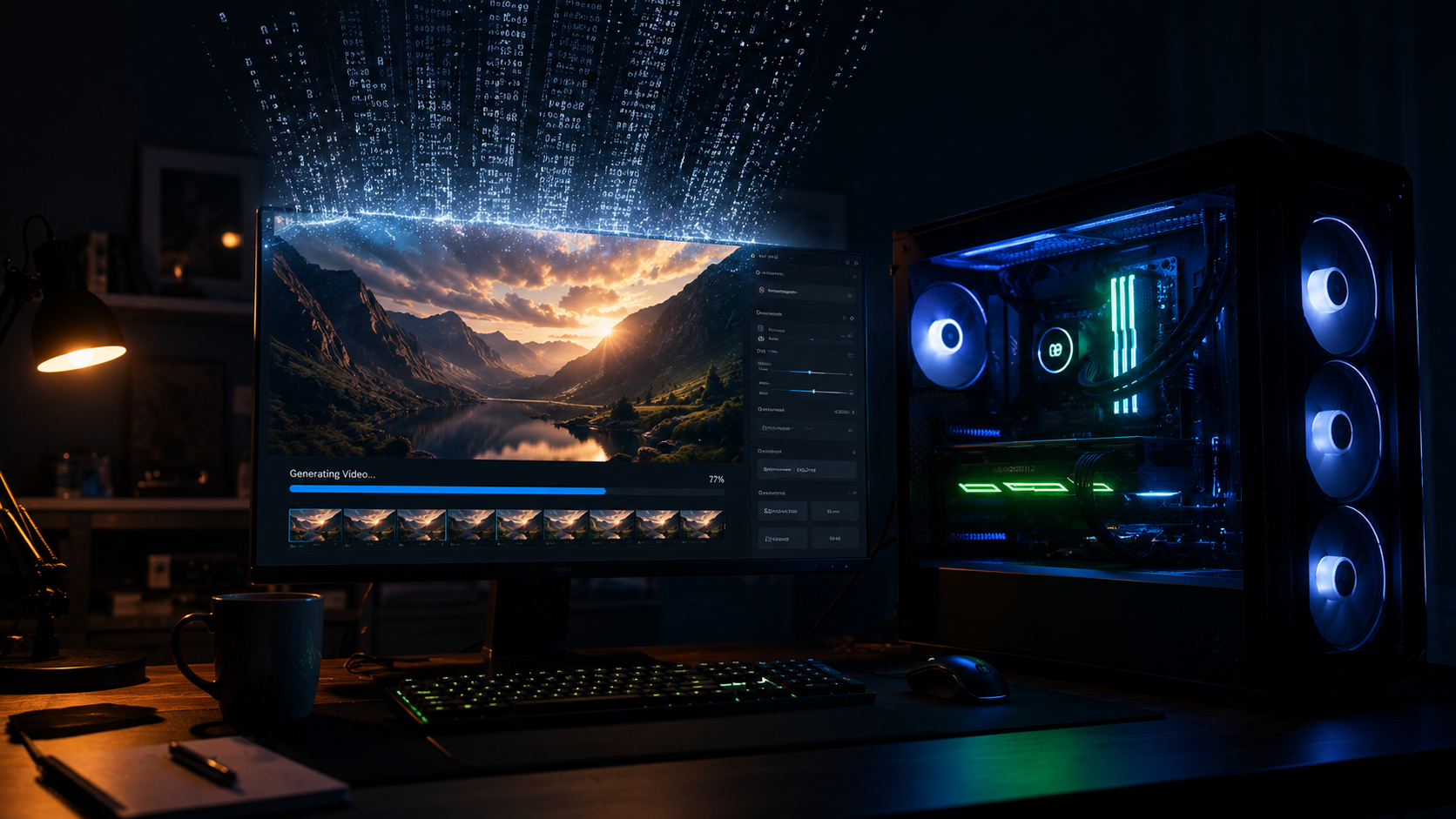
LTX 2.3 installs through the Wan2GP project and runs with a few command-line steps. The walkthrough I analysed used Git, Miniconda, and the Wan2GP repository to load the model. Here is the core flow.
Step 1: Install Git
Install Git on Windows so you can clone the repository.
Step 2: Install Miniconda or Anaconda
Install Miniconda or Anaconda to manage the Python environment.
Step 3: Clone Wan2GP
Clone the Wan2GP repository from GitHub.
Step 4: Create and activate a Conda environment
Create and activate a Conda environment, then install dependencies.
Step 5: Download LTX 2.3 and launch Wan2GP
Download the LTX 2.3 model and launch Wan2GP.
Step 6: Load LTX 2.3 and start generating
Load LTX 2.3 inside the Wan2GP interface and start generating.
Once running, LTX 2.3 supports text-to-video, image-to-video generation, and a first-frame to last-frame mode for guided motion. The same tutorial tested fight scenes, samurai sword duels, anime, singing and dancing, opera and orchestra, figure skating, 3D Pixar-style clips, camera movement with on-screen text, and vertical format output. The added sound generation is the headline upgrade over earlier LTX versions.
ControlNet support also lets you steer motion and composition more precisely, which helps when a plain prompt drifts off your intended shot.
Suggested Visual: a labeled diagram of the LTX 2.3 install flow showing Git, Conda, Wan2GP, and model download. Filename: ltx-2-3-local-install-flow.png
Local install tip
Keep LTX 2.3 inside a clean Conda environment and use Wan2GP as the runtime layer. A clean environment makes dependency issues easier to isolate.
How Do You Use JoyAI-Echo for Multi-Shot Genvideos?

JoyAI-Echo is built for long, multi-shot video, and it is the first open source model marketed as able to generate up to five-minute clips while keeping character appearance and vocal timbre consistent. JD.com released it as an open framework with weights on Hugging Face and code on GitHub.
The technical hook is a slot-paired cross-modal memory bank that reduces identity drift across cuts, plus Distribution Matching Distillation, which the project credits with a 7.5x inference speedup for streaming generation. In the benchmark notes I reviewed, JoyAI-Echo is positioned ahead of Kling’s Happy Oyster in directing mode and head-to-head with the closed-source Alibaba Wan 2.6.
The practical cost is size. The pipeline is described as roughly a 70GB model, so you need serious local VRAM and storage before this becomes a daily tool.
Hardware warning
JoyAI-Echo is designed for long, multi-shot output, but the pipeline is described as roughly a 70GB model. Confirm your VRAM and storage before treating it as a daily workflow.
Best Open Source Genvideos Tools Compared by Use Case
The right tool depends on clip length, sound needs, and your hardware.
| Tool | Best For | Standout Feature |
|---|---|---|
| LTX 2.3 | Short clips with audio | Local sound generation |
| JoyAI-Echo | Long multi-shot scenes | Character and voice consistency |
| Wan2GP | Running models locally | Lighter local runtime layer |
LTX 2.3 is the better entry point for most creators. JoyAI-Echo is the pick when you need narrative length and stable characters across shots. Wan2GP is less a generator than a wrapper that makes local genvideos models easier to run.
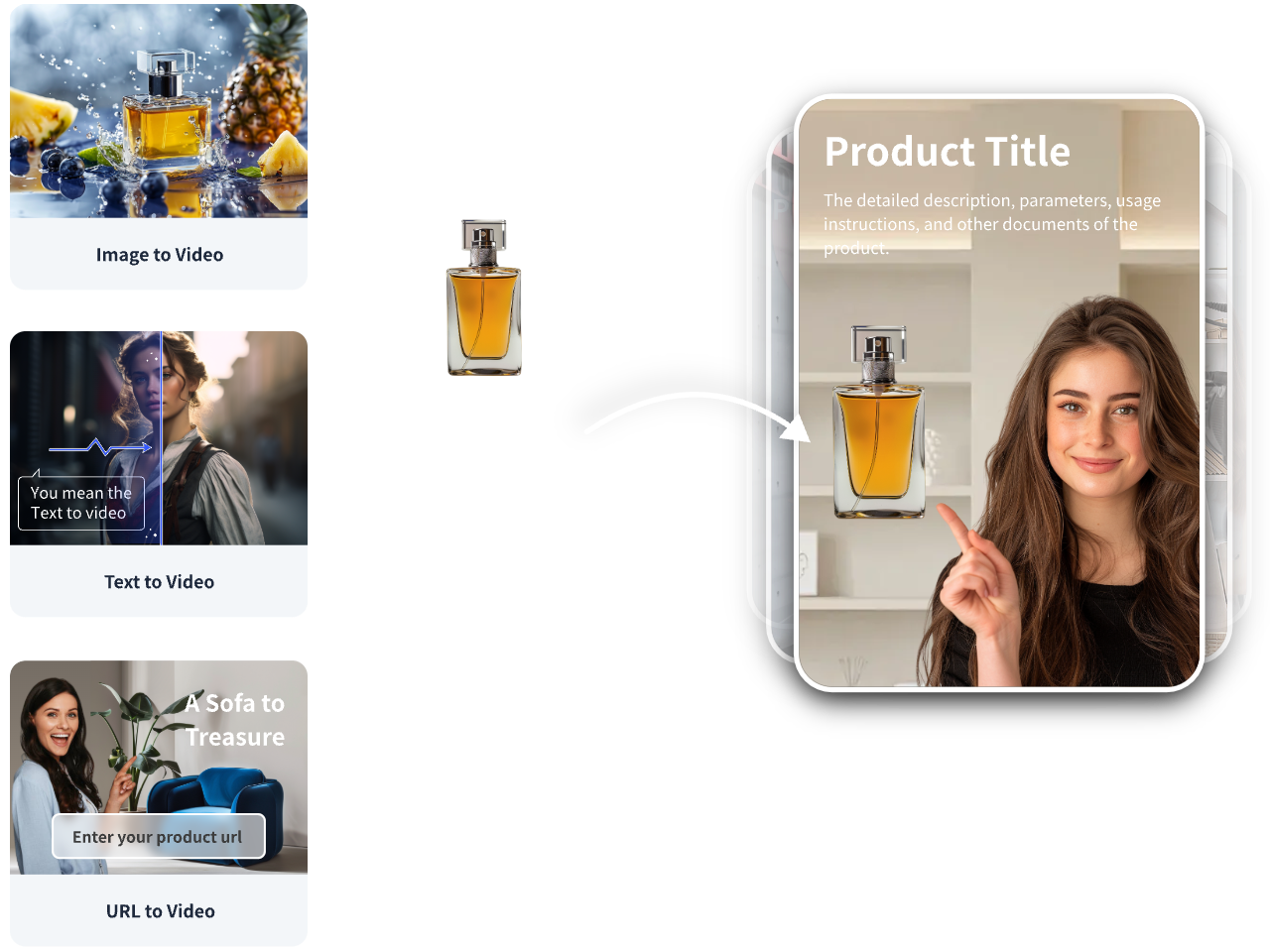
If you are building UGC-style or product ads rather than open-ended scenes, a hosted option can save setup time. VidAU is an AI video ad platform that generates video ads from product URLs, images, or scripts in 49 languages, and tools like VidAU AI Video and UGC Avatars (https://www.vidau.ai/ugc-avatars/) skip the local install entirely. The honest limitation: VidAU is a hosted ad platform, so it is not the choice if your goal is running open source weights on your own GPU.
Create Hosted AI Videos With VidAU
Use VidAU AI Video, UGC Avatars, URL to Video, Product Sample to Video, Text to Speech, and Video Enhancer when your goal is ad-ready output faster than building a local genvideos pipeline.
VidAU workflow
Where VidAU fits beside local genvideos
- Use LTX 2.3 for local short clips with audio: Choose LTX 2.3 when you want open source generation, local sound, and no cloud credit ceiling.
- Use JoyAI-Echo for long multi-shot experiments: Choose JoyAI-Echo when you need character and voice consistency across longer scenes and have enough hardware.
- Also use Wan2GP as the runtime layer: Use Wan2GP when you want a lighter local wrapper that makes models easier to launch and test.
- Use VidAU AI Video for deadline-driven marketing: Choose VidAU when you need fast product, ad, or UGC-style videos from URLs, images, or scripts.
- Use Text to Speech and Video Enhancer for cleanup: Pair local generation with dedicated voice and enhancement tools when output needs narration or polish.
What Hardware Do You Need for Local Genvideos?
Local genvideos work needs a strong GPU with high VRAM, plus storage for large model files. The JoyAI-Echo pipeline is around 70GB, and the LTX 2.3 tutorial I reviewed ran on an Nvidia RTX 5000 Ada workstation card. These are reference points from the research, not the only cards that work, but they signal the tier you should expect.
If your machine is modest, start with LTX 2.3 and shorter clips before attempting JoyAI-Echo’s long-form pipeline.
Hardware reality
These hardware details are reference points, not strict minimums. Still, they signal the tier to expect: strong GPU, high VRAM, and enough storage for large model files and generated outputs.
Common Mistakes When Running Genvideos Locally
From the workflows I analysed, a few mistakes repeat.
- Skipping Conda environments and installing dependencies globally, which breaks setups.
- Assuming any GPU works; undersized VRAM stalls or crashes large models.
- Expecting one-shot perfection; ControlNet and frame guidance reduce drift.
- Ignoring storage; a 70GB model plus outputs fills disks fast.
- Treating long-form output as instant when streaming generation still takes time.
The cleaner you keep your environment, the fewer reinstalls you will face.
Watch out
Do not install dependencies globally, underestimate VRAM, ignore storage, or expect one-shot perfection. Local genvideos work best when the environment is clean and the workflow is patient.
When Should You Skip Local Genvideos?
Skip local setups when speed and repeatability matter more than full control. If you generate marketing videos on a schedule, the install effort and hardware cost rarely pay off versus a hosted workflow. For turning a product page into a clip, URL to Video or Product Sample to Video is faster than building a local pipeline.
Local genvideos shine for experimentation, custom control, and creators who want no credit ceilings. Hosted tools shine for deadline-driven, repeatable production.
Workflow fit
Local genvideos shine for experimentation, custom control, and no credit ceilings. Hosted tools shine for deadline-driven, repeatable production.
Key takeaway
Final Thoughts
For most people exploring genvideos locally, LTX 2.3 is the practical starting point because it adds sound and installs through a documented Git and Conda flow. Move to JoyAI-Echo once you need long, multi-shot video with consistent characters and have the VRAM and storage to handle a 70GB pipeline.
If your real goal is ad-ready video rather than open source tinkering, test a hosted route first with VidAU AI Video, then reserve local installs for the projects that truly need custom control. You can also pair local generation with Text to Speech or a Video Enhancer when output needs cleanup.
FAQ
Here are answers to common questions about genvideos, open source AI video generators, local installation, LTX 2.3, JoyAI-Echo, Wan2GP, GPU and VRAM requirements, GitHub and Hugging Face downloads, command-line setup, and when hosted tools like VidAU are a better fit.
What is the best open source AI video generator for local installation?
LTX 2.3 is the strongest starting choice for local genvideos because it generates video with synced sound and installs through Wan2GP using Git and Conda. For long multi-shot scenes, JoyAI-Echo is the better option, offering character and voice consistency across cuts at the cost of heavier hardware demands.
Can I run genvideos models without paying for cloud credits?
Yes. Open source AI video generators like LTX 2.3 and JoyAI-Echo run on your own GPU using weights from GitHub and Hugging Face. After the initial hardware investment, you avoid the per-clip credit systems that most cloud generators adopt because their GPU costs are high.
What hardware do I need to run LTX 2.3 or JoyAI-Echo locally?
You need a strong GPU with high VRAM and ample storage. The LTX 2.3 tutorial I reviewed used an Nvidia RTX 5000 Ada card, and the JoyAI-Echo pipeline is roughly a 70GB model. These are reference points from the research, not strict minimums, but they show the hardware tier to expect.
How does JoyAI-Echo keep characters consistent across shots?
JoyAI-Echo uses a slot-paired cross-modal memory bank to reduce identity drift, so character appearance and vocal timbre stay stable across multiple shots. It also applies Distribution Matching Distillation, which the project credits with a 7.5x inference speedup for streaming generation of long clips up to five minutes.
Is LTX 2.3 better than the previous LTX version?
LTX 2.3 improves on earlier LTX releases mainly through local sound generation, which earlier versions lacked. The walkthrough I analysed tested it across fight scenes, anime, singing, opera, figure skating, camera movement, and vertical format, plus image-to-video and first-frame to last-frame modes with ControlNet support.
Where can I download these open source AI video generators?
Both tools are distributed through GitHub for code and Hugging Face for model weights, with Wan2GP often used as the local runtime for LTX 2.3. Availability of any open source project can change over time, so confirm the current repositories before installing.
Do I need coding skills to install genvideos tools locally?
You need basic command-line comfort rather than full development skills. The LTX 2.3 process involves installing Git and Miniconda, cloning a repository, creating a Conda environment, and launching Wan2GP. Following the steps carefully matters more than coding ability, though some troubleshooting patience helps.
When should I use a hosted tool instead of local genvideos?
Use a hosted tool when you need fast, repeatable output on a schedule, especially for marketing. Local genvideos suit experimentation and custom control without credit limits. For ad-style video from a product URL, image, or script, a hosted platform like VidAU is faster than building a local pipeline.


