Blog AI Ads Tools 2 Google Nano Banana Gemini 3 Pro Google Gemini News: Latest on Gemini 4.0 and Updates – Now

Google Gemini News · Enterprise AI Updates

Google Gemini News: Enterprise Agent Platform, Gemini 4.0 Rumors, and Latest Feature Updates

Learn how Google’s Enterprise Agent Platform, file generation features, Workspace integrations, and rumored Gemini 4.0 release could shape enterprise AI workflows.

By the VidAU Editorial Team · Updated 2026 · 20 min read

Learn how Google’s new Enterprise Agent Platform and file generation features could transform your business operations while staying updated with the latest google gemini news surrounding the rumored Gemini 4.0 release. Stay ahead with Gemini’s newest advancements that promise major productivity improvements for teams, creators, and businesses.

Quick summary

  • Google announced the Gemini Enterprise Agent Platform on April 23, 2026, at Google Cloud Next, positioning Gemini around enterprise-ready agentic AI workflows.
  • Gemini gained file creation capabilities on May 1, 2026, allowing users to generate PDFs, Word documents, Excel spreadsheets, Google Docs, and Google Slides through prompts.
  • Gemini 4.0 remains unconfirmed, but the article discusses signals, speculation, and possible timing around Google I/O.
  • Google’s broader Gemini strategy centers on Workspace integration, enterprise security, agentic AI, developer access, NotebookLM, Google Vids, and productivity-focused AI adoption.
google gemini news

Google Unveils Enterprise Agent Platform: A New Era for Agentic AI

Google officially announced the Gemini Enterprise Agent Platform on April 23, 2026, at Google Cloud Next, marking a significant strategic shift toward agentic AI capabilities. This announcement represents Google’s most ambitious move yet in helping enterprises manage, scale, and optimize AI agents that can execute complex multi-step tasks autonomously.

Sundar Pichai, CEO of Google and Alphabet, emphasized during the announcement that Google serves as “customer zero” for its own technologies. This approach allows the company to test and refine Gemini’s capabilities internally before rolling them out to enterprise customers. The platform is designed to address a critical gap in the enterprise AI market: the need for AI systems that don’t just respond to queries but actively complete tasks on behalf of users.

The Enterprise Agent Platform enables businesses to deploy AI agents that can book flights, manage calendars, run multi-step workflows, and interact with various business systems without constant human supervision. This represents a fundamental evolution from conversational AI to truly autonomous agentic systems that can handle complex operational tasks.

Google’s internal testing has produced remarkable results. The company reports that AI agents now generate 75% of new code written internally, demonstrating the platform’s capacity to handle technical work at scale. In marketing operations, teams have achieved 70% faster turnaround times while maintaining personalization across creative assets. These metrics provide concrete evidence of the productivity gains enterprises can expect when implementing agentic AI workflows.

The timing of this announcement is strategic. As competitors like OpenAI and Anthropic push forward with their own agentic AI initiatives, Google is positioning Gemini as the enterprise-ready solution built on years of infrastructure experience and deep integration with Google Workspace and Google Cloud services.

Why this matters

The Enterprise Agent Platform signals a move from conversational AI toward autonomous systems that can manage multi-step workflows, interact with business systems, and complete operational tasks.

New File Creation Capabilities Transform Gemini’s Practical Utility

On May 1, 2026, Google rolled out a significant feature update that allows Gemini to create and export files directly. Users can now generate PDFs, Word documents, Excel spreadsheets, Google Docs, and Google Slides through natural language prompts. This capability transforms Gemini from a conversational assistant into a practical document generation tool.

The feature works seamlessly within the Gemini interface. Users simply describe the document they need, and Gemini produces a properly formatted file ready for download or direct export to Google Workspace. For example, a user can request “Create a marketing budget spreadsheet with Q2 projections” and receive a complete Excel file with appropriate formulas and formatting.

This update addresses a common pain point in AI workflows: the gap between generating content and producing deliverable files. Previously, users had to copy AI-generated content and manually format it into documents. The new capability eliminates this friction, making Gemini more practical for daily business operations.

The file creation feature integrates with Google Gemini Advanced subscriptions and works across multiple file formats. Users can specify format preferences, request specific layouts, and even provide templates for Gemini to follow. The system maintains appropriate formatting conventions for each file type, ensuring that generated documents meet professional standards.

For content creators and business professionals, this represents a meaningful productivity enhancement. A marketing manager can generate complete presentation decks, sales teams can produce customized proposals, and financial analysts can create formatted reports without switching between multiple tools. The feature reduces the time from concept to deliverable document significantly.

Gemini 4.0 Speculation: What the Signals Suggest

While Google has not officially announced Gemini 4.0, multiple indicators point toward a major model release in the near future, likely timed for Google I/O or shortly thereafter. Industry analysts and AI researchers have identified several signals that suggest substantial development work on next-generation Gemini models.

The most compelling evidence comes from architectural clues in Google DeepMind’s research publications and technical blog posts. References to training infrastructure capable of handling models with approximately 10 trillion parameters have appeared in technical documentation. Additionally, mentions of context windows extending to 1 million tokens suggest Google is working on models with dramatically expanded capabilities.

These specifications, if accurate, would represent a significant leap from current Gemini models. A 10-trillion-parameter architecture would position Gemini 4.0 as one of the largest language models in production, potentially surpassing current frontier models in raw capability. The extended context window would enable Gemini to process entire codebases, lengthy documents, or extended conversation histories without losing coherence.

Industry observers note that Google’s investment patterns align with preparation for a major model launch. The company has made substantial computational investments in AI infrastructure, and internal teams have been testing increasingly capable model versions. Google’s pattern of announcing major AI developments at I/O makes the annual developer conference a likely venue for Gemini 4.0’s debut.

However, it’s crucial to distinguish between speculation and confirmed information. Google has not announced a release date, confirmed specifications, or made official statements about Gemini 4.0. The model names Gemini 3.5 and Gemini 4.0 appear in technical discussions and leak reports, but these should be treated as unconfirmed until Google makes an official announcement.

The competitive context adds weight to speculation about an imminent release. With OpenAI having released GPT-5.5 and reports of internal testing of GPT-5.6, and Anthropic advancing Claude Opus to version 4.7, Google faces pressure to demonstrate continued innovation in frontier AI capabilities. A Gemini 4.0 release would reassert Google’s position in the competitive landscape.

Watch out

Gemini 4.0 has not been officially announced. Release timing, specifications, and model naming should be treated as speculation until Google confirms details.

Google’s Internal AI Adoption Demonstrates Real-World Impact

One of the most compelling aspects of Google’s Gemini announcement is the company’s extensive internal deployment. By positioning itself as “customer zero,” Google has gathered meaningful data on how AI agents perform in real enterprise scenarios.

The statistic that AI agents now generate 75% of new code at Google represents a fundamental shift in software development workflows. This doesn’t mean Google has replaced 75% of its engineers; rather, it indicates that AI tools assist in the majority of code creation tasks. Engineers focus on architecture, design decisions, and complex problem-solving while AI handles routine implementation, boilerplate code, and standard patterns.

Google’s approach to code generation with Gemini involves sophisticated workflows where AI agents understand project context, follow coding standards, and integrate with existing systems. The company has developed internal tools that allow engineers to specify requirements at a high level while AI handles detailed implementation. This workflow has accelerated development cycles while maintaining code quality standards.

In marketing operations, Google achieved 70% faster turnaround times through AI-powered creative processes. Marketing teams use Gemini to generate ad copy variations, create campaign materials, and personalize content for different audience segments. The AI handles repetitive aspects of creative production while human marketers focus on strategy, brand alignment, and high-level creative direction.

Google’s cybersecurity operations have also benefited from agentic AI deployment. Security teams use AI agents to monitor threats, analyze patterns, and respond to incidents faster than traditional manual processes allow. The agents can process vast amounts of security data, identify anomalies, and suggest remediation actions, enabling security teams to stay ahead of evolving threats.

These internal use cases provide validation for the Enterprise Agent Platform’s potential. When Google presents these statistics to enterprise customers, they’re not offering theoretical capabilities but proven results from production deployments at massive scale.

Gemini Advanced: The Premium Tier Continues to Evolve

Google Gemini Advanced represents the premium tier of Google’s AI offering, providing access to the most capable models and advanced features. The subscription service has evolved significantly since its initial launch, incorporating new capabilities that justify the premium positioning.

Gemini Advanced subscribers gain access to more sophisticated reasoning capabilities, longer conversation memory, and deeper integration with Google Workspace applications. The service includes priority access to new features, such as the recently launched file creation capabilities, before they roll out to free-tier users.

One of Gemini Advanced’s key differentiators is its integration depth with Google Workspace. Subscribers can use Gemini directly within Gmail to compose emails, summarize threads, and manage communication workflows. In Google Drive, Gemini can analyze documents, extract insights, and answer questions about file contents. Google Sheets users can leverage Gemini for formula creation, data analysis, and automated report generation.

The Google Slides integration allows users to generate presentation content, suggest layouts, and create visual elements through natural language commands. Google Vids, a newer addition to the Workspace suite, incorporates Gemini capabilities for video content creation, enabling users to produce marketing videos and training materials more efficiently.

Gemini Advanced also includes access to Gems, Google’s customizable AI assistant feature. Gems allow users to create specialized versions of Gemini tailored to specific tasks or workflows. For example, a marketing professional might create a Gem specialized in brand voice consistency, while a developer might build a Gem focused on code review and optimization.

The subscription includes expanded usage limits, allowing power users to engage with Gemini more extensively without hitting rate restrictions. This makes Gemini Advanced practical for professional workflows where users need consistent, reliable access throughout the workday.

Google positions Gemini Advanced as an AI productivity platform rather than just a chatbot subscription. The integration with Workspace, combined with advanced model capabilities and priority feature access, creates a comprehensive environment for AI-augmented work.

Competitive Landscape: Gemini vs GPT-5.5 vs Claude Opus 4.7
google gemini news

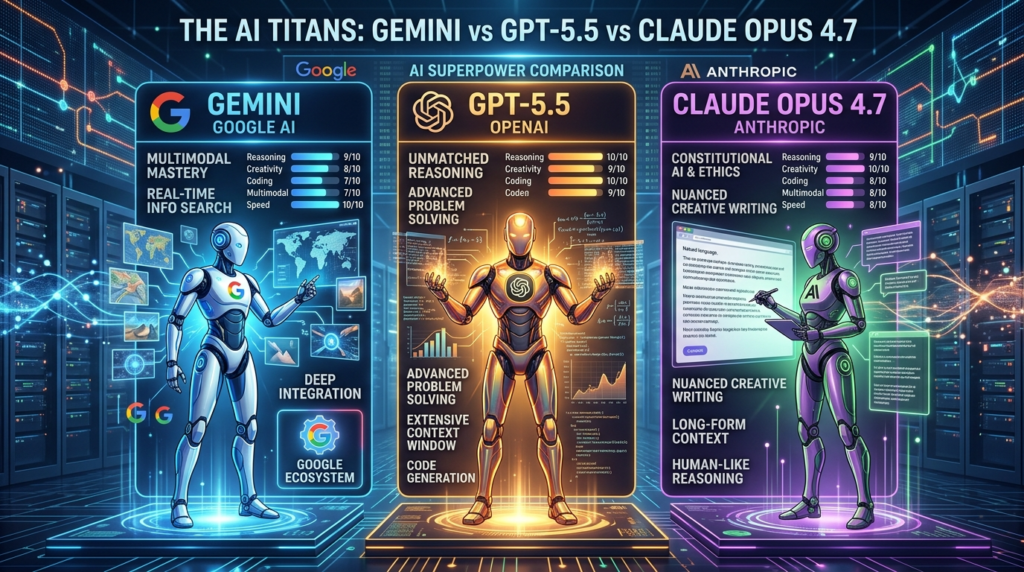
The AI model landscape has become intensely competitive in 2026, with Google Gemini, OpenAI’s GPT series, and Anthropic’s Claude all pushing the boundaries of what large language models can achieve. Understanding how these models compare helps contextualize Google’s recent announcements and anticipated releases.

OpenAI recently released GPT-5.5, with reports suggesting internal testing of GPT-5.6 is already underway. This rapid iteration pace puts pressure on competitors to match OpenAI’s development velocity. GPT-5.5 introduced significant improvements in reasoning capabilities and demonstrated strong performance in coding tasks. The rumored GPT-5.5 Codex variant suggests OpenAI is developing specialized models for software development workflows.

Anthropic has positioned Claude Opus 4.7 as the model prioritizing safety and reliability while maintaining competitive performance. Claude has gained particular traction among enterprises concerned about AI safety and among developers who appreciate its strong performance in coding tasks. Anthropic recently announced major upgrades to Claude Code, including integrations with Blender and Autodesk Fusion, expanding Claude’s utility for creative professional workflows.

Google Gemini’s competitive positioning emphasizes deep integration with existing Google services and infrastructure. While OpenAI and Anthropic operate primarily as standalone AI services, Gemini benefits from native integration with Gmail, Google Drive, Google Workspace, and Google Cloud Platform. This integration advantage makes Gemini particularly attractive to enterprises already invested in the Google ecosystem.

Performance comparisons between these models vary by task and benchmark. In coding benchmarks, all three models demonstrate strong capabilities, with specific advantages varying by programming language and task type. For creative tasks, each model shows different strengths in areas like tone, style control, and instruction following.

The announcement of Google’s Enterprise Agent Platform represents a strategic differentiation. While OpenAI and Anthropic focus primarily on model capabilities, Google is building comprehensive infrastructure for deploying and managing AI agents at enterprise scale. This platform approach could give Google an advantage in enterprise sales even if individual model performance remains comparable to competitors.

Context window size has emerged as a key competitive dimension. Google’s rumored work on 1 million token context windows would match or exceed competitors, enabling use cases that require processing extremely long documents or maintaining extended conversation history. This capability matters particularly for enterprise applications involving complex documentation or extensive code analysis.

Pricing and access models differ across providers. Google bundles Gemini Advanced with Google Workspace subscriptions, creating value through integrated productivity tools. OpenAI offers standalone subscriptions with various tier options. Anthropic has focused on API access and enterprise licensing. These different business models reflect distinct go-to-market strategies and target customer segments.

AI model ecosystemPositioning described in the articleEnterprise angle
Google GeminiDeep integration with Gmail, Google Drive, Google Workspace, and Google Cloud PlatformEnterprise Agent Platform, Workspace productivity, agent deployment infrastructure
OpenAI GPT-5.5Strong reasoning and coding performance with rapid iteration cyclesStandalone AI services and specialized coding variants discussed as rumors
Anthropic Claude Opus 4.7Safety, reliability, coding strength, and creative professional integrationsEnterprise traction among safety-conscious organizations and developers

Agentic AI: The Strategic Direction of Modern AI Development

The concept of agentic AI represents a fundamental evolution in how AI systems function. Unlike conversational AI that responds to user prompts, agentic AI takes autonomous action to complete multi-step tasks. Google’s emphasis on the Enterprise Agent Platform reflects this industry-wide shift toward AI systems that operate with greater independence.

Agentic AI systems can pursue goals across multiple steps, make decisions based on context, interact with various tools and services, and adapt their approach when encountering obstacles. For example, an agentic AI assistant tasked with scheduling a meeting might check multiple calendars, evaluate location options, send invitations, and follow up with non-responders without requiring human intervention at each step.

This capability level requires substantial technical advancement beyond basic language model performance. Agentic systems need reliable reasoning capabilities to plan multi-step workflows, robust error handling to recover from failures, integration infrastructure to interact with external systems, and safety mechanisms to prevent harmful actions.

Google’s approach to agentic AI emphasizes enterprise readiness. The Enterprise Agent Platform provides tools for deploying agents, monitoring their actions, setting permission boundaries, and auditing their behavior. These enterprise features address concerns that prevent organizations from adopting fully autonomous AI systems.

The productivity gains Google reports from internal deployment demonstrate agentic AI’s practical value. When AI agents handle routine multi-step tasks, human workers can focus on higher-level strategy, creative problem-solving, and relationship management. This division of labor between AI and human capabilities represents the vision for enterprise AI adoption.

Security and control remain critical concerns for agentic systems. An AI agent with permission to access corporate systems and take autonomous actions could potentially cause significant harm through errors or malicious use. Google’s platform includes security controls, action logging, and rollback capabilities to mitigate these risks.

The shift toward agentic AI reflects growing model capabilities. Early language models could generate text but struggled with multi-step reasoning and real-world task completion. As models have improved in reasoning ability, planning capacity, and tool use, agentic applications have become practical. Google’s investment in this direction signals confidence that current model generations can reliably handle autonomous workflows.

Google Workspace Integration: Gemini’s Productivity Ecosystem

Gemini’s integration with Google Workspace represents one of its strongest competitive advantages. Unlike standalone AI assistants that require users to switch contexts, Gemini operates directly within the productivity tools millions of professionals use daily.

In Gmail, Gemini can draft emails based on brief instructions, summarize lengthy email threads, extract action items from conversations, and suggest responses that maintain appropriate tone and context. These capabilities reduce the time users spend managing email while maintaining personal communication quality. The system understands email context, including previous conversations, recipient relationships, and communication patterns.

Google Drive integration allows users to interact with their stored content through natural language. Users can ask Gemini to find specific documents, summarize reports, extract data from spreadsheets, or answer questions about document contents. This transforms static file storage into an interactive knowledge base where information becomes immediately accessible through conversation.

Google Docs receives substantial benefit from Gemini integration. Users can generate initial drafts, request specific sections, get writing suggestions, and restructure content through natural language commands. The system maintains document formatting and can adjust tone, style, and complexity to match user requirements. This makes Gemini practical for various writing tasks from business communications to technical documentation.

Google Sheets integration brings AI capabilities to data analysis and spreadsheet management. Users can ask Gemini to create formulas, generate charts, analyze trends, and produce summaries of complex datasets. The system can explain existing formulas in plain language, suggest data cleaning steps, and automate repetitive spreadsheet tasks. This makes advanced spreadsheet capabilities accessible to users without extensive Excel expertise.

Google Slides benefits from Gemini’s ability to generate presentation content and suggest visual layouts. Users can describe their presentation goals and have Gemini create initial slide decks with appropriate structure, content, and visual elements. The system can also refine existing presentations, suggest improvements, and adapt content for different audiences.

Google Vids introduces AI-powered video creation to the Workspace suite. Users can generate video content for marketing, training, or internal communications through text descriptions. This capability makes video content creation accessible to teams without dedicated video production resources. While not the primary focus of Gemini, this integration demonstrates the breadth of productivity tools receiving AI enhancement.

For organizations considering AI adoption, the Workspace integration reduces deployment friction. Teams already using Google Workspace can access Gemini capabilities without learning new interfaces or disrupting established workflows. This integration advantage accelerates adoption and increases the practical value of AI capabilities.

Practical Applications: How Enterprises Are Using Gemini

Beyond Google’s internal deployment, early enterprise adopters have begun implementing Gemini for various business workflows. These real-world applications demonstrate how different industries are leveraging AI agent capabilities.

Software development teams use Gemini for code generation, review, and migration tasks. Development workflows now commonly involve engineers describing requirements at a high level while AI handles detailed implementation. Code review processes benefit from AI analysis that catches potential issues, suggests optimizations, and ensures adherence to coding standards. Complex code migration projects, such as updating codebases to new framework versions, leverage AI to handle repetitive transformation tasks while engineers focus on architectural decisions.

Marketing teams have adopted Gemini for content creation and campaign development. Marketing workflows now include AI-generated copy variations for A/B testing, personalized content adapted for different audience segments, and rapid creative iteration based on performance data. The 70% faster turnaround time Google reported internally reflects similar improvements early enterprise adopters are experiencing.

Customer service operations use Gemini-powered agents to handle routine inquiries, provide product information, and escalate complex issues to human agents. These implementations reduce response times while maintaining service quality. The AI agents can access customer history, understand product details, and provide accurate information consistently.

Financial analysis teams leverage Gemini for report generation, data analysis, and trend identification. Analysts describe the insights they need, and AI processes relevant data to produce formatted reports with supporting charts and explanations. This accelerates routine reporting while allowing analysts to focus on strategic interpretation and recommendations.

Human resources departments use Gemini for candidate screening, interview scheduling, and employee communications. The AI can review resumes against job requirements, coordinate scheduling across multiple calendars, and draft personalized communication that maintains consistent messaging. These applications reduce administrative burden while improving candidate experience.

Legal teams have begun experimenting with Gemini for document review, contract analysis, and legal research. While human review remains essential for legal work, AI can accelerate initial document review, identify relevant precedents, and highlight potential issues for attorney attention. This hybrid approach improves efficiency without compromising the careful analysis legal work requires.

Sales organizations use Gemini to generate customized proposals, analyze customer needs, and prepare meeting materials. Sales representatives can quickly produce tailored presentations that address specific customer requirements and pain points. The AI can also analyze customer data to suggest relevant talking points and anticipate likely objections.

Understanding Gemini Gems: Customization for Specialized Tasks

Gemini Gems represent Google’s approach to customizable AI assistants tailored for specific workflows. Unlike the general-purpose Gemini interface, Gems allow users to create specialized AI assistants with particular expertise, behavior patterns, and domain knowledge.

Creating a Gem involves defining its purpose, providing relevant context and guidelines, and specifying how it should respond to different types of requests. For example, a content marketing Gem might be configured with brand voice guidelines, target audience information, and content strategy principles. When users interact with this Gem, it applies these specialized parameters to every response.

Gems prove particularly valuable for repeated workflows. A developer might create a code review Gem that applies specific team standards, checks for common issues, and provides feedback in a consistent format. A legal professional might build a contract analysis Gem that understands standard clause types and identifies potential concerns. These specialized assistants eliminate the need to provide the same context repeatedly.

The system allows multiple Gems for different purposes. A marketing team might maintain separate Gems for social media content, email campaigns, product descriptions, and press releases. Each Gem understands the specific requirements and conventions for its domain, producing more relevant output than a general-purpose assistant would provide.

Gems can incorporate domain-specific knowledge that general models might not emphasize. A medical research Gem could be configured to prioritize certain types of evidence and maintain appropriate scientific rigor. An educational content Gem might adapt explanations to specific grade levels and learning objectives. This specialization makes AI assistance more practical for professional applications.

Organizations can share Gems across teams, creating consistency in how AI tools are used. When all team members use the same Gems configured with agreed-upon guidelines, the AI-generated content maintains greater consistency than if each person used the general assistant differently.

The Gems feature reflects a broader trend in AI tools toward customization and specialization. As AI capabilities mature, users need ways to adapt general-purpose models to their specific requirements. Gems provide this adaptability without requiring technical expertise in AI model fine-tuning.

File Creation Feature: Technical Implementation and Capabilities

The recently launched file creation capability represents a significant technical achievement in AI-to-document conversion. This feature handles the complex task of transforming conversational AI output into properly formatted, professionally structured documents.

The system supports multiple file formats including PDF, DOCX, XLSX, Google Docs format, Google Sheets format, and Google Slides format. Each format requires different handling because PDFs preserve exact layout, Word documents use flexible formatting, spreadsheets require structural data organization, and presentations need visual hierarchy.

When generating a document, Gemini interprets the user’s intent to determine appropriate structure. A request for a marketing plan produces a document with section headings, bullet points, and structured content. A budget request generates a spreadsheet with proper formulas, formatting, and organization. This contextual understanding prevents users from needing to specify detailed formatting requirements.

The feature integrates with Google Drive, allowing users to save generated files directly to their cloud storage. This eliminates the download-upload cycle and maintains file accessibility across devices. For Google Workspace users, files can be created directly in native Google formats, enabling immediate collaboration with team members.

Users can refine generated documents through conversational iteration. If the initial output doesn’t meet requirements, users can request specific changes and regenerate the file. This iterative refinement process mirrors how humans draft documents but operates much faster.

The system maintains formatting consistency appropriate to each document type. Business letters include proper headers and spacing, resumes follow standard layout conventions, and reports use appropriate heading hierarchy. This attention to convention makes generated documents look professionally prepared.

Technically, the feature likely involves specialized formatting layers that convert language model output into structured document formats. The AI must understand both content requirements and format conventions simultaneously, representing sophisticated model capability development.

For users, this feature eliminates a common friction point in AI workflows. Previous generations of AI assistants could generate excellent content but left users to manually format and structure outputs. The file creation capability completes the workflow from idea to deliverable document.

Privacy, Security, and Enterprise Concerns

As organizations adopt Gemini for business-critical workflows, questions about privacy, security, and data handling become paramount. Google has addressed these concerns through various technical and policy measures designed for enterprise adoption.

Data privacy protections ensure that information shared with Gemini receives appropriate confidentiality treatment. For enterprise customers, Google maintains strict data separation, ensuring that one organization’s data never trains models used by others. This isolation addresses concerns about proprietary information leaking across organizational boundaries.

Google Workspace integration includes granular permission controls. Administrators can specify which users have access to Gemini features, what data the AI can access, and what actions it can perform. This administrative control allows organizations to balance AI benefits against security requirements.

For heavily regulated industries, Google offers additional compliance certifications and security features. Financial services organizations can deploy Gemini while maintaining regulatory compliance. Healthcare organizations can use the system while adhering to patient privacy requirements. These industry-specific considerations matter for broad enterprise adoption.

Audit logging provides visibility into AI interactions. Organizations can track what questions were asked, what data was accessed, and what actions were taken. This audit trail supports compliance requirements and provides accountability for AI-generated outputs.

The shift toward agentic AI introduces additional security considerations. An AI agent that can take autonomous actions potentially poses greater risk than a conversational assistant. Google’s Enterprise Agent Platform includes safeguards such as action approval workflows, permission boundaries, rollback capabilities, and monitoring systems to detect anomalous behavior.

Data retention policies allow organizations to control how long conversational history and generated content are stored. Some organizations prefer minimal data retention for security reasons, while others want historical records for audit purposes. Flexible policies accommodate different organizational needs.

Google’s position as a major cloud infrastructure provider gives it significant experience with enterprise security requirements. The company applies lessons from years of cloud service operation to Gemini’s security architecture. This experience shows in features like multi-factor authentication, encryption in transit and at rest, and security incident response capabilities.

Transparency about model limitations and potential errors helps organizations use AI responsibly. Google acknowledges that language models can produce incorrect information, exhibit biases, or misunderstand complex instructions. This honesty allows enterprises to implement appropriate verification processes for AI-generated work.

Watch out

Agentic AI adds security complexity because autonomous systems can take actions across business systems. Permission boundaries, audit trails, approval workflows, and rollback capabilities become essential.

The Road to Google I/O: What to Expect

Google I/O has historically served as the venue for Google’s most significant AI announcements. With the conference approaching, speculation about what Google will unveil has reached a peak. Based on available signals and historical patterns, several major announcements appear likely.

The most anticipated announcement is an official reveal of Gemini’s next major model version, whether called Gemini 3.5, Gemini 4.0, or another designation. Google has followed a pattern of showcasing significant model improvements at I/O, and the timing aligns with the development cycles suggested by research publications and infrastructure investments.

Expanded agentic capabilities seem certain to feature prominently. Following the Enterprise Agent Platform announcement at Google Cloud Next, I/O would provide an opportunity to demonstrate these capabilities to the developer community and announce additional agent-related tools and APIs.

Deeper integrations with Android and Google hardware products could emerge. Google’s ecosystem advantage depends on AI capabilities extending across its product portfolio. Announcements about Gemini integration with Android features, Pixel devices, or Nest products would reinforce this ecosystem strategy.

Developer tools and APIs typically receive significant attention at I/O. Google will likely announce new developer capabilities for building on Gemini, improved APIs for accessing model features, and tools for deploying AI agents. These announcements matter for the developer ecosystem that builds applications on Google’s AI infrastructure.

New benchmark results and capability demonstrations will probably feature in the keynote. Google traditionally uses I/O to showcase what its AI can do through live demonstrations. Expect impressive examples of complex tasks, multi-step reasoning, and practical applications that highlight improvements over current capabilities.

Pricing and availability updates for Gemini services might be announced. As the competitive landscape evolves, Google may adjust its pricing strategy or expand availability to additional markets. Enterprise licensing options could receive particular attention given the focus on business applications.

Partnership announcements with major enterprises or technology companies could validate Google’s enterprise strategy. Showcasing major organizations deploying Gemini at scale would demonstrate real-world traction and encourage broader adoption.

The conference timing matters strategically. With OpenAI and Anthropic actively releasing updates, Google needs to maintain momentum in the AI race. I/O provides a high-profile platform to demonstrate continued innovation and reassert Google’s position as an AI leader.

NotebookLM Integration and Research Capabilities

NotebookLM represents another dimension of Google’s AI strategy, focusing on research and knowledge synthesis. While distinct from Gemini’s primary interfaces, NotebookLM demonstrates related AI capabilities applied to different use cases.

NotebookLM excels at processing multiple documents and synthesizing information across sources. Researchers can upload papers, articles, and notes, then interact with the material through natural language queries. The system provides answers grounded in the uploaded sources, maintaining better factual accuracy than open-domain conversation.

The tool generates summaries, identifies connections between documents, and helps users explore complex topics efficiently. For academic researchers, this accelerates literature review processes. For business analysts, it enables faster synthesis of market research and competitive intelligence. The capability to work with user-provided sources rather than relying solely on training data makes NotebookLM particularly valuable for specialized domains.

Integration between NotebookLM and Gemini provides complementary capabilities. While Gemini excels at general conversation and task completion, NotebookLM specializes in document-grounded research. Users working on research-intensive projects can leverage both tools for different aspects of their workflow.

The system maintains source attribution, showing which documents support each claim or answer. This transparency helps users verify information and builds trust in AI-generated insights. For professional research where accuracy matters, source attribution is essential.

NotebookLM’s document processing capabilities extend to various file types. Users can upload PDFs, text documents, web pages, and other content formats. The system extracts and understands content from these diverse sources, making heterogeneous document collections accessible through unified natural language interfaces.

For teams conducting collaborative research, NotebookLM provides shared workspaces where multiple users can contribute sources and explore findings together. This collaborative aspect makes the tool practical for team projects and organizational knowledge management.

Video Content Creation: Google Vids and VidAU AI

Video content has become essential for marketing, training, and communication. Google Vids brings AI-powered video creation into Google Workspace, while specialized platforms like VidAU AI offer focused capabilities for marketing video production.

Google Vids allows users to create video content through text descriptions and templates. The system generates video sequences, adds appropriate visuals, incorporates text overlays, and produces complete videos suitable for various business purposes. This makes video creation accessible to users without video editing expertise.

For organizations producing training materials, Google Vids streamlines content creation. Instructional videos can be generated from written procedures or documentation. The system adds visual elements that reinforce key points and maintains consistent styling across video libraries.

Marketing teams use Google Vids for promotional content, product demonstrations, and social media videos. The integration with Google Workspace means marketing materials stay within the same ecosystem as other business content, simplifying asset management and collaboration.

VidAU AI represents a specialized approach to video creation focused specifically on advertising and marketing use cases. The platform emphasizes features like AI avatars for spokesperson-style videos, UGC-style video production that mimics authentic user-generated content, and multilingual video creation for international campaigns. For organizations creating substantial volumes of marketing video content, specialized platforms can offer capabilities and workflows optimized for high-volume production.

Video creation represents one application where AI capabilities translate into immediate business value. Video content traditionally required specialized skills and equipment. AI-powered tools democratize video creation, enabling more organizations to leverage video in their communications and marketing efforts.

The convergence of AI language capabilities and video generation opens new creative possibilities. Users can describe video concepts in natural language and see them realized visually. This accelerates the creative process and allows rapid iteration on video content concepts.

Create AI Videos with VidAU

Use VidAU AI to create AI avatar videos, UGC-style ads, multilingual campaign assets, product videos, and marketing-ready video content at scale.

VidAU workflow

From AI content concept to marketing-ready video output

  1. Start with a campaign goal: Define whether the video needs to support marketing, training, product education, social ads, UGC-style content, or multilingual campaign distribution.
  2. Choose the right video workflow: Use Google Vids for Workspace-native business video creation or VidAU AI for specialized advertising, avatar-led, UGC-style, and multilingual marketing video production.
  3. Generate and adapt assets: Create avatar videos, product demonstrations, localized voiceovers, subtitles, and platform-ready versions for different markets or channels.
  4. Scale high-volume production: Use specialized AI video workflows when teams need repeatable, consistent, and fast marketing video output.

Developer Resources and API Access

For developers building applications on Google’s AI infrastructure, comprehensive API access and development tools are essential. Google provides various resources for integrating Gemini capabilities into custom applications.

The Gemini API offers programmatic access to model capabilities, allowing developers to build AI features into their applications. API endpoints support conversational interfaces, content generation, analysis tasks, and specialized capabilities. Rate limits and pricing tiers accommodate different use cases from small projects to large-scale deployments.

Developers can access detailed documentation covering API endpoints, request formats, response handling, and best practices. Code examples in multiple programming languages help developers quickly implement common patterns. This documentation reduces the learning curve for teams new to AI integration.

Google Cloud Platform integration allows developers to combine Gemini with other Google Cloud services. Applications can use Gemini for AI capabilities while leveraging Cloud Storage for data, Cloud Functions for backend logic, and other GCP services as needed. This integrated ecosystem simplifies application architecture.

Model fine-tuning capabilities allow organizations to adapt Gemini for specialized use cases. While the base model provides broad capabilities, fine-tuning can improve performance on domain-specific tasks. This customization option matters for applications requiring specialized expertise or particular behavioral patterns.

Google provides SDKs for popular development frameworks and platforms. These SDKs wrap the API in language-specific libraries that feel natural to developers working in different ecosystems. This reduces integration friction and accelerates development timelines.

For organizations building agentic applications, Google offers tools for agent deployment, monitoring, and management. These enterprise-grade tools address concerns about deploying autonomous AI systems in production environments.

Developer community resources including forums, sample applications, and tutorial content help developers learn effective AI integration patterns. These resources accelerate skill development and provide solutions to common implementation challenges.

Looking Forward: The Future of Google Gemini

Gemini’s trajectory suggests continued evolution toward more autonomous, capable, and seamlessly integrated AI systems. Several trends point toward where Google is likely heading with future developments.

Increased autonomy represents the clearest trend. The shift from conversational AI to agentic AI will continue, with systems gaining ability to handle progressively complex multi-step tasks. Future versions will likely demonstrate improved planning capabilities, better error recovery, and more sophisticated decision-making.

Multimodal capabilities will expand beyond text. Current Gemini versions handle text and some image understanding, but future iterations will likely incorporate more sophisticated visual processing, audio understanding, and potentially other modalities. This expansion enables richer interactions and broader application scenarios.

Personalization will become more sophisticated. As AI systems learn from individual interaction patterns and preferences, they will provide increasingly tailored experiences. This personalization will respect privacy boundaries while making AI assistance more contextually relevant.

Integration depth across Google’s product ecosystem will increase. As Gemini capabilities mature, expect to see AI features extending into more Google products and services. This ecosystem integration represents a key competitive advantage Google can leverage.

Enterprise capabilities will continue receiving major investment. Google’s focus on enterprise AI solutions reflects the substantial market opportunity in business applications. Future announcements will likely emphasize enterprise features, security enhancements, and industry-specific capabilities.

Model efficiency improvements will make sophisticated AI capabilities available in more contexts. As models become more efficient, they can run on less powerful hardware, reducing costs and enabling edge deployment scenarios.

Collaborative AI features will evolve to support team workflows better. Future developments will likely emphasize how multiple users can work together using AI assistance, how AI can facilitate team communication, and how organizations can build shared AI resources.

The competitive landscape will drive continued innovation. As OpenAI, Anthropic, and other AI developers push capabilities forward, Google must maintain its competitive position through continued advancement. This competition ultimately benefits users through faster capability development.

Key takeaway

Conclusion

Google Gemini is moving beyond chatbot-style assistance toward enterprise-ready AI infrastructure, autonomous agents, file generation, Workspace-native productivity, specialized Gems, research workflows, developer APIs, and AI-powered video creation. The Gemini Enterprise Agent Platform, file creation update, and deep Workspace integrations show how Google is positioning Gemini as a practical productivity ecosystem for businesses.

At the same time, Gemini 4.0 remains speculation until Google confirms a release. The larger direction is clear: enterprise AI is becoming more agentic, more integrated, more multimodal, and more focused on real workflow outcomes. For video creation and marketing teams, tools like Google Vids and VidAU AI show how this broader AI shift is also changing how organizations produce, localize, and scale content.

FAQ

Here are answers to common questions about the Google Gemini Enterprise Agent Platform, Gemini 4.0 rumors, file creation, Gemini Advanced, Gemini Gems, Workspace integration, security, NotebookLM, API access, and agentic AI.

What is the Google Gemini Enterprise Agent Platform?

The Google Gemini Enterprise Agent Platform is an infrastructure announced at Google Cloud Next on April 23, 2026, designed to help enterprises deploy, manage, scale, and optimize AI agents that can perform complex multi-step tasks autonomously. Unlike conversational AI that simply responds to queries, this platform enables businesses to create agents that book flights, manage calendars, execute workflows, and interact with various business systems without constant human supervision.

When will Gemini 4.0 be released?

Google has not officially announced Gemini 4.0 or confirmed a release date. However, multiple signals suggest a major model release may occur around Google I/O or shortly thereafter. Industry analysts point to technical documentation mentioning 10 trillion parameter architectures and 1 million token context windows as evidence of significant development work. Until Google makes an official announcement, any Gemini 4.0 information should be considered speculation rather than confirmed fact.

How does the new Gemini file creation feature work?

The file creation feature, launched on May 1, 2026, allows users to generate and download files directly from Gemini through natural language prompts. You can create PDFs, Word documents, Excel spreadsheets, Google Docs, and Google Slides by simply describing what you need. For example, requesting “Create a quarterly marketing budget spreadsheet” produces a complete Excel file with appropriate formatting and structure ready for download or export to Google Drive.

What is Google Gemini Advanced and is it worth the upgrade?

Google Gemini Advanced is the premium subscription tier offering access to the most capable Gemini models, advanced features like file creation, deeper Google Workspace integration, priority access to new capabilities, and Gems for creating customized AI assistants. Whether it’s worth upgrading depends on your needs—if you’re a heavy Google Workspace user who relies on AI for professional work, the advanced capabilities and integrations provide significant productivity value. Casual users may find the free tier sufficient.

How does Gemini compare to GPT-5.5 and Claude Opus 4.7?

Gemini, GPT-5.5, and Claude Opus 4.7 represent the current frontier of large language models with comparable capabilities but different strengths. OpenAI’s GPT-5.5 offers strong reasoning and coding performance with rapid iteration cycles. Anthropic’s Claude emphasizes safety and reliability with recent integrations for creative professional tools. Gemini’s key advantage is deep native integration with Google Workspace and Google Cloud Platform, making it particularly attractive for enterprises already using Google’s ecosystem. Performance varies by specific task and benchmark.

What are Gemini Gems and how do I use them?

Gemini Gems are customizable AI assistants tailored for specific workflows or tasks. You create a Gem by defining its purpose, providing relevant context and guidelines, and specifying response patterns. For example, you might create a marketing Gem configured with your brand voice guidelines, a code review Gem that applies your team’s standards, or a contract analysis Gem that understands legal clause types. Gems eliminate the need to provide the same context repeatedly and enable specialized AI assistance for professional workflows.

How is Google using Gemini internally?

Google positions itself as “customer zero” for Gemini technology. Internal deployment statistics reveal that AI agents now generate 75% of new code at Google, marketing teams achieve 70% faster turnaround times using AI-powered creative processes, and cybersecurity operations leverage AI agents for threat monitoring and incident response. These internal use cases validate the Enterprise Agent Platform’s capabilities and demonstrate real-world productivity gains at massive scale.

Can Gemini integrate with my Google Workspace account?

Yes, Gemini integrates deeply with Google Workspace applications including Gmail, Google Drive, Google Docs, Google Sheets, Google Slides, and Google Vids. This integration allows you to use Gemini directly within these productivity tools—drafting emails in Gmail, analyzing documents in Drive, generating content in Docs, creating formulas in Sheets, and building presentations in Slides. For Google Workspace users, this native integration represents one of Gemini’s strongest advantages over standalone AI assistants.

What security measures does Gemini have for enterprise use?

Gemini includes enterprise-grade security features such as strict data separation ensuring one organization’s data doesn’t train models for others, granular permission controls for administrators to manage user access and AI capabilities, compliance certifications for regulated industries, comprehensive audit logging for tracking AI interactions, encryption in transit and at rest, and specialized safeguards for agentic AI including action approval workflows and rollback capabilities.

What is NotebookLM and how does it relate to Gemini?

NotebookLM is a Google AI tool focused on research and knowledge synthesis, distinct from but related to Gemini. It excels at processing multiple documents and answering questions grounded in user-provided sources rather than general training data. Researchers can upload papers and notes, then interact with the material through natural language. While Gemini handles general conversation and task completion, NotebookLM specializes in document-grounded research with source attribution for verification.

How can developers access Gemini capabilities?

Developers can access Gemini through the Gemini API, which provides programmatic access to model capabilities for building AI features into custom applications. Google offers comprehensive documentation, code examples in multiple programming languages, SDKs for popular development frameworks, integration with Google Cloud Platform services, model fine-tuning capabilities for specialized use cases, and tools for deploying and managing agentic applications in production environments.

What makes Google’s approach to agentic AI different from competitors?

Google’s approach emphasizes enterprise readiness through the dedicated Enterprise Agent Platform announced at Google Cloud Next. While competitors like OpenAI and Anthropic focus primarily on model capabilities, Google provides comprehensive infrastructure for deploying, monitoring, securing, and scaling AI agents in business environments. This includes administrative controls, security boundaries, audit capabilities, and integration with existing Google Cloud and Workspace services—addressing practical concerns that prevent enterprises from adopting fully autonomous AI systems.

Scroll to Top