


The complete guide to Super Bowl ad costs in 2026 — how broadcast pricing works, total production budgets, ROI measurement, and programmatic digital alternatives.
📋 Key Takeaways — Super Bowl Ad Economics
- →The standalone network inventory cost for a standard 30-second spot has reached a historic plateau, solidifying the need for secondary activation campaigns.
- →True campaign cost is often double the broadcast buy, requiring heavy investment in creative production, celebrity licensing, and pre-game digital hype.
- →A commercial cannot rely on Sunday broadcast delivery alone; success is determined by the “earned media multiplier” achieved across social ecosystems before and after kickoff.
- →Industry leaders are using agile digital channels to bypass broadcast barriers entirely, intercepting attention with fast-paced social and programmatic campaigns.
- →Smart brands utilize generative content systems to adapt their high-cost campaign assets into hundreds of localized, platform-specific vertical variants instantly.
Every year, marketing departments face the same strategic crossroad: do we allocate a significant portion of our yearly capital to a single, high-impact broadcast moment, or do we distribute that capital across high-velocity, programmatic digital funnels? To make this decision rationally, you must separate the cultural prestige of broadcast television from the cold, measurable mechanics of customer acquisition. The cost structure of premium media has evolved, and the brands that understand the math behind the placement are the ones capturing market share.
This guide deconstructs the absolute cost profile of television’s most expensive inventory, analyzes the secondary channels that make it viable, and provides a blueprint for brands seeking to achieve Super Bowl-level market penetration without spending their entire annual budget on a single Sunday broadcast.
What Is a Super Bowl Ad?
What Is a Super Bowl Ad?
A Super Bowl ad is a premium television commercial broadcast during the annual NFL Super Bowl championship game. Highly prized for delivering massive concurrent audiences (often exceeding 115 million viewers), these 30-second spots represent the most expensive advertising inventory in media, serving as major cultural events that launch integrated, multi-platform marketing campaigns.
To truly understand how much is a Super Bowl ad, one must look beyond the initial invoice sent by the broadcasting network. While the media buy secures a precise 30-second slot in the game, the real value of the asset lies in its ability to command undivided attention. In a fragmented media landscape where audiences split their focus across three screens simultaneously, the Super Bowl is one of the few remaining events where the commercials are actively anticipated, analyzed, and shared as cultural content. This makes the placement a launchpad for deep-funnel consumer journeys.
The Raw Economics: How Much Is a Super Bowl Ad in 2026?
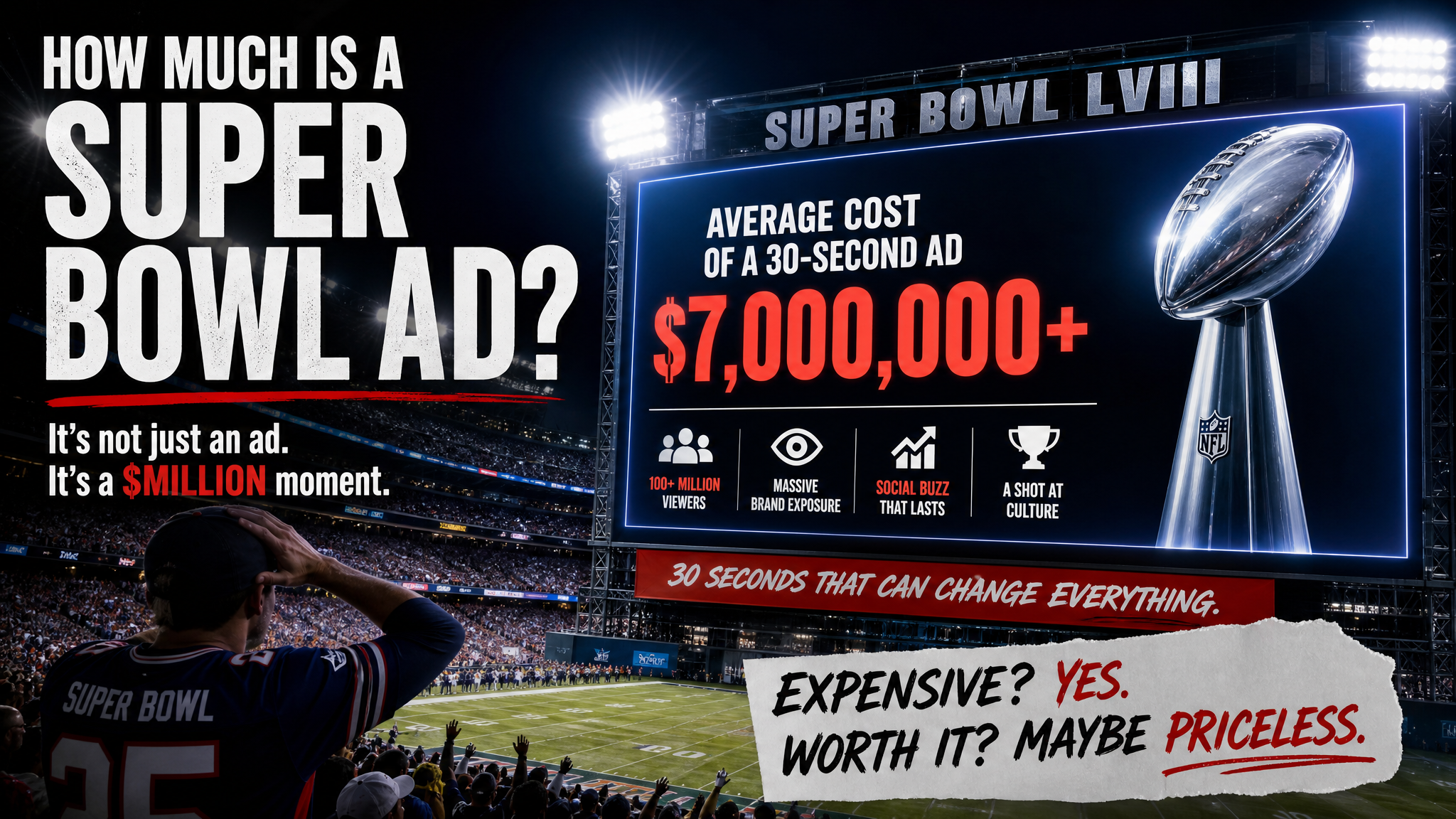
In 2026, the broadcast network price for a standard 30-second commercial slot sits between $7 million and $7.5 million. This translates to an astronomical $233,333 per second. If you look at the raw media buy in isolation, the cost appears prohibitive to all but the largest global conglomerates. However, when evaluated on a Cost-Per-Thousand (CPM) basis, the math becomes surprisingly rational.
With an estimated concurrent audience of 115 million to 120 million viewers, a $7 million media buy delivers a CPM of approximately $58 to $60. This is competitive with premium CTV (Connected TV) placement and targeted programmatic digital video, which frequently trade at CPMs of $45 to $65 for highly qualified audiences. The fundamental difference is scale: instead of delivering 115 million impressions over three months, the Super Bowl delivers them in 30 seconds.
However, this raw CPM calculation assumes perfect delivery. It does not account for the fact that a broadcast commercial lacks the native click-to-convert tracking, individual user targeting, and sequential follow-up capabilities of modern social ad platforms. To make a broadcast investment viable, brands must build complex digital capture systems that catch viewers on their mobile devices while they watch the primary broadcast.
The Historical Price Curve: Analyzing the Price of Attention
To grasp why the media buy has reached its current valuation, we must analyze the Super Bowl ad cost history. In 1967, during Super Bowl I, a 30-second commercial cost advertisers a mere $42,000. Adjusted for inflation, that represents roughly $380,000 in modern capital — a bargain compared to today’s rates.
As the game grew from a standard sporting match into a cultural phenomenon, the price of entry escalated rapidly. By 1995, the cost surpassed the $1 million milestone. By 2015, that number rose to $4.5 million. The steady increase shows that even as cable subscriptions fell and digital streaming grew, the value of a unified, highly engaged mass audience grew exponentially.
When you map this curve against standard consumer behavior, a fascinating paradox emerges: the cost of television inventory has risen even as general TV viewership has declined. This inflation occurs because the Super Bowl has become the *only* program capable of guaranteeing instant, massive, and concurrent attention. In a world of fragmented, on-demand digital content, the premium on unified, live attention has soared, driving costs up and making efficient digital amplification essential.
The Total Production Cost Matrix: Hidden Fees and Secondary Investments
The headline-grabbing network cost is only the first of several major expenses. In reality, a $7 million media buy requires a total campaign budget of $15 million to $20 million to execute successfully. If you attempt to run a low-budget, poorly produced video on a $7 million broadcast slot, the contrast with premium ads will damage your brand equity.
The true total cost of a Super Bowl commercial campaign includes several key cost centers:
- Cinematic Creative Production ($2.5M – $5M): Super Bowl commercials are treated like short films. They require top-tier directors, professional lighting, specialized cameras, and complex post-production special effects.
- A-List Talent and Celebrity Licensing ($1.5M – $4M): To cut through the noise, most brands hire well-known actors, athletes, or musicians. These high-profile partnerships require extensive contract negotiations, usage-rights fees, and residual payments.
- SAG-AFTRA residuals and union fees ($500K – $1M): Broadcasting a commercial to over 100 million concurrent viewers triggers significant union talent residuals, which scale based on audience reach.
- Digital Hype and Social Amplification ($3M – $5M): To ensure your ad is seen, you must run teaser campaigns, partner with digital creators, and deploy programmatic vertical ads across social platforms before, during, and after kickoff.
Stop paying high agency overhead fees. Convert core concepts into platform-ready 9:16 ads in minutes. Plans start at $9.99/mo
🎬 Start Creating Now →Because the total production overhead is so high, modern brands cannot rely on traditional, slow-moving agencies to handle all their secondary content. To support their multi-million dollar broadcast spots, growth-focused creative teams use high-velocity tools to rapidly produce platform-specific digital variations. For example, some brands use modern AI-powered video ad generators like VidAU.ai to convert their core campaign concepts into hundreds of native, platform-ready digital ads in minutes, ensuring complete coverage across all digital touchpoints.
Decoding the Return on Investment: Brand Equity vs. Direct Response
How does a brand rationally justify spending $15 million on a single day of advertising? The answer depends on your primary marketing objective. Broadly speaking, Super Bowl campaigns serve two very different goals: top-of-funnel Brand Equity and bottom-of-funnel Connected Direct Response.
For established consumer brands (like Pepsi, Budweiser, or Doritos), the campaign is a defensive play. It is designed to maintain market leadership, reinforce brand authority, and secure valuable retail shelf space. For these giants, success is measured through long-term brand health metrics: share of voice (SOV), purchase intent shift, and consumer brand affinity over the next six months.
For venture-backed digital brands, the play is entirely offensive. These companies require immediate, high-volume customer acquisition. They measure success by direct digital conversions: app downloads, website traffic spikes, and immediate sales volume. The classic example is Coinbase’s famous bouncing QR code ad, which generated so much immediate web traffic that it crashed their landing page. This is direct-response television advertising executed at a massive, unprecedented scale.

Traditional Broadcast Model vs. Connected Digital First Model
| Ad Metric & Feature | Traditional Broadcast Ad Buy | Connected Digital-First Strategy |
|---|---|---|
| Direct Media Cost | $7,000,000 – $7,500,000 for a 30-second slot | Fully adjustable, from $5,000 to $1,000,000+ |
| Audience Precision | Broad, non-targeted mass broadcast demographic | Granular behavioral interest and purchase intent data |
| Conversion Friction | High; requires viewers to manually search on mobile | Low; click-to-buy native integration in social feeds |
| Attribution Model | Delayed, indirect modeling and survey diagnostics | Real-time, direct-response click tracking and pixels |
| Creative Agility | Low; a single high-budget video file locked in advance | High; continuous testing of 15–25 creative variants |
| Campaign Lifetime | Single broadcast window on Sunday evening | Multi-month lifecycle with automated retargeting funnels |
Analyzing this comparison reveals that while the traditional broadcast spot delivers unmatched concurrent exposure, the digital-first model offers far better attribution, targeting, and resource efficiency. For brands with capital limitations, trying to match the broadcast budgets of massive companies is a fast way to run out of money. The smarter play is to use digital channels to capture the attention surrounding the game at a fraction of the cost.
Scale digital campaigns concurrently alongside live TV coverage without premium overhead. Starting from $9.99/mo
🎬 Start Siphoning Attention →The Social Siphon Strategy: How to Capture Super Bowl Attention Digitally
You do not need to purchase a $7 million network slot to win on Super Bowl Sunday. In 2026, clever brands use the “Social Siphon Strategy” to intercept the massive digital conversations happening around the game. While millions of viewers watch the television screen, their phones are open in their hands. They are active on social media, sharing real-time memes, checking sports apps, and engaging with creators.
To execute this strategy successfully, you must deploy high-velocity, responsive digital campaigns that align with the game’s live events. This requires producing a wide variety of native social video variants in advance so you can publish the perfect context-relevant ad the moment a major play occurs. Because standard video production pipelines are too slow for real-time events, agile brands use automated tools to build their digital assets.
For instance, by building structured asset libraries and deploying TikTok ad production systems, marketing teams can generate, edit, and launch contextual social ads in minutes. If a major celebrity makes a surprise appearance or a bizarre play happens, you can launch a relevant, high-converting social campaign while the conversation is still peaking on user feeds.
How to Prepare for a Super Bowl-Level Campaign Launch
If your brand is ready to execute a high-impact media campaign during a major national event, you must prepare your technical and creative infrastructure. Follow this step-by-step framework to ensure your campaign runs flawlessly:
📋 High-Impact Media Campaign Framework
Prepare and Stress-Test Your Digital Infrastructure
Before launching a campaign that will drive millions of concurrent visitors, perform rigorous load testing on your website, landing pages, and e-commerce checkout funnels. If your site load time increases by even two seconds under pressure, your conversion rate will drop precipitously, wasting your media investment.
Build Your Cross-Platform Digital Capture Funnel
Ensure your Facebook, Instagram, Google, and TikTok tracking pixels are active and properly configured. You must have dedicated retargeting funnels designed to capture and nurture the sudden surge of traffic generated by your primary campaign launch, turning temporary interest into long-term customer relationships.
Produce Your Modular Creative Asset Library
Instead of relying on a single, expensive video asset, design a modular system of video components. Create 5 distinct hooks, 3 bodies, and 2 CTAs, allowing you to quickly combine them into multiple platform-specific variants. Ensure that all digital-first assets are formatted natively in 9:16 vertical layouts for optimal social feed delivery, as detailed in our guide to ecommerce video ads.
Coordinate Real-Time Social Monitoring and Distribution
Set up a dedicated campaign war room during the live event. Monitor trending hashtags, organic memes, and viral conversations. Empower your team to make immediate budget and creative adjustments, pushing contextually relevant ads live as events unfold on screen.
Analyze Post-Campaign Attributed Conversion Data
Once the event concludes, pull conversion, retention, and traffic data. Analyze the path of your converted users: did they convert immediately from the live social campaign, or did they require multiple retargeting touches over the next 7 days? Document these insights to improve your next major launch strategy.
Scale vertical video variants instantly. Convert e-commerce links into social assets automatically. From $9.99/mo
🎬 Try VidAU Now →Strategic and Creative Pitfalls to Avoid
When the stakes are this high, a single strategic misstep can result in millions of dollars of wasted capital. These are the most common creative and logistical mistakes brands make during high-impact national launches:
Many brands spend millions on abstract, cinematic, or humorous commercials that entertain viewers but fail to clearly communicate what the product is or why it is useful. If your audience remembers the joke but forgets your brand, your campaign has failed to deliver value.
- Neglecting Post-Game Audience Retargeting: Assuming the broadcast spot alone will drive sustained sales. Without an aggressive, programmatic retargeting funnel set up to capture users on social feeds over the next two weeks, your conversion numbers will collapse.
- Relying on Non-Native Digital Assets: Re-uploading a horizontal 16:9 television commercial directly to TikTok or Instagram Reels. This layout looks lazy and unprofessional. You must produce channel-native 9:16 vertical variations for social platforms, utilizing high-performing vertical frameworks such as modern ugc ads to connect with audiences.
- Failing to Monitor Website Load Capacity: Crashing your digital storefront because of a sudden spike in concurrent traffic. If your server infrastructure cannot handle the direct-response surge, your media investment is lost.
- Over-complicating the Primary Call to Action: Asking viewers to complete complex actions like scanning a tiny QR code, visiting a long URL, and entering a multi-digit promo code. Keep your CTA simple, clear, and high-contrast.

Digital-First Alternatives: Achieving Mass Scale for a Fraction of the Cost
For growing, resource-constrained e-commerce brands, a traditional $7 million television slot is rarely capital-efficient. Fortunately, you do not need to purchase a broadcast ad to achieve massive, high-impact reach. By leveraging modern programmatic video and creator platforms, you can build a highly visible, incredibly effective “digital Super Bowl” campaign tailored to your budget.
Instead of betting your entire year on a single broadcast window, consider these high-impact alternatives:
- Programmatic Connected TV (CTV) Takeovers: Purchase targeted CTV ad inventory specifically on streaming sports apps and entertainment programs. This approach lets you reach the same living room screens during game week, but with advanced behavioral targeting and a fraction of the cost.
- Agile Digital Video Advertising Campaigns: Deploy highly engaging, creator-led video campaigns across TikTok, Instagram Reels, and YouTube Shorts. These native formats drive far higher direct conversion and click-through rates than television, as highlighted in the latest AI video generation news.
- Influencer and Creator Partnerships: Collaborate with mid-tier and macro creators to produce conversational product reviews and challenges during game week, tapping into their established trust and organic reach.
To support this high-velocity digital approach, brands must be able to test and iterate on creative concepts continuously. By utilizing AI-powered video tools like VidAU.ai, your growth team can convert product URLs into hundreds of high-converting social video variations instantly, allowing you to scale your creative output without expanding your production team.
The Next Decade of Mass Media: Attention Arbitrage in the Connected Age
As we look past 2026, the nature of mass media will continue to evolve. The lines between traditional television and digital streaming have blurred completely. Every television screen is connected, every viewer is multi-tasking, and every piece of content must fight for attention across a crowded ecosystem of devices.
In this hyper-connected market, the value of traditional broadcast spots will continue to be debated. While the cultural prestige of the Super Bowl remains unmatched, the brands that scale sustainably will be those that master attention arbitrage — learning how to combine high-impact cultural moments with data-driven, programmatic digital funnels.
By shifting from isolated, high-cost broadcast models to integrated, digital-first creative pipelines, your brand can secure massive consumer reach, drive consistent conversions, and build a lasting competitive advantage that outlasts any single Sunday game.
Related Resources
Scale Your Creative Pipeline with VidAU
VidAU.ai converts any product URL or written script into high-converting, vertical 9:16 social ads in minutes — complete with photorealistic AI avatar presenters, professional synthetic voices, and auto-generated captions.
🎬 Try VidAU Now →Plans start from $9.99/month · No credit card required · High-fidelity video output
FAQ — Frequently Asked Questions
How much is a Super Bowl ad in 2026?
In 2026, a standard 30-second Super Bowl ad slot costs between $7 million and $7.5 million for broadcast rights alone. This fee does not cover hidden costs, including high-end agency production fees, SAG-AFTRA talent residuals, intellectual property licensing, and the mandatory multi-platform digital distribution campaigns needed to support the broadcast slot.
What is the true total cost of a Super Bowl commercial campaign?
The true total cost of a Super Bowl ad campaign typically ranges from $15 million to $20 million. While the network inventory is $7 million, brands spend an additional $3 million to $5 million on cinematic video production, celebrity talent buyouts, and another $5 million on programmatic digital distribution to maintain attention after the game ends.
How does a Super Bowl ad’s CPM compare to digital advertising?
A Super Bowl ad delivers a broadcast CPM of roughly $55 to $65 based on 115+ million concurrent viewers. While this is comparable to premium connected TV (CTV) inventory, the broadcast model lacks the direct, click-to-buy attribution, behavioral micro-targeting, and structural long-term engagement offered by programmatic digital video channels.
Is a Super Bowl ad worth it for smaller or growing e-commerce brands?
For growing brands, a traditional television slot is rarely capital-efficient. Instead of risking $10 million on a single 30-second broadcast window, growth-focused brands achieve superior ROI by deploying programmatic video ads, native vertical campaigns, and high-velocity UGC frameworks to intercept consumer attention across social ecosystems.
How long does it take to produce a Super Bowl commercial?
A traditional Super Bowl commercial requires four to six months of production planning. This includes creative scripting, cinematic filming, legal reviews for licensing, celebrity scheduling, and post-production rendering. In contrast, modern digital-first campaigns can be scaled and adapted within days using programmatic creation systems.
Why do some brands choose regional Super Bowl ad slots?
Brands choose regional Super Bowl slots to target specific geographical markets at a fraction of the cost. Instead of spending $7 million on national coverage, a regional ad allows a business to target specific metropolitan areas for $150,000 to $350,000, while maintaining the association and prestige of the event.
How do brands measure the exact return on investment (ROI) of a Super Bowl ad?
Brands measure Super Bowl ad ROI through a mix of immediate digital response metrics and long-term brand equity studies. Growth brands focus on real-time web traffic spikes, search volume increases, and app downloads, while established enterprises track post-event retail sales lift, consumer brand affinity, and social share of voice.
What is the baseline cost of buying a regional Super Bowl ad?
A regional Super Bowl ad slot typically ranges from $100,000 to $400,000 depending on the size and demand of the target metropolitan market. While far cheaper than a national slot, regional buys do not reach the massive concurrent audience, lacking the unified viral impact of national distribution.
How much does celebrity talent cost for a Super Bowl commercial?
Celebrity appearances in Super Bowl ads generally cost between $1 million and $5 million. This fee covers their on-camera performance, pre-game promotional obligations, social media amplification, and contract-specific usage rights. This high cost is why hybrid production methods are becoming popular to scale secondary assets.
How can AI tools complement a Super Bowl campaign?
AI tools complement a Super Bowl campaign by scaling secondary digital-first assets. After investing millions in a broadcast spot, brands use AI video tools to instantly generate hundreds of social-ready vertical ad variations. This matches the campaign’s core concept, capturing attention across mobile platforms without repeating high production costs.
Sources and Performance Benchmarks: Television broadcast and connected media inventory cost datasets Q1-Q2 2026. Global sports broadcasting audience metrics and concurrent streaming delivery research. Creative velocity and cross-channel marketing reports via VidAU.ai internal media planning laboratory.