

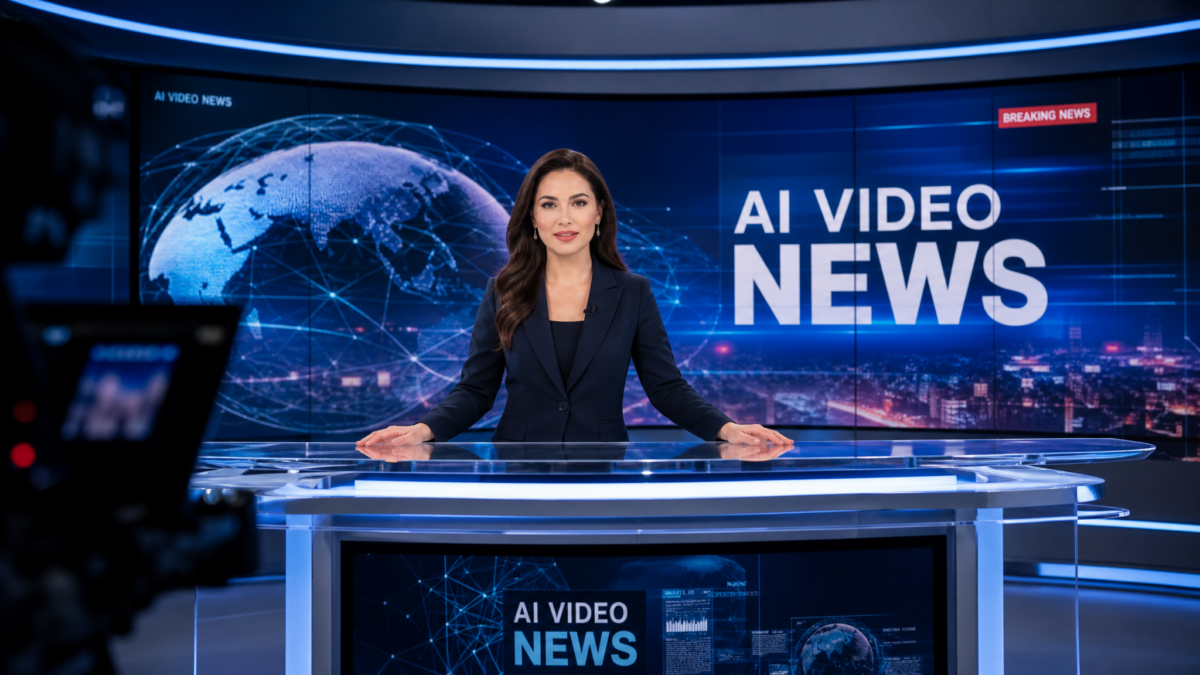
AI video news tools now produce broadcast-ready news segments from a text script in under five minutes. This guide covers how AI news generators work, which use cases return the highest ROI, what the major platforms offer, and how to build an automated news video workflow in 2026.
📋 Key Takeaways — AI Video News 2026
- →AI news video generators convert any text script into a broadcast-ready segment in under 5 minutes — AI avatar presenter, synthesized voiceover, auto-sourced b-roll, and burned-in captions included.
- →AI handles the production layer (filming, presenting, editing, rendering) — not the journalism layer. Human editorial judgment remains non-negotiable at the script stage.
- →Multilingual publishing is the highest-ROI use case — one English script generates the same segment in 120+ languages simultaneously at zero extra production cost per language.
- →Top 2026 use cases: newsroom-to-social pipelines, corporate comms, multilingual distribution, real estate/financial briefings, and educational current events.
- →AI image generation news (model release coverage) and AI video news (production method) are distinct topics often confused in search — one is a content category, the other is a workflow.
- →The most expensive mistake is skipping editorial review because production is fast — speed of generation does not substitute for factual accuracy in the script.
Pick any major news organisation and look at their YouTube channel. There is almost certainly a row of short-form vertical videos — news summaries, daily briefings, market updates — produced at a cost that would have been prohibitive three years ago. Some are human-presented. An increasing number are not. The presenter is an AI avatar. The voiceover is synthetic. The segment was ready within minutes of the story being written. The viewer rarely knows the difference.
This is the shift happening across professional media, corporate communications, and independent publishing right now. AI video news is not a future capability being tested in labs. It is production infrastructure that thousands of organisations have already deployed. What separates teams getting real value from it versus those running expensive pilots is understanding exactly what the technology does, what it does not do, and where the workflow risks live. For context on how AI is changing adjacent content workflows, see our AI Podcast Generator 2026 guide.
What Is an AI News Video Generator?
What Is an AI News Video Generator?
An AI news video generator is a tool that converts written news scripts, articles, or URLs into complete broadcast-style video news segments using AI avatar presenters, synthesized voiceovers, auto-sourced visuals, and burned-in captions — without a camera, studio, or human presenter. The full production cycle typically completes in under five minutes per segment.
The terminology in this space is frequently conflated. An AI news generator may refer to a text-only tool that writes news summaries from data feeds. An AI news video generator specifically produces video output with a visible presenter and audio. An AI video generation news search typically returns coverage of AI video technology developments themselves — model releases, capability updates, regulatory discussions. Knowing which you mean before evaluating tools saves considerable time and budget.
How AI News Video Generation Actually Works
Most people who encounter AI news video for the first time assume the process is more complex than it is. The production chain has four components, each handled by a separate AI layer the user does not need to manage individually.
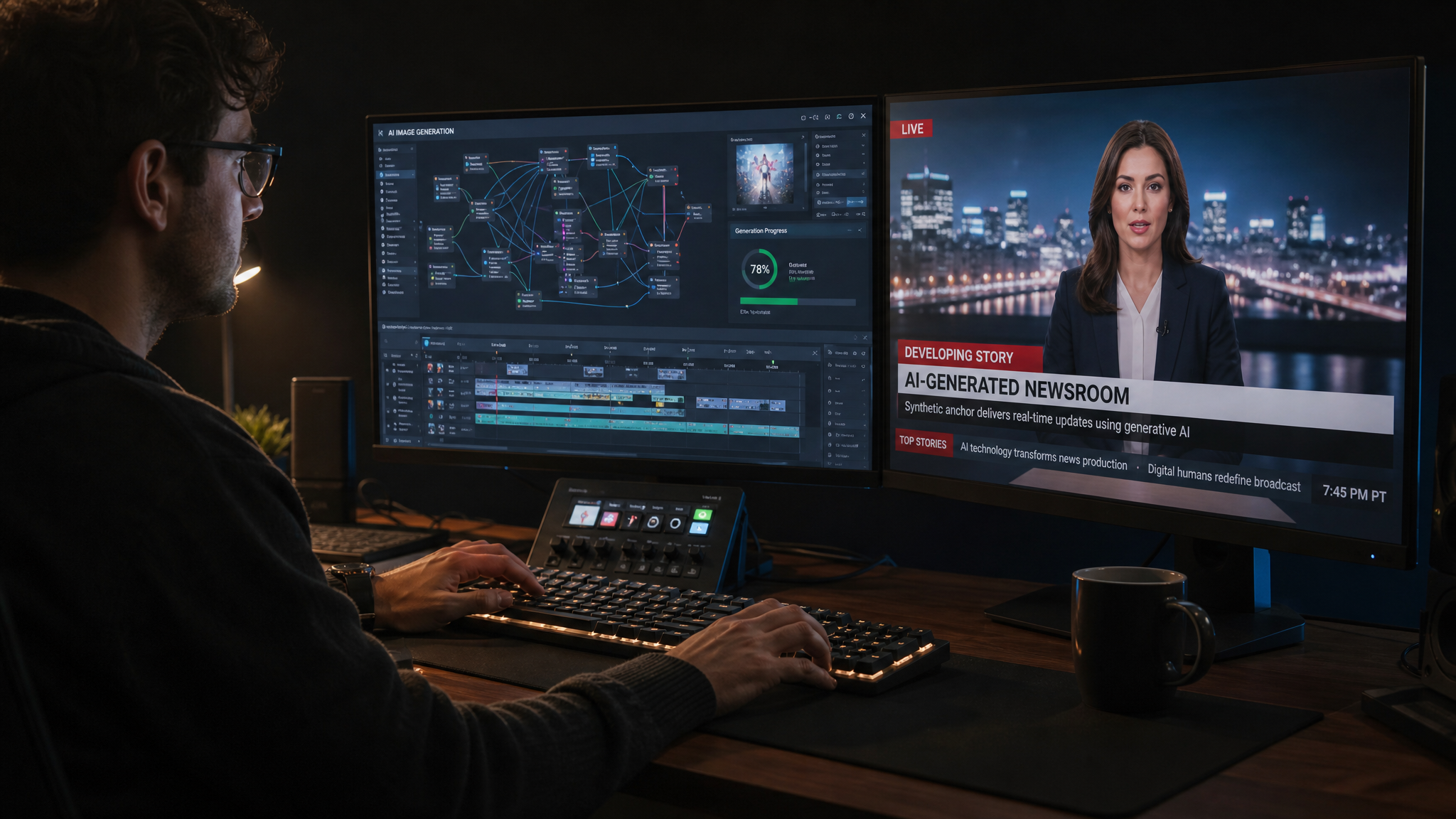
1. Voice Synthesis
Neural text-to-speech converts the script into natural speech with correct intonation, sentence stress, and pacing. Modern systems apply emotional tone variation — a breaking news segment sounds different from a finance briefing, even from the same text style.
2. Avatar Rendering
An AI avatar presenter is rendered speaking the synthesized audio with accurate lip-sync and natural facial expression. Most platforms offer 50–150+ avatar options across age, ethnicity, and presenter style.
3. Visual Sourcing and B-Roll
The platform automatically sources or generates relevant background visuals based on the script topic. Some use licensed stock libraries; others use AI-generated imagery. The presenter is composited over these visuals automatically.
4. Caption and Graphic Overlay
Captions are auto-generated and burned into the video. Lower-thirds, headline banners, and network-style graphic templates are applied automatically. Most platforms include news-specific graphic templates as standard.
Where AI Video News Is Delivering Real ROI in 2026
The gap between organisations getting measurable value from AI news video and those running expensive pilots almost always comes down to use case selection. High-ROI applications share a specific characteristic: they are script-driven and format-repeatable — the same structure produced many times with different content.
1. Newsroom-to-Social Video Pipeline
News organisations that already produce written articles are sitting on a continuous supply of AI video inputs. Every published article is a ready-made script. Platforms that accept article URLs and automatically generate social-format video segments (9:16 for TikTok and Reels, 16:9 for YouTube) allow publishers to expand into video without a dedicated video team. A newsroom producing 20 articles per day can produce 20 video summaries per day at near-zero marginal cost.
2. Corporate Communications and Internal News
The internal communications use case is arguably more mature than media. HR departments, executive offices, and communications teams producing weekly company updates, policy announcements, or town hall summaries use AI video news to add a video layer without a production team. The controlled, script-driven nature of corporate communications is near-ideal for AI generation. See our digital advertising guide for how AI content tools fit into broader communications strategies.
3. Multilingual News Distribution
This is the highest-ROI application for most organisations, and the one most significantly differentiated from traditional production. A single English-language news script can generate the same video segment in 120+ languages simultaneously, each with a native-quality AI voice. A news operation that previously could only distribute in two or three languages for budget reasons can now distribute in forty. The marginal cost per additional language is effectively zero.
Generate multilingual video news segments from any script or article URL. From $9.99/mo
🎬 Start Creating →4. Real Estate and Financial Market Briefings
Daily market summaries, property listings, and financial updates are among the most data-dense, script-driven content types produced in professional media. AI news video generators excel here: structured data feeds are easy to convert into a standard script template, which is then processed into video automatically. A financial publisher can produce a fresh 90-second market briefing every morning without any human video production involvement beyond data input and script template maintenance.
5. Educational Current Events
Schools, universities, and educational publishers producing current events content for students use AI news video to maintain frequency and clarity at low cost. The format — clear presenter, straightforward script, accessible vocabulary — maps well onto AI generation quality. Educational institutions that previously updated video content monthly can maintain weekly or daily cadences.
A Note on AI Image Generation News vs AI Video News
Search engines frequently surface these two topics together, and they are genuinely different things worth separating clearly before any strategic discussion.
AI image generation news = coverage of AI image generation technology: model releases (Midjourney v7, DALL-E 4, Stable Diffusion updates), capability benchmarks, policy changes, and industry analysis. This is a content category about AI technology developments.
AI video news = using AI tools to produce video news content: the workflow, platforms, and applications described throughout this article. This is a production method for creating video journalism and content.
Both are significant topics in 2026 and both move quickly. AI image generation news specifically has accelerated dramatically, with major model releases happening on roughly 60–90 day cycles. For publishers covering the AI beat, using AI production tools to cover AI image generation developments is itself a relevant use case — the meta-irony is not lost on anyone in the space.
Traditional News Video Production vs AI News Video: The Real Comparison
| Factor | Traditional News Video | AI News Video Generator |
|---|---|---|
| Production time per segment | 2–6 hours | Under 5 minutes |
| Team required | Camera, presenter, editor, graphics (3–5 people) | One person with a text script |
| Cost per segment | $200–$2,000+ (depending on team) | Under $5 at scale |
| Languages per production run | 1 (re-record per language: $500–$2,000) | 120+ at zero extra cost |
| Episode consistency | Variable (presenter energy, lighting, audio) | Identical across every segment |
| Scale ceiling | Limited by team capacity and studio time | Effectively unlimited (batch generation) |
| Breaking news response time | Minimum 1–2 hours from script to published | Under 10 minutes from script to published |
| Editorial judgment | Human throughout | Human at script stage only |
The editorial judgment row is the one that matters most and the one most often underweighted in platform marketing. AI video generation does not improve or verify the underlying journalism — it executes production on whatever script it receives. The journalist’s job does not get smaller; the production team’s job does. Understanding this distinction is essential before deploying AI news video at scale.
Leading AI News Video Platforms: What to Know in 2026
The platform landscape for AI news video has matured considerably in 2025–2026. The major categories each have meaningful technical differentiation worth understanding before committing to a workflow.
| Platform Category | Strengths | Limitations | Best For |
|---|---|---|---|
| Avatar-first platforms | High avatar realism, strong enterprise features | Higher pricing, less optimised for high-volume news workflows | Corporate communications, branded news content |
| Template-based video tools | Fast production, accessible pricing, news templates pre-built | Lower avatar quality, less flexible customisation | Social media news summaries, starter workflows |
| Voice-first platforms | Superior voice quality, emotional range | Audio only — no video output without additional workflow | Voice overlay for self-produced video |
| URL-to-video native platforms | Direct URL ingestion, multi-format export, lower cost per segment | Less news-specific template depth | High-volume publishing, multilingual distribution |
The key differentiator most platform comparisons miss: URL-to-video capability. For news organisations that publish written articles first, a platform that can directly ingest an article URL and structure it into a video script automatically eliminates the primary manual step in the workflow. Teams adopting AI news video at volume should treat this as a first-order requirement, not a nice-to-have.
As more content teams move toward scalable AI publishing pipelines, tools that handle direct URL ingestion and multi-format export — where a published article automatically spawns video assets for every distribution channel in the same session — reduce per-video friction more significantly than avatar quality improvements alone. For a broader look at how ecommerce teams are using the same URL-to-video infrastructure, see the Facebook Ad Best Practices 2026 guide.
Turn Any Article or URL Into a Video News Segment
Convert article URLs into AI avatar-presented video segments for YouTube, TikTok, LinkedIn, and broadcast — in 120+ languages from a single source.
🎬 Try VidAU — From $9.99 →Plans from $9.99/month · No credit card required to explore
How to Build an AI News Video Workflow: Step by Step
📋 7-Step AI News Video Workflow Framework
Audit Your Existing Content for AI-Ready Scripts
List the content types you already produce that are script-driven and format-repeatable: daily briefings, weekly summaries, market updates, product announcements. These are your immediate automation candidates. Start with the highest-frequency, lowest-complexity content type first.
Define Output Channels and Format Requirements
Decide before selecting a platform: which channels need video (YouTube, TikTok, LinkedIn, broadcast, internal intranet), and what format each requires (16:9, 9:16, 1:1, duration limits). Platforms that output all formats from a single session eliminate significant post-production overhead.
Select a Platform Based on Your Primary Use Case
Match platform selection to your actual production requirement. If multilingual output is essential, prioritise 100+ language coverage with native-quality voices per language. If URL-to-video is critical, test this feature specifically on your content type before committing. See the AI content tools comparison guide for broader platform selection frameworks.
Build a Script Template for Each Content Type
AI news video quality is almost entirely determined by script quality. Build a standard template for each content type: opening hook, three to five key points, closing line, call-to-action. Standardised templates produce consistent video quality; unstructured scripts produce inconsistent results regardless of platform.
Establish Editorial Review Before Every Export
Every AI-generated video segment should receive human review of: factual accuracy, appropriate avatar selection for tone, correct visual context, and caption accuracy. The review should take 2–3 minutes per segment. Production speed does not substitute for editorial accuracy — this step is non-negotiable.
Run a Multilingual Test Batch
If multilingual distribution is part of your strategy, run a ten-segment batch in your top three target languages before full rollout. Review each with a native speaker for voice naturalness and tonal accuracy. Most platforms perform strongly in Spanish, French, and German; quality varies more for tonal Asian languages. Verify before committing production volume.
Measure and Optimise at the Script Level
Track performance (views, completion rate, engagement) by script structure, not video format alone. Hook strength in the first 3–5 seconds determines completion rate more than avatar choice or production quality. Optimise your script templates based on performance data, then let the AI handle production volume.
Common Mistakes in AI News Video Production

Treating the speed of generation as permission to skip editorial review. A factual error in a text article can be corrected in 30 seconds. A factual error in a published video requires re-rendering, re-exporting, and re-uploading — plus the reputational cost is asymmetric because video feels more authoritative. Build editorial review into the workflow before going live at volume.
- Choosing platform over workflow. Evaluating AI news video platforms on demo quality rather than on how they fit your actual production process. The most impressive demo is often not the most efficient for high-volume, fast-turnaround news content.
- Unstructured scripts as inputs. Feeding loosely written summaries into AI video generators rather than properly structured scripts. AI presents your writing fluently — it does not restructure poor writing. Output quality is directly proportional to input quality.
- Tone mismatch between avatar and content. Using an upbeat, casual avatar for breaking news or sensitive topics. Avatar selection should match the emotional register of the content. Most platforms offer news-specific avatar styles; use them.
- Skipping multilingual quality review. Assuming that because English output is high quality, all language versions are equally strong. Language quality varies significantly across platforms, especially for tonal languages and regional dialects.
- Optimising for length rather than hook strength. Completion rate data consistently shows that the first 5 seconds determine performance more than total video length. Optimise scripts for hook strength, then let AI handle production at whatever length the content requires.
- No disclosure framework. Publishing AI-generated news video without any disclosure policy. A simple “produced with AI tools” note in the video description builds rather than undermines credibility with informed audiences in 2026 — and positions the organisation ahead of regulatory requirements that are moving toward mandated disclosure.
Where AI Video News Is Heading in the Next 12 Months
Real-Time Generation from Data Feeds
The current workflow requires a human to input a script. The next iteration removes this step for structured data types: financial markets, sports scores, weather, election results. Platforms are developing direct API connections to data providers that allow templates to auto-populate and generate video automatically when new data arrives. A financial publisher will produce a market close video automatically at 4:01pm, triggered by the exchange data feed, without any human production involvement.
Personalized News Video at Scale
Dynamic variable insertion at the video level is in development across multiple platforms. The same news segment can be rendered with different audience-specific details — local weather data, relevant stock prices, regional policy context — producing thousands of personalised video variants from a single template at near-zero marginal cost. This has significant implications for local news publishers that currently cannot serve hyper-local audiences economically.
Disclosure and Regulatory Frameworks
The regulatory environment around AI-generated video news is developing faster in 2026 than the technology itself. The EU AI Act provisions covering synthetic media in journalism contexts, US FCC guidance on AI-generated broadcast content, and platform-level policies from YouTube, TikTok, and Meta are all moving toward mandatory disclosure requirements. Organisations building disclosure into production workflows now will be significantly better positioned when requirements become legally binding.
Related Resources
AI Video News 2026: Key Insights
- →AI handles the production layer, not the journalism layer. Technology eliminates filming, presenting, editing, and graphics. It does not verify facts, source stories, or exercise editorial judgment. The human role shifts from production to editorial — which is exactly where it belongs.
- →Multilingual distribution is the transformative capability. One script generating 120 language versions at zero marginal cost per language is not incremental improvement — it is a structural change in what is economically possible for publishers of any size.
- →Script quality is the primary production variable. AI news video output quality is directly proportional to input script quality. Platform selection matters less than editorial discipline at the script stage.
- →Editorial review is not optional at speed. Production time advantage is real. That advantage does not justify skipping human review. A 2-minute check before every export costs almost nothing; errors discovered after publication are expensive to fix and costly to credibility.
- →Real-time data-triggered video generation is 12 months away. Financial publishers, sports media, and weather services are closest to deploying fully automated template-to-video pipelines triggered by live data feeds. Planning for this capability now is operationally useful.
- →Disclosure is a credibility strategy, not a compliance burden. Organisations building AI production disclosure into workflows proactively are building audience trust before it becomes legally required. Those that retrofit it under pressure will have a harder conversation with their audiences.
Start Producing AI News Video Today
Convert any article, script, or URL into a broadcast-ready video news segment with AI avatar presenter, voiceover, captions, and multi-platform export — in 120+ languages from one source.
🎬 Try VidAU — From $9.99 →Plans from $9.99/month · No credit card required · URL to video in minutes
“AI-generated news video is crossing the quality threshold that matters — not cinematic perfection, but credibility. Audiences are beginning to accept it the same way they accepted stock photos.”
— Casey Newton, Founder, Platformer
FAQ — AI Video News
What is an AI news video generator?
An AI news video generator converts written news scripts, articles, or URLs into broadcast-ready video news segments using AI avatar presenters, synthesized voiceovers, auto-sourced visuals, and captions — without a camera, studio, or human presenter. Production time is typically under 5 minutes per segment. Leading platforms support 120+ languages from a single script input.
How accurate are AI-generated news videos?
AI news video accuracy depends entirely on the quality of the input script — the AI renders what it is given. Editorial verification happens at the script stage, not the generation stage. Organisations using AI news generators should maintain the same editorial verification standards as any other news production workflow. Speed of generation does not substitute for journalistic accuracy.
Can AI replace human journalists and news presenters?
AI replaces the production layer of news: filming, editing, rendering, presenting on camera. It does not replace reporting, source verification, or editorial judgment. The roles eliminated are production and presenting. The roles that remain and grow are reporting, writing, and editorial oversight. AI news video is production infrastructure, not a journalism substitute.
What are the main use cases for AI news video generators in 2026?
The primary use cases in 2026 are: newsroom-to-social video publishing, corporate internal communications, multilingual news distribution from a single script, real estate and financial market briefings, educational current events content, and sports highlight narration. The highest-ROI applications share one characteristic: they are script-driven and format-repeatable.
How is AI image generation news different from AI video news?
AI image generation news refers to coverage of AI image generation technology — model releases from Midjourney, DALL-E, Stable Diffusion — as a content category. AI video news refers to using AI tools to produce video news content as a production method. One is a subject of journalism; the other is a method of video production. Both are active topics in 2026 but describe entirely different things.
What should content teams do to prepare for AI video news workflows?
Content teams should: audit which content types are script-driven and format-repeatable; define output channel and format requirements before platform selection; build standard script templates for each content type; establish an editorial review step before every export; test multilingual output with native speakers before full distribution; and measure performance at the script level, optimising hooks rather than chasing production quality improvements.
Sources: Platform capability and pricing data verified May 2026 from publicly available platform documentation. Language support figures from leading platform specification pages Q2 2026. AI Podcast Generator Guide 2026 · Facebook Ad Best Practices 2026.