


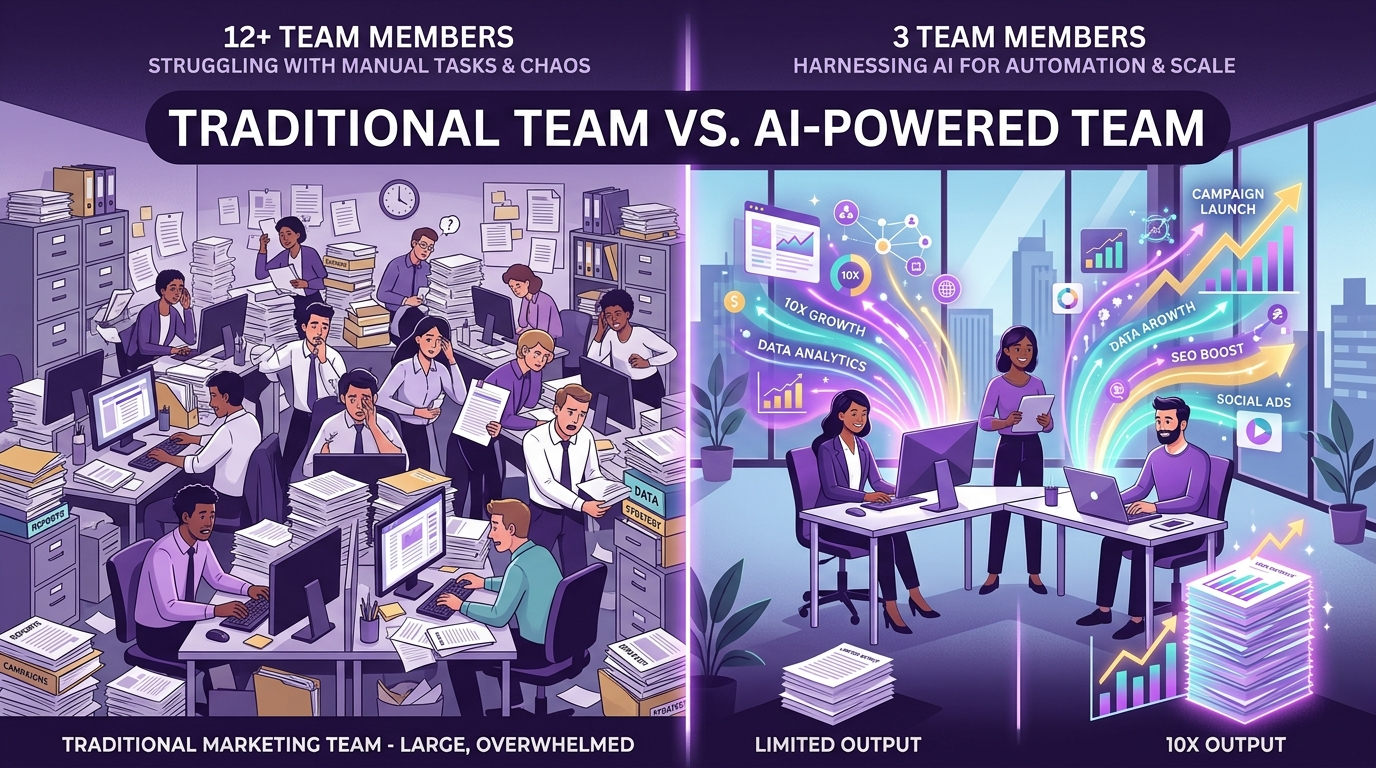
The brands winning in marketing right now are not the ones with the biggest teams. They are the ones that figured out which parts of marketing can be handled by machines and moved humans out of those parts. A five-person marketing team running AI-powered content production, automated ad testing, and agentic reporting can outproduce a twenty-person traditional team — today, with tools that exist right now.
The challenge is not access to the tools. It is knowing which tools solve which problems, in which order, and how to build workflows that hold under production pressure. Most brands fail not because AI does not work but because they start in the wrong place. This is the framework that fixes that.
How to Scale Your Marketing with AI
Scale marketing with AI by systematically replacing repeatable execution tasks with AI tools and agents — starting with content production and creative testing, then moving to reporting and campaign optimisation. Automate the measurable and repeatable first. Preserve human judgment for strategy and client relationships. Build workflows that compound rather than require constant manual intervention.
Key Takeaways
- →Start with content production and creative testing — fastest ROI, frees capacity for everything else.
- →Automate execution before judgment. AI handles repeatable tasks well. High-stakes decisions poorly. Build in that order.
- →The constraint on AI marketing scale is almost never technology — it is workflow design and change management.
- →A four-person AI-powered team outproduces a twenty-person traditional team on content volume, testing velocity, and reporting speed.
- →Measure ROI in hours reclaimed and output per person — not in tool subscription costs.
The 4-Layer AI Marketing Framework
The framework maps the marketing function into execution layers from most automatable to least, giving you a sequenced approach that builds compound value rather than creating new complexity.
| Layer | Function | AI Readiness | ROI Timeline | Human Role |
|---|---|---|---|---|
| 1 | Content production | Very high — automate now | 30-60 days | Direction, editing, quality |
| 2 | Creative testing | Very high — automate now | 30-60 days | Hypothesis, interpretation |
| 3 | Reporting and analytics | High — automate soon | 60-90 days | Insight extraction, decisions |
| 4 | Campaign optimisation | High — automate soon | 60-120 days | Budget authority, strategy |
| 5 | Strategy and planning | Medium — AI-assisted | 6-12 months | Full ownership |
| 6 | Client relationships | Low — humans only | N/A | Full ownership forever |
Layer 1: Content Production at Scale
Content production is where AI delivers the fastest, most measurable ROI. The gap between what a human team can produce per week and what an AI-augmented team produces is categorical, not incremental. A single marketing manager with the right AI stack can produce more blog content, social posts, and email sequences in a week than a five-person team could manually in a month.
A proper AI content workflow has three stages: brief generation (AI identifies topics and keyword gaps), draft production (AI produces first drafts following your brand standards), and human review (a human edits for accuracy and approves). The workflow produces more content, faster, at lower cost per piece, without reducing quality below an acceptable threshold.
Layer 2: Creative Testing Velocity
The biggest constraint on paid advertising performance is creative, not targeting or budget. The brands with the highest ROAS test the most creative variants the fastest. A brand testing twenty ad variants per week finds winning creative faster than one testing two. AI makes twenty-variant weekly testing achievable at budgets starting at $5,000 per month in ad spend.
AI video tools produce platform-ready ad creative from a product URL in minutes. AI copy tools generate dozens of headline and hook variants simultaneously. The loop: generate variants, run with minimal budget, scale winners, discard losers, repeat continuously rather than monthly.
Need to test 20+ ad creative variants per week without a production team? AI video tools make it achievable at any budget.
Layer 3: Reporting Automation
Reporting consumes an estimated 15-20% of senior marketing time in traditional setups — pulling data from five platforms, formatting slide decks, distributing by email, answering questions in meetings. Modern AI analytics platforms connect directly to your ad accounts, website analytics, email platform and CRM, pull data automatically, identify anomalies, generate narrative summaries, and distribute on schedule. The human role shifts from producing the report to interpreting insights and making decisions.
Layer 4: Campaign Optimisation
AI-powered optimisation runs continuously rather than on a weekly human review cycle. Meta Advantage+, Google Performance Max, and TikTok Smart+ all include agentic optimisation that adjusts bids, reallocates budget, and rotates creative without manual intervention. The brands winning on these platforms provide the best inputs — high creative volume, accurate conversion signals, clear goals — then let the algorithm run.
The AI-Powered Marketing Team Structure
Strategist
1 person
Owns goals, direction, and brand positioning. Sets the brief for AI systems. Makes final budget and strategy decisions. Cannot be automated — this is the judgment layer.
Systems operator
1 person
Builds and maintains AI workflows. Connects tools. Troubleshoots automation failures. The highest-value new role in marketing — requires both marketing knowledge and systems thinking.
Creative director
1 person
Reviews and improves AI-generated creative. Sets brand standards AI must meet. Identifies winning creative directions and briefs AI to explore variations. Quality control for volume output.
Growth analyst
1 person
Interprets AI-generated reports. Owns testing frameworks and learning velocity. Connects marketing performance to business outcomes. Makes optimisation recommendations.
7-Step Implementation Guide
- Audit your current time allocation. Map where your team’s hours actually go. Most teams discover 40-60% of marketing time is in automatable execution tasks. This audit becomes your implementation priority list.
- Start with one content type. Pick blog articles, social posts, or email sequences and build one AI workflow. Get it running reliably before adding more. Reliability beats ambition in the early stages.
- Build a creative testing system. Define your testing cadence (weekly), variant count target (10-20 per campaign), and signal threshold. Build the AI production pipeline that feeds this system consistently.
- Replace manual reporting. Connect analytics platforms to an AI reporting tool. Train stakeholders on AI-generated reports before stopping manual ones. Transition takes 2-4 weeks.
- Enable agentic campaign optimisation. Activate the highest level of AI-driven optimisation available on each ad platform. Provide quality inputs and reduce manual intervention in bidding and placement decisions.
- Build a quality control process. As AI handles more output, human quality control becomes more important. Define exactly what standard AI output must meet before publication or activation.
- Measure and compound. Track hours reclaimed and output per person monthly. Use capacity freed by AI for higher-value strategic work rather than just maintaining the same output cheaper.
Common Mistakes
- Starting with strategy automation. AI performs worst at highest-judgment tasks. Start with execution. Strategy comes later.
- Too many tools at once. Pick one problem, build one workflow, prove it, then add the next. Ten simultaneous tools creates integration complexity with no proven returns.
- No quality standard before volume. Large volumes of AI content without a clear quality bar damages brand credibility fast. Define the standard first.
- Measuring ROI in tool costs. Tools cost hundreds per month. The capacity they unlock is worth thousands. Compare AI output cost to equivalent human cost, not to the subscription fee.
- Not retraining the team. Teams not taught how to work with AI — how to prompt, review outputs, catch errors — consistently underperform teams that invest in this training.
Frequently Asked Questions
How do you scale marketing with AI?
Start by automating the most repeatable execution tasks — content production, ad creative testing, and reporting. Build reliable AI workflows in each area, then free human capacity for strategy, client relationships, and quality control. The sequence matters: execution before judgment, reliability before ambition.
What AI tools are best for scaling marketing in 2026?
Highest-impact: AI video and creative generators for content volume, AI copy tools for written content at scale, agentic campaign optimisation built into ad platforms, AI analytics for automated reporting, and AI SEO tools for content planning. The right stack depends on which marketing functions consume the most human time in your operation.
How much can AI reduce marketing costs?
Brands with systematic AI workflows report 40-70% reductions in content production costs, 30-50% reductions in reporting time, and 20-40% improvements in ad creative performance through higher testing velocity. Total reduction depends on which functions are automated and the baseline efficiency of the existing team.
How long does it take to scale marketing with AI?
Most brands see meaningful improvements within 30-60 days of systematic AI adoption for content and reporting. Full transformation of the marketing function typically takes 6-12 months. The constraint is almost never the technology — it is change management and workflow redesign inside the team.
How do you build an AI-powered marketing team?
Four roles: a strategist who owns direction and goals, a systems operator who builds AI workflows, a creative director who reviews AI outputs and maintains brand standards, and a growth analyst who interprets data and drives optimisation. Smaller than a traditional team, significantly higher output per person.
Final Verdict
- →The brands winning right now are not the biggest — they are the most systematically automated.
- →Start with content and creative testing. These deliver the fastest ROI and free capacity for every other AI adoption.
- →Four-person AI-powered teams outproduce twenty-person traditional teams on content volume, testing velocity, and reporting speed.
- →The constraint is change management, not technology. The tools exist and work today.
Start Scaling Your Marketing Content with AI
VidAU helps marketing teams produce video content, ad creatives, and product videos at scale — no production team required.
No credit card required · From $9.99/month
Agency-Agent Shift 2026Why the retainer model is ending
Agentic AI Companies 2026Why software is being replaced
Ecommerce Video Ads 2026Creative velocity guide
Sources: McKinsey AI adoption in marketing report 2026 · Meta Advantage+ performance data 2026 · Google Performance Max documentation 2026 · Industry operator research, VidAU 2026.