
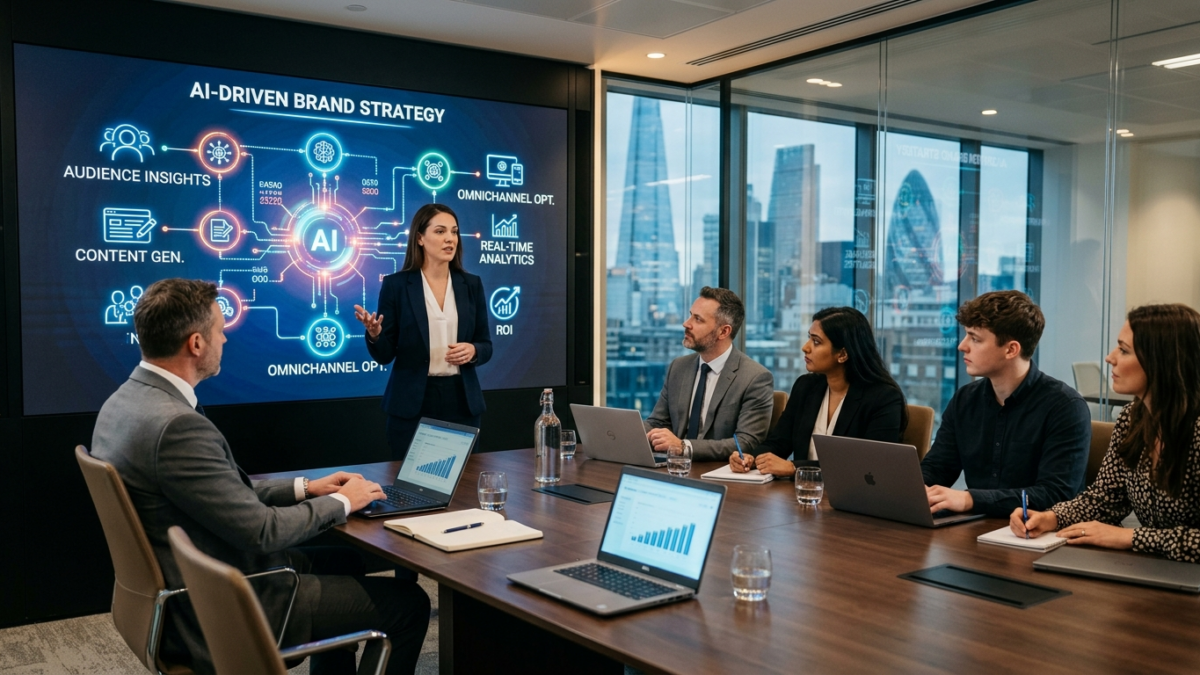
The question used to be whether to hire a marketing agency or build in-house. That debate has been replaced by a more specific one: do you bring in an AI marketing consultant to set up and train your team, or do you invest in building genuine AI marketing capability internally? Both paths work. They work for different brands at different stages, and the cost of choosing the wrong one is significant.
This is not a theoretical comparison. It is a decision framework built from how the market actually works in 2026 — what AI marketing consultants actually deliver, what in-house AI marketing capability actually costs, and which model produces better outcomes for which types of brands.
AI Marketing Consultant vs In-House AI: The Verdict
Hire an AI marketing consultant if you need fast implementation without building expertise from scratch, your team is small, or AI is not a core competitive differentiator. Build in-house AI capability if AI marketing is a strategic differentiator, you have budget for a senior hire, or you need deep integration with proprietary data. Most brands under $10M revenue benefit more from a consultant. Most brands over $50M with strong marketing teams benefit more from building in-house.
Key Takeaways
- →Consultants deliver faster time-to-value. In-house delivers deeper long-term integration. The right choice depends on your scale and strategic roadmap.
- →Most brands under $10M revenue benefit more from a consultant engagement than from a full-time hire.
- →The biggest consultant risk is dependency — paying for ongoing execution rather than capability building. Demand knowledge transfer explicitly.
- →The biggest in-house risk is the 6-18 month learning curve before a new hire reaches full productivity with AI marketing systems.
- →Practitioner consultants outperform theorist consultants by a wide margin. Ask for case studies with measurable outcomes, not tool certifications.
What AI Marketing Consultants Actually Do in 2026
The AI marketing consulting market split sharply in 2025 into two camps: practitioners and theorists. Practitioner consultants have built AI marketing systems themselves, at real brands, with measurable results. Theorist consultants have studied the tools, earned certifications, and can explain AI marketing fluently without having shipped a single production workflow. The difference in outcomes between these two types is enormous.
A genuine AI marketing consultant in 2026 does the following: audits the client’s current marketing stack and identifies automation opportunities, designs and builds AI workflows for content production, creative testing, reporting, and campaign optimisation, trains the internal team to operate those workflows, and measures results with clear before-and-after metrics. Engagements typically run 6-12 weeks for workflow implementation and 3-6 months for full operational transformation.
What In-House AI Marketing Capability Actually Looks Like
Building genuine AI marketing capability in-house means one of two things: upskilling an existing team member who has the aptitude and interest to become the AI marketing operator, or hiring a dedicated AI marketing professional. Both paths are viable. Both take longer than brands typically expect.
The in-house path produces deeper integration — the AI marketing operator understands your brand, your historical data, your internal tools, and your strategic priorities in a way that a consultant cannot replicate. That depth compounds over time. A good in-house AI marketing operator after 18 months is dramatically more valuable than they were at month three. That compounding advantage is the core argument for building in-house.
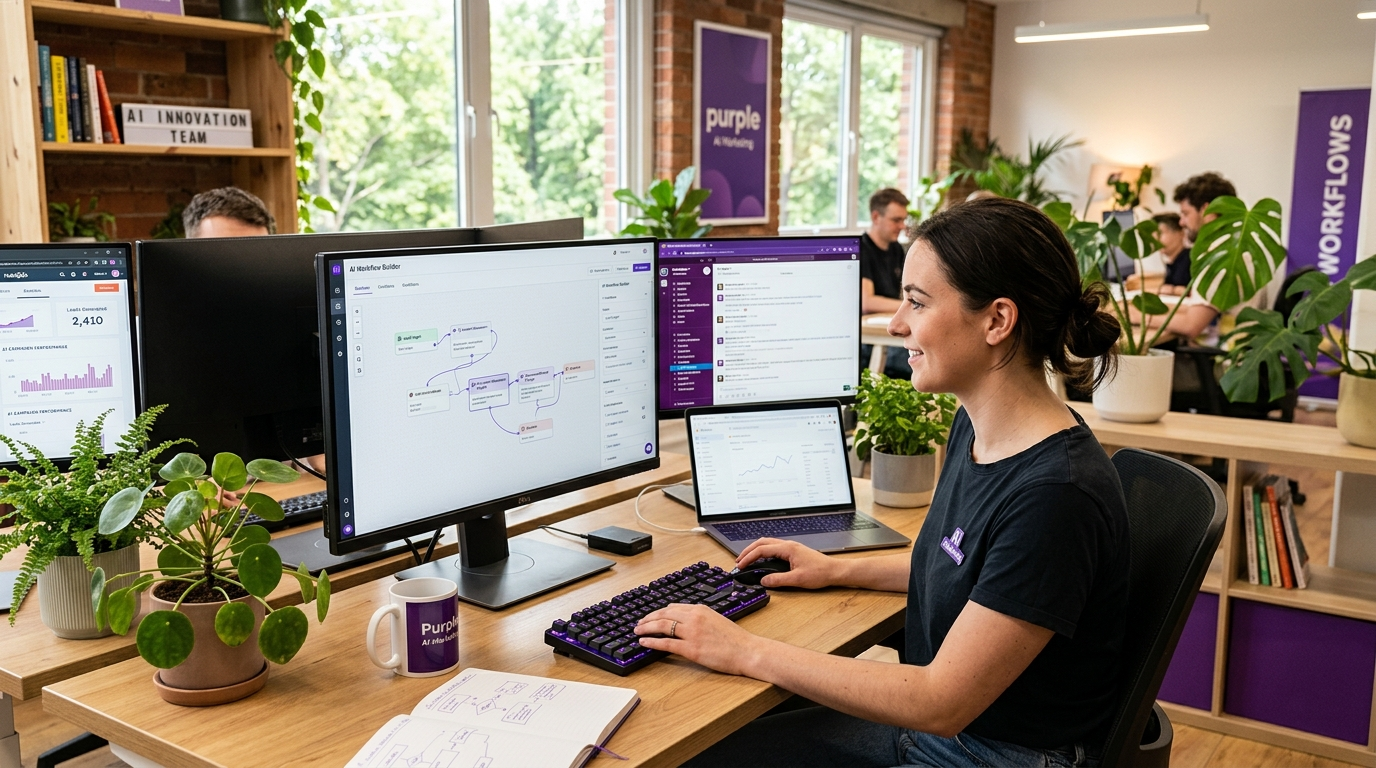
Cost Comparison: Consultant vs In-House
| Cost Factor | AI Marketing Consultant | In-House AI Marketing Hire |
|---|---|---|
| Base cost | $5K-25K/month or $150-300/hr | $80K-180K/year salary |
| Onboarding time | 1-2 weeks | 3-6 months to full productivity |
| Knowledge retention | Leaves with consultant | Stays in-house |
| Brand depth | Limited | Deep over time |
| Flexibility | Can scale up/down | Fixed overhead |
| Tool costs | Often bundled at markup | Direct pricing |
| Best for | Fast implementation, small teams | Long-term, AI as differentiator |
Head-to-Head on the Metrics That Matter
| Dimension | AI Marketing Consultant | In-House AI Team | Winner |
|---|---|---|---|
| Time to first results | 4-8 weeks | 6-12 months | Consultant |
| Depth of brand integration | Limited | Deep | In-house |
| Cost for 12 months | $60K-300K | $80K-120K | In-house |
| Cost for 3 months | $15K-75K | $20K-30K + learning curve | Consultant |
| Knowledge transfer | Risk of dependency | Compounding internal capability | In-house |
| Flexibility to change direction | High | Lower — headcount is fixed | Consultant |
| Access to cross-industry playbooks | High — sees many brands | Limited to own brand | Consultant |
Decision Framework: Which Path Is Right for You
Choose a consultant if…
Fast implementation priority
You need AI workflows running in weeks not months. Your team is under 10 people and a dedicated AI hire is not justifiable yet. You want to test and prove AI ROI before committing to headcount. AI marketing is a capability you need but not your core strategic differentiator.
Build in-house if…
Long-term strategic priority
AI marketing is a core competitive differentiator for your business. You have budget for a senior hire ($120K+). You need deep integration with proprietary data, internal systems, or complex brand guidelines. You are planning to scale AI marketing significantly over 2-3 years.
Do both if…
Hybrid approach
Bring a consultant in for 3-6 months to build the initial workflows and train an internal hire simultaneously. This collapses the in-house learning curve from 12-18 months to 3-4 months by having the consultant build the systems the new hire then operates. The most efficient path for mid-market brands ($10M-$100M revenue).
Avoid if…
Warning signs
Avoid consultants who cannot produce before-and-after metrics from previous engagements. Avoid in-house hires who are tool-focused rather than strategy-focused. Avoid any engagement where knowledge transfer is not explicit and contractual.
How to Hire an AI Marketing Consultant in 2026
- Define the outcome, not the input. Brief consultants on what you want to achieve (AI content workflow producing 10 articles per week, or creative testing system running 20 variants per campaign) rather than on a vague AI transformation mandate.
- Ask for practitioner proof. Request a specific case study with before-and-after metrics. If they cannot produce one, decline.
- Require knowledge transfer in the contract. The engagement should end with your team capable of operating the systems independently. Make this explicit and measurable in the contract terms.
- Check tool relationships. Some consultants receive referral fees from AI tool vendors. This creates incentive to recommend tools that pay commission rather than tools that fit your needs. Ask directly whether they receive any compensation from tool vendors they recommend.
- Set a 90-day success metric. Before starting, define exactly what success looks like at 90 days. If you cannot agree on a measurable outcome, the engagement is likely to produce generic recommendations rather than implemented workflows.
Common Mistakes
- Hiring a theorist consultant instead of a practitioner. The market is flooded with AI marketing consultants who have completed online courses and read industry reports but have never shipped a production AI marketing workflow. The quality gap is enormous.
- Not requiring knowledge transfer. Consultants who build systems only they understand create permanent dependency. Make knowledge transfer a contractual deliverable with clear milestones.
- Hiring an in-house AI marketer before you know what you need. Hiring a senior AI marketing professional before defining the workflows and tools you need them to operate leads to expensive mismatches. Build clarity on the system first, then hire to operate it.
- Treating the consultant engagement as one-time. AI marketing tooling evolves rapidly. A consultant who implements a workflow in Q1 and disappears may leave you with systems that are outdated by Q4. Plan for ongoing relationship or clear handoff to an in-house operator.
Frequently Asked Questions
What does an AI marketing consultant do?
An AI marketing consultant audits your current marketing operations, identifies automation opportunities, designs and builds AI workflows for content, creative testing, reporting, and campaign optimisation, trains your team to operate them, and measures results. The best consultants are practitioners who have built these systems at real brands, not theorists who advise without building.
How much does an AI marketing consultant cost?
Freelance AI marketing consultant rates run $150-300/hour. Boutique AI marketing agencies charge $5,000-25,000/month. Project-based workflow implementations typically run $10,000-50,000 depending on scope. In-house AI marketing hires cost $80,000-180,000/year in salary plus benefits — significantly higher when fully loaded with benefits and employer costs.
Should I hire an AI marketing consultant or build in-house?
Hire a consultant if you need fast implementation without building expertise from scratch, your team is small, or AI marketing is not a core competitive differentiator. Build in-house if AI marketing is strategic, you have senior hire budget, or you need deep proprietary data integration. Most brands under $10M benefit more from a consultant. Most brands over $50M with strong teams benefit more from building in-house.
What should I look for in an AI marketing consultant?
A practitioner with demonstrated results and measurable case studies, knowledge of both AI tools and underlying marketing strategy, no undisclosed vendor referral relationships, explicit knowledge transfer in the engagement, and a clear 90-day success metric agreed before starting. If they cannot produce before-and-after metrics from previous clients, move on.
Is an AI marketing consultant worth the cost?
Yes, in specific situations: when the alternative is a 12-18 month in-house learning curve, when you need proven playbooks from multiple implementations, or when you need a specific workflow built and running in weeks. The ROI depends heavily on choosing a practitioner consultant over a theorist — ask for measurable case studies before engaging anyone.
Final Verdict
- →Consultant wins on speed and flexibility. In-house wins on depth and long-term compounding value.
- →Most brands under $10M: consultant first, build in-house later once AI marketing is proven and the role is defined.
- →Most brands over $50M with strong marketing teams: build in-house, use a consultant to compress the learning curve in the first 3 months.
- →The practitioner vs theorist distinction matters more than consultant vs in-house. A practitioner consultant beats a theorist in-house hire every time.
Start Building Your AI Marketing Stack
Whether consultant or in-house, every AI marketing operation needs high-quality video creative. VidAU makes that part easy.
No credit card required · From $9.99/month
Best Free AI Marketing ToolsTested and ranked 2026
Agency-Agent Shift 2026Why the retainer model is ending
AI Share of Voice 2026The brand survival metric
Sources: AI marketing consultant market rate survey 2026 · In-house AI marketing salary benchmarks, LinkedIn Talent Insights 2026 · McKinsey AI marketing adoption research 2026 · Industry practitioner interviews, VidAU research team 2026.
AI Marketing Consulting 2026What to ask, what to pay, what to build