


“We’re producing 3x more content since adopting AI” is the most common AI marketing ROI claim in 2026, and it’s also close to meaningless on its own. Volume is a measure of activity, not outcome xE2x80x94 and activity metrics have a long history of making teams feel productive while revenue impact stays flat. Proving real ROI requires metrics that connect AI adoption to something that actually moves the business.
Why Volume Metrics Mislead
Output volume answers “how much did we make,” not “did it work.” A team publishing three times more blog posts with AI assistance can simultaneously see conversion rate per post decline, if the quality bar dropped to sustain that pace. Volume metrics only prove ROI when paired with a quality-adjusted or outcome metric xE2x80x94 on their own, they measure the wrong thing.
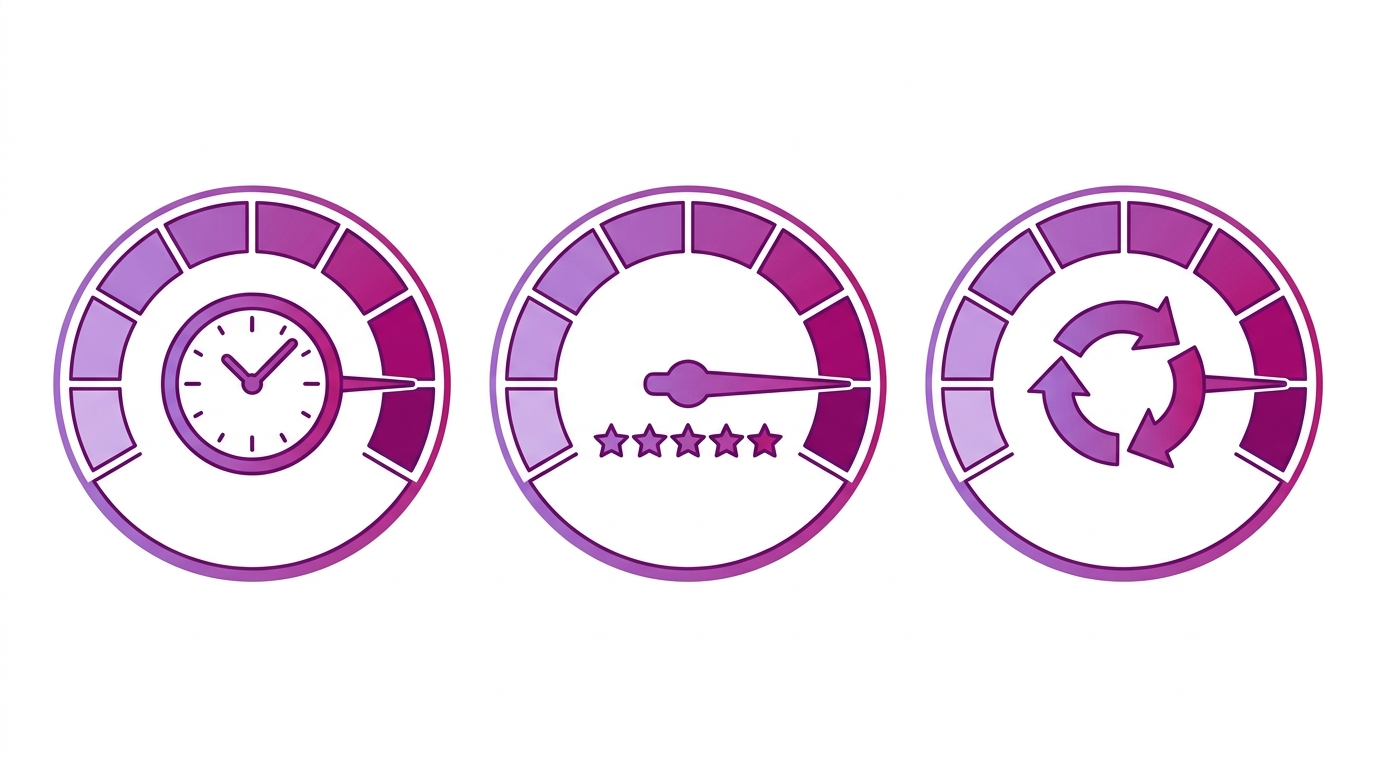
The Three Metrics That Matter
Time-to-outcome
xE2x86x92 Fastest to measure
How long it takes from idea to a live, measurable asset xE2x80x94 campaign brief to launched ad, draft to published post. AI’s clearest ROI is often speed, and speed compounds into more testing cycles per quarter.
Quality-adjusted output
xE2x86x92 The real volume check
Per-piece conversion, engagement, or ranking performance, tracked before and after AI adoption xE2x80x94 not just count of pieces produced.
Rework rate
xE2x86x92 Often overlooked
How much AI-generated work requires substantial human correction before it’s usable. A high rework rate quietly erases the time savings AI was supposed to deliver.
| Metric | What it reveals | Measurement window |
|---|---|---|
| Content/campaign volume | Activity level only | Immediate, but misleading alone |
| Time-to-outcome | Real speed gain | 1 quarter |
| Quality-adjusted output | Whether quality held | 1-2 quarters |
| Rework rate | Hidden cost of AI errors | Ongoing, weekly tracking |
| Revenue-attributed ROI | The end goal | 2-3 quarters |
Reporting time saved on the AI step alone, without netting out the time spent reviewing and correcting AI output. The honest ROI number is the net time saved, not the gross drafting-speed improvement.
Want a tool with measurable production speed gains? ROI
Connecting to Revenue
The end goal is still revenue-attributed impact xE2x80x94 did AI-assisted content or campaigns actually influence pipeline or sales. This takes longer to prove cleanly (2-3 quarters is realistic) because it requires isolating AI’s contribution from other variables. Time-to-outcome and quality-adjusted output are the faster leading indicators worth reporting in the meantime, while the revenue case builds.

Building the Reporting Habit
Track all four metrics xE2x80x94 volume, time-to-outcome, quality-adjusted output, rework rate xE2x80x94 from day one of AI adoption, even before a formal ROI report is due. Retroactively reconstructing this data is far harder than capturing it as you go, and having the full picture from the start makes the eventual ROI conversation with finance much easier to win.
Time-to-outcome and quality-adjusted output tell the real story
Track rework rate too xE2x80x94 it’s where hidden costs quietly erase the reported time savings.
Built for measurable production speed and quality
Why is content volume a misleading AI marketing ROI metric?
Volume measures activity, not outcome. Output can rise while conversion or engagement stays flat or declines.
How do you measure quality-adjusted output?
Track downstream performance per piece xE2x80x94 conversion, engagement, ranking xE2x80x94 not just count of pieces published.
What’s a realistic timeline to see measurable AI marketing ROI?
Time-to-outcome metrics can show movement within a quarter; revenue-attributed ROI usually needs two to three quarters.
Key Takeaways
- Output volume alone is a misleading ROI metric xE2x80x94 it measures activity, not business outcome.
- Time-to-outcome, quality-adjusted output, and rework rate together tell the real story.
- Rework rate is the most commonly skipped metric, and often where reported ROI gets overstated.
- Report net time saved, not gross drafting-speed improvement.
- Track all four metrics from day one xE2x80x94 retroactive reconstruction is much harder than capturing as you go.
Sources: Marketing measurement frameworks and AI adoption ROI studies, as of 2026.