
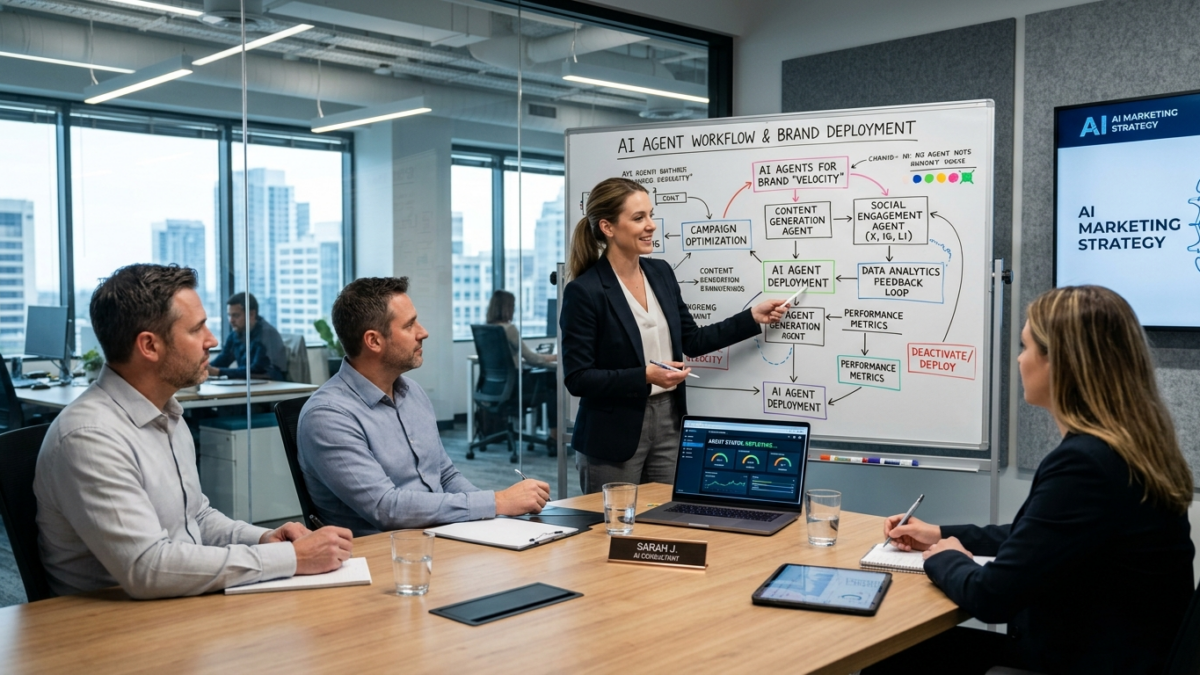
The AI marketing consulting market in 2026 has a supply problem. Demand for consultants who can actually implement AI marketing systems — who have built and run the tools, not just read about them — has grown faster than the supply of practitioners who qualify. The gap has been filled by a large number of theorist consultants: people with AI marketing certifications, polished decks, and fluent AI vocabulary who have never shipped a production marketing agent workflow in their life.
The ROI difference between a practitioner consultant and a theorist consultant is not marginal. It is categorical. A practitioner engagement ends with working systems, trained internal operators, and measurable before-and-after performance data. A theorist engagement ends with a strategic roadmap document, a recommended tech stack, and a follow-up proposal for implementation support.
This guide gives you the questions, frameworks, and rate benchmarks to identify practitioners, structure engagements correctly, and decide what to outsource versus build in-house — so you get the outcome rather than the deliverable.
AI Marketing Consulting in 2026: What You Need to Know
AI marketing consulting in 2026 ranges from $150-300/hour for freelance practitioners to $5,000-25,000/month for boutique agencies. The most important distinction is practitioner versus theorist — only practitioners who have built and run AI marketing systems deliver meaningful ROI. Before hiring any consultant, request a specific before-and-after case study with measurable outcomes. If they cannot produce one, move on. The engagement structure that works: consultant builds the systems, internal team learns to operate them, consultant exits with full knowledge transfer.
Key Takeaways
- →The practitioner versus theorist distinction matters more than any other factor in AI marketing consultant selection. Only practitioners who have built and run systems deliver ROI.
- →Ask for a before-and-after case study with measurable outcomes before engaging anyone. No concrete case study = theorist. Move on.
- →Knowledge transfer must be contractual. The engagement should end with your team operating the systems independently, not dependent on the consultant for ongoing execution.
- →Most brands under $10M revenue: consultant engagement first, build in-house after systems are proven and the role is defined.
- →The hybrid approach — consultant builds, internal hire operates — collapses the in-house learning curve from 12-18 months to 3-4 months.
Practitioner vs Theorist: The Most Important Distinction
The AI marketing consulting market split into two camps as demand grew faster than supply of proven practitioners. Understanding which camp a consultant falls into is the single most important evaluation step.
Practitioner consultants have built AI marketing systems at real brands with measurable outcomes. They can tell you exactly which workflow they built, what changed in the performance numbers, what went wrong during implementation and how they fixed it, and what the internal team was able to do after the engagement ended. Their advice comes from operational experience, not from reading industry reports and attending conferences.
Theorist consultants have studied AI marketing thoroughly. They know the tools, the frameworks, the terminology, and the strategic principles. They can produce compelling strategic frameworks and credible technology recommendations. What they cannot do is build a production AI marketing workflow, debug an n8n automation, or tell you why a specific Advantage+ campaign configuration underperformed based on actual campaign data.
AI Marketing Consulting Rates in 2026
| Type | Rate | Engagement | Best For |
|---|---|---|---|
| Freelance practitioner | $150-300/hr | Project-based | Specific system implementation |
| Boutique AI agency | $5K-25K/mo | Retainer | Ongoing AI marketing management |
| Project implementation | $10K-50K | Fixed fee | Building specific AI workflows |
| Enterprise AI consultancy | $25K-100K/mo | Long-term retainer | Full marketing AI transformation |
| In-house AI marketing hire | $80K-180K/yr | Permanent | Long-term internal capability |
Rates have increased significantly from 2024 as demand for proven practitioners has outpaced supply. The highest rates are justified for consultants with documented case studies at comparable brands. Rates that seem low for the scope promised should trigger scrutiny — they often indicate a theorist charging practitioner-adjacent rates without practitioner-level outcomes.
The 5 Questions to Ask Before Hiring Any AI Marketing Consultant
- “Can you show me a specific before-and-after case study with measurable outcomes from a brand comparable to mine?” This is the most important question. No concrete case study with numbers is the clearest signal that you are talking to a theorist.
- “Have you personally built and run the AI systems you’re recommending, or are you advising on tools you know from documentation and demos?” The distinction between tool familiarity and operational experience is enormous. A consultant who has built 10 n8n workflows thinks differently about implementation risks than one who has read n8n’s documentation.
- “Do you receive referral fees or commissions from any AI tool vendors you might recommend?” Many consultants receive undisclosed referral payments from tool vendors they recommend. This is a direct conflict of interest that should be disclosed upfront. If they deflect this question, treat it as a red flag.
- “What will my team be able to do independently when our engagement ends?” The answer should be specific: your content ops manager will be able to build and modify the content agent workflow, your growth analyst will be able to run the weekly SEO audit and interpret the outputs. If the answer is vague, the consultant is likely building dependency rather than capability.
- “What specific metric defines success at 90 days, and will you commit to it in the contract?” Practitioners agree to specific outcome metrics because their implementation experience makes them confident in delivering. Theorists resist outcome commitments because they are delivering strategy and recommendations, not implemented results.
>
Engagement Structure That Works
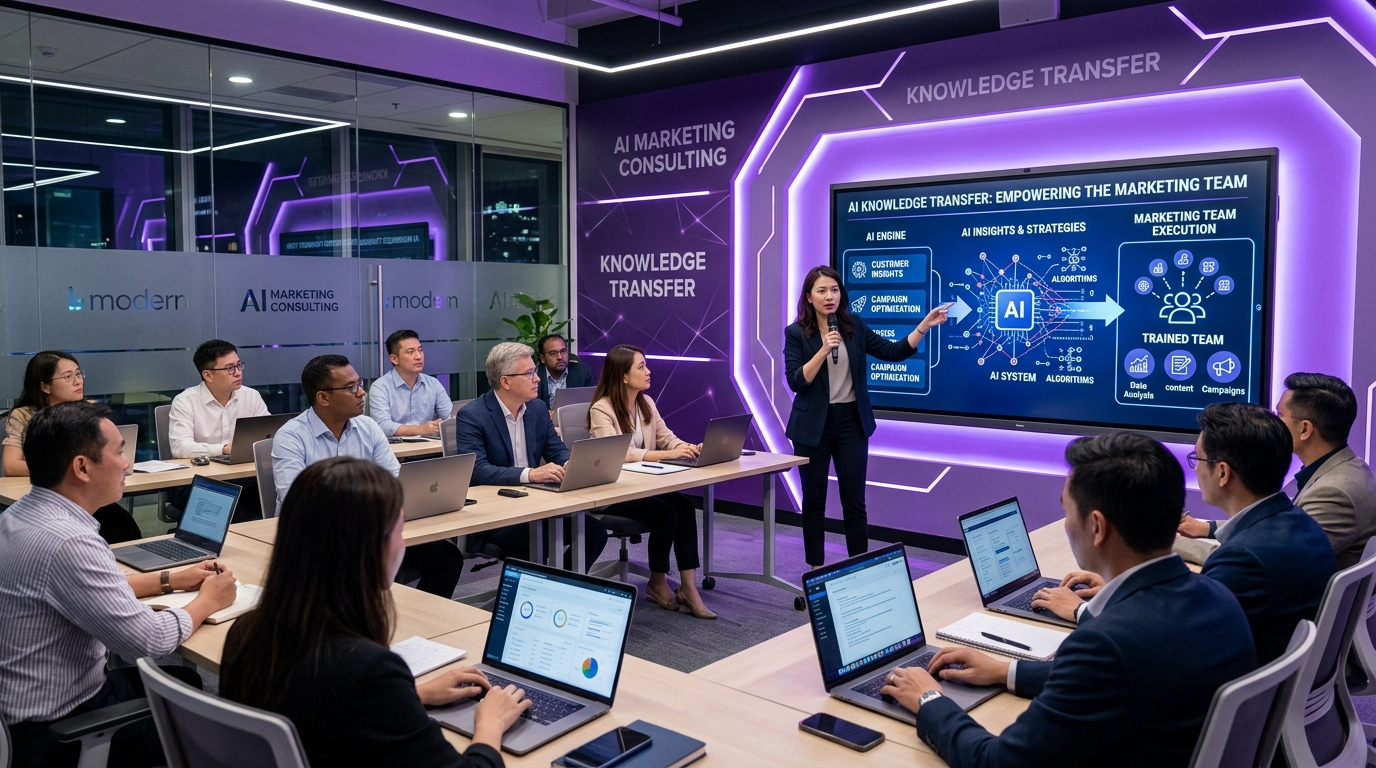
The engagement structure that produces the best outcomes combines consultant implementation with internal knowledge transfer and defines a clear exit point when the consultant’s role ends.
Phase 1 (Weeks 1-4): Audit and design. Consultant maps current marketing operations, identifies automation opportunities, designs the target AI workflow architecture. Deliverable: specific implementation plan with tool stack, workflow designs, and success metrics.
Phase 2 (Weeks 5-10): Build and deploy. Consultant builds the AI workflows, runs parallel testing against current processes, troubleshoots issues, and trains the internal team member who will operate the systems. Deliverable: working AI marketing systems with demonstrated performance improvement.
Phase 3 (Weeks 11-12): Handoff and validation. Consultant exits as internal operator takes full ownership. 30-day post-handoff check-in included. Deliverable: internal team operating independently with documented playbooks.
In-House vs Outsource: The Decision Framework
Hire a consultant if…
Speed and expertise
You need working AI systems in weeks, not months. Your team is small and a dedicated hire is not justified yet. You want proven playbooks from multiple implementations. AI marketing is a capability you need but not your core strategic differentiator. Budget under $500K marketing spend annually.
Build in-house if…
Long-term strategy
AI marketing is a core competitive differentiator for your business. You have budget for a senior hire ($120K+). You need deep integration with proprietary data and systems. You plan to scale AI marketing significantly over 2-3 years. Marketing budget over $1M annually.
Do both (hybrid) if…
Fastest path
Bring a consultant in for 3-4 months to build the initial systems while simultaneously hiring an internal AI marketing operator. The consultant builds; the internal hire watches and learns. The in-house learning curve collapses from 12-18 months to 3-4 months. Best path for brands at $1M-$10M marketing budget.
Avoid if…
Warning signs
Any consultant who cannot produce before-and-after case studies. Any engagement without explicit knowledge transfer milestones. Any consultant who recommends tools they receive undisclosed referral fees for. Any proposal where success is defined as deliverables (strategy documents) rather than outcomes (performance improvements).
Red Flags in AI Marketing Consulting Proposals
- Success defined as deliverables, not outcomes. A proposal that promises a “comprehensive AI marketing strategy document” is a theorist proposal. A practitioner proposal promises measurable performance changes with specific timelines.
- Vague knowledge transfer language. “We will empower your team with AI marketing capabilities” means nothing. “Your content ops manager will be trained to operate and modify the content agent workflow independently by week 10” means something.
- Tool recommendations without implementation experience. If a consultant recommends a specific tool stack but cannot explain what went wrong during their last implementation of those tools and how they fixed it, they have not implemented them.
- No defined exit point. Engagements without a defined endpoint create permanent dependency. The business model of many consulting firms depends on this dependency. Good practitioner consultants design their exit into the engagement from day one.
Frequently Asked Questions
What does an AI marketing consultant do in 2026?
Assesses current marketing operations, identifies automation opportunities, implements AI tools and agent workflows, trains internal teams, and measures ROI. The best consultants are practitioners who have built and run these systems at real brands — not theorists who advise without building.
How much does AI marketing consulting cost?
$150-300/hour for freelance practitioners, $5,000-25,000/month for boutique agencies, $10,000-50,000 for project-based implementations. Rates have increased significantly as demand for proven practitioners has outpaced supply. Low rates for broad scope should trigger scrutiny.
What questions should I ask before hiring an AI marketing consultant?
Five questions: (1) Show me a specific before-and-after case study with measurable outcomes. (2) Have you built and run these systems yourself or do you know them from documentation? (3) Do you receive referral fees from tool vendors? (4) What will my team be able to do independently after our engagement? (5) What specific metric defines 90-day success and will you commit to it contractually?
Should I hire a consultant or build AI marketing in-house?
Hire a consultant if you need fast implementation and AI is not your core competitive differentiator. Build in-house if AI marketing is strategic and you have senior hire budget. The hybrid approach — consultant builds while internal hire learns — collapses the in-house learning curve from 12-18 months to 3-4 months and is the best path for most mid-market brands.
How do I tell if an AI marketing consultant is a practitioner or theorist?
Ask for a specific before-and-after case study with exact numbers from a comparable brand. A practitioner gives you concrete implementation details and performance data. A theorist gives you framework presentations and strategic language without specific implemented examples. Also ask whether they have personally built the tools they recommend or know them from documentation only.
Final Verdict
- →Practitioner or theorist is the only evaluation that matters. Everything else is secondary. No case study with numbers = theorist. Move on.
- →Knowledge transfer must be contractual and specific. Vague “empowerment” language means dependency, not capability building.
- →The hybrid approach (consultant builds, internal hire operates) is the fastest path to independent AI marketing capability for most brands.
- →90-day success metrics in the contract separate practitioners from theorists in one question. Practitioners commit. Theorists deflect.
Start Building Your AI Marketing Stack
Whether you work with a consultant or build in-house, every AI marketing operation needs a video production system. VidAU makes that part straightforward.
No credit card required · From $9.99/month
AI Agents for Marketing 2026Deploy, replace, and control guide
Scale Marketing with AIThe 4-layer operator framework
Agency-Agent Shift 2026Why the retainer model is ending
Sources: AI marketing consulting market rate survey 2026 · In-house AI marketing hire salary benchmarks, LinkedIn Talent Insights 2026 · McKinsey AI marketing adoption and consulting market research 2026 · Practitioner interviews, VidAU research team 2026.
AI Agents vs Human TeamsThe decision framework for 2026AI Systems Integrator NicheMost underserved role in 2026