
Every few years, someone declares the future of advertising is here. They are usually wrong by five to ten years — the technology is real but the adoption is thin, the infrastructure is missing, or the consumer behaviour has not caught up. 2026 is different. The shifts that analysts were forecasting for 2028 and 2030 arrived on an accelerated timeline, and the brands treating them as distant future concerns are already losing ground to the brands treating them as present-day operating reality.
Three things changed advertising permanently in the last eighteen months: AI systems now generate creative at a quality and cost that makes traditional production uncompetitive for most use cases, platform AI agents now manage media buying decisions that used to require teams of specialists, and AI answer engines have replaced search result pages as the primary discovery channel for a growing proportion of consumer and B2B queries. None of these are coming. All three are here, running at scale, determining which brands are visible and which are not.
The question is not whether to respond to these shifts. It is whether you respond in 2026 while the competitive window is open, or in 2027 when your competitors have already compounded the advantage.
The Future of Advertising in 2026: Three Irreversible Shifts
The future of advertising is defined by three permanent structural changes: AI creative production replacing traditional agency and production house models, agentic media buying systems replacing manual campaign management, and AI answer engines replacing search results as the primary brand discovery channel. Brands winning in this environment have rebuilt their marketing operations around these three realities — producing more creative faster, running campaigns that optimise continuously without human intervention, and building content structured for AI citation rather than search click-through.
Key Takeaways — Future of Advertising 2026
- →The three irreversible advertising shifts — AI creative, agentic media buying, AI discovery — are not approaching. They are operating at scale right now.
- →Creative velocity is the new media buying. The brands testing the most creative variants per week consistently outperform those with the highest budgets but lowest creative volume.
- →Agentic platforms reward good inputs, not good management. The human role shifts from campaign management to creative direction and signal quality.
- →GEO is the new SEO. Being cited in AI-generated answers is the new first-page ranking. Brands not investing in this are becoming invisible to a fast-growing audience segment.
- →Traditional production is not dead, but it is no longer the primary model. AI-generated content handles the volume. Human creative handles the direction and the flagship executions.
Shift 1: AI Creative Production Has Made Traditional Production Uncompetitive
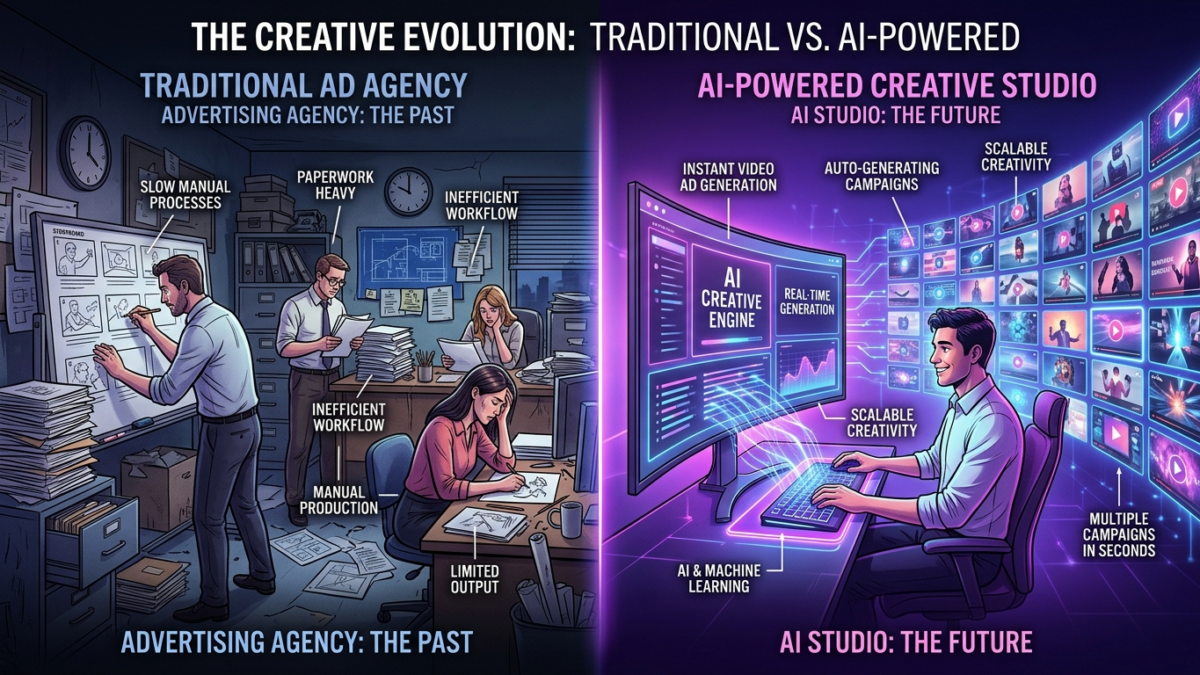
A traditional thirty-second product video ad costs between $500 and $5,000 to produce, takes five to fifteen business days, and produces one creative execution. An AI-generated video ad costs $2 to $20, takes five minutes, and can produce fifty variants in a single session. These are not comparable production models. One is built for a world where creative was scarce and expensive. The other is built for a world where creative is abundant and cheap.
The implications go beyond cost. Modern ad platforms — Meta Advantage+, TikTok Smart+, Google Performance Max — are optimisation machines that need creative volume to operate effectively. They find winning audiences by testing creative variants against different segments. A brand supplying two creative variants gives the algorithm almost nothing to work with. A brand supplying fifty variants across different hooks, formats, and messages gives the algorithm a rich signal environment and finds the winning combination in days instead of months.
This is why AI creative production is not just an efficiency improvement — it is a structural advertising advantage. More creative means better algorithm performance, which means better ROAS, which means more budget efficiency, which means faster scaling. The compounding effect of creative velocity is the defining performance advantage in 2026.
Want to produce 20+ ad creative variants per week without a production team? VidAU turns any product URL into a finished video ad in under 5 minutes.
Shift 2: Agentic Media Buying Is Replacing Campaign Management
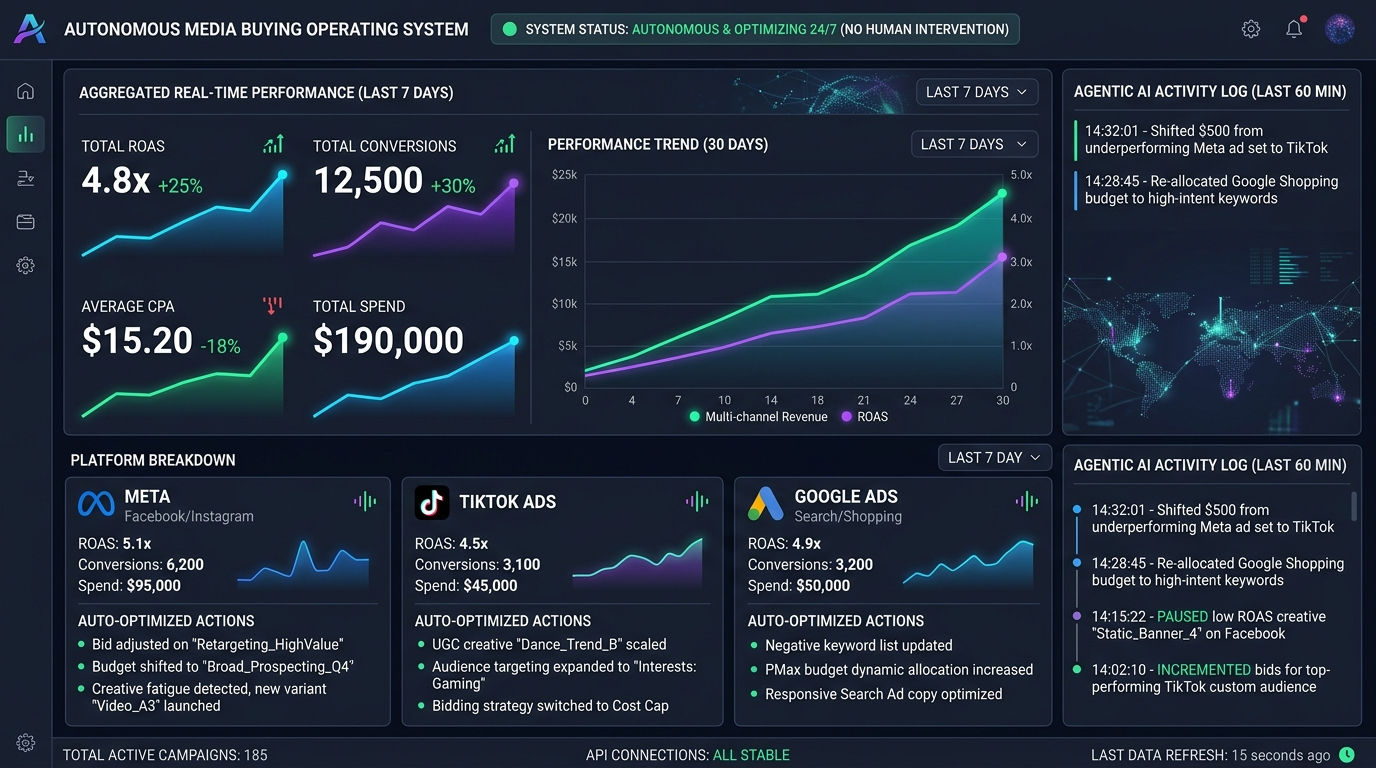
The job of the media buyer — making daily decisions about bids, budgets, audiences, and creative rotation based on performance data — is being systematically automated by platform AI systems. Meta Advantage+ Shopping Campaigns, Google Performance Max, and TikTok Smart+ are not optimisation tools that assist human decision-making. They are autonomous agents that replace human decision-making in the execution layer entirely.
These systems process signals at a scale and speed no human team can match. Meta’s auction system processes millions of variables per impression — user context, creative performance history, audience segment behaviour, time-of-day patterns, and hundreds of other signals — to determine the optimal bid and creative for each individual placement. A human media buyer reviewing a campaign once per week is working with a fraction of this information and making decisions days after the optimal moment has passed.
The brands that perform best on these platforms in 2026 are not the ones with the most sophisticated manual campaign management. They are the ones that provide the best inputs — high creative volume, accurate conversion signals, clear campaign objectives — and then let the algorithm run without constant intervention. The human role shifts from making decisions to setting conditions and supplying creative.
| Platform | Agentic System | What It Automates | What Humans Still Own |
|---|---|---|---|
| Meta | Advantage+ Shopping | Audiences, bids, placements, creative rotation | Creative production, budget, campaign objective |
| Performance Max | All inventory, bidding, audience signals | Asset quality, conversion tracking, goals | |
| TikTok | Smart+ | Targeting, bid, creative selection | Creative volume, budget, product catalogue |
| Amazon | Performance+ | Sponsored placements, audience matching | Product listing quality, pricing, reviews |
Shift 3: AI Answer Engines Are Replacing Search as the Primary Discovery Channel
For decades, the search results page was the primary moment of brand discovery for high-intent queries. A consumer searching for “best project management software” or “top running shoes for flat feet” would see a list of results, click through to sites, and begin their evaluation. Brands competed for those rankings through SEO. The click was the beginning of the relationship.
AI answer engines have fundamentally changed this dynamic. Google AI Overviews now answer over 30% of searches directly, presenting a synthesised response that cites two to four sources by name. ChatGPT handles over 100 million daily queries, the majority of which produce answers without any URL to click. Perplexity, Claude, and Gemini are embedded in enterprise workflows where brand evaluation and vendor research happen entirely within the AI interface.
In this model, the brand that gets cited in the AI answer receives the recommendation. The brand absent from the answer does not exist for that query. And unlike traditional advertising, you cannot buy your way into an AI citation — you earn it through the quality and structure of your content.
Who Is Losing Ground in 2026
- Brands relying entirely on traditional production agencies. A six-week production cycle for a thirty-second ad is incompatible with the creative velocity required to feed modern agentic ad platforms effectively.
- Brands managing campaigns manually. Teams spending significant time on bid adjustments, audience segmentation, and placement decisions are doing work that platform AI systems do better, faster, and continuously. This time is being wasted on the automatable layer instead of invested in strategy and creative direction.
- Brands optimising only for traditional search rankings. A brand with a strong SEO position but no GEO strategy is increasingly invisible to users who find answers in AI-generated responses rather than clicking through search results.
- Brands treating AI advertising as a test rather than a commitment. Running one AI-generated ad as an experiment while maintaining a primarily traditional advertising operation produces no meaningful learning and captures no compounding advantage.
What Winning Brands Look Like in 2026
Creative-first operations
Structural advantage
Winning brands have restructured their creative operations around AI production. They produce 20-50 ad variants per week, test continuously, scale winners within 72 hours, and retire underperforming creative without sentiment. Their creative output is ten times higher than traditional competitors at a fraction of the cost.
Platform-native AI adoption
Media efficiency
Winning brands use Meta Advantage+, Google Performance Max, and TikTok Smart+ at their maximum AI optimisation setting. They provide clean conversion data, high creative volume, and clear objectives, then let the platform AI make execution decisions. Their media efficiency compounds because the algorithm has richer signals to work with.
GEO-first content strategy
Discovery visibility
Winning brands structure all content for AI citation: FAQ sections, speakable schema, direct answer paragraphs, and third-party citation building. They appear in AI-generated answers for category queries because they built content specifically optimised for AI engine extraction, not just keyword ranking.
Unified performance measurement
Decision clarity
Winning brands measure AI share of voice alongside traditional metrics. They know their citation rate in ChatGPT, Google AI Overviews, and Perplexity for their core category queries. This gives them visibility into the discovery layer that traditional analytics tools completely miss.
The Action Framework: What to Do in the Next 90 Days
- Audit your creative production speed. How long does it currently take to go from brief to live ad? If the answer is more than one week, you are operating on a timeline incompatible with modern ad platform requirements. Identify where AI production can collapse this to hours.
- Set up AI creative production infrastructure. Choose your primary AI video tool (VidAU for product ads, HeyGen for spokesperson content) and build a repeatable weekly production workflow. Target 10-20 variants per active campaign per week within 30 days.
- Activate platform-native agentic optimisation. Switch at least one campaign on each major platform to its highest AI optimisation mode. Provide clean conversion data and adequate creative. Measure performance versus manually managed campaigns over 60 days.
- Run an AI share of voice audit. Take 50 queries representative of your category and run them through Google AI Overviews, ChatGPT, and Perplexity. Record how often your brand is cited versus competitors. This baseline measurement makes the GEO opportunity concrete rather than theoretical.
- Restructure at least 5 core content pages for GEO. Add FAQ sections, speakable schema, and direct-answer paragraphs to your highest-traffic content. Measure the change in AI citation rate over 60-90 days.
Frequently Asked Questions
What is the future of advertising in 2026?
Three irreversible shifts define it: AI creative production replacing traditional agency models, agentic media buying systems replacing manual campaign management, and AI answer engines replacing search results as the primary brand discovery channel. These are not approaching changes — all three are operating at scale right now and determining competitive outcomes today.
How is AI changing advertising in 2026?
AI is changing advertising at three layers simultaneously: creative (AI tools generate ads at a fraction of traditional cost and time), media buying (platform AI agents like Meta Advantage+ and Google Performance Max optimise campaigns autonomously 24/7), and discovery (AI answer engines like ChatGPT and Google AI Overviews are replacing search result pages as the primary first touchpoint for brand discovery).
What is agentic advertising?
Agentic advertising refers to AI systems that manage advertising campaigns autonomously — making real-time decisions about bidding, audiences, and creative selection without requiring human approval. Meta Advantage+, Google Performance Max, and TikTok Smart+ are the most widely deployed agentic advertising systems in 2026, running continuously and processing signals at a scale no human team can match.
Is traditional advertising dead?
Not dead but radically restructured. The execution tasks that AI does better — campaign optimisation, creative variant testing, audience segmentation — are being automated. The judgment tasks — brand strategy, creative direction, cultural insight — remain human. Brands losing ground are those still allocating human time to automatable execution rather than to higher-value judgment work.
What is creative velocity and why does it matter?
Creative velocity is how fast a brand can produce and test advertising creative variants. It matters because modern agentic ad platforms find winning creative faster when given more variants to test. A brand testing 20 variants per week finds its winner in days. A brand testing 2 variants per week takes months. AI production is the unlock — it removes the cost and time barriers that limited creative testing volume.
Final Verdict — Future of Advertising 2026
- →The future arrived early. The brands treating 2026 advertising shifts as future concerns are already behind competitors treating them as present operating reality.
- →Creative velocity is the primary competitive differentiator — not budget, not targeting sophistication, not brand equity. Volume of testable creative wins.
- →Agentic platforms reward inputs, not management. Shift human time from campaign execution to creative production and strategy.
- →GEO is not optional. Brands invisible in AI-generated answers are invisible to a growing proportion of their potential audience. This gap compounds.
Build the Creative Velocity That Modern Advertising Requires
VidAU produces product video ads from any URL in under 5 minutes. Test 20 hooks per week. Find winners fast. Scale before competitors catch up.
No credit card required · From $9.99/month
What is GEO? 2026 GuideGenerative engine optimisation
Agency-Agent Shift 2026Why the retainer model is ending
Ecommerce Video Ads 2026Creative velocity guide
Sources: Meta Advantage+ performance documentation 2026 · Google Performance Max AI optimisation documentation 2026 · TikTok Smart+ launch documentation 2026 · Google Search AI Overview coverage data 2026 · ChatGPT usage statistics, OpenAI 2026.