Ads of Real Estate: The Complete Digital Advertising Guide for Agents & Brokerages in 2026
Every platform, format, ROI metric, and AI video strategy real estate professionals need to run ads that actually generate leads and close listings in 2026.
Create Your First Listing Video Free →No credit card required · Free tier available
The real estate advertising landscape has undergone a fundamental transformation over the past five years. What once meant a yard sign, a newspaper column, and a Zillow listing now demands a full-stack digital presence — Facebook video campaigns, Instagram Reels, Google search ads, YouTube pre-rolls, and increasingly, AI-generated listing videos published across multiple platforms within hours of a property going live. The agents and brokerages winning listings in 2026 are not those with the biggest budgets, but those who understand which ad formats work, which platforms deliver the highest-quality leads, how to measure return on investment accurately, and how to produce professional video content consistently without spending thousands per listing on traditional production.
In this complete guide, you’ll get a platform-by-platform breakdown of digital real estate ad platforms, a practical framework for measuring ROI and campaign effectiveness, a walkthrough of the ad formats that convert best in 2026, and a detailed look at how VidAU’s AI video tools help agents and creators produce listing video ads at scale — in minutes, not days.

Why Digital Ads Are Now Non-Negotiable for Real Estate
The data on how buyers find properties has shifted decisively. According to the National Association of Realtors, more than 97% of home buyers use the internet during their search — and the majority begin that search on a mobile device. Meanwhile, the average buyer consumes multiple pieces of video content about a property before ever requesting a showing. This behavioral shift means that real estate ads that live only on portal listings and static print materials are reaching a steadily shrinking fraction of the available buyer pool.
Digital advertising fills that gap by meeting buyers where they actually spend their time: scrolling through Instagram, watching YouTube, searching on Google, and engaging with content on Facebook. Critically, digital real estate ads offer something print never could — precise audience targeting. Rather than advertising to everyone in a ZIP code, an agent can now target buyers within a specific income bracket, recently searched for homes in a target neighborhood, who are homeowners likely to upsize, or who have recently moved to a metro area. That specificity is what makes digital real estate advertising so powerful when executed correctly.
The Major Platforms for Real Estate Ads — And When to Use Each
Not all platforms are created equal for real estate advertising. The right channel depends on your listing type, your target buyer profile, your budget, and whether you’re optimizing for brand awareness, lead generation, or direct inquiry. Here’s a practical breakdown of each major platform and its strategic fit for real estate advertising:
| Platform | Best Ad Format | Primary Strength | Best For |
|---|---|---|---|
| Video ads, Lead Gen forms, Carousel | Unmatched audience targeting depth | Buyer lead generation, retargeting | |
| Reels, Stories, Carousel | Visual appeal, younger buyer reach | Lifestyle properties, luxury listings | |
| Google Search | Text ads, Responsive Search | High buyer intent at moment of search | Capturing active property searchers |
| YouTube | In-stream video, Bumper ads | Long-form property showcase | High-value listings, market reports |
| TikTok | Short-form video, Spark Ads | Viral reach, first-time buyer audience | Starter homes, investor education |
| Video Pins, Idea Pins | Home inspiration browsing behavior | Home staging, interior design appeal | |
| Sponsored Content, InMail | Professional and investor audience | Commercial real estate, investment properties |
For most residential agents, Facebook and Instagram represent the highest-priority investment — they offer the deepest targeting options, the lowest cost per lead relative to other channels, and the formats (video, carousel, lead generation forms) that match how buyers engage with property content. Google Search ads are essential for capturing buyers with active purchase intent who are searching terms like “homes for sale in [city]” or “3-bedroom houses near [neighborhood].” YouTube becomes increasingly important for higher-value listings where a 60-second video walkthrough meaningfully influences the decision to book a showing.
The Ad Formats That Convert Best for Real Estate in 2026
Within each platform, the format you choose is as important as the targeting. The real estate industry has learned — through years of A/B testing — which creative formats drive the most inquiries per dollar spent. Here are the formats that consistently outperform across real estate digital ads:
Video Listing Ads
Video is the undisputed highest-performing format for real estate ads across every major platform. A well-produced 30–60 second listing video — showing the property’s exterior, key interior spaces, and neighborhood context — generates dramatically more engagement and inquiries than static photography ads of the same property. The reason is spatial: video communicates the flow, size, and feel of a property in a way that still images fundamentally cannot. Buyers who watch a full video tour are significantly more likely to be qualified leads when they request a showing, because they’ve already made an emotional connection with the space.
Carousel Property Ads
Carousel ads — where a buyer can swipe through multiple images of a property in a single ad unit — are the second most effective format for residential listings on Facebook and Instagram. They allow you to take the viewer on a structured journey through the home: exterior first, living spaces second, kitchen and primary bedroom third, outdoor areas last. Each card can carry a different caption highlighting a specific feature. Carousel ads have a lower cost per click than video in many markets and work well for properties where you have strong photography but haven’t yet produced a video.
Facebook Lead Generation Ads
For agents whose primary goal is capturing buyer contact information rather than driving traffic to a listing page, Facebook Lead Gen ads are exceptionally effective. These ads open a pre-filled contact form within the Facebook app — meaning the buyer never has to leave their feed — and submit their name, email, and phone number with one tap. The friction reduction compared to sending someone to a landing page dramatically increases form completion rates. Lead Gen ads work best for high-demand properties, open house announcements, and buyer guide offers.
Google Responsive Search Ads
For capturing buyers at the exact moment of active property searching, Google Responsive Search Ads are essential. Unlike social ads that interrupt scrolling behavior, search ads appear precisely when a potential buyer types “homes for sale in [city]” — meaning the intent to purchase is already established. These ads are text-based and compete on keyword relevance, ad quality score, and bid — making them more technically demanding to optimize but extraordinarily valuable when done well.
Instagram and TikTok Reels
Short-form vertical video on Instagram Reels and TikTok has become one of the fastest-growing formats for real estate marketing content. The algorithmic distribution on both platforms means that a compelling listing Reel can reach far beyond your existing follower base at zero additional ad spend — effectively giving you organic reach on top of any paid promotion. The most effective real estate Reels are 15–30 seconds, lead with the most visually striking element of the property (a view, a kitchen, a pool), and include captions for silent viewing.
How to Measure the ROI of Real Estate Online Ads
One of the most common questions agents and brokerages ask when evaluating their digital marketing investment is: how do I know if my ads are actually working? Measuring the ROI of real estate online ads is more nuanced than most industries because the sales cycle is long, deals are high-value but infrequent, and attribution — connecting a specific ad click to a closed transaction months later — requires deliberate tracking infrastructure. Here is a practical framework:
Cost Per Lead (CPL)
Total ad spend divided by the number of qualified leads generated. For Facebook real estate campaigns, a CPL of $15–$50 is typical in competitive markets. Track this per campaign and per ad format to identify your most efficient lead sources.
Lead-to-Showing Rate
The percentage of leads who schedule an in-person or virtual showing. A well-targeted campaign should convert 10–20% of leads to showings. Low conversion here indicates a targeting or creative quality problem, not a volume problem.
Showing-to-Offer Rate
The percentage of showings that result in an offer. This metric separates casual browsers from serious buyers and helps you evaluate whether your ads are reaching the right audience, not just generating clicks.
Cost Per Transaction
Total ad spend divided by the number of closed transactions attributed to digital ads. This is the ultimate ROI metric — compare it to your average commission to determine net profitability per ad dollar spent.
Return on Ad Spend (ROAS)
Commission revenue generated divided by total ad spend. A ROAS of 5× or higher — meaning $5 in commission for every $1 spent on ads — is generally considered strong for residential real estate. Luxury markets can achieve 20× or higher.
Video View-Through Rate
The percentage of viewers who watch at least 75% of your listing video. A high view-through rate (above 25%) indicates the property and creative quality are resonating — and these viewers are your highest-intent audience for retargeting.
The biggest mistake agents make with real estate ad ROI tracking is not setting it up before campaigns launch. Install the Facebook Pixel on your website or landing pages from day one, connect your Google Analytics 4 account with conversion goals defined, and use a CRM that allows you to tag leads by source (Facebook ad, Google ad, Instagram, etc.). Without this infrastructure, you’re flying blind on which ad dollars are actually generating income — and which are being wasted.

How Real Estate Agencies Measure the Effectiveness of Digital Ads
Individual agents and large brokerages approach ad effectiveness measurement differently, but the most successful real estate agencies use a consistent set of KPIs that span both the campaign level and the business level. Understanding these metrics — and how they connect to each other — is what separates agencies that scale their digital marketing intelligently from those that spend without clarity.
Campaign-Level Metrics (What Platforms Report)
At the campaign level, agencies monitor impressions (total ad views), reach (unique users who saw the ad), click-through rate (CTR — the percentage of viewers who clicked), cost per click (CPC), cost per lead (CPL), and video completion rate. These metrics tell you how well your creative and targeting are performing within each platform’s ecosystem. A high impression count with low CTR indicates a targeting or creative problem. A high CTR with low lead conversion indicates a landing page or offer problem.
Business-Level Metrics (What Actually Matters)
Smart agencies go beyond platform dashboards and connect ad performance to actual business outcomes. The metrics that matter at the business level are: leads generated per listing, qualified appointments booked per campaign, listings won as a result of demonstrating strong marketing capabilities to sellers, days on market for listings promoted with digital ads versus those without, and ultimately, commission revenue attributable to paid digital channels.
Attribution Modeling for Long Sales Cycles
Real estate’s long sales cycle — typically 30 to 90+ days from first contact to closing — makes attribution challenging. Most ad platforms use last-click attribution by default, which credits the final touchpoint (often a Google search ad) and ignores the Instagram video ad that first introduced the buyer to the property weeks earlier. Agencies that invest in multi-touch attribution modeling get a much clearer picture of which channels are genuinely contributing to transactions versus which are simply present at the final step. Tools like Google Analytics 4 with data-driven attribution and CRMs like Follow Up Boss or Lofty can help build a more accurate attribution picture.
Top-performing real estate agencies conduct a structured monthly review of their digital ad effectiveness using this sequence: (1) Review CPL by platform and campaign type — which channel generated leads most efficiently? (2) Review lead-to-appointment conversion — are the leads actually booking showings? (3) Review appointment-to-offer conversion — are showings from digital leads resulting in offers? (4) Calculate ROAS for the month — total commission from digitally-sourced transactions divided by total ad spend. (5) Adjust budget allocation toward the channels delivering the strongest ROAS and pause underperformers.

How to Use VidAU to Create and Scale Real Estate Video Ads
The single biggest constraint on digital advertising performance for most real estate agents and brokerages is not budget — it’s creative production. Running effective video ads across Facebook, Instagram, YouTube, and TikTok simultaneously requires a constant supply of polished video content. Traditionally, producing a single professional listing video costs $300–$1,500 and takes 3–7 days from filming to delivery. For an agent managing multiple listings, that timeline and cost structure makes consistent video advertising practically impossible.
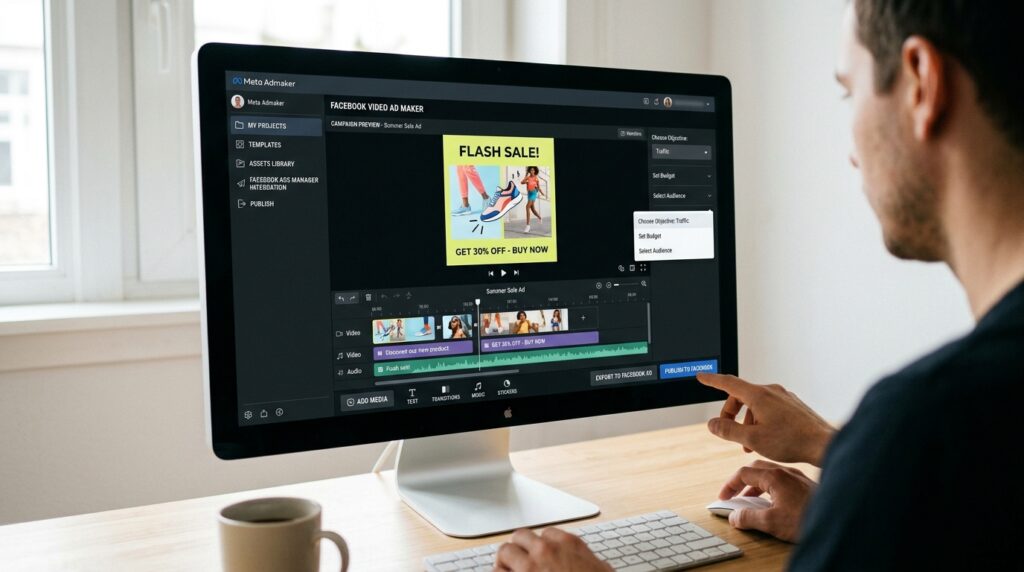
VidAU’s AI video platform eliminates that bottleneck entirely. Rather than hiring a videographer for every listing, you paste a property URL or upload listing photos, and VidAU’s AI generates a professionally composed video ad — complete with transitions, captions, voiceover, and branding — in minutes. For real estate professionals, this changes the economics of video advertising fundamentally: every listing, regardless of price point, can have a professional video ad from day one on market.
URL to Video Ads
Paste any MLS listing URL or property page link and VidAU automatically pulls the listing photos, property details, and description — then generates a polished 30–60 second video ad ready for Facebook, Instagram, or YouTube. No filming, no editing, no waiting. Try URL to Video.
Product Sample to Video
Upload your own listing photography directly and VidAU converts the still images into a dynamic video with cinematic transitions, animated overlays, and professional pacing. Perfect for agents who have professional photos but no video footage. See Product Sample to Video.
UGC Avatars
Create authentic-looking spokesperson-style listing videos featuring AI avatars that walk through the property’s key features, present the asking price, and deliver a call-to-action — without ever pointing a camera at yourself. Ideal for agents who want consistent on-brand video at scale. Explore UGC Avatars.
VidRemix
Take your best-performing listing video and instantly reformat it for every platform — convert a landscape YouTube video into a vertical Instagram Reel and a square Facebook ad without re-editing. Maximize reach from every video you produce. Try VidRemix.
Video Enhancer
Upscale listing video footage — even shot on a smartphone — to professional quality before publishing. Ideal for agents recording quick walkthroughs on their phone who want a polished result without expensive equipment. Use the Video Enhancer.
Image to Video
Transform static listing photos into animated video clips with smooth camera movements, depth effects, and transitions that make properties feel alive and immersive — even without any actual video footage. Explore Image to Video.
Practical Workflow: From Listing URL to Published Facebook Ad in Under 10 Minutes
Here is the exact workflow an agent or property marketing team can use with VidAU to go from a new listing to a live Facebook video ad in a single session. First, copy the MLS listing URL or the property page URL from your brokerage website. Second, paste it into VidAU’s URL to Video Ads tool — VidAU pulls the listing photos, property address, bed/bath count, square footage, and description automatically. Third, select your preferred video template, choose an AI voiceover style, and add your brokerage logo and contact CTA. Fourth, export in the formats you need — landscape for YouTube, vertical for Instagram Reels and TikTok, square for Facebook feed. Fifth, upload directly to Facebook Ads Manager with your targeted audience settings and a budget as low as $5/day to start generating buyer leads immediately.
This workflow replaces a process that previously required scheduling a videographer, waiting for editing delivery, and spending $500+ per listing — with a 10-minute workflow that costs a fraction of that, repeatable for every listing in your portfolio.
How Real Estate Creators and Influencers Can Use VidAU to Promote Listings
The intersection of real estate content creation and affiliate/influencer marketing has grown significantly. Real estate creators — agents who build audiences on TikTok and Instagram, neighborhood lifestyle creators, property investment educators, and home décor influencers — are increasingly partnering with brokerages and developers to promote listings and services to their engaged audiences. VidAU is purpose-built for this use case, enabling creators to produce professional listing video content at a pace and scale that manual production can’t match.
Promoting Listings as a Real Estate Creator
Creators with a real estate or lifestyle audience can use VidAU’s URL to Video Ads feature to produce listing showcase videos for brokerage partners quickly. Rather than spending a half-day filming and editing a property walkthrough video for a partner agent, a creator can paste the listing URL into VidAU, generate a polished 30-second showcase in minutes, add their branded intro and call-to-action, and publish across their TikTok, Instagram, and YouTube channels — with an inquiry link or affiliate tracking link in the bio. This enables creators to take on more brokerage partnerships simultaneously without production becoming a bottleneck.
Neighborhood and Market Update Content at Scale
Real estate creators who build audiences around local market expertise — “what’s happening in [neighborhood],” “is now a good time to buy in [city]?” — can use VidAU’s Product Sample to Video and UGC Avatars features to produce regular market update videos without filming themselves every time. An AI avatar can deliver a weekly market conditions update, interest rate commentary, or new listing roundup — maintaining audience engagement with consistent content output even during busy market periods.
Promoting Real Estate Services to Wider Audiences
Lifestyle and home décor creators — who may not be licensed agents but have audiences of aspiring homeowners, interior design enthusiasts, or property investors — can partner with real estate brands and use VidAU to produce sponsored content at scale. The VidRemix feature makes it easy to repurpose a single piece of brand-sponsored content into multiple formats optimized for each platform, maximizing the creator’s deliverables per partnership without additional production time. For more strategies on building real estate content that converts, explore VidAU’s TikTok content guides and YouTube content strategies.
Creators promoting real estate listings, developments, or agent services in exchange for compensation — whether cash, commission, or reciprocal promotion — are required under FTC guidelines to clearly disclose the material relationship in every piece of content. A simple “paid partnership,” “sponsored,” or “I earn a commission if you inquire through my link” disclosure in the caption or at the start of the video is sufficient. This applies regardless of how organic the content looks or feels.
Real Estate Ad Content Strategy: What to Create and When
Having the right tools is one thing — knowing what to create and when is what separates agents who build consistent lead pipelines from those who post sporadically and wonder why their ads don’t convert. Here is a practical content calendar framework for real estate ad campaigns:
New Listing Launch (Day 1–3 on Market)
The moment a listing goes active is the highest-urgency content moment. Launch a Facebook and Instagram video ad within 24 hours of going live — using VidAU’s URL to Video tool to produce it from the listing URL immediately after MLS upload. Simultaneously publish an organic Reel or TikTok of the listing to capture algorithmic reach at no cost. The first 72 hours on market generate disproportionate buyer attention, and video ads ensure you capture that window fully.
Open House Announcement (3–5 Days Before)
Run a Facebook Lead Gen ad promoting the open house 3–5 days in advance, targeting buyers in a 20–30 mile radius who have shown interest in similar properties. Include the date, time, and a compelling visual of the property’s most photogenic feature. Collect RSVPs through the lead form to build your prospect list even before the open house occurs.
Price Reduction Announcement
A price reduction is a marketing event, not a disappointment — treat it as one. Launch a retargeting video ad to everyone who engaged with your original listing ad (viewed the video, clicked the link, or visited the listing page) announcing the new price. These are already-warm prospects who showed initial interest; the price change may be the nudge they needed.
Market Update Content (Weekly or Biweekly)
Beyond individual listings, the agents who build lasting digital audiences publish consistent market education content — interest rate updates, inventory reports, neighborhood spotlights, buyer/seller tips. This content builds brand authority, grows organic following, and keeps your audience engaged between listing campaigns. Use VidAU’s UGC Avatars to produce this content consistently without filming yourself every time.
Frequently Asked Questions About Real Estate Ads
How do you measure the ROI of real estate online ads?
Measuring the ROI of real estate online ads requires tracking the full funnel — not just clicks and impressions. The key metrics are: Cost Per Lead (total ad spend ÷ leads generated), Lead-to-Showing Rate (what percentage of leads book a showing), Showing-to-Offer Rate (what percentage of showings result in offers), and ultimately Return on Ad Spend (ROAS — commission revenue from ads-sourced deals ÷ total ad spend). To track this accurately, install the Facebook Pixel on your website, set conversion goals in Google Analytics 4, and use a CRM that tags every lead by source so you can trace each transaction back to the originating ad campaign. A ROAS of 5× or higher — $5 in commission for every $1 spent on ads — is generally considered strong for residential real estate.
How do real estate agencies measure the effectiveness of digital ads?
Effective real estate agencies measure digital ad effectiveness at two levels simultaneously. At the campaign level, they track CTR (click-through rate), CPL (cost per lead), video view-through rate, and cost per qualified appointment. At the business level, they track leads generated per listing, days on market for digitally-promoted listings versus non-promoted listings, listings won as a result of demonstrating digital marketing capabilities to sellers, and commission revenue attributable to digital ad channels. The most sophisticated agencies also use multi-touch attribution modeling — rather than last-click — to understand which platforms are genuinely influencing buyer decisions across the 30–90 day sales cycle, not just which ad received the final click before conversion.
What is the best platform for real estate ads in 2026?
For most residential agents, Facebook and Instagram offer the best combination of targeting precision, ad format variety, and cost per lead — making them the highest-priority platforms for real estate advertising. Google Search ads are essential for capturing buyers at the moment of active property searching. YouTube is increasingly important for high-value listings where video walkthroughs influence showing decisions. TikTok is growing rapidly for reaching first-time buyers and investment-curious younger audiences. The optimal strategy for most agents is a multi-platform approach with the majority of budget on Meta (Facebook/Instagram) and a secondary allocation to Google Search.
How much should a real estate agent spend on digital advertising?
There is no universal answer, but a practical starting framework is to allocate 10–15% of your expected commission income from a listing toward digital advertising for that listing. For a $500,000 property at 2.5% buyer’s agent commission ($12,500), a $1,000–$1,500 digital ad budget is defensible if the campaign generates a qualified buyer. For agents just starting with digital advertising, beginning with $5–$10/day on Facebook targeting a local geographic audience is a low-risk way to learn platform mechanics before scaling up.
Do video ads really outperform static image ads for real estate?
Yes, consistently and significantly. Properties promoted with video ads generate up to 4× more engagement than those promoted with static images on Facebook and Instagram. More importantly, the quality of the lead differs — buyers who watch a full property video before clicking through are more informed, more emotionally engaged, and more likely to schedule a showing than buyers who only saw a photo. The challenge has historically been production cost and time. AI video tools like VidAU eliminate that barrier by making professional real estate video production accessible for every listing regardless of price point.
What makes a high-converting real estate video ad?
The highest-converting real estate video ads share five characteristics: they open with the property’s most visually striking feature within the first 3 seconds (before the viewer scrolls past); they are 30–60 seconds long — long enough to showcase the property, short enough to hold attention; they include captions since most social media video is watched without sound; they end with a clear, specific call to action (book a showing, request the full virtual tour, call for pricing); and they are tailored to a specific buyer persona in both the visual content and the ad copy targeting. VidAU’s templates are structured around these proven conversion principles.
How can AI video tools help real estate agents run better ads?
AI video tools like VidAU solve the single biggest production bottleneck in real estate digital advertising: the time and cost of creating professional video content for every listing. By pasting a listing URL into VidAU’s URL to Video Ads tool, an agent can generate a publish-ready video ad in minutes — eliminating the $300–$1,500 videographer cost and the 3–7 day production delay. This means every listing, regardless of price point, can have a professional video ad live within hours of hitting the market — dramatically improving first-week visibility during the period when buyer interest is highest.
What is retargeting and why does it matter for real estate ads?
Retargeting is the practice of showing ads specifically to people who have already interacted with your content — visited your listing page, watched your video ad past 50%, or clicked an earlier ad — but didn’t inquire. In real estate, where buyers research for weeks before committing, retargeting is one of the highest-ROI ad strategies available. A buyer who watched 75% of your listing video is a warm prospect; showing them a follow-up ad with a new angle (a price reduction, an open house invitation, or a neighborhood highlight) costs a fraction of a cold-audience impression and converts at dramatically higher rates.
Conclusion — Building a Real Estate Ad Strategy That Compounds
The real estate ad landscape in 2026 rewards consistency, measurement discipline, and creative quality above all else. Agents who commit to running video ads on every listing from day one — measuring their CPL, ROAS, and business-level attribution rigorously — and who continuously optimize based on what the data tells them, build advertising systems that compound in effectiveness over time. Each campaign teaches you more about your market’s buyer behavior. Each video ad that performs well gives you creative intelligence to apply to the next one. Each retargeting audience grows larger and more valuable.
The biggest practical barrier to this kind of consistent, data-driven advertising has always been video production capacity. An agent who can only afford to produce a professional video for their highest-value listings is running a fraction of the ads they could be running. VidAU removes that constraint — making it economically viable to produce professional video ads for every listing, every campaign, and every content type in your marketing calendar.
Start with VidAU’s URL to Video Ads for your next listing, add Product Sample to Video for photo-to-video conversion, use UGC Avatars for market update content, and VidRemix to maximize reach across every platform. Check VidAU’s pricing plans to find the right tier for your listing volume — and start building the real estate advertising system that compounds.