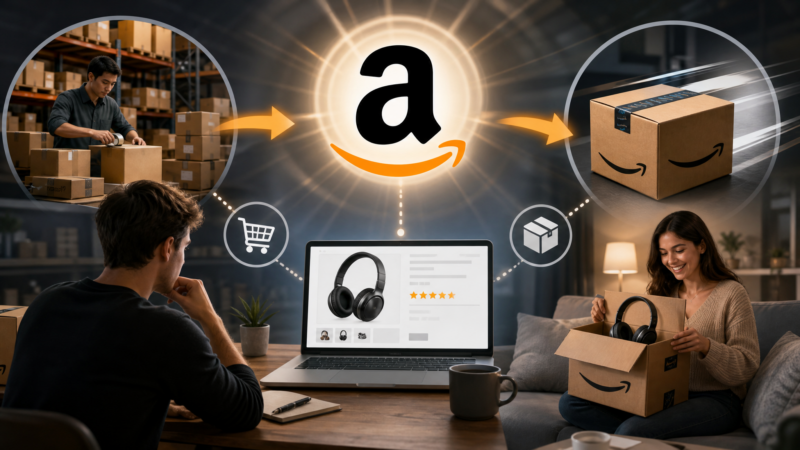


AI agents in ecommerce are no longer theoretical — ChatGPT Instant Checkout launched in September 2025, Google UCP is live, and McKinsey projects $3–5T in commerce redirected by 2030. This guide covers what every ecommerce business must understand and do now.
ChatGPT’s Instant Checkout launched in September 2025. A user asks for a recommendation on running shoes. The agent browses product feeds, compares structured data from multiple merchants, evaluates shipping times and return policies, and completes the purchase. The customer never visits any retailer’s website.
If your product data is not structured correctly, your prices are buried in marketing copy, or your catalog is not integrated with agentic commerce protocols, the agent never considers you. You are not ranked lower. You do not exist.
This is the most significant shift in ecommerce since Google made search the primary discovery channel. And unlike Google’s arrival, this one is happening with 18 months of public data already documenting the transition. For context on how this changes the advertising and content side of ecommerce, see our Facebook Ad Best Practices 2026 guide.
What Are AI Agents in Ecommerce?
What Are AI Agents in Ecommerce?
AI agents in ecommerce are autonomous software systems — deployed on platforms like ChatGPT, Google Gemini, and Microsoft Copilot — that can search products, compare prices and shipping terms, and complete purchases on behalf of users without the user visiting a retailer’s website. They communicate via open protocols including ACP (OpenAI), UCP (Google), and MCP (Anthropic). Merchants without structured data and protocol integration are effectively invisible to these systems.
📋 How AI Agents Are Changing Ecommerce (Quick Summary)
- AI shopping agents now complete real purchases without users visiting websites — live on ChatGPT, Google Gemini, and Microsoft Copilot
- AI-referred traffic to ecommerce sites grew 805% in 2025; eMarketer projects $20.9B in AI-platform retail spend in 2026
- Products recommended by AI agents convert at 4.4× the rate of traditional search (McKinsey)
- 75% of retailers say AI agents will be essential to compete within one year (Salesforce, March 2025)
- Merchants without Schema.org markup, structured product data, and protocol integration are largely invisible to agent decision-making
- The agentic era compresses the traditional awareness → consideration → decision funnel into a single AI interaction
- Early adopters compound advantages: AI recommendation systems are being trained and conditioned now, not later
- Morgan Stanley estimates AI shopping agents could represent $190–$385B in US ecommerce spending by 2030
The Shift to the Agentic Web: What Is Actually Happening in 2026
The agentic web refers to an internet layer where autonomous AI systems act on behalf of users — finding products, negotiating terms, completing transactions — without human-directed browsing. In commerce, this means the customer relationship is increasingly mediated not through your website, but through an AI that decides whether to include your products at all.
What makes 2026 the inflection point is the convergence of three forces: open commerce protocols (ACP, UCP, MCP) that standardize how agents transact, consumer readiness (a third of US adults already replace Google searches with AI for product research), and maturing LLM capabilities that understand preferences, constraints, and context rather than just keywords.
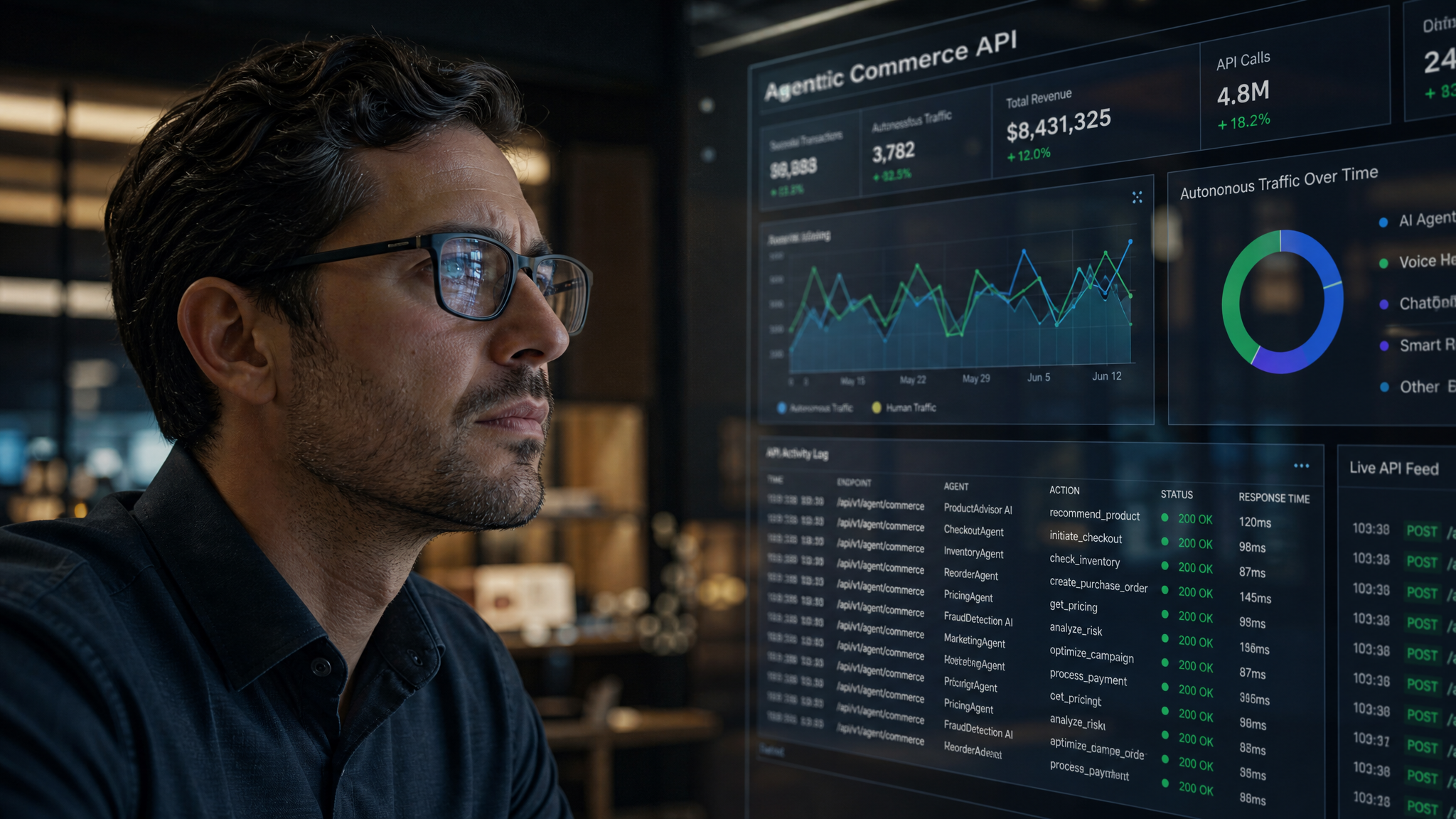
ChatGPT Instant Checkout has been live since September 2025 with Etsy and Shopify merchants. Microsoft Copilot Checkout launched in January 2026 with Shopify, PayPal, and Stripe. Google’s Business Agent via UCP is live. AI agents are not coming. They are already transacting.
The Three Eras of Online Discovery
To understand what AI agents require from merchants, it helps to understand how discovery has evolved — and what changed for businesses at each transition.
Desktop & SEO
Search engines index pages. Businesses compete for keyword rankings. Success requires well-structured HTML, title tags, and inbound links. The website is the destination.
Mobile & UX
Mobile traffic overtakes desktop. Apps and social platforms create new discovery surfaces. UX, page speed, and social proof become competitive levers. The website experience drives conversion.
Agentic & Machine-Readable
AI agents make purchasing decisions autonomously. Structured data, protocol compliance, and machine-readable content determine visibility. The website is no longer the primary purchase path.
Each era shift changed the rules of competition without warning. Businesses that adapted early to search engines in the 1990s built organic traffic advantages that compounded for decades. Businesses that moved to mobile-first design early captured markets that desktop-first competitors scrambled to recover. The agentic era is the same shift — larger in scope, faster in execution.
The Death of the Traditional Customer Journey
The traditional ecommerce funnel has five stages: awareness, consideration, intent, purchase, and loyalty. Each stage requires content and touchpoints designed to move a human buyer from discovery to decision across multiple sessions and platforms.
AI agents collapse this into a single interaction. A user says: “I need a lightweight running shoe under $120 with free returns, delivered by Thursday.” The agent evaluates the entire product landscape, applies the stated constraints, reads external reviews, verifies shipping times via API, and returns a single recommendation — or completes the purchase directly. The awareness stage, the consideration stage, and the browsing behavior that filled most of your analytics — gone.
The implications for ecommerce businesses are significant:
- Session data and on-site behavioral analytics lose relevance for agent-originated purchases
- Retargeting and email sequences are bypassed entirely when the agent completes checkout in a third-party interface
- Brand discovery content becomes less important than structured product data that agents can parse reliably
- The “dark funnel” — purchases where analytics show no browsing — expands dramatically
When a purchase happens inside ChatGPT, there is no click-through, no landing page visit, and no session duration to attribute. This is the new reality for AI-mediated transactions. Brands must shift to server-side tracking and API logs to understand which agents are querying their catalogs and completing checkouts. See our Facebook Ad Best Practices guide for how this “dark funnel” shift requires brands to rethink attribution entirely.
Stay visible across both human and AI-mediated channels with product video ads built for every platform. From $9.99/mo
🎬 Try VidAU →How AI Agents Evaluate Ecommerce Websites
Understanding exactly what AI agents look for — and what causes them to skip a merchant entirely — is the foundation of any agentic commerce strategy.
Structured Data (Schema.org / JSON-LD)
Schema.org Product markup lets agents parse prices, availability, shipping times, return policies, and ratings directly without interpreting marketing copy. Products without markup force agents to guess — and agents do not guess in your favor. This is the single most impactful technical action for agentic visibility.
Content Clarity and Factual Accuracy
AI agents read for facts, not marketing language. Clear specifications, honest product descriptions, and direct answers to common questions (“What is the return policy?”, “Does this come in size XL?”) score better in agent evaluation than aspirational copy.
Technical Accessibility and API Integration
Agents need to access product data programmatically. Merchants implementing ACP (OpenAI’s Agentic Commerce Protocol), UCP (Google’s Universal Commerce Protocol), or Shopify’s Agentic Storefront feature unlock direct purchasing capability across ChatGPT, Copilot, and Gemini simultaneously.
External Reputation and Review Signals
AI agents pull from third-party review platforms (Google Reviews, Trustpilot, Yelp, Reddit) to validate merchant credibility. A store with 4.8 stars and 1,200 reviews will be ranked higher in agent recommendations than an equivalently priced store with no external validation signal.
Price and Logistics Transparency
AI agents evaluate on concrete, comparable criteria: price, delivery speed, return window, and total cost including shipping. These must be immediately machine-readable. Agents optimizing for user utility choose the merchant who presents this data most clearly and reliably, not the one with the best brand story.
Content Freshness and Data Accuracy
Agents receive negative signals from outdated or inaccurate data — out-of-stock items shown as available, old pricing, incorrect shipping estimates. Real-time inventory and pricing accuracy is more important in the agentic era than it was in traditional SEO.
Why Most Ecommerce Sites Are Invisible to AI Agents
Consumer demand for AI shopping is real (39% adoption, 805% traffic growth), but conversion through those channels lags 86% behind affiliate benchmarks because merchant infrastructure was not built for agents. The 4.4× conversion potential McKinsey documents exists — but only for merchants whose data infrastructure can actually support agent queries.
The three most common reasons ecommerce sites fail agent evaluation:
- No structured data. Most sites use product descriptions written for human persuasion. Prices, availability, specifications, and policies are embedded in narrative copy that agents cannot reliably extract. Schema.org markup resolves this with a few hours of technical implementation.
- Marketing-first copy. Copy optimized for conversion persuasion (“experience the difference”, “revolutionary formula”) contains almost no factual information agents can use. The paradox: your best-performing human-targeted copy is often your worst-performing agent-targeted content.
- No protocol integration. Without ACP, UCP, or a commerce platform that handles this (Shopify’s Agentic Storefronts), agents cannot complete transactions even when they identify your product as a good match. Discovery without transactability is worthless in agentic commerce.
Machine-Readable Ecommerce: What It Actually Means
The distinction between human-friendly content and machine-readable content is the most important concept for ecommerce businesses adapting to AI agents in 2026.
| Content Type | Human-Friendly (Current) | Machine-Readable (Required) |
|---|---|---|
| Price | “Affordable luxury from $89” | <span itemprop="price">89</span> |
| Availability | “Hurry — only a few left!” | inStock in Schema.org markup |
| Shipping | “Fast delivery guaranteed” | Structured shipping time in product feed (e.g., 2–3 days) |
| Return Policy | “We stand behind every product” | Explicit hasMerchantReturnPolicy schema with days and conditions |
| Product Specs | “Designed for the modern athlete” | JSON-LD with dimensions, weight, materials, compatibility |
| Reviews | Star graphics and testimonial quotes | AggregateRating schema with count and average |
Machine-readable content does not replace human-friendly content. It runs alongside it. A product page optimized for both humans and agents has marketing-oriented body copy for human readers and Schema.org JSON-LD in the page header supplying the same facts in structured form. One implementation; two audiences.

AI SEO vs Traditional SEO: A Fundamental Reorientation
| Dimension | Traditional SEO | AI SEO (AEO / GEO) |
|---|---|---|
| Goal | Rank on a results page | Be selected by an agent |
| Primary signal | Keywords and backlinks | Structured data and factual accuracy |
| Outcome measured | Clicks and sessions | Decisions and transactions |
| Content optimized for | Persuasion and engagement | Clarity and machine parseability |
| Visibility mechanism | Crawling and indexing | Protocol compliance and data feeds |
| Competition arena | Search results page position | Agent recommendation inclusion |
| Speed of change | Months | Days to hours (real-time feeds) |
The critical insight: ranking first on Google and being included in an AI agent’s recommendation set are different things requiring different technical actions. A store can rank #1 for “lightweight running shoes” and be completely invisible to ChatGPT Shopping because it lacks structured product markup and ACP integration. These two optimization tracks must be managed separately in 2026.
Already Creating Ecommerce Video Ads?
VidAU generates product video ads from any URL for TikTok, Meta, and Amazon — useful alongside whatever agentic commerce strategy you build.
🎬 Try VidAU — Starting from $9.99 →Plans from $9.99/month · No credit card required to explore
The Agent-Ready Ecommerce Strategy: Step-by-Step
📋 7-Step Agent-Ready Ecommerce Strategy
Implement Schema.org Product Markup on Every Product Page
Add JSON-LD structured data to every product page covering: name, price, availability, description, brand, SKU, aggregate rating, shipping details, and return policy. Use Google’s Rich Results Test to validate. This is the single highest-impact action for agentic visibility — a few hours of implementation, permanent competitive advantage.
Add Direct-Answer Sections to Product Pages and FAQs
Create FAQ sections that answer the most common agent queries about your products: shipping time, return policy, product dimensions, compatibility, and care instructions. Use clear headings, short direct answers, and FAQ schema markup. AI agents extract and use this content directly in responses.
Structure Pricing, Shipping, and Policy Information Clearly
Ensure your price, delivery window, and return policy are machine-readable on every product page and in your Merchant Center feed. These are the primary decision variables for AI shopping agents. They must be accurate, current, and structured — not embedded in narrative copy.
Connect to Open Commerce Protocols
If you use Shopify: enable Agentic Storefronts to connect to ChatGPT, Perplexity, and Microsoft Copilot simultaneously. For non-Shopify platforms: evaluate ACP (OpenAI) and UCP (Google) direct integration, or work with middleware providers. Implementing UCP specifically grants automatic compatibility with MCP and A2A protocols as well.
Maintain a Clean, Current Product Feed
AI agents receive negative signals from stale data. Out-of-stock items shown as available, outdated pricing, or incorrect shipping estimates generate recommendation failures that train agents to deprioritize your catalog. Automate feed updates to sync at least daily.
Build External Credibility Signals
AI agents pull review data from Google, Trustpilot, and social platforms to validate merchant credibility. Actively collect post-purchase reviews. Respond to negative reviews to show merchant responsiveness. Strong external rating signals improve agent recommendation priority independently of your structured data.
Shift Analytics to Server-Side and API-Based Tracking
Traditional pixel-based analytics will miss agent-originated transactions. Implement server-side event tracking and API logging to capture agent queries, product feed requests, and checkout completions that originate outside your website. This data is how you measure and optimize agentic commerce performance.
The First-Mover Advantage in the Agentic Web
AI recommendation systems do not just pick the best product in any given moment. They are conditioned by historical data and repeated selections. A merchant who appears in ChatGPT Shopping recommendations consistently in Q1 2026 builds a signal that reinforces future inclusion. A merchant who starts implementation in Q4 2026 enters a market where early movers have months of recommendation history already embedded in AI training and weighting systems.
The open protocols reduce the cost barrier. ACP and UCP implementation is free. Shopify’s Agentic Storefronts are included in existing merchant subscriptions. The barrier to entry is organizational will, not technical cost. That means first-mover advantage in agentic commerce is genuinely accessible to businesses of any size. For how this connects to a full ecommerce growth strategy, see our guide to starting a dropshipping business in 2026.
Real-World Implications for Ecommerce Businesses
The aggregate effect of AI agent adoption on ecommerce operations in 2026 and beyond:
| Dimension | Traditional Web (2024) | Agentic Web (2026+) |
|---|---|---|
| Customer action | Human browses & searches | AI agent decides and transacts |
| Visibility mechanism | SEO rankings & paid ads | AI recommendations & protocol integration |
| Primary content format | Visual UX and persuasion copy | Structured data and factual accuracy |
| Purchase interface | Your website | ChatGPT, Gemini, Copilot, Perplexity |
| Analytics model | Session-based, pixel-tracked | Server-side, API-logged |
| Competitive advantage | Design, UX, content quality | Data structure, protocol compliance, external credibility |
- Fewer website visits per transaction. As more purchases originate through AI agent interfaces, site traffic will increasingly underrepresent actual sales volume. A declining sessions-to-revenue ratio may be a sign your agentic commerce integration is working.
- More API-driven transactions. Revenue will increasingly flow through protocol-based integrations rather than traditional checkout flows. The checkout page becomes one transaction surface among several, not the primary one.
- Higher importance of product data quality than content marketing. In human-driven discovery, great content drives traffic and conversion. In agent-driven discovery, accurate, structured product data drives selection. The content marketing team and the data team share the same priority for the first time.
- Brand relationships mediated by agents. If an AI consistently recommends Nike running shoes, the customer may not visit Nike.com. The brand relationship is maintained through agent selection, not direct site visits — changing the entire model of ecommerce brand building.
Mistakes Businesses Make with AI Agents
| Mistake | Why It Costs You | What to Do Instead |
|---|---|---|
| Ignoring structured data | Agents skip your products entirely. No markup = no consideration. | Implement Schema.org Product markup with JSON-LD on every product page. Validate with Google Rich Results Test. |
| Writing only for humans | Marketing copy contains almost no parseable information for agents. | Add factual structured sections alongside persuasion copy: specs, policies, shipping times as machine-readable fields. |
| Not updating product feeds | Stale data generates negative agent signals. Being shown as in stock when you are not is worse than not being shown at all. | Automate feed updates to sync with inventory daily or in real-time. |
| No protocol integration | Agents can discover your products but cannot transact. Discovery without checkout capability is worthless in agentic commerce. | Enable Shopify Agentic Storefronts or implement ACP/UCP directly. |
| Ignoring external reviews | Agents weight external validation heavily. A store with no external reviews is treated as unverified. | Actively collect post-purchase reviews on Google and Trustpilot. Respond to all negative reviews. |
| Treating this as future planning | ChatGPT Checkout and Google UCP are live. Treating this as a 2027 project means losing transactions to competitors who moved in 2025. | Implement structured data and protocol basics this quarter. The first-mover window is narrow. |
Related Resources
AI Agents and Ecommerce: Key Insights
- AI agents replace search for product discovery, not just enhance it. A third of US adults already use AI assistants instead of Google for product research. AI-referred ecommerce traffic grew 805% in 2025. This is not adoption growth — it is a behavioral shift that is already mainstream.
- Structured data becomes the primary visibility mechanism. Without Schema.org markup and product feed accuracy, AI agents cannot evaluate your products. Ranking on Google does not make you visible to AI agents. These are separate systems requiring separate optimizations.
- Websites must be machine-readable, not just human-friendly. Marketing copy that works on human readers often contains no parseable information for agents. Factual structured content sections must accompany persuasive content.
- Protocol integration unlocks transactability. Discovery without checkout capability (via ACP, UCP, or Shopify Agentic Storefronts) is worthless in agentic commerce. Agents that cannot complete a purchase for you will complete it for a competitor who has integrated.
- Speed and clarity outperform design and brand narrative. AI agents optimize for user utility: price, shipping speed, return policy, reliability. The merchant who presents these facts most clearly and accurately wins agent selection, regardless of brand aesthetic.
- Early adoption creates compounding, durable advantage. AI recommendation systems are being trained now. Merchants embedded in agent training data and recommendation logic in 2026 will be defaulted to by those systems as they scale. This is the most durable competitive advantage available in ecommerce today.
Build Ecommerce Video Ads That Work Across Every Channel
VidAU converts product URLs into video ads for TikTok, Meta, YouTube, and Amazon. Test more creatives, find winners faster, stay visible on both human and AI-mediated channels.
🎬 Try VidAU — Starting from $9.99 →Plans from $9.99/month · No credit card required · Product URL to video ad in minutes
FAQ — AI Agents in Ecommerce
Will AI agents replace Google search for ecommerce shopping?
Partially, and already measurably. A third of US adults now replace Google product searches with AI assistants. AI-referred traffic to ecommerce sites grew 805% in 2025. For product discovery specifically, AI agents are becoming the primary interface for a growing segment of shoppers — consumers ask for a recommendation directly rather than searching and browsing results pages.
How do AI agents choose which products to buy?
AI agents evaluate products based on: structured data quality (Schema.org markup, JSON-LD), price and shipping time (machine-readable, not buried in copy), return policy clarity, external review ratings (Google, Trustpilot), inventory accuracy, and protocol accessibility (ACP, UCP). Merchants without structured product data are essentially invisible to agent evaluation systems regardless of their Google rankings.
What is AI SEO and how is it different from traditional SEO?
AI SEO (also called AEO — Answer Engine Optimization, or GEO — Generative Engine Optimization) optimizes content and product data to be selected by AI agents rather than ranked in blue-link search results. Traditional SEO targets ranking position for human searchers via keywords and backlinks. AI SEO targets structured data quality, factual clarity, and protocol compliance so AI agents include your products in recommendations and complete purchases through your catalog.
Do small businesses have a chance in the agentic commerce era?
Yes — and the early-mover advantage is disproportionately available to small businesses that act in 2026. The open protocols (ACP, UCP) are free. Shopify’s Agentic Storefronts are included in existing subscriptions. Schema.org implementation requires hours, not months. Cost is not the barrier; speed is. A small merchant implementing agentic infrastructure today will be embedded in AI training data before enterprise competitors complete their internal approval processes.
What is the Agentic Commerce Protocol (ACP)?
The Agentic Commerce Protocol (ACP), launched by OpenAI in September 2025, is a standardized communication framework that allows AI agents to query merchant product feeds and complete purchases programmatically — without a browser session or traditional checkout flow. ChatGPT’s Instant Checkout uses ACP, enabling purchases from Shopify merchants directly inside ChatGPT conversations. Google’s equivalent is the Universal Commerce Protocol (UCP), which launched at NRF in January 2026.
Sources: McKinsey & Company Agentic Commerce Analysis 2025 · eMarketer AI Retail Spend Projections 2026 · PwC AI Business Investment Survey, April 2025 · Salesforce Retail Trends Report, March 2025 · Morgan Stanley AI Commerce Forecast 2030 · MetaRouter Agentic Commerce Statistics 2026 · Facebook Ad Best Practices 2026 · AI Podcast Generator Guide 2026. All data verified May 2026.