
The term AI agent gets used loosely to describe everything from a ChatGPT prompt that writes a caption to a fully autonomous system managing an entire paid media account without human review. The gap between those two things is enormous, and conflating them leads to either disappointed expectations from teams that expected magic from a basic tool, or unnecessary caution from teams that think autonomous AI in marketing is further away than it actually is.
In 2026, AI agents for marketing are real, deployed, and delivering measurable results for the brands that have figured out where they belong in the marketing operation. They are not replacing marketing teams. They are not handling brand strategy or creative direction. But they are autonomously handling significant volumes of execution work that used to require human time every day — content drafting, social scheduling, bid optimisation, keyword gap analysis, performance reporting, and email sequencing. The brands that have restructured their operations around this reality are outproducing and outperforming competitors still doing this work manually.
This is the complete 2026 guide to AI agents in marketing: what they actually are, what they can and cannot replace, and how to deploy them without the failures that come from moving too fast in the wrong direction.
What Are AI Agents for Marketing in 2026?
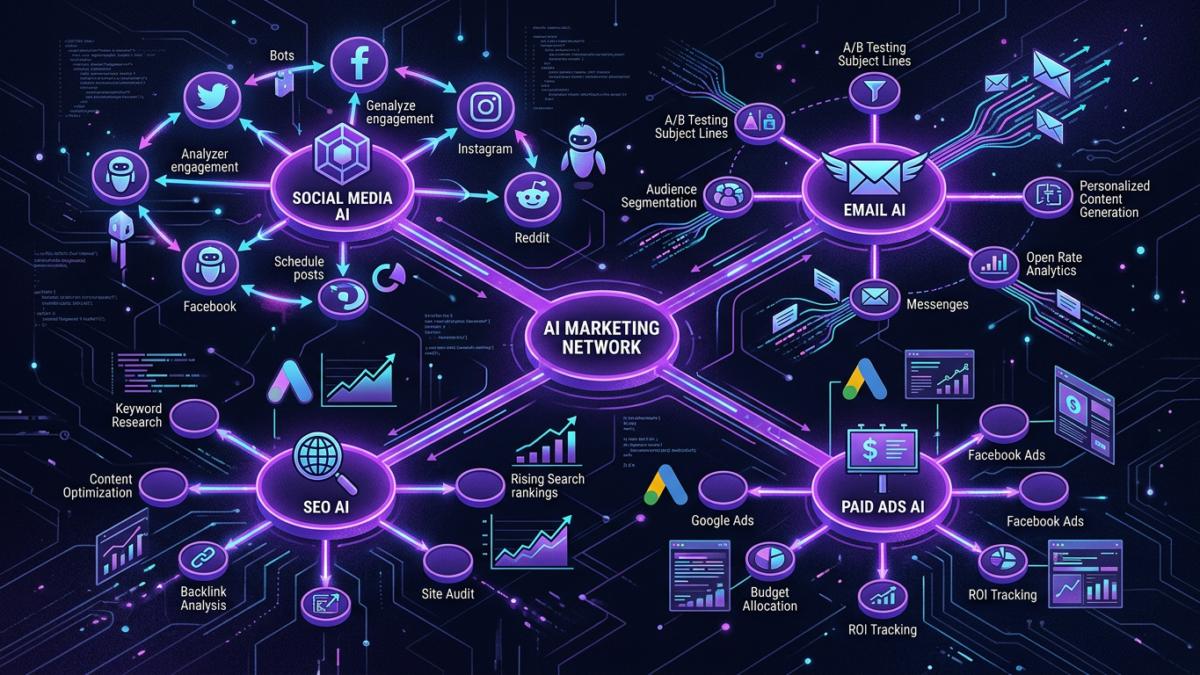
AI marketing agents are autonomous systems that execute marketing tasks within defined workflows without continuous human direction. They differ from AI tools in that they act proactively — monitoring conditions, identifying needs, executing tasks, and adjusting based on results — rather than simply responding to prompts. In 2026, marketing AI agents reliably handle content production, campaign optimisation, SEO monitoring, email sequencing, and performance reporting. They do not reliably handle brand strategy, creative direction, cultural judgment, or high-stakes decisions requiring contextual nuance.
Key Takeaways — AI Agents for Marketing 2026
- →AI marketing agents are autonomous, proactive systems — not just AI tools you prompt. The distinction matters for deployment planning.
- →They replace execution, not judgment. Content drafting, bid optimisation, reporting, and scheduling are agent-ready. Brand strategy, creative direction, and cultural nuance are not.
- →Start with one agent for one task. Prove quality before expanding. The brands that fail with AI agents deploy too broadly too fast without quality control gates.
- →Platform-native agents (Meta Advantage+, Google Performance Max) are the easiest first deployment — already built, proven, and requiring only good inputs.
- →Human quality control is not optional. Agent-produces, human-approves, agent-publishes is the reliable deployment pattern for most marketing functions in 2026.
AI Tool vs AI Agent: Why the Distinction Matters
An AI tool is reactive. You prompt it, it responds, you decide what to do with the output. ChatGPT when you ask it to write a blog post is an AI tool. It does nothing until prompted. Once it responds, the work is yours to act on.
An AI agent is proactive. It monitors conditions, identifies tasks that need doing, executes them, evaluates the outcome, and adjusts its behaviour — with or without a human prompt for each step. A content agent that monitors your editorial calendar, identifies posts due in the next 48 hours, drafts them based on your brief template, and flags them in a Slack channel for review is operating as an agent. It is not waiting for you to ask.
| Dimension | AI Tool | AI Agent |
|---|---|---|
| Initiates action | No — waits for prompt | Yes — monitors and acts |
| Handles multi-step tasks | With repeated prompting | Autonomously |
| Adjusts based on outcomes | No | Yes — feedback loop |
| Runs without human present | No | Yes — within defined scope |
| Setup complexity | Low | Medium-high |
| ROI ceiling | Limited by human availability | Scales independently |
What AI Marketing Agents Replace in 2026
Content production
High readiness
Content brief generation, first-draft writing for blog posts and social content, meta description and title optimisation, email subject line testing, and content repurposing from long-form to short-form. A content agent with access to your brand guidelines and keyword targets can produce draft content continuously, flagging each piece for human review before publication.
Campaign optimisation
Already deployed at scale
Bid management, budget reallocation across campaigns and ad sets, creative rotation based on performance signals, audience exclusion updates, and dayparting adjustments. Meta Advantage+ and Google Performance Max are the most widely deployed marketing agents in existence — already running for most ecommerce advertisers.
SEO monitoring
High readiness
Keyword ranking movement alerts, technical SEO issue detection, content gap identification against competitors, internal linking opportunity surfacing, and meta tag optimisation for new pages. SEO agents that run daily audits and surface prioritised action lists are available through tools like Semrush and Ahrefs with varying levels of agent capability.
Reporting and analytics
Highest time savings
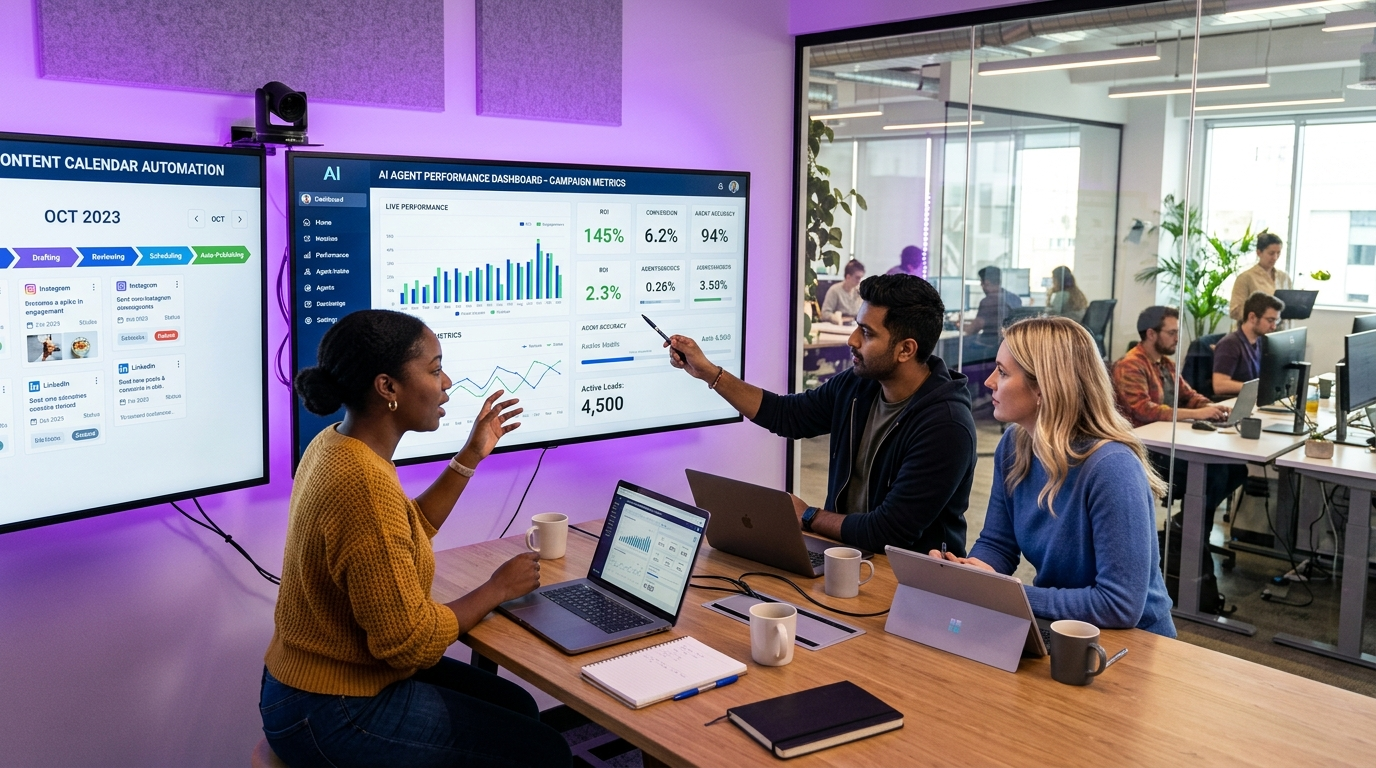
Automated performance report generation, anomaly detection and alerting, cross-channel attribution data assembly, and narrative summary writing. Reporting agents eliminate the 15-20% of senior marketing time typically spent on data pulling and report formatting in traditional team structures.
What AI Marketing Agents Cannot Replace in 2026
The clearest signal that a task is not agent-ready is that it requires judgment based on contextual information that cannot be fully specified in advance. Agents execute defined rules well. They fail at tasks where the right answer depends on factors that cannot be anticipated and coded into the workflow.
- Brand strategy and positioning decisions. Whether to respond to a cultural moment, how to handle a brand crisis, which creative direction aligns with the brand’s long-term positioning — these require human judgment that integrates context an agent cannot access.
- Creative direction and aesthetic taste. Agents can produce creative variations at volume. They cannot determine which creative direction is genuinely distinctive versus generically safe. This is a human aesthetic and cultural judgment call.
- High-stakes relationship management. Influencer partnership negotiations, agency relationships, enterprise sales conversations, and media relations require human relationship intelligence that agents cannot replicate.
- Cultural sensitivity and timing. Identifying when a campaign concept is inadvertently tone-deaf, when a particular moment is not the right time to run a promotion, or when a response to public criticism will make a situation worse — these require human cultural awareness.
>
The 4-Stage AI Marketing Agent Deployment Framework
- Identify agent-ready tasks. Map every marketing task your team performs in a week. Separate tasks that are rule-based, measurable, and high-volume (agent candidates) from tasks requiring judgment, creativity, or relationship context (human tasks). The agent candidates list is your deployment roadmap.
- Start with one agent, one task. Choose the highest-volume, most clearly defined task from your candidate list. Build or deploy one agent for that single task. Run it in parallel with the human workflow for two to four weeks, comparing agent output quality against human output quality. Do not expand until quality is validated.
- Build quality control gates. Define exactly what standard agent output must meet before it goes live. Build a review step where a human approves each agent output before it is published or activated. The agent-produces, human-approves, agent-publishes pattern is the reliable deployment model for most marketing functions in 2026. Fully autonomous publishing without review is appropriate only after an extended quality validation period with demonstrated reliability.
- Measure and expand systematically. Track hours reclaimed, output volume change, and quality metrics (engagement rates, conversion rates, error rates) for each deployed agent. Use these measurements to build the business case for expanding agent scope. Expand to the next highest-priority task only after the current agent is running reliably.
Best AI Agent Platforms for Marketing in 2026
| Platform | Best For | Technical Level | Cost |
|---|---|---|---|
| Meta Advantage+ | Campaign optimisation — no setup needed | Low — built into Meta | Free with ad spend |
| Google Performance Max | Search + shopping optimisation | Low — built into Google Ads | Free with ad spend |
| n8n | Custom marketing workflows, self-hosted | Medium-high | Free (self-hosted) |
| Make (Integromat) | Marketing tool integration and automation | Medium | $9-99/mo |
| Relevance AI | Custom AI agent building, no-code | Medium — visual builder | $19-199/mo |
| Zapier AI | Connecting existing tools with AI logic | Low | $20-100/mo |
| Jasper AI | Content agent workflows | Low | $39-125/mo |
Common AI Marketing Agent Mistakes
- Deploying too broadly before proving quality. The most common failure mode. Teams deploy agents across five marketing functions simultaneously before any single agent has been validated. Output quality is poor across all five, confidence collapses, and the entire initiative gets written off as not working.
- Skipping quality control gates. Allowing agents to publish directly without human review in the early stages almost always results in output that damages brand credibility. Build the approval step before removing it.
- Trying to agent-ify judgment tasks. Deploying an agent to handle brand tone-of-voice decisions or creative direction produces generic, safe, forgettable output. Agents handle execution. Humans handle judgment.
- Not measuring agent performance. Treating agent deployment as a set-and-forget operation without ongoing quality monitoring leads to gradual output degradation that goes unnoticed until it causes a problem.
AI video agents that produce product ads from any URL are the easiest first marketing agent deployment. Try VidAU’s URL-to-Video tool and see autonomous video production in action.
Frequently Asked Questions
What are AI agents for marketing?
AI marketing agents are autonomous systems that execute marketing tasks within defined workflows without continuous human direction. Unlike AI tools that respond to prompts, agents proactively monitor conditions, identify tasks, execute them, and adjust based on outcomes. In 2026 they handle content production, campaign optimisation, SEO monitoring, email sequencing, and reporting autonomously.
What marketing tasks can AI agents replace?
Content brief generation and first-draft writing, social scheduling, campaign bid optimisation, SEO keyword gap analysis, email sequence management, performance report generation, and ad creative variant production. Tasks requiring brand judgment, creative direction, cultural sensitivity, and strategic decision-making remain human.
How do I deploy an AI marketing agent?
Four stages: identify agent-ready tasks (rule-based, measurable, high-volume), start with one agent for one task, build a quality control gate where humans approve outputs before they go live, then measure and expand systematically. Do not deploy across multiple functions simultaneously before validating quality in one.
What is the difference between an AI tool and an AI agent?
An AI tool responds to prompts and produces outputs a human then acts on. An AI agent proactively monitors conditions, identifies what needs doing, executes tasks, and adjusts based on results without requiring a human to prompt each step. Agents operate within defined workflows; tools require human initiation for every action.
Are AI marketing agents reliable in 2026?
Reliable for structured, rule-based, measurable tasks. Unreliable for tasks requiring brand judgment, cultural nuance, and strategic decision-making. The pattern that works: agent produces, human approves, agent publishes. This combination delivers agent-scale output volume with human-quality control.
Final Verdict — AI Marketing Agents 2026
- →AI marketing agents replace execution, not judgment. Content, reporting, campaign optimisation, and scheduling are ready now. Strategy and creative direction stay human.
- →The deployment pattern that works: one agent, one task, quality control gate, validate, then expand. Not five agents across all functions on day one.
- →Platform-native agents (Advantage+, Performance Max) are the easiest starting point — already built, proven, and requiring only high-quality inputs.
- →Human approval is not optional in early deployment. It is what keeps agent-scale output from becoming brand-damaging output.
Start with the AI Agent That Produces Video Ads Autonomously
VidAU’s URL-to-Video is the simplest first marketing agent deployment — paste a product URL, get a finished video ad. No prompting, no editing, no team.
No credit card required · From $9.99/month
Agency-Agent Shift 2026Why the retainer model is ending
Scale Marketing with AIThe 4-layer operator framework
Future of Advertising 2026Three irreversible shifts
Sources: Relevance AI marketing agent deployment case studies 2026 · n8n marketing automation documentation 2026 · Meta Advantage+ performance documentation 2026 · Google Performance Max AI agent documentation 2026 · VidAU product documentation 2026.
Marketing AI Agents: Full Platform ComparisonEvery platform worth considering in 2026