


The B2B marketing playbook that worked in 2022 is producing diminishing returns. Not because the fundamentals changed — demand generation, pipeline building, and account-based marketing are still the core functions — but because the channels through which buyers research, evaluate, and discover vendors have shifted significantly, and most B2B marketing teams are optimising for the old channels while their buyers have moved to the new ones.
The most significant shift is the research channel. 63% of B2B buyers now use AI assistants in their vendor research process. They ask ChatGPT or Perplexity to recommend project management tools, compare CRM platforms, or surface the top vendors in a category before engaging with any company’s sales team. The brand that appears in that AI-generated answer is the brand on the shortlist. The brand absent from the answer is not in the consideration set.
This guide covers the B2B marketing AI developments that have materially changed pipeline generation in 2026 and what revenue leaders need to do differently as a result.
B2B Marketing AI in 2026: The Critical Shifts
The four shifts every B2B revenue leader must understand in 2026: AI assistants have become a primary B2B buyer research channel (63% of buyers use them for vendor evaluation), AI SDR tools are replacing tier-1 human prospecting at a fraction of the cost, AI content production has enabled a level of thought leadership volume that manual teams cannot match, and GEO (Generative Engine Optimisation) has emerged as the new SEO priority for brands that want to appear in AI-generated vendor shortlists.
Key Takeaways — B2B Marketing AI 2026
- →63% of B2B buyers use AI assistants for vendor research. Brands not appearing in AI-generated answers are invisible to a majority of their potential buyers at the research stage.
- →AI SDR tools have crossed the ROI threshold for high-volume prospecting in structured categories. They are not replacing enterprise sales — they are replacing the tier-1 qualification work that consumed most human SDR time.
- →AI content production enables the thought leadership volume that builds AI answer engine citation authority. Brands publishing 10x more structured content are being cited more frequently in AI-generated vendor research.
- →Dark social is growing as a B2B influence channel — Slack, Teams, private LinkedIn, and AI assistant sessions that traditional analytics cannot track.
- →GEO is the new SEO for B2B. The brands appearing in ChatGPT and Perplexity answers for category queries are winning vendor shortlist inclusion before any sales interaction.
How B2B Buyers Are Actually Researching in 2026
The B2B buyer journey has always started with research. What changed in 2026 is where that research happens. Traditionally, buyers searched Google, read G2 or Gartner reviews, consumed vendor content, and engaged with sales when they had enough information to have a productive conversation. That journey still exists. It now has a new first step that precedes all of it.
Increasingly, the B2B buying journey starts with an AI assistant query. A VP of Marketing evaluating marketing automation platforms asks ChatGPT “what are the best marketing automation platforms for a B2B SaaS company with 50 sales reps” and gets a synthesised answer that names three to five platforms with brief comparisons. Those platforms are now on the shortlist. The platforms not named are not in the consideration set for that buyer. The buyer then proceeds to read G2 reviews, consume vendor content, and eventually engage with sales — but only for the platforms already surfaced by the AI answer.
This is the zero-moment-of-truth problem for B2B in 2026. The moment of truth — the first time a vendor enters a buyer’s consideration set — is increasingly happening inside an AI assistant interface that no vendor analytics tool can track and no paid placement can currently access on most platforms.
AI SDR Tools: What Is Actually Working
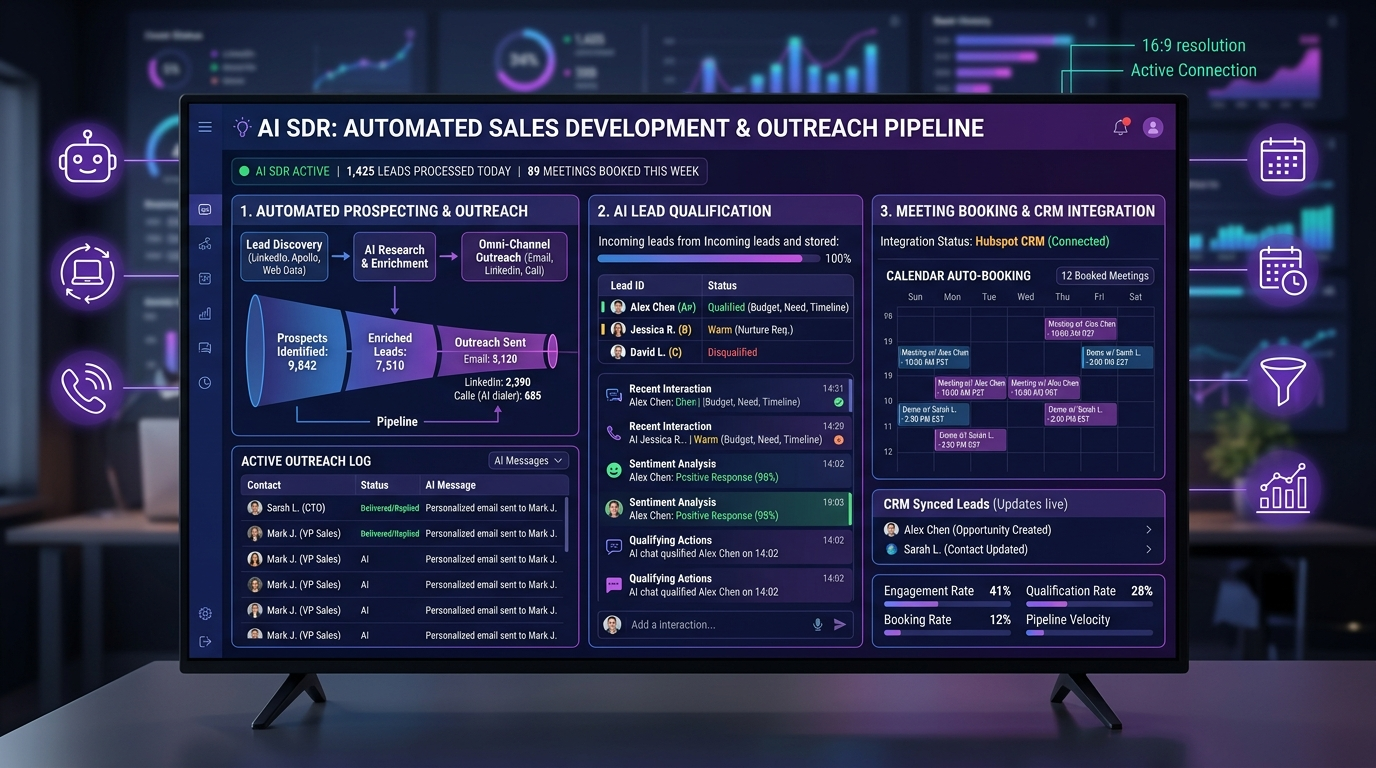
AI SDR tools — systems that automate the prospecting, outreach, and initial qualification functions of human sales development representatives — have moved from promising experiment to operational reality for a growing number of B2B companies in 2026. The ROI case is strongest in specific conditions: high ICP volume (large addressable market of clearly defined prospects), structured qualification criteria (clear signals that indicate fit), and transactional or mid-market deal sizes where the sales cycle is short enough for automated sequences to be effective.
Platforms like Artisan AI, 11x.ai, and Relevance AI handle ICP identification, personalised outreach generation, sequence management, and response qualification. The meeting-booking rate from AI SDR outreach now approaches human SDR performance in optimised deployments, at a cost per meeting that is typically 60-80% lower. The caveat: AI SDRs handle volume and structure well. They handle nuance, relationship-based selling, and complex enterprise navigation poorly. The optimal configuration is AI SDR for tier-1 qualification feeding human AEs for progression and close.
AI Content Production for B2B Thought Leadership
The connection between thought leadership content volume and AI search visibility is direct. AI answer engines are trained on and retrieve content from sources that have built comprehensive, authoritative coverage of their category topics. A B2B SaaS brand that publishes three blog posts per month is competing for AI citation share against brands publishing thirty. The 10x content volume advantage is structural, not marginal.
AI content production tools have made 10x volume achievable for B2B marketing teams of any size. The workflow: a content strategist identifies topic gaps and defines the angle, AI drafts structured content following the brand’s voice and editorial standards, a human editor reviews for accuracy and adds original insight, and the piece publishes. Production time drops from two to three days per article to three to four hours. A one-person content team can publish daily rather than weekly.
The quality requirement in B2B is higher than in consumer content. B2B buyers are more sophisticated and more sceptical of generic AI-generated content. The human editorial layer is not optional — it is what separates AI-assisted content that builds genuine authority from AI-generated content that damages it.
GEO for B2B Brands: The New Competitive Frontier
Generative Engine Optimisation for B2B means structuring content so that AI systems can extract and cite it accurately in response to buyer research queries. The tactics are the same as GEO for consumer brands but the query types differ. B2B buyers ask AI systems comparative questions (what is the best CRM for X), specific feature questions (which platforms include Y functionality), and category-definition questions (what is Z and how does it work).
B2B brands that appear most frequently in AI-generated answers for their category have typically done three things: built comprehensive FAQ and definition content covering every angle of their category, earned citations from authoritative industry publications and review sites that AI systems treat as credible sources, and structured all content with clear, extractable answers rather than long-winded prose that buries the key information.
Run 20 queries your ideal buyers would ask to research your category through ChatGPT and Perplexity. Count how often your brand is mentioned versus your top 3 competitors. If your citation rate is below 25% of queries, GEO is your most important marketing investment right now — not because it is trendy, but because it is where a growing proportion of your buyers are making shortlist decisions.
B2B Video in 2026: The Underutilised Demand Generation Channel
B2B video adoption has lagged consumer video adoption significantly, and the gap represents a genuine competitive opportunity. Most B2B brands are still producing one to two video assets per quarter — a product demo, a customer testimonial, perhaps a webinar recording. Meanwhile, the data on B2B video performance in 2026 shows that video content consistently outperforms text content in LinkedIn engagement, email click-through rates, and landing page conversion rates.
AI video production has removed the primary barrier to B2B video scale: cost and production time. Brands can now produce explainer videos, product demos, and thought leadership video clips at a volume that makes video a primary content format rather than an occasional premium asset. The use case that delivers the most direct pipeline impact is the personalised video outreach sequence — AI-generated video messages personalised for specific accounts or personas that perform significantly better than text-based outreach in cold contact situations.
Most Effective B2B Marketing Channels in 2026
| Channel | Primary Use | AI Enhancement | 2026 Priority |
|---|---|---|---|
| Paid targeting, thought leadership | AI content + video production | Tier 1 | |
| Content / SEO / GEO | Organic discovery, AI citation | AI content production, GEO optimisation | Tier 1 |
| Email automation | Nurture, reactivation | AI personalisation at scale | Tier 1 |
| AI SDR outreach | Prospecting, qualification | Fully AI-driven | Tier 1 (qualified) |
| Webinars / events | Mid-funnel engagement | AI content repurposing | Tier 2 |
| Google paid search | High-intent capture | Performance Max | Tier 2 |
| Review platforms (G2) | Social proof, research stage | Limited | Tier 2 |
| Podcast / audio | Brand authority | AI production tools | Tier 3 |
Frequently Asked Questions
How is AI changing B2B marketing in 2026?
Across four areas: buyer research (63% of B2B buyers use AI assistants to research vendors), demand generation (AI SDR tools automate tier-1 qualification at lower cost), content production (AI enables 10x thought leadership volume), and brand discovery (AI answer engines are the new first touchpoint in the B2B buyer journey, requiring GEO investment to maintain visibility).
What is an AI SDR and is it worth using?
An AI SDR is a system that automates prospecting, personalised outreach, and initial qualification. It is worth using for B2B companies with high ICP volume, structured qualification criteria, and mid-market deal sizes. Leading platforms include Artisan AI, 11x.ai, and Relevance AI. Cost per qualified meeting is typically 60-80% lower than human SDR teams in optimised deployments.
How should B2B brands respond to AI answer engines?
Run an AI share of voice audit: take 20 buyer research queries and run them through ChatGPT and Perplexity. Count how often you are cited versus competitors. Then invest in GEO: FAQ content on all category topics, speakable schema, third-party citation building from industry publications, and structured content that AI systems can extract clearly. This is now the primary B2B discoverability investment.
What B2B marketing channels are most effective in 2026?
LinkedIn for paid targeting and thought leadership, content/SEO/GEO for organic discovery and AI citation, email automation for nurture, and AI SDR outreach for prospecting are the Tier 1 channels. Webinars, Google paid search, and review platforms (G2, Capterra) are strong Tier 2 channels. The content creation and distribution methods within each channel have been transformed by AI.
How do B2B buyers use AI in their purchase process in 2026?
63% of B2B buyers use AI assistants (ChatGPT, Perplexity, Claude) in their vendor research. They generate vendor shortlists, compare features, surface pricing, and evaluate fit before engaging with any sales team. The AI answer is increasingly the first touchpoint in the B2B buying journey — before website visits, before Google searches, before review platform checks.
Final Verdict — B2B Marketing AI 2026
- →AI assistants are now the first touchpoint in the B2B buyer journey for a majority of buyers. GEO is not optional for B2B brands that want to be on those shortlists.
- →AI SDR tools have crossed the ROI threshold for high-volume prospecting. Use them for tier-1 qualification; keep humans for progression and close.
- →AI content production enables the thought leadership volume that drives AI answer engine citation. 10x content volume at consistent quality is achievable today.
- →Measure AI share of voice alongside traditional pipeline metrics. The brands leading on AI citation today are building pipeline advantages that will compound for years.
Build the Content That Earns B2B AI Citations
AI video content and structured written content are the two primary inputs that build AI answer engine authority. VidAU produces the video half of that equation from any URL or brief.
No credit card required · From $9.99/month
Future of Advertising 2026Three irreversible shifts
Agency-Agent Shift 2026Why the retainer model is ending
Scale Marketing with AIThe operator framework
Sources: Forrester B2B buyer behaviour research 2026 · Gartner B2B digital marketing survey 2026 · LinkedIn B2B marketing benchmark report 2026 · ChatGPT usage statistics, OpenAI 2026 · Artisan AI and 11x.ai platform performance documentation 2026.