VidAU Editorial · AI Search
Claude Opus 5.5: Features, Coding Capabilities, and What Makes It Different
Learn Claude fast with a practical 5.5 tutorial. See features, coding capabilities, and what makes it standout.
By the VidAU Editorial Team · Reviewed before publishing
Artificial intelligence is changing how developers write code, build applications, automate tasks, and create interactive experiences. Anthropic continues to expand its Claude model family with models designed to handle increasingly complex technical and professional workloads.
Claude Opus 5.5 is a major addition to this development. Released on September 22, 2026, the model focuses on long-running agentic coding, complex software engineering, computer use, and professional knowledge work. It introduces a 1-million-token context window, supports up to 128,000 output tokens, and offers adaptive thinking for demanding tasks.
For developers and creators, these capabilities introduce new possibilities. You can use Claude Opus 5.5 to work through large codebases, troubleshoot software, build interactive projects, and automate multi-step development workflows.
One particularly interesting application involves using AI coding agents to recreate open-world gaming experiences, including projects inspired by GTA 6 in Roblox.
This guide explores Claude Opus 5.5, its features, release information, Claude Code integration, model comparisons, and practical applications for developers and creative teams.
Quick Summary
• Claude Opus 5.5 launched on September 22, 2026, with improvements in agentic coding, software engineering, and professional knowledge work.
• The model supports a 1-million-token context window and up to 128,000 output tokens, making it suitable for complex development projects.
• Claude Code integration helps developers build applications, debug software, refactor codebases, and automate development tasks.
• Claude Opus 5.5 supports creative coding applications, including Roblox game development, where developers can build GTA-inspired environments and gameplay systems.
• Its API pricing starts at $4 per million input tokens and $20 per million output tokens, making it cheaper than the original Opus 5.
Claude Opus 5
To understand Claude Opus 5.5, it helps to examine its predecessor, Claude Opus 5.
Anthropic introduced Claude Opus 5 on July 24, 2026. The model brought improvements to software development, agentic workflows, complex reasoning, and professional knowledge work. It also introduced a 1-million-token context window and support for 128,000 output tokens.
Claude Opus 5.5 builds on this foundation with improved coding performance, more efficient token pricing, and capabilities designed for longer autonomous tasks.
What Makes Claude Opus 5 Different?
Claude Opus 5 focuses on complex tasks requiring reasoning, coding, and professional problem-solving.
Some of its core applications include:
• Software development and debugging.
• Large-scale codebase analysis.
• Multi-step research and reasoning.
• Application development.
• Technical documentation.
• AI agent development.
These capabilities established the foundation for the Opus 5.5 release.
What Has Improved in Claude Opus 5.5?
Claude Opus 5.5 introduces several improvements over the original Opus 5.
| Feature | Claude Opus 5 | Claude Opus 5.5 |
| Context window | 1 million tokens | 1 million tokens |
| Maximum output | 128K tokens | 128K tokens |
| Input pricing | $5/MTok | $4/MTok |
| Output pricing | $25/MTok | $20/MTok |
| Cache reads | $0.50/MTok | $0.20/MTok |
| Thinking | Adaptive | Adaptive, always on |
| Primary focus | Coding and professional work | Long-running agentic coding and knowledge work |
Sources: Anthropic’s official model documentation.
The most noticeable changes involve pricing and the model’s focus on sustained autonomous work. Anthropic reports that Opus 5.5 costs approximately 40% less to run than Opus 5 for typical workloads.
Why the Upgrade Matters to Developers
Large software projects often require developers to examine multiple files, understand dependencies, identify errors, and implement changes across an entire application.
Claude Opus 5.5 targets these challenges through its long context window and agentic coding capabilities.
For example, a developer working on an existing application might ask Claude to:
1. Examine the project structure.
2. Identify outdated dependencies.
3. Locate bugs across multiple files.
4. Recommend a migration strategy.
4. Implement the required changes.
4. Run tests and review the results.
This approach reduces the need to manually explain every part of a large project before starting a development task.
GTA 6 Roblox

One interesting application of advanced AI coding models involves recreating complex gaming experiences inside platforms such as Roblox.
The combination of Claude Opus 5.5 and Roblox development tools offers an interesting workflow for creators who want to build open-world environments, driving mechanics, interactive missions, and custom game systems.
GTA 6 Roblox is a useful search topic for this intersection of AI-assisted development and user-generated gaming experiences. However, a Roblox recreation inspired by GTA 6 is a fan-made project, not the official Grand Theft Auto VI game.
How Claude Opus 5.5 Can Help Build a GTA-Inspired Roblox Game
Claude Opus 5.5 can assist developers with the Lua scripting and technical planning required for a Roblox open-world project.
Rather than building every feature manually, developers can describe the required mechanics and ask Claude to generate, review, and improve the scripts.
Some possible applications include:
• Open-world map systems.
• Vehicle spawning and driving mechanics.
• Character movement and animations.
• Police pursuit systems.
• Mission and reward systems.
• Interactive buildings and environments.
• Multiplayer gameplay mechanics.
Building an Open-World Environment
An open-world game requires several connected systems. These include map design, player movement, vehicle interactions, mission progression, and environmental elements.
Claude Opus 5.5 can help break these requirements into smaller development tasks.
For example, you might ask it to create a Roblox city with roads, buildings, traffic lights, vehicle dealerships, and interactive locations.
The model can then help generate Lua scripts for the different gameplay systems.
Creating Vehicle and Driving Mechanics
Driving systems play an important role in open-world games.
With Claude Opus 5.5, a Roblox developer might request scripts for:
• Vehicle acceleration and braking.
• Steering and suspension.
• Vehicle damage.
• Garage and vehicle selection.
• Traffic behaviour.
• Vehicle entry and exit animations.
You should test each system inside Roblox Studio because generated scripts still require debugging, performance checks, and gameplay adjustments.
Can Claude Opus 5.5 Build GTA 6 in Roblox?
Claude Opus 5.5 does not independently recreate the official GTA 6 game with one prompt.
However, it can assist with individual development components, including scripting, environment planning, gameplay mechanics, and debugging.
The distinction matters because an AI coding model assists with development. It does not automatically deliver a complete commercial game.
Claude Opus 5 vs Fable 5
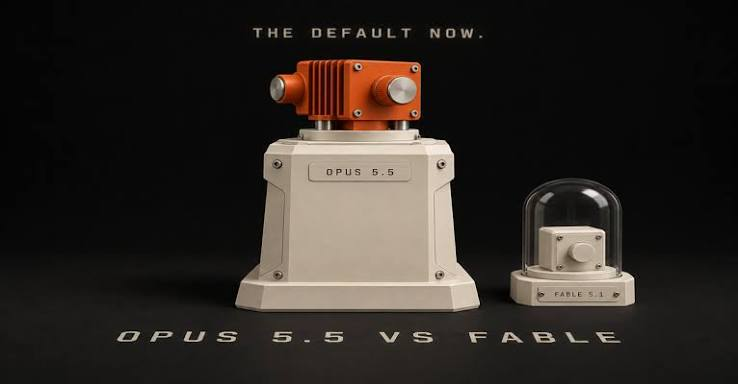
Claude Opus 5 vs Claude Fable 5 belong to Anthropic’s Claude 5 model family, but they target different areas of AI performance.
Claude Opus 5 focuses on coding, software engineering, and professional knowledge work. Claude Fable 5 targets demanding reasoning and long-horizon agentic work.
Claude Opus 5.5 adds another dimension to the comparison because Anthropic positions it as a more efficient model for long-running coding and knowledge-work tasks.
Claude Opus 5 vs Fable 5: Key Differences
| Comparison | Claude Opus 5 | Claude Fable 5 |
| Main focus | Coding and professional work | Demanding reasoning |
| Software engineering | Core use case | General capability |
| Agentic workflows | Strong support | Designed for long-horizon tasks |
| Context window | 1 million tokens | 1 million tokens |
| Maximum output | 128K tokens | 128K tokens |
| API pricing per million input tokens | $5 | Check current model pricing |
| API pricing per million output tokens | $25 | Check current model pricing |
The table reflects the original Opus 5 release and Fable 5 model positioning. Pricing and availability vary by model version.
Coding and Software Development
Claude Opus 5 focuses on complex coding tasks, including application development, debugging, and large-scale software changes.
Fable 5 targets demanding reasoning and long-running agentic tasks. Its capabilities make it relevant to projects requiring extensive planning and multiple stages of problem-solving.
For developers, the best comparison involves testing both models on the same repository and measuring code accuracy, test completion, and correction time.
Reasoning and Complex Problem-Solving
Both models support complex reasoning, but their primary design priorities differ.
Claude Opus 5 suits technical work where implementation and code quality matter. Fable 5 targets tasks where extensive reasoning and sustained problem-solving take priority.
Where Does Claude Opus 5.5 Fit In?
Claude Opus 5.5 improves the Opus line with stronger agentic coding capabilities and lower API prices.
At launch, Anthropic reported that Opus 5.5 performed at the level of Fable 5.1 on most work while costing 40% less to run than Opus 5.
It therefore offers developers an updated option for complex coding and professional workflows without the original Opus 5 pricing.
Opus 5 Claude Code
Claude Code is Anthropic’s agentic coding tool. It helps developers work with existing codebases, modify files, execute commands, investigate errors, and manage development tasks.
Claude Opus 5.5 integrates with Claude Code, allowing developers to use the model for demanding programming tasks and extended development sessions. Anthropic identifies long-running autonomous coding agents and large-scale refactoring among its primary use cases.
What Can You Do With Claude Opus 5.5 in Claude Code?
The combination supports several practical development workflows.
1. Build applications
Describe an application, its required features, and its preferred technology stack. Claude Code helps generate the project structure and implementation.
2. Debug existing projects
Ask the model to inspect error messages, investigate affected files, and suggest corrections.
3. Refactor large codebases
Use the model to review existing code, identify duplicated logic, and implement structural improvements.
4. Write and run tests
Ask Claude Code to generate test cases, execute available test commands, and investigate failures.
5. Automate development tasks
Delegate repetitive engineering tasks, documentation updates, and code maintenance.
How to Use Claude Opus 5.5 With Claude Code
Follow this workflow to get started.
Step 1: Install Claude Code
Install Claude Code using Anthropic’s official instructions.
Official resource: Claude Code Documentation.
Step 2: Open Your Project
Navigate to your existing project folder using your terminal.
Start Claude Code from the project directory so the tool has access to the relevant files.
Step 3: Select Claude Opus 5.5
Choose Claude Opus 5.5 as your model where your Claude Code subscription or configuration supports it.
The API model identifier is:
claude-opus-5-5
Step 4: Give Claude a Clear Development Task
Start with a specific instruction instead of asking the model to rebuild your entire application immediately.
Example:
Analyze this project and explain its folder structure, technology stack, dependencies, and major components.
Identify potential bugs, outdated packages, and performance issues.
Do not modify any files yet. First, provide a clear development plan with the files you intend to change and the reason for each change.
Step 5: Review and Test the Changes
Review Claude’s proposed changes before allowing major modifications.
Run the relevant tests, inspect the updated files, and verify that the application works as expected.
Why the 1-Million-Token Context Window Matters in Claude Code
Large development projects often contain extensive documentation, configuration files, dependencies, and interconnected components.
Claude Opus 5.5 supports a 1-million-token context window. This gives developers more room to provide project information and maintain context during complex workflows.
However, a larger context window does not guarantee perfect recall or eliminate the need for clear instructions. Developers should still organise project documentation and divide complex work into manageable tasks.
Claude Opus 5 release
Anthropic officially released Claude Opus 5 on July 24, 2026. The company subsequently introduced Claude Opus 5.5 on September 22, 2026.
The release of Opus 5.5 introduced improvements in coding, agentic workflows, and professional knowledge work.
Claude Opus 5.5 Release Date
Original model
July 24, 2026
Claude Opus 5
Updated model
September 22, 2026
Claude Opus 5.5
Where Is Claude Opus 5.5 Available?
Anthropic lists several access options for Claude Opus 5.5:
- Claude applications for eligible Pro, Max, Ultra, Team, and Enterprise users.
- Claude API.
- Amazon Bedrock.
- Google Cloud.
- Microsoft Foundry.
Developers who want to integrate the model into their applications should use the official Claude Platform documentation.
Claude Opus 5.5 API Model Identifier
The official API model identifier is:
claude-opus-5-5
Developers should use this identifier when configuring supported API integrations. Check the provider’s documentation for the appropriate authentication, request format, and regional availability.
Official resources:
- Claude Opus 5.5 Model Overview
- Anthropic Claude Opus
- Claude API Documentation
Claude Opus 5.5 Pricing and API Costs
Claude Opus 5.5 offers lower standard API token prices than Claude Opus 5.
Anthropic lists the following standard rates:
| Pricing category | Claude Opus 5.5 |
| Input tokens | $4 per million |
| Output tokens | $20 per million |
| 5-minute cache writes | $5 per million |
| 1-hour cache writes | $8 per million |
| Cache reads | $0.20 per million |
| Batch API input | $2 per million |
| Batch API output | $10 per million |
How Much Does a Claude Opus 5.5 API Request Cost?
Your total cost depends on the number of input and output tokens your application uses.
For example, consider a request involving 100,000 input tokens and 20,000 output tokens.
- Input cost: 100,000 × $4 per million = $0.40.
- Output cost: 20,000 × $20 per million = $0.40.
- Total: $0.80.
Illustrative calculation using standard API rates, excluding caching, tools, and other applicable charges.
Claude Opus 5.5 Fast Mode
Anthropic also offers Fast Mode for Claude Opus 5.5. The company states that Fast Mode delivers up to 2.5 times faster output.
The premium rates are $8 per million input tokens and $40 per million output tokens.
Fast Mode suits applications where response speed matters more than standard API cost.
Create With VidAU
Turn scripts, product URLs, and creative ideas into ad-ready video assets with a structured AI workflow.
Key takeaway
Final Thoughts
Claude Opus 5.5 represents an important development in AI-assisted software engineering and autonomous coding. Its large context window, improved coding capabilities, adaptive thinking, and lower API costs make it relevant to developers working on complex projects.
From building applications with Claude Code to developing GTA-inspired Roblox experiences, the model offers several opportunities for technical and creative experimentation.
For developers, the next step is to test Claude Opus 5.5 against real projects, review its output, and identify workflows where AI assistance saves development time.
Explore the official Claude Opus 5.5 documentation for model specifications, API access, and integration guidance.
Frequently asked questions
What is Claude Opus 5.5?
Claude Opus 5.5 is an advanced AI model developed by Anthropic. It focuses on long-running agentic coding, complex software engineering, computer use, and professional knowledge work.
When was Claude Opus 5.5 released?
Anthropic released Claude Opus 5.5 on September 22, 2026. Its predecessor, Claude Opus 5, launched on July 24, 2026.
Is Claude Opus 5.5 better than Claude Opus 5?
Claude Opus 5.5 introduces improvements in coding and agentic workflows, alongside lower API pricing. Anthropic reports a 40% reduction in typical running costs compared with Opus 5.
Can Claude Opus 5.5 build games in Roblox?
Claude Opus 5.5 assists with Roblox game development through code generation, Lua scripting, debugging, and gameplay system design. Developers still need Roblox Studio, game assets, and testing to complete their projects.
How much does Claude Opus 5.5 cost?
Standard API pricing starts at $4 per million input tokens and $20 per million output tokens. Fast Mode costs $8 and $40 per million tokens respectively.