

The strategic playbook for scaling dropshipping companies shopify brands in the era of generative answer engines — how deep real-time inventory API synchronization, localized light-fulfillment micro-hubs, and context-rich product schema structures have replaced unbranded price-arbitrage pipelines.
📋 Key Takeaways — Shopify Dropshipping Strategy 2026
- →The traditional price-arbitrage loop is systematically broken. Modern dropshipping companies shopify pipelines must build defensible value through real-time API integrations, unique custom-packaging runs, and physical product differentiation.
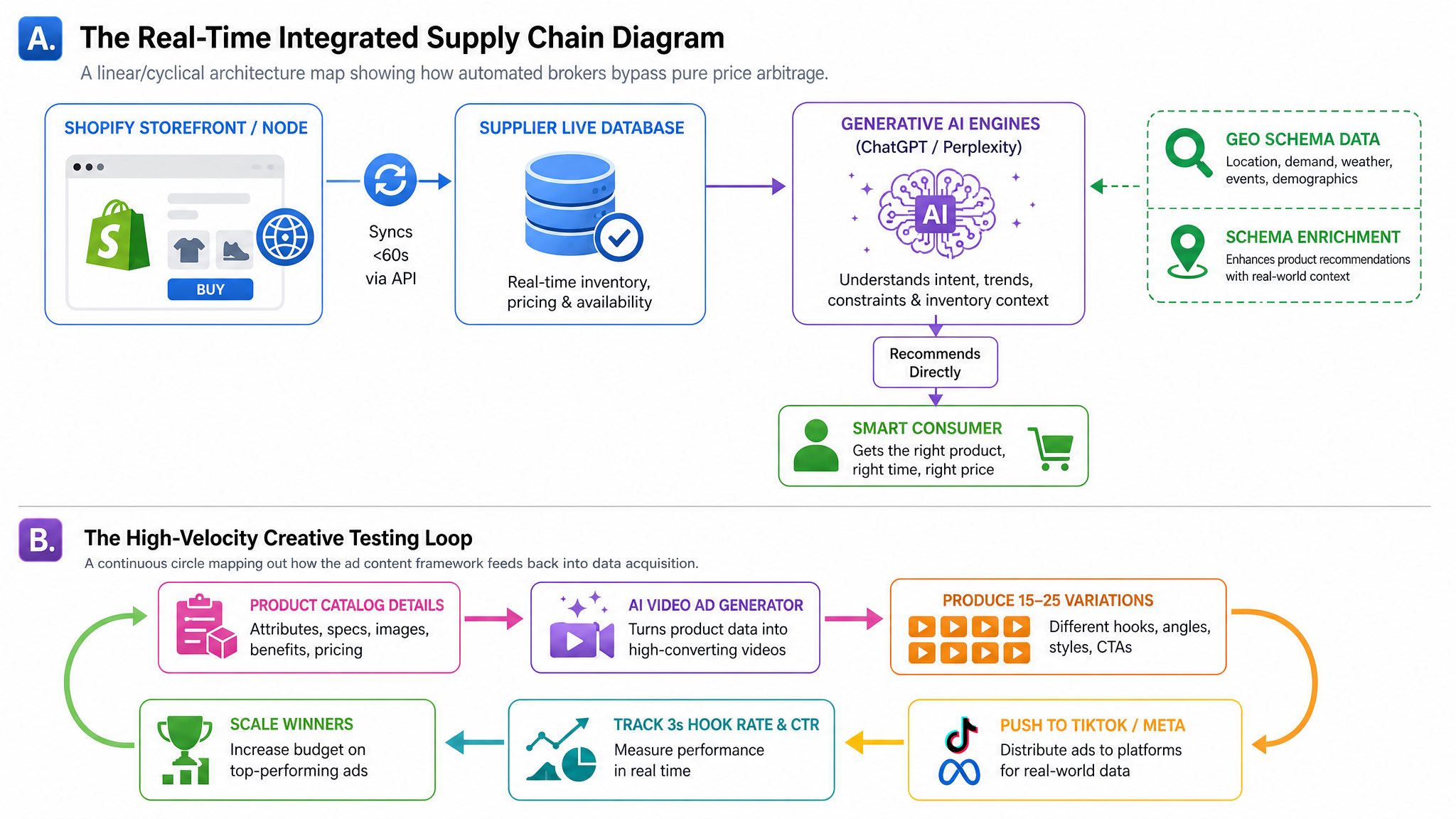
- →Real-time inventory synchronization (every 30 to 60 seconds) is mandatory. Relying on daily bulk supplier updates results in selling out-of-stock SKUs, triggering processor disputes and platform-wide gateway bans.
- →Generative search engines (ChatGPT, Gemini, Perplexity) act as automated buyer agents. Stores optimized for Generative Engine Optimization (GEO) are recommended directly in conversational buying workflows.
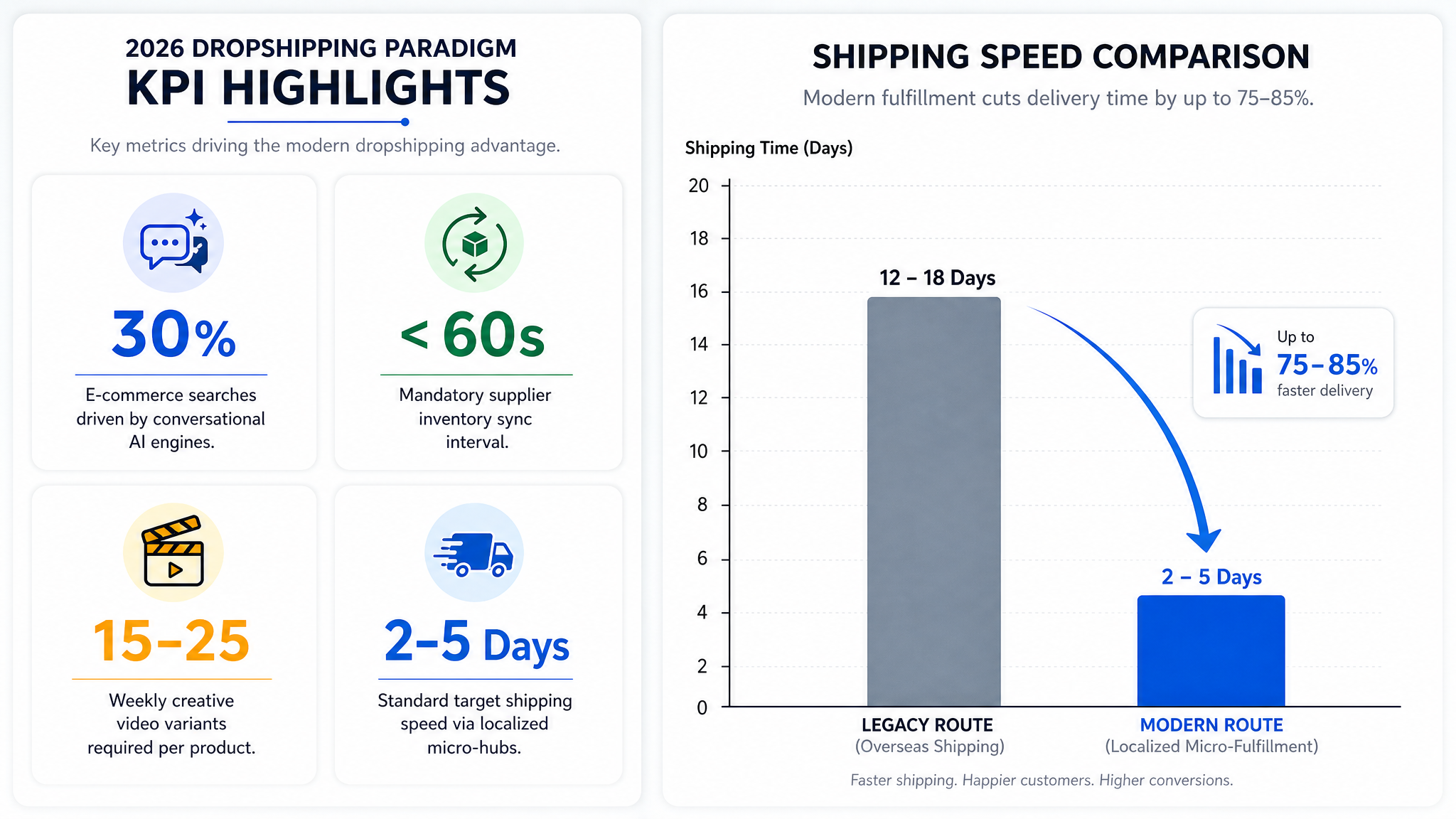
- →Relying exclusively on direct 15-day shipping windows from overseas factories is a structural failure. High-growth brands secure localized micro-fulfillment hubs to offer 2-to-5 day shipping times.
- →Creative testing velocity is the primary driver of digital acquisition. Producing 15 to 25 weekly vertical-native ad variants using AI-driven creation suites yields a sustainable ROAS advantage.
- →Customization at scale is operationally viable. Sourcing agents can execute print-on-demand variations, custom product manual inserts, and localized white-labeling on-the-fly.
For several seasons, the playbooks governing dropshipping companies shopify stores relied on a simple formula: find a trending item on an overseas marketplace, build a clean landing page, and run aggressive paid social traffic to a marked-up price point. This was retail price arbitrage in its purest, most fragile form. For businesses looking to understand the core steps to build a store from scratch, our editorial resource on how to start a dropshipping business provides a foundational blueprint.
In 2026, this baseline arbitrage loop is broken. The rise of conversational search models and autonomous shopping agents has fundamentally shifted power to the consumer. If an AI search assistant can instantly cross-reference a product photo across the web to locate the direct factory supplier, a dropshipping brand offering nothing but a checkout interface becomes obsolete. To scale in the current landscape, digital merchants must run their operations as advanced logistical brokers rather than simple middle-marketers. This guide covers how modern brands are adapting to survive.
What Is the Modern Dropshipping Shopify Paradigm in 2026?
What Is the Modern Dropshipping Shopify Paradigm?
The modern dropshipping companies shopify paradigm is an integrated supply chain model where Shopify storefronts operate as localized, API-driven retail fronts. Instead of simple unbranded price arbitrage, successful brands use automated, real-time inventory syncing, localized light-assembly micro-fulfillment hubs, and customized white-labeling on-demand to offer 2-to-5 day shipping windows and unique product value.
The terminology surrounding unbranded supply chain logistics has evolved. A generation ago, dropshipping meant manually copying addresses into web forms. Today, dropshipping companies shopify ecosystems function as complex digital brokerage operations. The platform serves as a high-speed customer-acquisition and data-processing node. The underlying fulfillment loop is managed by automated supply-chain agents that translate real-time sales data into on-demand production and localized delivery routes.
This operational shift is driven by a stark reality: consumers expect immediate delivery, absolute price transparency, and seamless customer service. Brands that fail to integrate their supply chains directly into their digital platforms face rising checkout abandonment rates, high customer-acquisition costs, and swift payment processor reviews. To understand how these changes fit into the broader retail market, explore our comprehensive breakdown of ecommerce marketing trends.
The Disruption of Pure Retail Price Arbitrage
The foundational threat to traditional dropshipping is the widespread adoption of consumer-facing generative engines. When a user asks an AI assistant to find a specific product, the engine does not merely return paid listings. It searches raw structured web data, reviews consumer sentiment across social forums, maps out actual supply networks, and directly compares product specifications.
If your Shopify store is listing a generic posture corrector for $45, and an AI agent can locate the identical product on an open factory marketplace for $8 with 5-day shipping, the AI assistant will advise the buyer against purchasing from your storefront. This is not theoretical; it is an active mechanism shifting e-commerce search dynamics. Pure retail price arbitrage — marking up a generic item without adding proprietary value — has been systematically designed out of the internet ecosystem.
To survive this transition, modern e-commerce companies must construct deep, defensible moats. These moats are built on three distinct pillars: context-rich product data structures that satisfy generative engine verification, hyper-efficient localized logistical networks, and dynamic visual creative systems that capture human attention before an AI agent is even consulted. These themes are explored in our detailed guide on the impact of AI agents in ecommerce.
Traditional vs. Autonomous Supply Frameworks
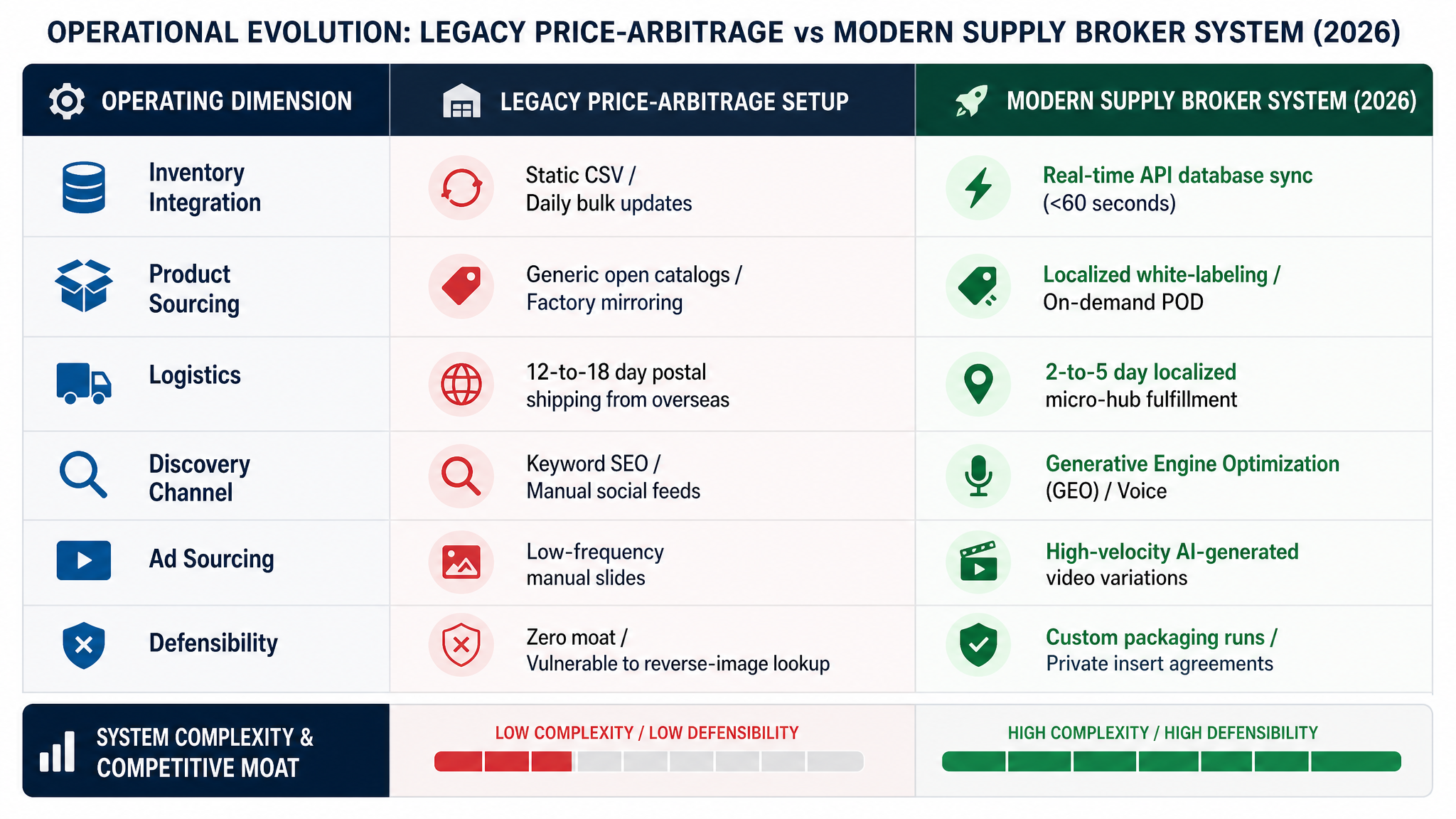
The contrast between legacy dropshipping companies shopify strategies and modern autonomous broker models is stark. The old way of dropshipping focused entirely on masking logistics; the new way focuses on optimizing logistics to build a defensible product brand.
| Operating Dimension | Legacy Price-Arbitrage Setup | Modern Supply Broker System |
|---|---|---|
| Inventory Integration | Static CSV uploads or daily bulk sync intervals | Real-time API database synchronization (<60 seconds) |
| Product Sourcing Focus | Generic open catalogs, direct factory mirroring | Localized white-labeling, POD custom variations |
| Delivery & Logistics | 12-to-18 day postal shipping direct from overseas | 2-to-5 day localized micro-hub fulfillment networks |
| Discovery Channel | Traditional search keywords and manual social feeds | Generative Engine Optimization (GEO) & voice search |
| Ad Sourcing & Velocity | Low-frequency manual creative, basic product slides | High-velocity vertical-native AI video ad variations |
| Defensibility Factor | Zero moat, highly vulnerable to reverse-image lookup | Custom packaging runs, private insert agreements |
| Customer Experience | Reactive refund queues, high chargeback volumes | Proactive tracking, local returns processing networks |
Optimizing for Generative Engine Optimization (GEO)
As search engines evolve into direct answer systems, dropshipping companies shopify stores must shift their digital discoverability structures. Generative engines do not read your pages like human shoppers do; they parse them to establish entity authority. If your product pages contain only thin descriptions copied directly from a supplier catalog, an AI model will quickly filter them out as duplicate, low-value spam.
To secure recommendations during a conversational query — such as “What are the best localized eco-friendly home organizational tools available for fast checkout?” — your store must be structured for GEO. This means maintaining clean structured data, incorporating complete schema layouts (following standard Schema.org Product guidelines), and displaying verifiable trust signals that machine crawlers can index with high confidence.
Generative crawlers verify e-commerce listings by triangulating data across three points: the product structured schema (validating SKU, brand, and pricing), independent social mentions (cross-referencing reviews on platform forums), and supplier registry details. If these three nodes do not match, the system will exclude your storefront from recommendations.
Furthermore, your product descriptions must use natural, context-rich language that answers semantic buyer questions. Instead of simply listing material specifications, explain how the item solves a specific problem, how it compares to alternative models, and under what conditions it performs best. This matches the conversational context of modern AI queries, boosting your brand’s visibility across AI answer engines. Keep in mind that this optimization must exist across all retail channels; for those expanding beyond a single store, our operational manual on how to start dropshipping on Amazon details parallel multi-channel strategies.
High-Velocity Creative Infrastructure for Ad Acquisition
While GEO secures organic machine-driven traffic, digital acquisition on platforms like TikTok and Meta remains the primary driver of immediate volume. However, the cost of traditional content production makes traditional creative pipelines unsustainable for testing multiple dropshipping products. High-growth dropshipping companies shopify operations use high-velocity testing systems to locate winning hooks at a fraction of the cost.
To maintain a profitable ROAS on cold traffic, e-commerce brands must produce and test 15 to 25 new vertical-native creative variations every single week. This requires a dedicated creative engine that can generate distinct hook visual setups, text overlays, and presenter styles without massive production budgets. Many modern operators rely on an ai video ad generator hosted on dedicated ad environments like TikTok for Business to scale their creative output effortlessly.
The Provocative Comparison
Challenges the status quo by introducing an immediate alternative. Creates instant curiosity and a strong visual pattern interrupt inside the user’s feed.
The Operational POV Hook
Matches natural, organic social media formats by placing the user inside a highly specific, relatable problem-solving scenario.
The Identity-Targeted Callout
Directly addresses the target buyer demographic. Filters out unqualified traffic immediately, driving highly motivated buyers to your landing page.
The Diagnostic Visual Hook
Uses visual tension in the first second to capture attention before any audio or text overlay is processed by the viewer.
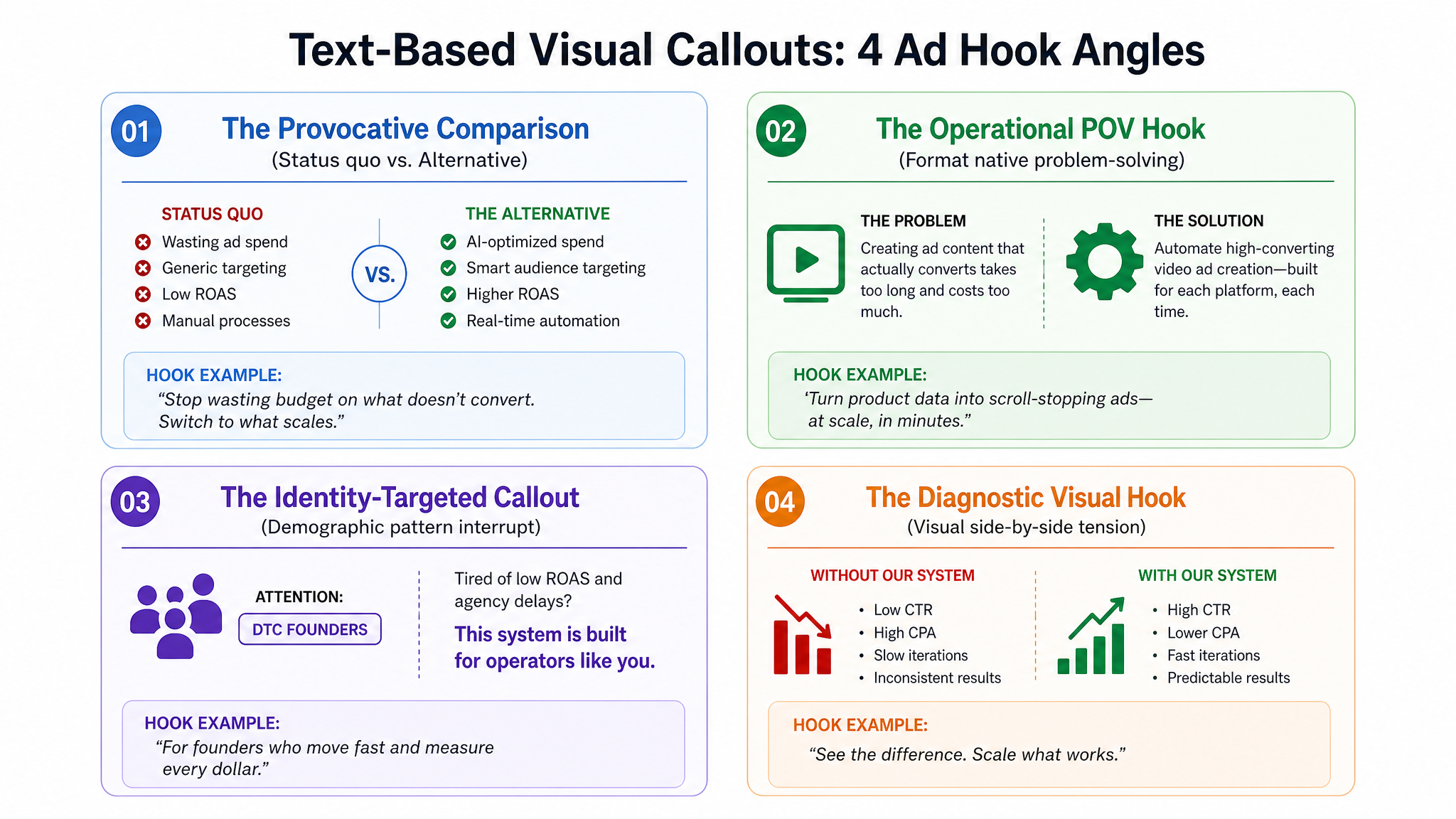
Using a structured ugc ads format allows brands to build trust with cold social media audiences. By testing multiple opening hooks against a single high-converting body script, you can easily identify winning angles, allocate ad spend efficiently, and scale your winning campaigns. For more insights into planning and structuring these ad assets, read our complete breakdown of ecommerce video ads.
The “Autonomous Supply Broker” Setup Framework
📋 Steps to Launching an Autonomous Supply Broker Setup
Establish Private Supplier Agreements
Do not rely on generic, public marketplace catalogs. Partner with dedicated sourcing agents or private suppliers who offer direct, real-time API integrations. Negotiate custom packaging options, branded insert cards, and quality control checks at the product level before any inventory is allocated.
Configure Real-Time Shopify API Syncing
Integrate your supplier’s inventory database directly into your Shopify backend. Set automated synchronization rules to update inventory levels every 30 to 60 seconds. Developers can leverage Shopify’s developer APIs to map precise real-time inventory updates and avoid payment gateway restrictions.
Structure Product Pages for Generative Engines
Rewrite every product page to answer natural-language search queries. Incorporate clean product schema markup, technical detail lists, and clear value statements. Avoid copying unoptimized supplier descriptions, which are flagged as duplicate content by AI search engines.
Build a High-Velocity Ad Production System
Set up an automated ad creation process to produce 15 to 25 vertical-native ad variants weekly. Use advanced video generation platforms to test various hook styles, presenter variations, and calls-to-action against your catalog assets. For more guidance on content creation platforms, see our review of the best ugc video platforms for digital marketers.
Deploy Localized Micro-Fulfillment Hubs
As soon as a SKU validates, move top-performing inventory to localized fulfillment hubs in your target markets. This allows you to offer standard 2-to-5 day shipping times, dramatically lowering your cart abandonment rates and improving overall customer satisfaction.
Activate Creative Performance Feedback Loops
Track your creative ad performance in real time using metrics like hook rate (3-second view rate), CTR, and conversion rates. Immediately pause underperforming variants and use data from winning creatives to guide your next round of ad production.
Convert product listings into high-converting 9:16 vertical ads with AI presenters, voiceovers, and auto-generated captions in minutes. Plans from $9.99/mo
🎬 Create Ads Instantly →Common Operational Failures to Avoid
Relying on daily bulk CSV uploads for inventory updates is an incredibly risky practice. In high-volume e-commerce, a supplier can sell out of an item in minutes. Selling out-of-stock products leads to immediate payment disputes, chargebacks, and gateway suspensions. Real-time API synchronization is mandatory to protect your business.
- Over-optimizing for short-term arbitrage. Focusing entirely on quick markups without building unique brand value makes your storefront highly vulnerable to reverse-image lookups and direct factory competition.
- Using unoptimized product image names. Leaving generic filenames like
product123.jpgmisses key SEO value. Use clean, descriptive, context-rich filenames likeeco-friendly-office-desk-organizer.jpgto rank in search results. - Accepting 15-day shipping windows. Long, unmonitored shipping delays cause customer frustration, leading to bad reviews and merchant payment holds. Transition your top-performing products to localized micro-hubs as soon as they show consistent sales volume.
- Lacking dynamic creative variations. Running campaigns with just 1 or 2 static ad creatives causes rapid ad fatigue and drives up acquisition costs. Build a dynamic, high-velocity testing workflow to continuously test new hooks and angles.
- Ignoring machine-readable schema fields. Leaving out schema fields like SKU, GTIN, or brand details prevents generative search engines from indexing and recommending your products to conversational buyers.
- Hiding return policies. Unclear or complex refund terms raise buyer hesitation and lead to chargebacks. State your returns process clearly on every product page to build trust with new shoppers.
The Localized Micro-Hub Logistics Strategy
As e-commerce customer expectations settle around 2-to-5 day shipping speeds, relying entirely on direct, long-distance postal delivery from overseas factories is a structural failure. High-volume brands running dropshipping companies shopify stores scale their operations through a process of gradual inventory localization.
During the initial validation phase, products are shipped directly from suppliers to confirm customer demand and creative angles. Once a product averages 15 to 25 consistent daily orders, the brand moves a batch of inventory (e.g., 500 units) to a localized micro-fulfillment hub within their target market. This instantly cuts shipping times down to 2 to 5 days, lowering customer support tickets and boosting repeat purchases. Sourcing agents can easily coordinate these localized batches, keeping your capital requirements low.
Transitioning to localized micro-hubs typically reduces cart abandonment by 23% and cut support costs in half. Faster delivery times also allow you to use premium payment gateways, protecting your cash flow and unlocking higher spending limits on your ad accounts.
Furthermore, localized micro-hubs allow you to add custom product packaging, branded inserts, and quality control steps that are impossible when shipping directly from bulk factory warehouses. This converts a generic dropshipped item into a real, defensible brand, paving the way for long-term growth and stable profit margins.
Predictive Catalog Management and Trend Sourcing
Sustaining high-margin e-commerce operations in 2026 requires predictive sourcing. Waiting for a product to go viral on TikTok before listing it on your store means you are already late to the market. By the time your site is live, dozens of competitors will be running ads for the exact same item, driving up ad costs and squeezing your margins.
Successful dropshipping companies shopify businesses analyze early visual data and trending social topics to identify rising demand before it peaks. By tracking early content patterns on platforms like TikTok and Instagram, you can anticipate viral product trends, secure exclusive supplier agreements, and launch targeted ad campaigns ahead of the competition. Incorporating powerful tools like Grok Imagine allows brands to generate custom, high-fidelity lifestyle mockups instantly, validating product concepts before importing physical units. This early-entry strategy secures high initial profit margins, establishing clear market authority before competitors flood the space.
Once you identify a promising trend, use high-speed creation engines like an image-to-video generator or a sketch-to-video AI tool to turn static product mockups into vertical-native video ads. Testing these dynamic ad creatives lets you validate consumer interest before purchasing inventory, protecting your capital and keeping your store highly responsive to market shifts.
The Strategic Outlook for E-Commerce Disintermediation
The long-term outlook for dropshipping companies shopify stores in 2026 is defined by complete system integration. Pure price arbitrage — hiding logistics behind a markup — is dead. The future belongs to smart supply brokers who leverage real-time API integrations and automated ad generation to build real, defensible brands.
By optimizing your product listings for generative search engines, setting up high-velocity ad testing, and shifting top products to localized micro-hubs, you can build a highly resilient e-commerce business. The tools to automate and scale these operations are readily available; the brands that succeed are those that execute this framework with discipline.
As these automation tools mature, platforms like VidAU will continue to drive this transformation. They allow e-commerce brands to close the creative production gap, test multiple marketing angles in minutes, and scale their Shopify operations to compete directly with traditional, established retail brands.
Related Resources
The Dropshipping Shopify 2026 Operational Blueprint
- Pure retail price arbitrage is over. Consumers use AI shopping assistants to instantly cross-reference product photos and find the lowest direct factory price. Modern dropshipping companies shopify systems must add real value through custom packaging and localized shipping.
- Real-time API synchronization is mandatory. Keeping your inventory levels synced every 30 to 60 seconds is essential. Relying on daily updates leads to selling out-of-stock items, resulting in costly chargebacks and payment gateway bans.
- Optimize your storefront for Generative Engine Optimization (GEO). Use clean product schemas, rich technical details, and clear value statements on your product pages. This ensures your store is indexed and recommended by conversational search engines like Perplexity and ChatGPT.
- Transition to localized micro-fulfillment hubs. Shipping products directly from overseas warehouses is no longer sustainable. Moving winning products to regional micro-hubs allows you to offer 2-to-5 day shipping times, boosting conversions and reducing customer support tickets.
- Scale your creative testing velocity. Testing 15 to 25 weekly vertical-native ad variants is crucial to sustain a profitable ROAS. Use advanced AI video tools to test multiple hook variations and creative angles at a fraction of traditional production costs.
- Utilize predictive sourcing. Don’t wait for product trends to go viral on social media. Track early content data and trending social topics to spot rising demand, launching targeted ad campaigns before competitors enter the market.
Create High-Converting TikTok Video Ads — From Any Product URL
VidAU turns any product link into a platform-ready 9:16 vertical ad with AI presenters, natural voiceovers, and auto-captions — perfect for high-velocity creative testing on Shopify dropshipping stores.
🎬 Get Started Now →Plans from $9.99/month · No credit card required · Turn any URL into a video in minutes
FAQ — Modern Shopify Dropshipping
How are modern dropshipping companies shopify integrations changing in 2026?
In 2026, modern dropshipping companies shopify systems have shifted from basic, slow-shipping retail arbitrage to highly automated supply brokers. Successful brands focus on real-time API integrations, localized print-on-demand variations, and on-demand micro-warehousing rather than simply listing unbranded products from overseas catalogs.
What is Generative Engine Optimization (GEO) for e-commerce?
GEO is the process of structuring your Shopify store data, product schemas, and brand citations so that generative AI engines like ChatGPT, Gemini, and Perplexity can easily crawl, verify, and recommend your products directly to users during conversational shopping searches.
Why is simple price arbitrage failing for dropshipping stores?
Price arbitrage is failing because consumers now use AI assistants that instantly cross-reference product images and specifications across the web to find the lowest-cost direct source. To survive, Shopify brands must offer unique value through custom packaging, superior localized customer service, or localized light assembly.
How often should inventory data sync between Shopify and dropshipping suppliers?
Successful e-commerce operators require real-time synchronization. Modern setups sync inventory databases every 30 to 60 seconds. Relying on daily bulk syncs leads to selling out-of-stock items, resulting in card processor disputes, chargebacks, and ultimately the suspension of payment gateways.
What creative strategy works best for dropshipping products on TikTok?
The most effective strategy is high-velocity testing of 15 to 25 weekly ad variants using vertical-native AI-generated UGC layouts. Testing hook variants in isolation from body content allows brands to discover winning creative angles at a fraction of traditional production costs.
Sources and benchmarks: Retail inventory sync latency benchmarks from industry supply chain reports. E-commerce search trend data compiled from conversational engine query distributions, Q1–Q2 2026. How to Start a Dropshipping Business · Ecommerce Marketing Trends 2026 · AI Agents in Ecommerce.