

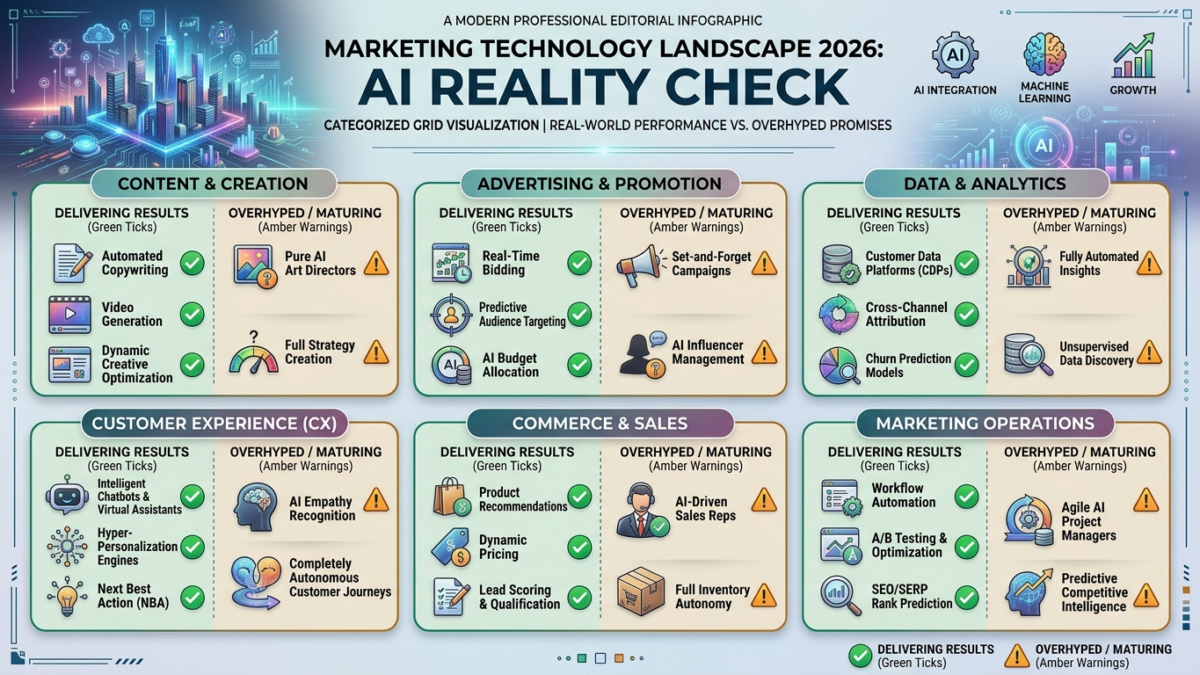
Marketing technology conferences in 2025 featured a lot of AI. Most of it was demos. Beautiful, technically impressive demos of tools that promised to transform marketing operations — and then sat in company tech stacks collecting subscriptions while delivering minimal measurable value. The gap between the AI marketing tool landscape and the AI marketing tool reality has been significant.
In 2026, that gap is narrowing — but it is narrowing unevenly. Some marketing technologies have crossed the threshold from impressive demo to genuine operational ROI. Others remain squarely in hype territory: technically real, commercially premature, organisationally complex, or simply not solving a problem that is actually limiting marketing performance.
This guide cuts through the noise. Technology that is actually working, technology that is genuinely overhyped, and the honest assessment of which category everything in the current martech landscape falls into.
Marketing Technology in 2026: What Is Working
The marketing technologies delivering proven ROI in 2026 are AI creative production tools (70-90% cost reduction), agentic campaign platforms (Meta Advantage+, Performance Max, TikTok Smart+), AI analytics and reporting automation, and GEO content optimisation for AI search visibility. The technologies still in hype territory include most AR/VR ad formats, blockchain attribution, and enterprise AI personalisation systems for brands without the data infrastructure to support them.
Key Takeaways
- →AI creative production and agentic campaign platforms are past the hype threshold — they deliver consistent, measurable ROI for brands that implement them properly.
- →Most brands need 7 martech categories, not 70. Tool sprawl is the primary martech ROI killer. Fewer, better-implemented tools consistently outperform large, poorly-integrated stacks.
- →AR/VR advertising, blockchain attribution, and most AI personalisation tools for mid-market brands remain in hype territory in 2026.
- →The highest-ROI martech investment for most brands in 2026 is an AI video production tool — it removes the primary bottleneck in performance marketing.
- →GEO is the new SEO tool category. Brands investing in AI search visibility today are building an advantage that compounds as AI answer engines capture more of total search volume.
Marketing Technologies Delivering Real ROI in 2026
AI video and creative generation
Highest ROI category
The most impactful martech development of the last two years. AI tools that convert product URLs into finished video ads (VidAU), generate avatar spokesperson videos (HeyGen), or produce polished brand video content (Runway) have removed the primary bottleneck in performance marketing. Brands producing 20+ creative variants per week using AI are outperforming traditional agency-dependent brands on every performance metric that matters.
Agentic campaign platforms
Essential for paid media
Meta Advantage+, Google Performance Max, and TikTok Smart+ have crossed from experimental to essential. Brands running these systems with high-quality inputs consistently outperform manually managed campaigns. The operational change required is significant — reducing human intervention in campaign decisions — but the performance data is clear. Agentic campaign management is now the standard, not the frontier.
AI analytics and reporting
High time savings
AI-powered analytics tools that automatically surface anomalies, generate narrative summaries, and produce distribution-ready reports are delivering 30-50% reductions in analytics time for marketing teams. Google Analytics 4’s AI features, Looker Studio automated reports, and dedicated AI analytics platforms eliminate the most time-consuming low-value marketing work at minimal cost.
Conversational AI for marketing
Proven for service and leads
AI chatbots and conversational agents handling tier-1 customer service and lead qualification have demonstrated consistent ROI. Response times drop from hours to seconds, qualification accuracy matches or exceeds human SDRs for structured qualification frameworks, and cost per qualified lead decreases significantly. Works best for brands with defined qualification criteria and high query volumes.
Technologies Still in Hype Territory in 2026
The technologies below are real and may deliver significant value eventually. In 2026, most brands are better served by the proven technologies above than by these categories. The exceptions are noted.
- AR/VR advertising. Technically impressive and occasionally effective for premium brand moments, but reach is still limited and production costs remain high. The exception: Meta’s AR filters for beauty and fashion brands where try-on functionality has demonstrated measurable conversion lift in specific categories.
- Blockchain advertising attribution. The promised solution to multi-touch attribution and fraud that has been “two years away” from mainstream adoption since 2019. The technical infrastructure exists. The industry coordination required for broad adoption does not. Not a priority for most brands in 2026.
- AI personalisation at scale for mid-market brands. Enterprise AI personalisation systems that dynamically customise every user experience in real time require significant data infrastructure, technical resources, and user volume to deliver ROI. For brands below $50M revenue, the implementation cost and complexity typically exceed the performance benefit. The exception is email personalisation, which is highly accessible and proven.
- Social listening and sentiment AI. Most tools in this category produce interesting dashboards and difficult-to-action insights. Brands that have found actionable use cases are typically large enterprises with dedicated brand insights teams. For most brands, the cost-to-insight ratio is unfavourable.
- NFT and Web3 marketing. No longer actively discussed as a serious channel by most marketing teams. The consumer adoption required for these to be meaningful advertising surfaces did not materialise.
The Essential Martech Stack for 2026
Most brands need seven categories of marketing technology, not seventy. The tendency to add tools for every tactical need creates integration complexity, data fragmentation, and operational overhead that destroys ROI. The brands with the most effective martech stacks in 2026 are typically running fewer tools, better integrated, with cleaner data flows.
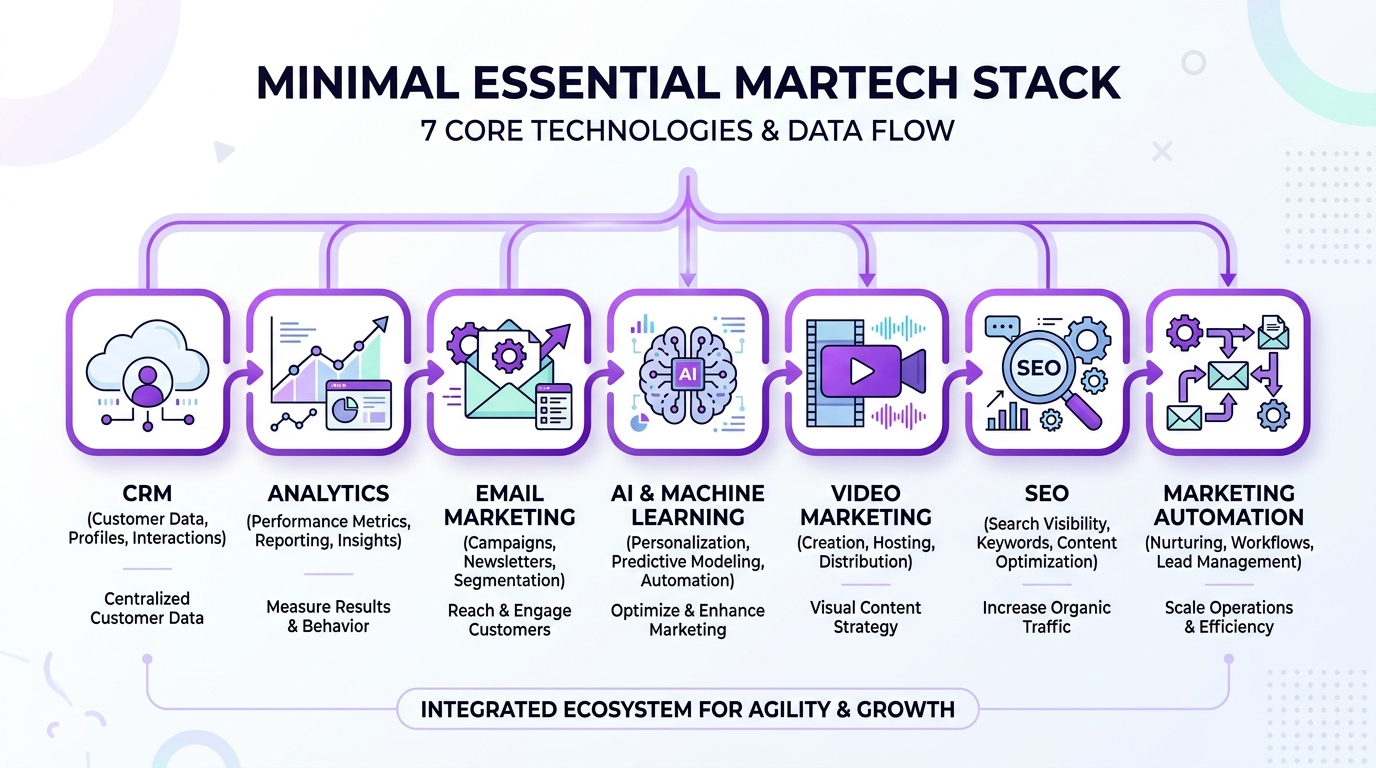
| Category | Recommended Tool(s) | Cost Tier | Priority |
|---|---|---|---|
| AI video production | VidAU, HeyGen | $10-100/mo | Essential |
| AI copy and content | Claude, ChatGPT | $0-20/mo | Essential |
| Web analytics | Google Analytics 4 | Free | Essential |
| SEO/GEO | Rank Math, Semrush | $0-120/mo | Essential |
| CRM + automation | HubSpot, Klaviyo | $0-50/mo | Essential |
| Email/SMS | Klaviyo, Omnisend | $20-100/mo | Essential |
| Social scheduling | Buffer, Later | $15-40/mo | Useful |
| Ad creative design | Canva AI | $0-15/mo | Essential |
The Biggest Martech Mistakes in 2026
- Tool sprawl without integration. Thirty marketing tools that do not share data produce thirty data silos. The integration cost and complexity exceed the value of individual tools. Build around a core stack and add incrementally.
- Buying enterprise tools before outgrowing SMB tools. Most brands buy tools for the scale they aspire to, not the scale they are at. Enterprise martech requires enterprise data volumes, technical resources, and operational maturity to deliver ROI. Use SMB-tier tools until the ceiling is genuinely hit.
- Not measuring tool ROI. Most marketing tools are renewed by default without measurement. Establish a clear ROI metric for every tool at implementation. If it cannot be measured, it probably should not be purchased.
- Automating broken processes. AI tools automate what is already happening. If a process produces bad outputs manually, automating it produces bad outputs faster. Fix the process before automating it.
Marketing Technology for Small Businesses in 2026
Small businesses get the highest ROI from the cheapest, most accessible marketing technologies. AI video production tools with free plans (VidAU) eliminate the agency cost of creative production. Platform-native AI campaign optimisation on Meta and Google is available at no extra cost beyond ad spend. Google Analytics 4 provides enterprise-grade analytics for free. Claude and ChatGPT free tiers handle content production at quality levels that were only available through expensive agencies two years ago.
The mistake most small business owners make is looking at enterprise martech coverage and concluding they need similar breadth. A small business running VidAU for creative, GA4 for analytics, Klaviyo for email, and Meta Advantage+ for paid media has a more effective stack than most companies with twenty-tool martech implementations — because it is simpler, better integrated, and more consistently used.
The highest-ROI martech investment for most brands in 2026 is an AI video production tool. Try VidAU and see what 20 ad variants per week does to your campaign performance.
Frequently Asked Questions
What marketing technology is actually working in 2026?
AI video and creative generation tools, agentic campaign platforms (Meta Advantage+, Google Performance Max, TikTok Smart+), AI analytics and reporting automation, and GEO content optimisation for AI search visibility. These technologies have crossed from experimental to essential for most marketing stacks.
What martech is overhyped in 2026?
AR/VR advertising formats (limited reach, high cost), blockchain advertising attribution (still not practically adopted), AI personalisation systems for mid-market brands (infrastructure requirements exceed ROI for most), and social listening AI tools (high cost, unclear action path for most brands).
How is AI being used in marketing in 2026?
Across five layers: creative production (AI generates video ads and copy at scale), media buying (agentic systems optimise campaigns autonomously), content strategy (AI identifies gaps and opportunities), customer service (conversational AI handles qualification and support), and analytics (AI surfaces anomalies and generates reports automatically).
What martech tools are essential in 2026?
Eight categories cover most needs: AI video production (VidAU, HeyGen), AI copy (Claude, ChatGPT), web analytics (Google Analytics 4 — free), SEO/GEO (Rank Math, Semrush), CRM and automation (HubSpot), email/SMS (Klaviyo), ad creative design (Canva AI), and social scheduling (Buffer, Later). Total cost for this stack: $0-400/month depending on tiers.
Should small businesses invest in AI marketing tools?
Yes, selectively. AI video generation (VidAU free plan), platform-native AI campaign optimisation (free on Meta and Google with ad spend), AI copy tools (Claude or ChatGPT free tiers), and Google Analytics 4 (free) together cover the most impactful capabilities at near-zero cost. Avoid expensive enterprise platforms with significant implementation overhead.
Final Verdict — Marketing Technology 2026
- →AI creative production is the highest-ROI martech investment. It removes the primary bottleneck in performance marketing and delivers immediate, measurable cost reduction.
- →Agentic campaign platforms are past the hype threshold. Run Advantage+, Performance Max, and Smart+ at maximum AI setting and provide good inputs.
- →7 core categories beat 70 fragmented tools. Fewer, better-integrated tools consistently outperform large, poorly-managed stacks.
- →AR/VR, blockchain attribution, and enterprise AI personalisation remain in hype territory for most brands in 2026. Invest there when the proven stack is already running well.
Start with the Highest-ROI Martech Investment
AI video production removes the creative production bottleneck that limits every other marketing technology. Try VidAU free and see the difference.
No credit card required · From $9.99/month
Scale Marketing with AIThe 4-layer operator framework
Best Free AI Marketing ToolsTested and ranked 2026
AI Share of Voice 2026The brand survival metric
Sources: Scott Brinker Marketing Technology Landscape 2026 · Meta Advantage+ case study data 2026 · Google Performance Max documentation 2026 · Gartner Hype Cycle for Digital Marketing 2026 · VidAU product performance data 2026.